oil capacity OPEL 1900 1973 User Guide
[x] Cancel search | Manufacturer: OPEL, Model Year: 1973, Model line: 1900, Model: OPEL 1900 1973Pages: 625, PDF Size: 17.22 MB
Page 541 of 625
98-32 1973 OPEL SERVICE MANUAL
inserting it in the connection. Another precaution -inspect the fitting for burrs which can cut the
“0”ring.
Restrictions
Restrictions may be due to powdered desiccant or
dirt and foreign matter. This may result in starved
evaporator and loss of cooling, or a seized compres-
SOT.When the amount of moisture in a system sufti-
ciently exceeds the capacity of the desiccant, it can
break down the desiccant and cause it to powder.
The powder passes through the dehydrator screen
with the refrigerant liquid and is carried to the ex-
pansion valve screen. While some of it may pass
through the valve screen into the evaporator, it may
quickly build up to cause a restriction.
Due to the fact that sufftcient oil can not be returned
to the compressor, it may seize.
Dirt
Dirt, which is any foreign material, may come from
cleaner residues, cutting, machining, or preserving
oils, metal dust or chips, lint or dust, loose rust,
soldering or brazing fluxes, paint or loose oxide
scale. These can also cause seized bearings by abra-
sion or wedging, discharge and expansion valve fail-
ure, decomposition of refrigerant and oil, or
corrosion of metal parts.
CorrosionCorrosion and its by-products can restrict valve and
drier screens, rough bearing surfaces or rapid fatigu-
ing of discharge reeds. This can result in high tem-
perature and pressure, decomposition or leaks. In
any event, this means a wrecked compressor.
From this, we can see the vicious circle that can be
produced in a refrigerating system to cause its fail-
ure. Corrosion can be the indirect cause of leaks, and
leaks can be the direct cause of corrosion. We can
also see the important role we as servicemen play in
maintaining chemical stability.
The major cause of corrosion is moisture.
Moisture
Moisture is the greatest enemy of refrigerating sys-
tems. Combined with metal, it produces oxide, Iron
Hydroxide and Aluminum Hydroxide. Combined
with R-12 it produces Carbonic acid, Hydrochloric
acid, and Hydrofluoric acid. Moisture can also cause
freeze-up of expansion valve and powdered desic-
cant.Although high temperature and dirt are responsible
for many difficulties in refrigerating systems, in most
instances it is the presence of moisture in the system
that accelerates these conditions. It can be said,themfore, that moisture is the greatest enemy of all.
The acids that it produces, in combination with both
the metals and the refrigerant, cause damaging
COT-
rosion. While the corrosion may not form as rapidly
with R-12 as with some other refrigerants, the even-
tual formation is as damaging.
If the operating pressure and temperature in the
evaporator is reduced to the freezing point, moisture
in the refrigerant can collect at the orifice of the
expansion valve and freeze. This temporarily re-
stricts the flow of liquid causing erratic cooling.
As previously mentioned, moisture in excess of the
desiccant’s capacity can cause it to powder.
YOU SHOULD KNOW AND REMEMBER..That the inside of the refrigerat,ion system is com-
pletely sealed from the outside world. And if that
seal remains broken at any point
- the system will
soon be destroyed. That complete and positive seal-
ing of the entire system is vitally important and that
this sealed condition is absolutely necessary to retain
the chemicals and keep them in a pure and proper
condition.
That all parts of the refrigeration system are under
pressure at all times, whether operating or idle, and
that any leakage. points are continuously losing re-
frigerant and oil.
That the leakage of refrigerant can be so silent that
the complete charge may be lost without warning.
That refrigerant gas is heavier than air and will rap-
idly drop to the floor as it flows from a point of
leakage.
That the pressure in the system may momentarily
become as high as 400 lbs. per square inch, and that
under such pressure the molecules of refrigerant are
forced out through the smallest opening or pore.
That the compressor is continually giving up some
lubricating oil to the circulating refrigerant and de-
pends upon oil in the returning refrigerant for con-
tinuous replenishment. Any stoppage or major loss
of refrigerant will therefore be fatal to the compres-
SOT.That the extreme internal dryness of a properly proc-
essed system is a truly desert condition, with the
drying material in the receiver holding tightly on to
the tiny droplets of residual moisture.
Page 556 of 625
REFRIGERANT COMPONENTS ALL MODELS9a- 47
B. Connect center flexible line of gauge set to the
fitting on the valve.
C. Start engine, turn temperature control knob to full
cold position, set blower switch to Max Hi. Operate
engine for 10 minutes at 2000 RPM to stabilize sys-tem.D. With compressor operating, slowly open valve on
refrigerant can and allow refrigerant to flow into
system (through manifold gauge set) until liquid in-
dicator clears up and immediately shut off valve at
gauge set and on refrigerant can. Check weight of
can and valve assembly and record.
E. Add an additional 1 lb. of refrigerant by adding
refrigerant from the can just weighed until can is
empty. Attach another can and add refrigerant until
can and valve assembly weigh the same as recorded.
6. Close valves at refrigerant drum or
can,7. Test for leaks and make operational check of
system.
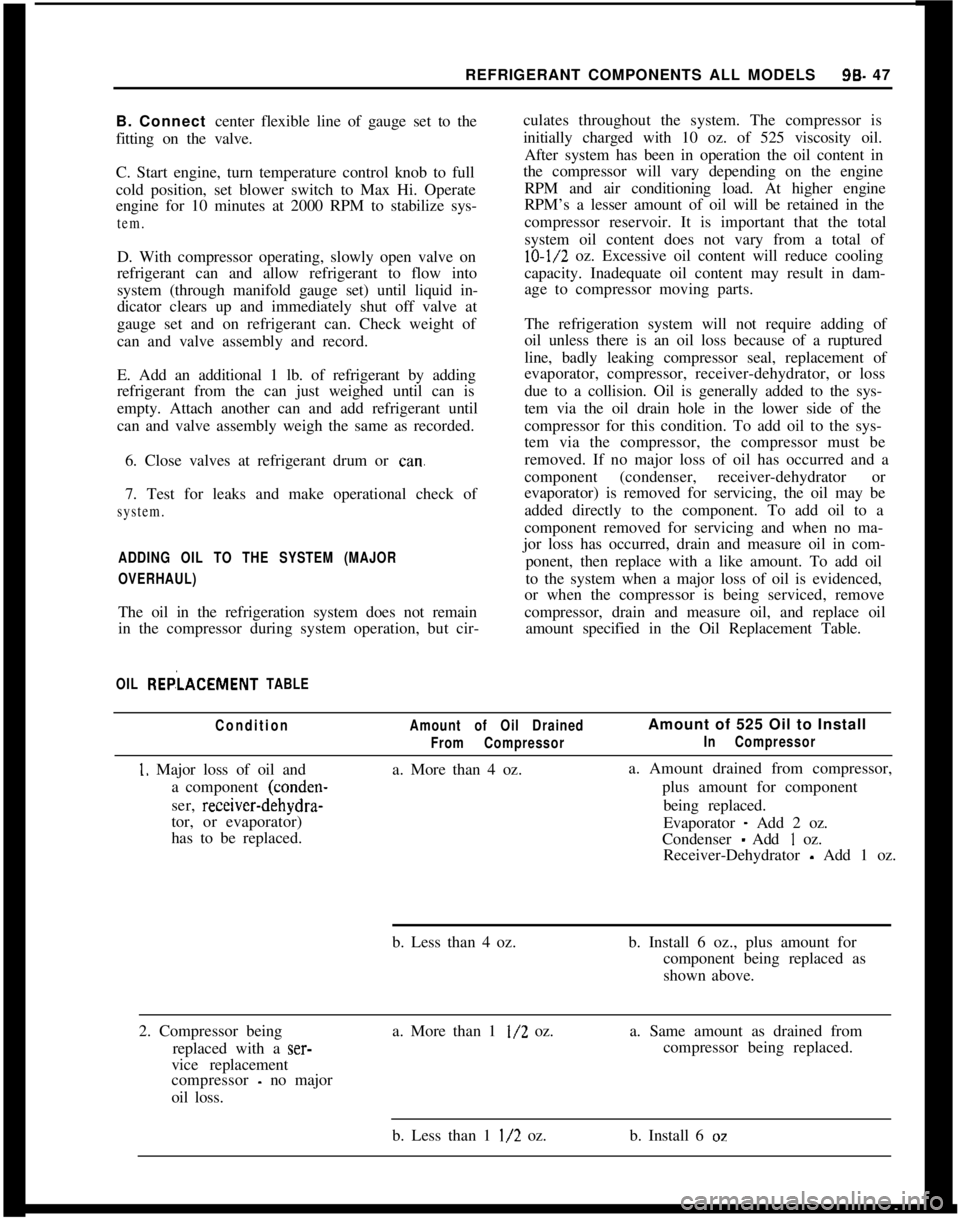
ADDING OIL TO THE SYSTEM (MAJOR
OVERHAUL)The oil in the refrigeration system does not remain
in the compressor during system operation, but cir-culates throughout the system. The compressor is
initially charged with 10 oz. of 525 viscosity oil.
After system has been in operation the oil content in
the compressor will vary depending on the engine
RPM and air conditioning load. At higher engine
RPM’s a lesser amount of oil will be retained in the
compressor reservoir. It is important that the total
system oil content does not vary from a total of10-l/2 oz. Excessive oil content will reduce cooling
capacity. Inadequate oil content may result in dam-
age to compressor moving parts.
The refrigeration system will not require adding of
oil unless there is an oil loss because of a ruptured
line, badly leaking compressor seal, replacement of
evaporator, compressor, receiver-dehydrator, or loss
due to a collision. Oil is generally added to the sys-
tem via the oil drain hole in the lower side of the
compressor for this condition. To add oil to the sys-
tem via the compressor, the compressor must be
removed. If no major loss of oil has occurred and a
component (condenser,receiver-dehydrator or
evaporator) is removed for servicing, the oil may be
added directly to the component. To add oil to a
component removed for servicing and when no ma-
jor loss has occurred, drain and measure oil in com-
ponent, then replace with a like amount. To add oil
to the system when a major loss of oil is evidenced,
or when the compressor is being serviced, remove
compressor, drain and measure oil, and replace oil
amount specified in the Oil Replacement Table.
OIL REP,‘LACEMENT TABLE
Condition
1. Major loss of oil and
a component (conden-
ser, receiver-dehydra-
tor, or evaporator)
has to be replaced.
Amount of Oil Drained
From Compressora. More than 4 oz.Amount of 525 Oil to Install
In Compressora. Amount drained from compressor,
plus amount for component
being replaced.
Evaporator
- Add 2 oz.
Condenser
- Add I oz.
Receiver-Dehydrator
- Add 1 oz.
b. Less than 4 oz.b. Install 6 oz., plus amount for
component being replaced as
shown above.
2. Compressor being
replaced with a
ser-vice replacement
compressor
- no major
oil loss.a. More than 1
l/2 oz.a. Same amount as drained from
compressor being replaced.
b. Less than 1
l/2 oz.b. Install 6 oz
Page 591 of 625
r98-82 1973 OPEL SERVICE MANUAL
SPECIFICATIONS
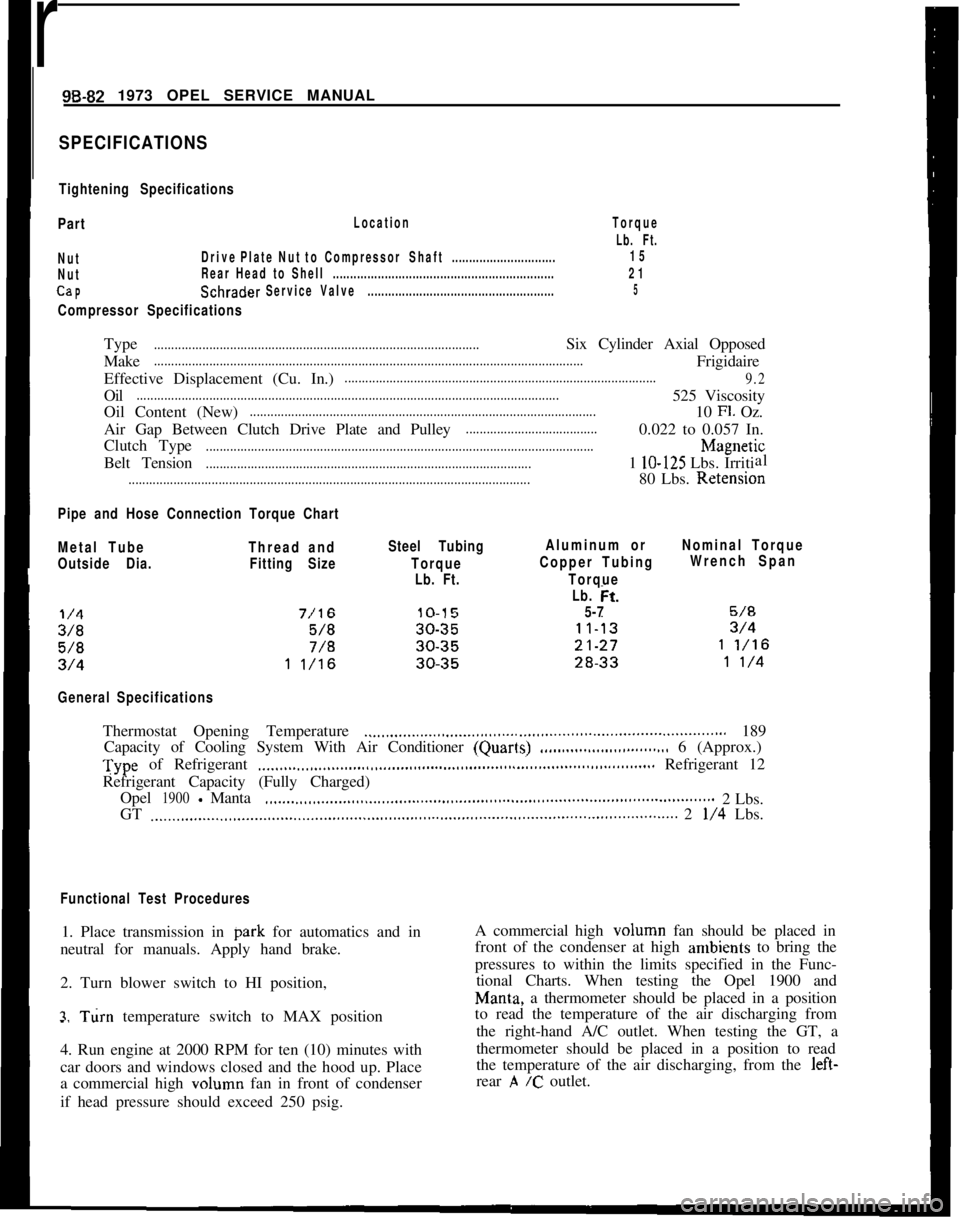
Tightening Specifications
Part
Location
NutDrivePlateNut toCompressorShaft..............................
NutRear Head to Shell................................................................
CaPSchraderServiceValve......................................................
Compressor Specifications
Torque
Lb. Ft.
15
21
5Type
..............................................................................................Six Cylinder Axial Opposed
Make
............................................................................................................................Frigidaire
Effective Displacement (Cu. In.)
..........................................................................................
9.2Oil
..........................................................................................................................525 Viscosity
Oil Content (New)
....................................................................................................10 Fl. Oz.
Air Gap Between Clutch Drive Plate and Pulley
......................................0.022 to 0.057 In.
Clutch Type
................................................................................................................h4agnetic
Belt Tension
..............................................................................................1 lo-125 Lbs. Irritial
....................................................................................................................80 Lbs. Retension
Pipe and Hose Connection Torque Chart
Metal TubeThread andSteel TubingAluminum orNominal Torque
I
Outside Dia.Fitting SizeTorqueCopper TubingWrench Span
Lb. Ft.Torque
Lb. tit.
5-7
General SpecificationsThermostat Opening Temperature
.._.....,,,...__....,,.............................................................. 189
Capacity of Cooling System With Air Conditioner (Quarls)
.,,..___....___............... 6 (Approx.)Type of Refrigerant
.___,,,._...,.,,,.__.....,,,.......,,,,.......,,,...................,,,......,,,............ Refrigerant 12
Refrigerant Capacity (Fully Charged)
Opel
1900-Manta,,._....,,,,._...._.,,,,.......,,,........,,............................................................2 Lbs.
GT
,..__..,..,..__..,,,.......,,,,.......,,,........,,,.,......,,,,,......,,.,,........,,.......,,..........,,............... 2 l/4 Lbs.
Functional Test Procedures1. Place transmission in park for automatics and in
neutral for manuals. Apply hand brake.
2. Turn blower switch to HI position,
3. Turn temperature switch to MAX position-.
4. Run engine at 2000 RPM for ten (10) minutes with
car doors and windows closed and the hood up. Place
a commercial high volumn fan in front of condenser
if head pressure should exceed 250 psig.A commercial high volumn fan should be placed in
front of the condenser at high ambients to bring the
pressures to within the limits specified in the Func-
tional Charts. When testing the Opel 1900 and
Man& a thermometer should be placed in a position
to read the temperature of the air discharging from
the right-hand A/C outlet. When testing the GT, a
thermometer should be placed in a position to read
the temperature of the air discharging, from the left-
rear
,A /c outlet.