seats OPEL 1900 1973 User Guide
[x] Cancel search | Manufacturer: OPEL, Model Year: 1973, Model line: 1900, Model: OPEL 1900 1973Pages: 625, PDF Size: 17.22 MB
Page 282 of 625
DRUM BRAKES5C- 23
Parking Brake Control System
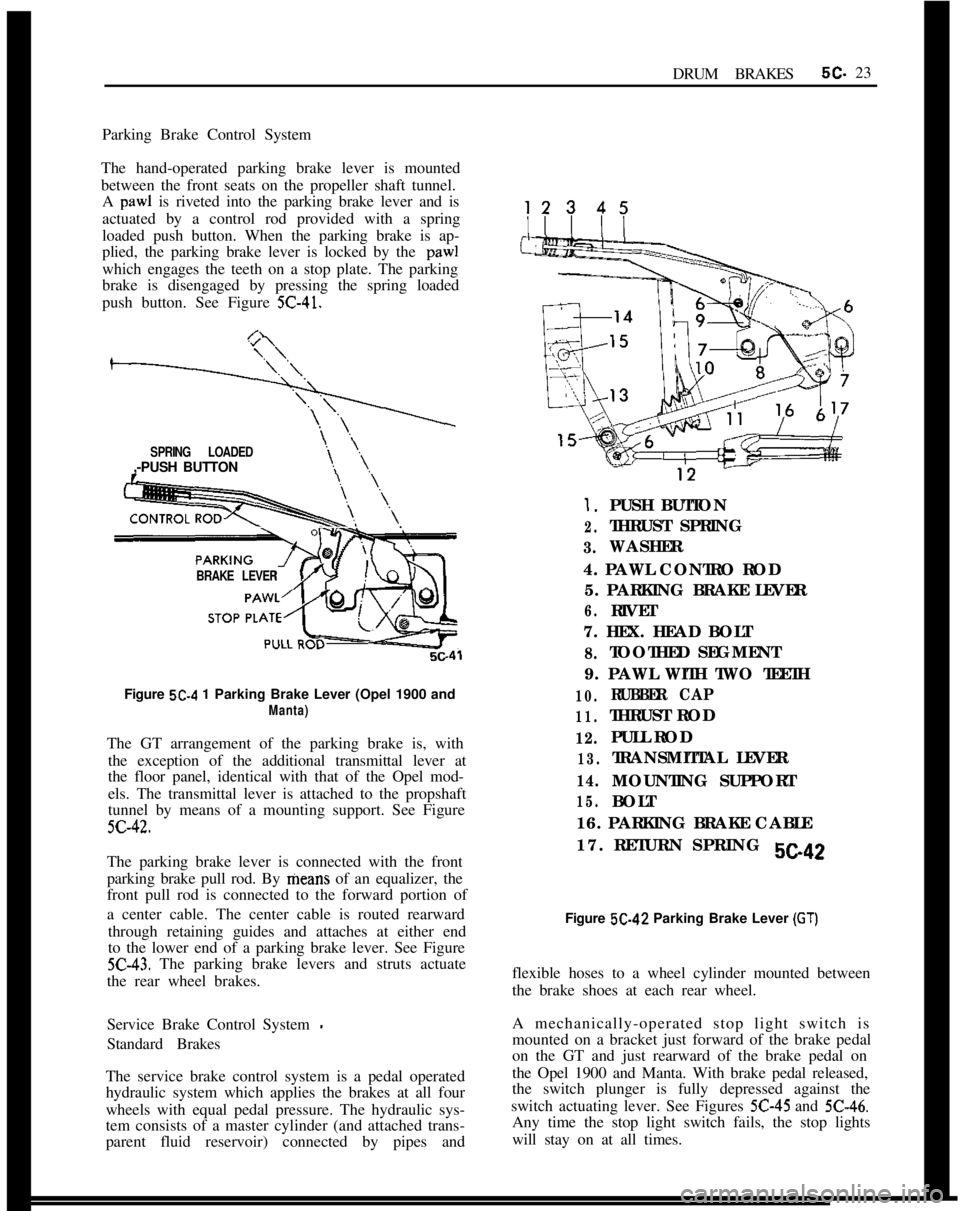
The hand-operated parking brake lever is mounted
between the front seats on the propeller shaft tunnel.
A paw1 is riveted into the parking brake lever and is
actuated by a control rod provided with a spring
loaded push button. When the parking brake is ap-
plied, the parking brake lever is locked by the
paw1which engages the teeth on a stop plate. The parking
brake is disengaged by pressing the spring loaded
push button. See Figure
5C-41.
SPRING LOADED,-PUSH BUTTON
BRAKE LEVER
s\., \\,Figure
5C-4 1 Parking Brake Lever (Opel 1900 and
Manta)The GT arrangement of the parking brake is, with
the exception of the additional transmittal lever at
the floor panel, identical with that of the Opel mod-
els. The transmittal lever is attached to the propshaft
tunnel by means of a mounting support. See Figure
5C-42.The parking brake lever is connected with the front
parking brake pull rod. By means of an equalizer, the
front pull rod is connected to the forward portion of
a center cable. The center cable is routed rearward
through retaining guides and attaches at either end
to the lower end of a parking brake lever. See Figure
5C-43. The parking brake levers and struts actuate
the rear wheel brakes.
Service Brake Control System
-Standard Brakes
The service brake control system is a pedal operated
hydraulic system which applies the brakes at all four
wheels with equal pedal pressure. The hydraulic sys-
tem consists of a master cylinder (and attached trans-
parent fluid reservoir) connected by pipes and
1.PUSH BUTTON
2.THRUST SPRING
3.WASHER
4. PAWL CONTRO ROD
5. PARKING BRAKE LEVER
6.RIVET
7. HEX. HEAD BOLT
8.TOOTHED SEGMENT
9. PAWL WITH TWO TEETH
10.RUBBER CAP
11.THRUST ROD
12.PULL ROD
13.TRANSMITTAL LEVER
14.MOUNTING SUPPORT
15.BOLT
16. PARKING BRAKE CABLE
17. RETURN SPRING
sea2Figure 5C-42 Parking Brake Lever
(GT)flexible hoses to a wheel cylinder mounted between
the brake shoes at each rear wheel.
A mechanically-operated stop light switch is
mounted on a bracket just forward of the brake pedal
on the GT and just rearward of the brake pedal on
the Opel 1900 and Manta. With brake pedal released,
the switch plunger is fully depressed against the
switch actuating lever. See Figures
5C-45 and 5C-46.Any time the stop light switch fails, the stop lights
will stay on at all times.
Page 293 of 625
6A- 21973 OPEL SERVICE MANUAL
ENGINE
CONTENTS
Subject
DESCRIPTION AND OPERATION:
EngineConstruction..........................................................
LubricationSystem............................................................
DIAGNOSIS:
Excessive Oil Consumption............................................NoisyValvesandLifters..................................................
MAINTENANCE AND ADJUSTMENTS:
Valve
LifterAdjustment..................................................
MAJOR REPAIR:
Engine Removal and Installation..................................
Engine
OilPanRemoval
andInstallation..................
Manifold, Cylinder Head, Valve Train and
Lifters................................................................................
Connecting Rod Bearings................................................
Crankshaft Bearings and Seals....................................
Piston, Rings and Connecting Rods............................
TimingChainCoverandTimingChain......................
Camshaft..............................................................................
Oil Pump Cover and Gears............................................
SPECIFICATIONS:
BoltTorque.Specifications
..............................................General Specifications......................................................
Engine Dimension and Fits............................................Page No.
6A- 2
6A- 4
6A- 6
6A- 6
6A- 7
6A- 86A-106A-126A-156A-166A-196A-236A-256A-266A-276A-286A-29
DESCRIPTION AND OPERATION
ENGINE CONSTRUCTION
Engine UsageThe 1.9 liter engine is standard equipment on all 1973
Opel
1900, Manta and GT models. This engine has
a compression ratio of
7.6:1 and operates on“regular” low lead grade fuel.
Engine ConstructionThe
cyfinderhead is made of high-grade chromium
grey cast iron. The valve guides are cast intergal with
the head. The overhead camshaft is supported in four
bearings in the cylinder head.Location of the
vzllve seats in combustion chamber
is above the center of cylinder bore. The spark plug
is positioned in the center and near the highest point
of combustion chamber. This arrangement provides
for short flame travel, uniform combustion and good
cold start prop&ties. Exhaust valves have seat in-serts of highly heat and water resisting material. The
head surface is alumetized and so are the seats of the
inlet v&es Alumetizing makes the valve heads
non- scaling and promotes long life. All engines have“rota-caps”.
The forged, five main bearing crankshaft has large-
diameter main and connecting rod bearing journals
with considerable overlap for vibration-free operat-
ion. T&metal bearing shells are used for main and
connecting rod bearings. The crankshaft end play is
controlled by the rear main bearing.
Page 296 of 625
ENGINE MECHANICAL AND MOUNTS6A- 5
incorporating a gear-type pump driven by the dis-
tributor shaft. The pump body forms part of the
timing case. A passage cast in cylinder block and a
suction pipe connect the pump to the screen cover
assembly in the sump of the oil pan.
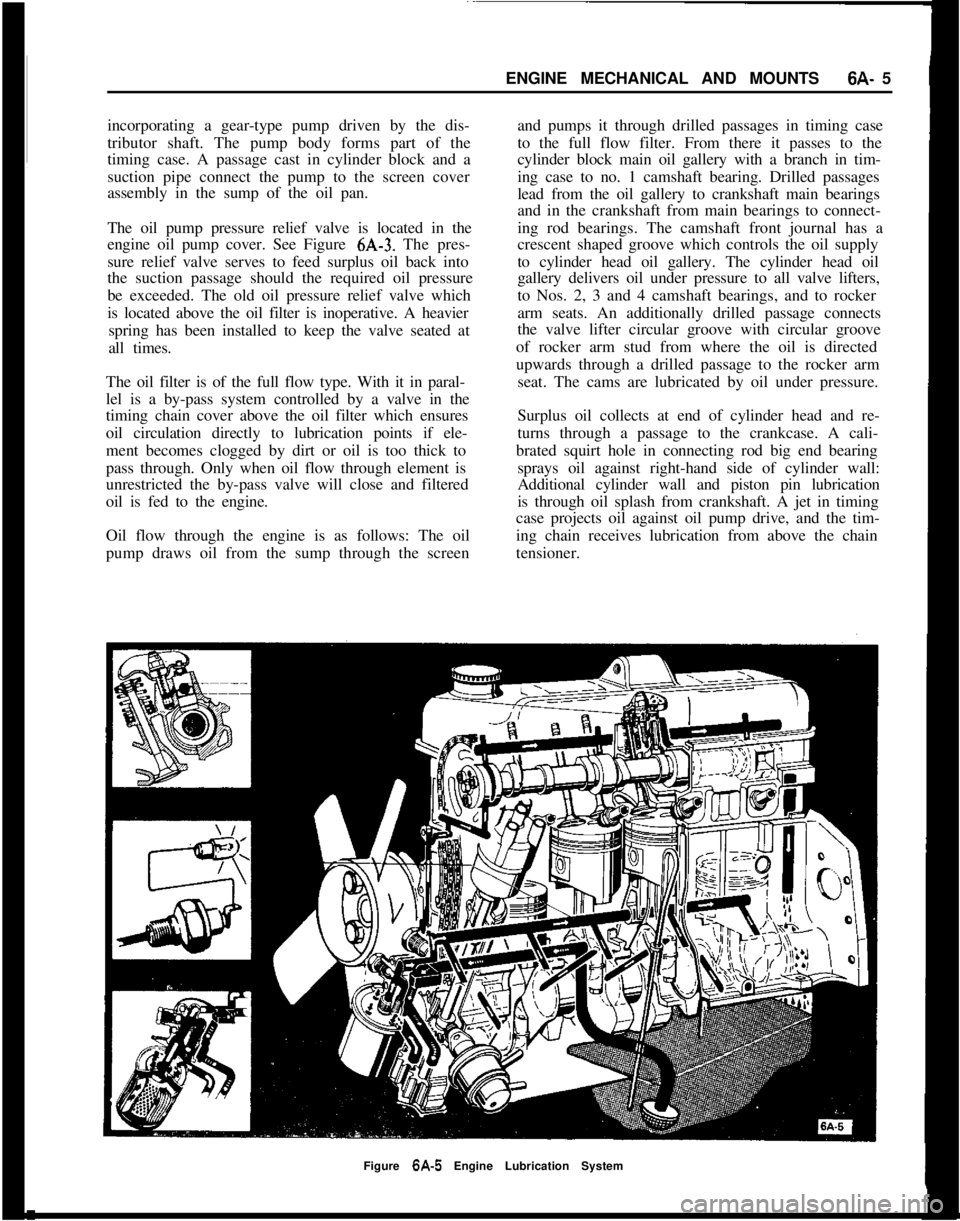
The oil pump pressure relief valve is located in the
engine oil pump cover. See Figure 6A-3. The pres-
sure relief valve serves to feed surplus oil back into
the suction passage should the required oil pressure
be exceeded. The old oil pressure relief valve which
is located above the oil filter is inoperative. A heavier
spring has been installed to keep the valve seated at
all times.
The oil filter is of the full flow type. With it in paral-
lel is a by-pass system controlled by a valve in the
timing chain cover above the oil filter which ensures
oil circulation directly to lubrication points if ele-
ment becomes clogged by dirt or oil is too thick to
pass through. Only when oil flow through element is
unrestricted the by-pass valve will close and filtered
oil is fed to the engine.
Oil flow through the engine is as follows: The oil
pump draws oil from the sump through the screenand pumps it through drilled passages in timing case
to the full flow filter. From there it passes to the
cylinder block main oil gallery with a branch in tim-
ing case to no. 1 camshaft bearing. Drilled passages
lead from the oil gallery to crankshaft main bearings
and in the crankshaft from main bearings to connect-
ing rod bearings. The camshaft front journal has a
crescent shaped groove which controls the oil supply
to cylinder head oil gallery. The cylinder head oil
gallery delivers oil under pressure to all valve lifters,
to Nos. 2, 3 and 4 camshaft bearings, and to rocker
arm seats. An additionally drilled passage connects
the valve lifter circular groove with circular groove
of rocker arm stud from where the oil is directed
upwards through a drilled passage to the rocker arm
seat. The cams are lubricated by oil under pressure.
Surplus oil collects at end of cylinder head and re-
turns through a passage to the crankcase. A cali-
brated squirt hole in connecting rod big end bearing
sprays oil against right-hand side of cylinder wall:
Additional cylinder wall and piston pin lubrication
is through oil splash from crankshaft. A jet in timing
case projects oil against oil pump drive, and the tim-
ing chain receives lubrication from above the chain
tensioner.
Figure 6A-5 Engine Lubrication System
Page 305 of 625
6A. 141973 OPEL SERVICE MANUAL
wire brushes for removing carbon, avoid scratching
valve seats and valve faces. A soft wire brush such as
J-8089 is suitable for this purpose.
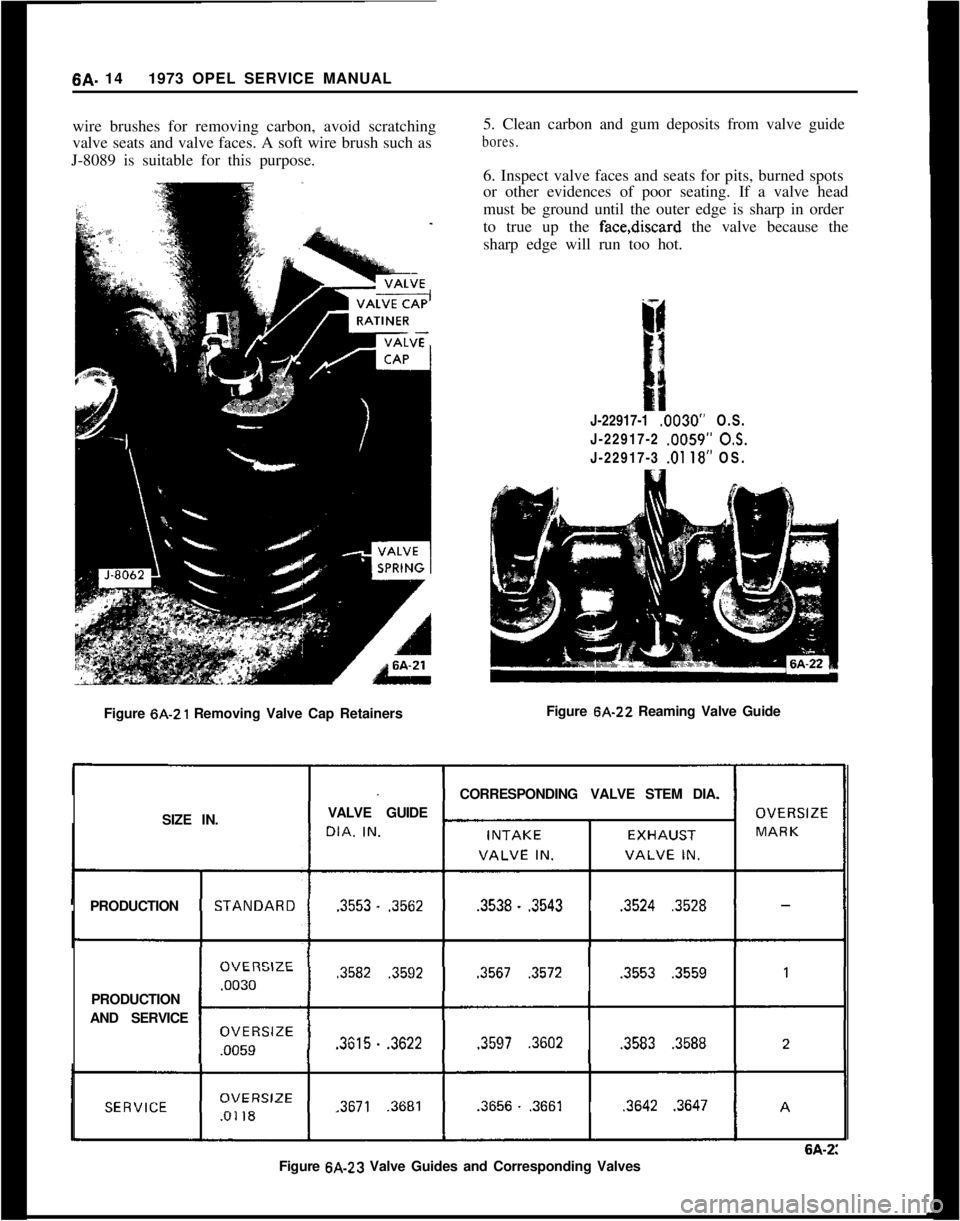
Figure 6A-21 Removing Valve Cap Retainers5. Clean carbon and gum deposits from valve guide
bores.6. Inspect valve faces and seats for pits, burned spots
or other evidences of poor seating. If a valve head
must be ground until the outer edge is sharp in order
to true up the face,discard the valve because the
sharp edge will run too hot.
J-22917-1 .0030” O.S.
J-22917-2 .0059”
05.J-22917-3 .Ol 18” OS.
Figure 6A-22 Reaming Valve Guide
CORRESPONDINGVALVE STEM DIA.
SIZE IN.VALVE GUIDE
PRODUCTION.3553.
.3562.3538..3543.3524.3528PRODUCTION
AND SERVICE
.3582.3592.3567.3572.3553.3559.3615.
.3622.3597.3602.3583.3588
.3671.3681.3656..3661.3642.3647
6A-2:Figure 6A-23 Valve Guides and Corresponding Valves
Page 306 of 625

ENGINE MECHANICAL AND MOUNTS6A- 15New inlet valves must not be refaced or lapped with
grinding compound.The correct angle for the intake
and exhaust valve head is 44 degrees.10. Install cylinder head.
11. Adjust valve clearance. See MAINTENANCE
AND ADJUSTMENTS.
7. Inspect valve guides. Worn or pitted guides can be
reamed to accept valves with oversize stems. Over-
size valves are occasionally used in production.
Oversize valves are marked
’ 1 u “2” or “A” and are
stamped into the valve stem end and also stamped
near spark plug hole. See Figure 6A-22.
Replacing Rocker Arm Studs1. When replacing rocker arm studs become
neces-
sary, remove air cleaner, rocker arm cover and
rocker arm.
8. Reseat valve seats in cylinder head in the following
sequence:
Intake
NOTE:The rocker arm studs are screwed into the
cylinder head. A tapered part of the stem serves to
a void stud loosening.With 45 degrees cutter, remove burnt structure until
a metallic bright seat is obtained. Lightly coat valve
head with red lead, insert it into guide and turn it
under light pressure several times back and forth.
Thereby a contact pattern is obtained and the seat
width can be measured. If valve does not seat per-
fectly all around, lightly recut valve seat to the estab-
lished seat width of
,049” - .059” with 30 degrees
correction cutter.
ExhaustThe directions for reconditioning intake valve seats
apply in principle also to exhaust valve seat recondi-
tioning with the exception that the valve seat width
should be
.063-,073 in. and different cutters are em-
ployed.
NOTE:
: OTse new valve seals whenever
valves are reconditioned.9. Lube valves with engine oil and reinstall valves,
valve springs, caps and cap retainers using J-8062.
Install valve spring with closely wound coils toward
cylinder head. See Figure
6A-24.2. Attach vise grip pliers to stud being removed and
remove from cylinder head.
3. Screw in new stud. Seat tapered part of stud by
striking stud end with a rubber hammer.
4. Place two turned down rocker arm nuts on
threaded part of stud.
5. Torque stud into cylinder head to 29
lb.ft.
Valve Lifter ServiceThe valve lifters can be removed after removing
rocker arm cover and rocker arms.No oversize lifters have been released due to the
insignificant wear of the valve lifters and cylinder
head guides.
Amply oil respective parts and install in reverse se-
quence to removal.
Carry out hydraulic valve lifter adjustment as ou-
tlined in MAINTENANCE AND ADJUST-
MENTS.
VALVE
I SPRING
CLOSE
WOUND
COILS
TOWARD
HEAD6A-24
Figure 6A-24 Valve SpringCONNECTING ROD BEARINGSA connecting rod bearing consists of two halves or
shells which are alike and interchangeable in rod and
cap. When the shells are placed in rod and cap the
ends extend slightly beyond the parting surfaces so
that when rod bolts are tightened the shells will be
clamped tightly in place to insure positive seating
and to prevent turning. Theends of shells must never
be tiled flush with parting surface of rod or cap.
If a precision type connecting rod bearing becomes
noisy or is worn so that clearance on crankpin is
excessive, a new bearing of proper size must be se-
lected and installed since no provision is made for
adjustment. Under no circumstances should the con-necting rod or cap be filed to adjust the bearing
clearance.
Page 308 of 625

ENGINE MECHANICAL AND MOUNTS6A- 17
seating and to prevent turning.The ends of she//s
must never be tiled flush with parting surface of
crankcase or bearing cap.Crankshaft bearings are the precision type which do
not require reaming to size. Shims are not provided
for adjustment since worn bearings are readily re-
placed with new bearings of proper size. Bearings for
service replacement are furnished in standard size
and undersizes. Under no circumstances should
crankshaft bearing caps be tiIed to adjust for wear in
old bearing.After removal of oil pan, pipe and screen assembly,
perform the following removal, inspection and in-
stallation operations on each crankshaft bearing in
turn so that the crankshaft will be well supported by
the other bearings.
If crankshaft has been removed to check straightness
the following procedure is suggested. Rest crank-
shaft on “V-blocks” at number one and number live
main bearing journals. Check indicator runout at
No. 3 main bearing journal. Total indicator reading
should not exceed
.C012”.1. Since any service condition which affects the
crankshaft bearings may also affect the connecting
rod bearings, it is advisable to inspect connecting rod
bearings
first. If crankpins are worn to the extent
that crankshaft should be replaced or reground, re-
placement of crankshaft bearings only will not be
satisfactory.
If replacement of cylinder block or crankshaft is re-
quired, always check main bearing clearance with
plastic-type gauge to obtain specified limits.
2. Remove one bearing cap, then clean and inspect
lower bearing shell and the crankshaft journal. If
journal surface is scored or ridged, the crankshaft
must be replaced or reground to insure satisfactory
operation with new bearings. Slight roughness may
be polished out with tine grit polishing cloth
thoroughly wetted with engine oil, and burrs may be
honed off with a tine stone.
3. If condition of lower bearing shell and crankshaft
journal is satisfactory, check the bearing clearance
with a plastic-type gauge.
4. When checking a crankshaft bearing with plastic-
type gauging material, turn crankshaft so that oil
hole is up to avoid dripping of oil on the gauge
material. Place paper shims in lower halves of adja-
cent bearings and tighten cap bolts to take the weight
of crankshaft
off the lower shell of beating being
checked.5. If bearing clearance exceeds
.C03”, it is advisable
to install a new bearing; however, if bearing is in
good condition and is not being checked because ofbearing noise, it is not necessary to replace the bear-
ing.6. Loosen all crankshaft bearing cap bolts
l/2 turn,
and remove cap of bearing to be replaced.
7. Remove upper bearing shell by inserting Bearing
Shell Remover and Installer J-8080 in oil hole in
crankshaft, then slowly turning crankshaft so that
the tool rotates the shell out of place by pushing
against the end without the tang. See Figure
6A-27.When turning crankshaft with rear bearing cap
removed hold oil seal to prevent it from rotating out
of position in crankcase.
8. The crankshaft journal cannot be measured with
an outside micrometer when shaft is in place; how-
ever, when upper bearing shell is removed the jour-
nal may be checked for out-of-round by using a
special crankshaft caliper and inside micrometer.
Figure 6A-27 Removing and Installing Crankshaft
Bearing Upper Shell
The caliper should not be applied to journal in line
with oil hole.
If crankshaft journal is more than
.M)12” out-of-
round, the crankshaft should be replaced since the
full mileage cannot be expected from bearings used
with an excessively out-of-round crankshaft.
9. Before installation of bearing shells make sure that
crankshaft journal and the bearing seats in crankcase
and cap are thoroughly cleaned.
10. Coat inside surface of upper bearing shell with
engine oil and place shell against crankshaft journal
so that tang on shell will engage notch in crankcase
when shell is rotated into place.
11. Rotate bearing shell into place as far as possible
by hand, then insert Installer J-8080 in crankshaft oil
hole and rotate crankshaft to push shell into place.
Bearing shell should move into place with very little
Page 339 of 625

6~. 46,1973 OPEL SERVICE MANUAL
ary barrel, it is provided with g transfer system.
When the secondary throttle valve starts to open,
two‘ports (which are normally just above the closed
valve) are uncovered, causing fuel to feed into the
secondary bore just before the secondary nozzle
starts feeding. This provides for an additional enrich-
ment of the air-fuel mixture at the beginning of full
throttle operation. See Figure
6E-7.
nInFlFigure
6E-7 Primary to Secondary Transfer System
Full Thrdttle Enrichment SystemIf the secondary throttle valve is fully opened, the
vacuum in the throttle valve area is reduced so that
the transfer ports (mentioned above) stop feeding.
However, the vacuum increases greatly in the sec-
ondary venturi area. An enrichment tube which pro-
trudes into the primary venturi area, feeds fuel
continuously during full throttle operation. See Fig-
ure
6E-2.
Acceleration SystemWhenever the throttle is closing, the suction stroke
of the diaphragm pump causes fuel to flow from the
float chamber through the inlet ball valve into the
pump chamber. When the throttle valve is opened
the diaphragm is moved inward by the pump con-
necting rod and the pump lever. Fuel is injected into
the primary bore through the injector tube. The
amount of fuel is determined by the pump stroke.
The inlet ball valve in the pump chamber prevents
fuel from flowing back into the float chamber during
the pressure stroke of the pump. The outlet ball valve
prevents air from being drawn into the injector tube
during the suction stroke of the pump. See Figure6E- 8.
Float Bowl VentilationWhile driving, the float bowl is ventilated from insideFigure
6E-8 Acceleration System
the carburetor. That is, the float bowl is connected
through the vent valve with the area under the air
cleaner.
When the engine is idling or off, the ventilation from
inside is cut off and ventilation from the charcoal
canister is cut in. The upper spring now seats the
valve on the upper seat. See Figure
6E-9.
-6E-9
Figure
6E-9 Float Bowl VentilationThe advantage of an inside vent while driving is that
air cleaner restriction does not enrichen the air fuel
mixture. The purpose of the charcoal canister vent
while idling or after shutting-off a hot engine, is to
prevent excess fuel vapors from entering the intakemanifold and outside air. Excess fuel vapors may
cause an idling engine to stall, or may make it dif-
ficult to restart a hot engine.
Page 347 of 625
6E- 561973 OPEL SERVICE MANUAL
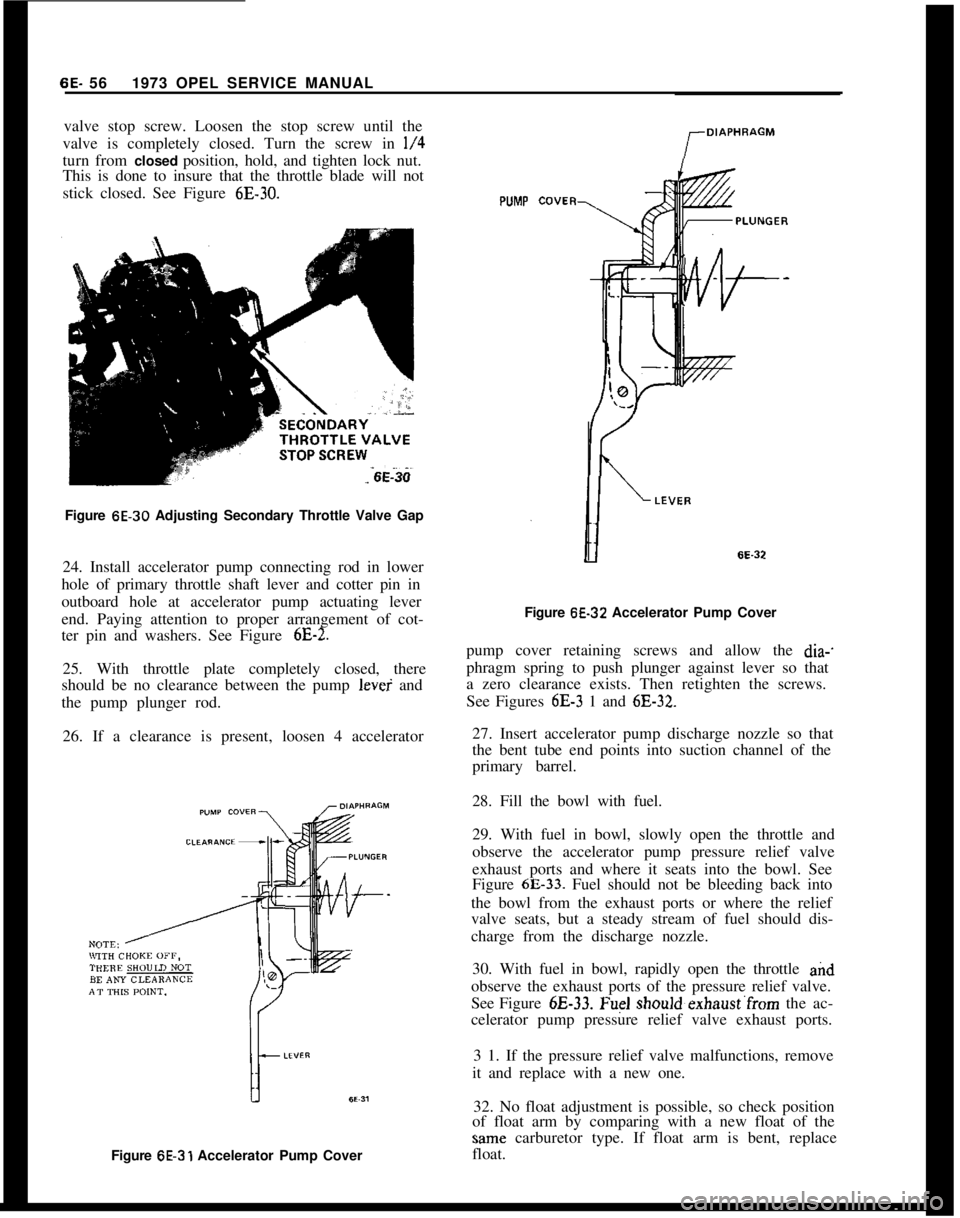
valve stop screw. Loosen the stop screw until the
valve is completely closed. Turn the screw in l/4turn from closed position, hold, and tighten lock nut.
This is done to insure that the throttle blade will not
stick closed. See Figure
6E-30.PUMPFigure 6E-30 Adjusting Secondary Throttle Valve Gap
24. Install accelerator pump connecting rod in lower
hole of primary throttle shaft lever and cotter pin in
outboard hole at accelerator pump actuating lever
end. Paying attention to proper arrangement of cot-
ter pin and washers. See Figure
6E-2.25. With throttle plate completely closed, there
should be no clearance between the pump levei and
the pump plunger rod.
26. If a clearance is present, loosen 4 accelerator
Figure
6E-31 Accelerator Pump CoverFigure 6C32 Accelerator Pump Cover
pump cover retaining screws and allow the
dia-’phragm spring to push plunger against lever so that
a zero clearance exists. Then retighten the screws.
See Figures
6E-3 1 and 6E-32.27. Insert accelerator pump discharge nozzle so that
the bent tube end points into suction channel of the
primary barrel.
28. Fill the bowl with fuel.
29. With fuel in bowl, slowly open the throttle and
observe the accelerator pump pressure relief valve
exhaust ports and where it seats into the bowl. See
Figure
6E-33. Fuel should not be bleeding back into
the bowl from the exhaust ports or where the relief
valve seats, but a steady stream of fuel should dis-
charge from the discharge nozzle.
30. With fuel in bowl, rapidly open the throttle atid
observe the exhaust ports of the pressure relief valve.
See Figure
6E-33. Fuel should~exhaust’from the ac-
celerator pump pressure relief valve exhaust ports.
3 1. If the pressure relief valve malfunctions, remove
it and replace with a new one.
32. No float adjustment is possible, so check position
of float arm by comparing with a new float of thesame carburetor type. If float arm is bent, replace
float.
Page 393 of 625
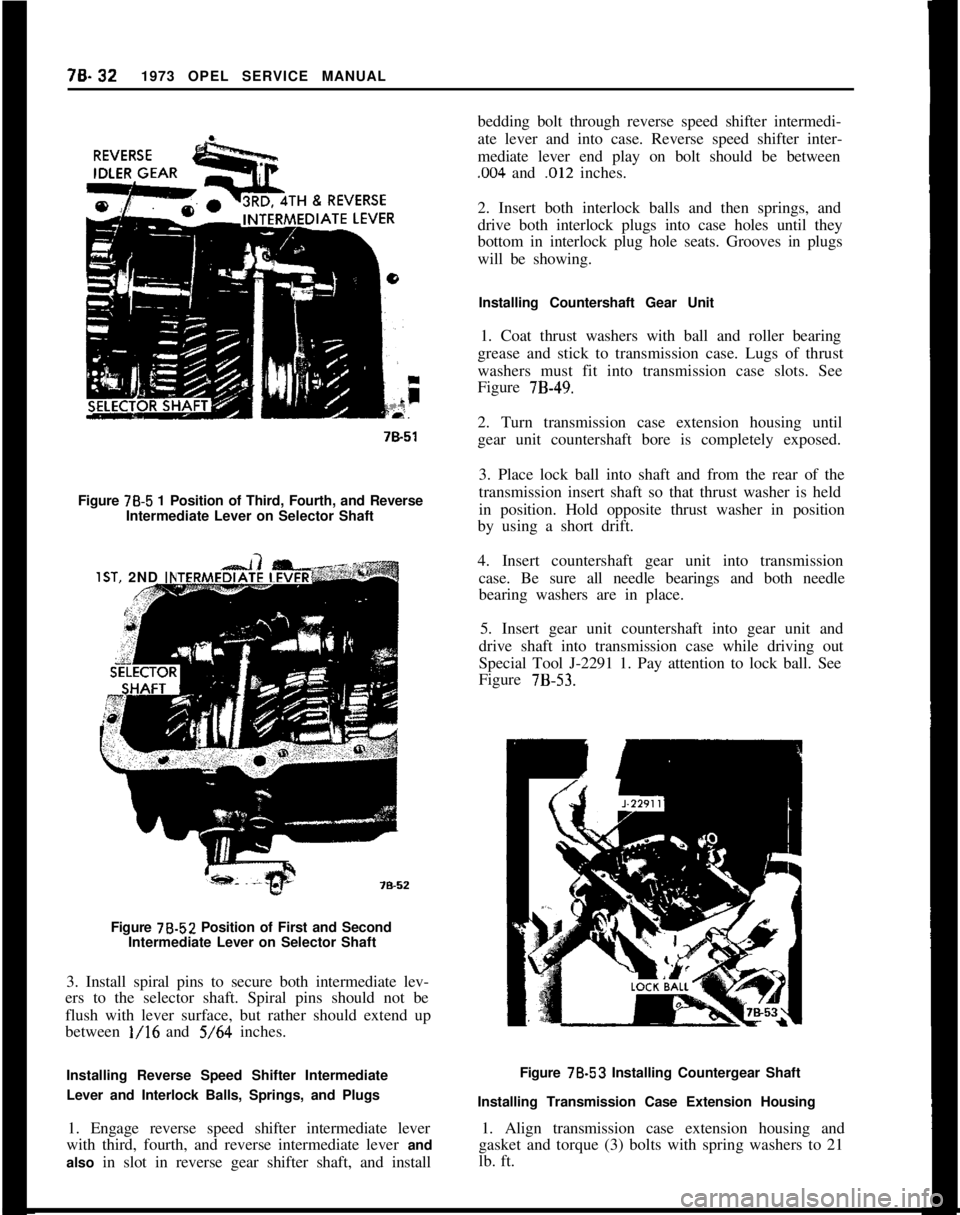
Figure 78-5 1 Position of Third, Fourth, and Reverse
Intermediate Lever on Selector Shaft
1ST. 2ND IlrFigure 78.52 Position of First and Second
Intermediate Lever on Selector Shaft
3. Install spiral pins to secure both intermediate lev-
ers to the selector shaft. Spiral pins should not be
flush with lever surface, but rather should extend up
between
l/16 and 5/64 inches.
Installing Reverse Speed Shifter Intermediate
Lever and Interlock Balls, Springs, and Plugs
1. Engage reverse speed shifter intermediate lever
with third, fourth, and reverse intermediate lever and
also in slot in reverse gear shifter shaft, and install
79-321973 OPEL SERVICE MANUAL
bedding bolt through reverse speed shifter intermedi-
ate lever and into case. Reverse speed shifter inter-
mediate lever end play on bolt should be between
,004 and .012 inches.
2. Insert both interlock balls and then springs, and
drive both interlock plugs into case holes until they
bottom in interlock plug hole seats. Grooves in plugs
will be showing.
Installing Countershaft Gear Unit
1. Coat thrust washers with ball and roller bearing
grease and stick to transmission case. Lugs of thrust
washers must fit into transmission case slots. See
Figure
7B-49.2. Turn transmission case extension housing until
gear unit countershaft bore is completely exposed.
3. Place lock ball into shaft and from the rear of the
transmission insert shaft so that thrust washer is held
in position. Hold opposite thrust washer in position
by using a short drift.
4. Insert countershaft gear unit into transmission
case. Be sure all needle bearings and both needle
bearing washers are in place.
5. Insert gear unit countershaft into gear unit and
drive shaft into transmission case while driving out
Special Tool J-2291 1. Pay attention to lock ball. See
Figure
7B-53.Figure 78-53 Installing Countergear Shaft
Installing Transmission Case Extension Housing
1. Align transmission case extension housing and
gasket and torque (3) bolts with spring washers to 21
lb. ft.
Page 417 of 625
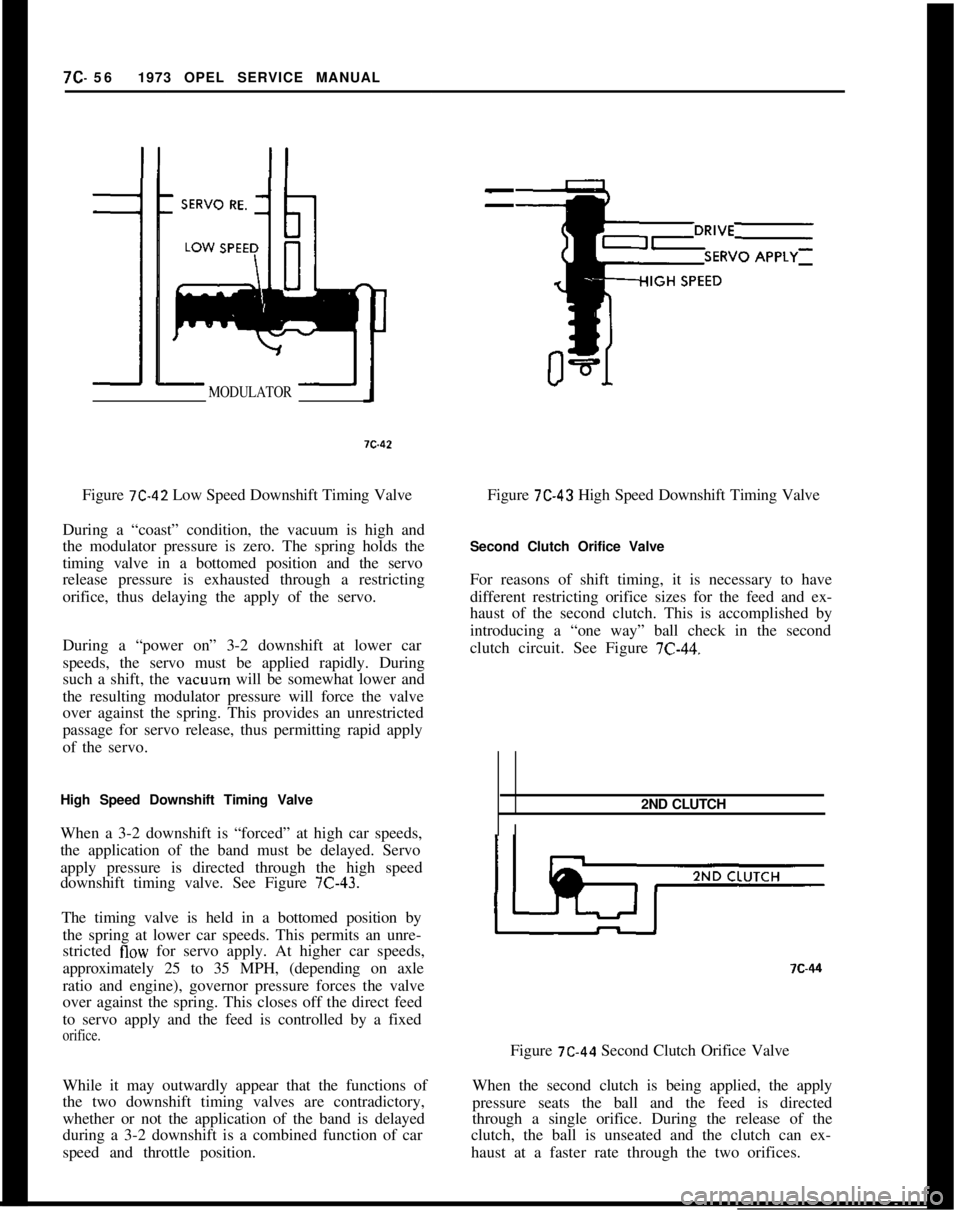
7C- 561973 OPEL SERVICE MANUALMODULATORFigure
7C-42 Low Speed Downshift Timing Valve
During a “coast” condition, the vacuum is high and
the modulator pressure is zero. The spring holds the
timing valve in a bottomed position and the servo
release pressure is exhausted through a restricting
orifice, thus delaying the apply of the servo.
During a “power on” 3-2 downshift at lower car
speeds, the servo must be applied rapidly. During
such a shift, the vacuum will be somewhat lower and
the resulting modulator pressure will force the valve
over against the spring. This provides an unrestricted
passage for servo release, thus permitting rapid apply
of the servo.
High Speed Downshift Timing Valve
When a 3-2 downshift is “forced” at high car speeds,
the application of the band must be delayed. Servo
apply pressure is directed through the high speed
downshift timing valve. See Figure
7C-43.The timing valve is held in a bottomed position by
the spring at lower car speeds. This permits an unre-
stricted
flow for servo apply. At higher car speeds,
approximately 25 to 35 MPH, (depending on axle
ratio and engine), governor pressure forces the valve
over against the spring. This closes off the direct feed
to servo apply and the feed is controlled by a fixed
orifice.While it may outwardly appear that the functions of
the two downshift timing valves are contradictory,
whether or not the application of the band is delayed
during a 3-2 downshift is a combined function of car
speed and throttle position.
--Figure
7C-43 High Speed Downshift Timing Valve
Second Clutch Orifice Valve
For reasons of shift timing, it is necessary to have
different restricting orifice sizes for the feed and ex-
haust of the second clutch. This is accomplished by
introducing a “one way” ball check in the second
clutch circuit. See Figure
7C-44.2ND CLUTCH
I?C-44
Figure
7C-44 Second Clutch Orifice Valve
When the second clutch is being applied, the apply
pressure seats the ball and the feed is directed
through a single orifice. During the release of the
clutch, the ball is unseated and the clutch can ex-
haust at a faster rate through the two orifices.