warning OPEL 1900 1973 User Guide
[x] Cancel search | Manufacturer: OPEL, Model Year: 1973, Model line: 1900, Model: OPEL 1900 1973Pages: 625, PDF Size: 17.22 MB
Page 94 of 625

I
/WIRING DIAGRAMS13-73ISeat Belt Warning System (Automatic
Page No.Transmission)
.GT.......................................................lJ-99HeatedRear Glass
.Opel1900.Manta...................15-100Heated Rear Glass
.GT..................................................*,lJ-101Opel 1900 Color Schematic.........................................
lJ-103Manta
ColorSchematic.................................................1 J-105GT
ColorSchematic
.........................................................1 J-107
Page 100 of 625

I
WIRING DIAGRAMS15.79
IIFigure lJ-6
Oil. Fuel. Temp. Tach, Stop and Brake Warning Light. GT
I
Page 118 of 625

WIRING DIAGRAMSlJ- 97
cI
&N
/I
IFigure 1 J-24 Seat Belt Warning System (Automatic Transmission) Opel 1900 Manta
Page 120 of 625

WIRING DIAGRAMSlJ-99Figure
lJ-26 Seat Belt Warning System (Automatic Transmissionl - GT
Page 273 of 625

5B- 141973 OPEL SERVICE MANUALConditionPossible CauseCorrection2. Partial system failure.2. Check front and rear brake system
and repair, if necessary. Also, check
brake warning light, if a failed
system is found and light did not
function.
3. Excessively worn shoe
and lining.3. Check and replace in axle sets.
4. Piston in caliper stuck
or sluggish.4. Remove caliper and rebuild.
5. Fading brakes due to
incorrect lining.
6. Vacuum leak.5. Remove and replace with original
equipment lining.
6. Check for ruptured hose or loose
attachment.
Excessive Pedal Travel1. Partial brake system
failure.1. Check both front and rear system
for a failure and repair. Also, check
warning light
- it should have indi-
cated a failure.
2. Insufficient fluid in
master cylinder.
3. Poor rear brake
adjustment.2. Fill reservoirs with approved
brake fluid. Check for leaks.
3. Adjust rear brake per
specifications.
4. Air trapped in system.4. Bleed system.
5. Bent shoe and lining.5. Replace axle set of shoe and
lining.
Dragging Brakes (A very
light drag is present in
all disc brakes
immediately after pedal
is released.)1. Master cylinder pistons
not returning correctly.1. With reservoir cover off, check
for fluid spurt at bypass holes as
pedal is depressed. Adjust push rod,
if necessary, or rebuild master
cylinder.
2. Restricted brake tubes2. Check for soft hoses or damaged
or hoses.tubes and replace with new hoses and
new double-walled steel brake tubing.
3. Incorrect parking brake
adjustment on rear brakes.3. Check and readjust to correct
specifications.
Grabbing or Uneven Braking
Action (All conditions
listed under “Pulls”
.)4. Check valve installed in
outlet to front disc brakes.
1. Malfunction of power
brake unit.4. Check master cylinder outlet and
remove check valve if present.
1. Check operation and repair, if
necessary.
Page 323 of 625
66.321973 OPEL SERVICE MANUAL
COOLING SYSTEM
CONTENTS
Subject
DESCRIPTION AND OPERATION:
Cooling System and Water Pump
. . . . . . . . . . . . . . . . . . . . . . . . . . . . . . . .DIAGNOSIS: (Not Applicable)
MAINTENANCE AND ADJUSTMENTS:
Checking and Filling Cooling System
. . . . . . . . . . . . . . . . . . . . . . . .Draining
andFlushingCoolingSystem. . . . . . . . . . . . . . . . . . . . . .Conditioning the Cooling System
. . . . . . . . . . . . . . . . . . . . . . . . . . . . . . . .Using and Testing Anti-Freeze Solutions
. . . . . . . . . . . . . . . . . .Fan Belt Adjustment or Replacement
. . . . . . . . . . . . . . . . . . . . . . . .Radiator Thermostat Inspection and Test
. . . . . . . . . . . . . . . .MAJOR REPAIR:
Water Pump Removal
. . . . . . . . . . . . . . . . . . . . . . . . . . . . . . . . . . . . . . . . . . . . . . . . . . . . .Radiator
Removal. . . . . . . . . . . . . . . . . . . . . . . . . . . . . . . . . . . . . . . . . . . . . . . . . . . . . . . . . . . . . .SPECIFICATIONS:
Cooling System Capacities
. . . . . . . . . . . . . . . . . . . . . . . . . . . . . . . . . . . . . . . . . . . .Page No.
68-32
6B-32
68-32
68-33
68-33
68-33
68-33
68-34
68-34
6B-35
DESCRIPTION AND OPERATION
COOLING SYSTEM AND WATER PUMPThe coiling system is of the conventional pressurized
type. A centrifugal pump arranged in timing case
serves to circulate the coolant.
When the thermostat is closed, the coolant will re-
turn to the pump via a by-pass for swift and uniform
warming up of the engine the coolant circulates
through the radiator, only when the engine has
reached normal operating temperature.
The heater system branches off the cooling system
ahead of thermostat in flow direction so that the
heater is in operation before engine has reached full
operating temperature.
MAINTENANCE AND ADJUSTMENTS
Checking and Filling Cooling SystemThe coolant level should be checked only when the
engine is cold and only enough coolant should be
added to bring the level halfway between core andtank top. It is unnecessary and undesirable to remove
the radiator cap and check the coolant level each
time the car stops at a filling station for gasoline or
oil, since the engine is usually hot at such times.
WARNING: Never remove the radiator cap quickly
when engine is HOT Sudden release of cooling
sys-
tern pressure may cause the coolant to boil and some
of it may be ejected from the radiator
filler neck,
resulting in
inl’ury to persons or damage to the car
finish.If it is necessary at any time to remove the radiator
cap when engine is hot, rotate the cap counterclock-
wise until first stop is reached. Leave cap in this
position until all pressure in cooling system has been
released, then turn cap past the first stop and remove
it.
Draining and Flushing
Cooling SystemThe cooling system should be completely drained
and the recommended coolant installed every two (2)
years.To drain the cooling system, remove radiator cap,
remove lower radiator hose from the lower tank and
Page 324 of 625
COOLING SYSTEM6B- 33
remove drain plug on right.side of cylinder block. Set
heater temperature control valve at full heat posi-
tion. After the cooling system is drained, and plugs
reinstalled, fill the system with clean water. Run the
engine long enough to open the thermostat for com-
plete circulation through the system, then com-
pletely drain the cooling system before sediment has
a chance to settle.
Conditioning the Cooling System
“Rust Inhibitor and Stop Leak”, or equivalent listed
under Group 8.800 is recommended for use in the
cooling system, particularly when preparing for in-
stallation of anti-freeze solution. This material stops
small seepage leaks, has rust preventive properties
and its soluble oil is effective in eliminating a squeal-
ing noise which sometimes develops at the water
pump seal washer. Instructions for its application are
printed on the conditioner bottle.
It is very important to make certain that the cooling
system is properly prepared before an anti-freeze so-
lution is installed, otherwise loss of solution through
leakage may occur or seepage may result in damage
to the engine. The cooling system should be drained
and flushed as described under Draining and Flush-
ing Cooling System. All joints should be checked for
leakage and corrected, and the conditioner described
above should be added with the anti-freeze solution.
Inspect the water pump, radiator core, heater and
defroster cores, water jacket plugs, and edge of cylin-
der head gaskets for evidence of water leaks. Tighten
all hose clamps in the cooling and heating systems
and replace any deteriorated hoses.
Using and Testing Anti-Freeze
Solutions
Inhibited year around (ethylene glycol type) engine
coolant solution which is formulated to withstand
two full calendar years of normal operation without
draining or adding inhibitors should be used at all
times. Freeze protection should be provided to pro-
tect against corrosion. When adding solution due to
loss of coolant for any reason or in areas where tem-
peratures lower than minus 20 degrees F. may be
encountered, a sufficient amount of any of the sev-
eral brands of year around coolant (Ethylene Glycol
base) compatible to GM Specification 1899-M avail-
able on the market should be used. Water or alcohol
base coolants are not recommended for this vehicle
at any time.
If for any reason water only is used as a coolant in
an emergency, it is extremely important that Buick
Heavy Duty Cooling System Protector and Water
Pump Lubricant or equivalent be added to the cool-
ing system as soon as possible. If any other cooling
System protector is used, be certain it is labeled toindicate that it meets General Motors Specification
GM 1894-M. It should be recognized that this is only
a temporary measure. The manufacture intends that
permanent type coolant solution be used year around
in the cooling system.
The cooling system should be completely drained
and the recommended coolant installed every two (2)years.It is advisable to test the anti-freeze solution at inter-
vals during the winter to make certain that the solu-
tion has not been weakened. Use only hydrometers
which are calibrated to read both the specific gravity
and the temperature, and have a table or other means
of converting the freezing point at various tempera-
tures of solution. Disregarding the temperature of
the solution when making the test may cause an error
as large as 30 degrees F. Care must be exercised to
use the correct float or table for the particular type
of anti-freeze being tested.
Fan Belt Adjustment or Replacement
A tight fan belt will cause rapid wear of the alterna-
tor and water pump bearings. A loose belt will slip
and wear excessively and will cause noise, engine
over-heating, and unsteady alternator output. A fan
belt which is cracked or frayed, or which is worn so
that it bottoms in the pulleys should be replaced. The
fan belt may be replaced by loosening the alternator
brace at alternator, slightly loosening the alternator
mounting bolts and moving alternator inward to pro-
vide maximum slack in the belt.
The alternator must be moved outward to adjust the
fan belt. After the generator brace and mounting
bolts are securely tightened, the fan belt tension
should be 45 lb. using Tensioner J-23600.
WARNING: Zfa
fan blade is bent or damaged in any
way, no attempt should be made to repair and reuse
the damaged part. A bent or damaged fan assembly
should always be replaced with a new
fal. assembly.
It is essential that fan assemblies remain in proper
balance and proper balance cannot be assured once
a fan assembly has been bent or damaged. A fan
assembly that is not in proper balance could fail and
fly apart during subsequent
we creating an ex-
tremely dangerous condition.
Radiator Thermostat Inspection and Test
A sticking radiator thermostat will prevent the cool-
ing system from functioning properly. If the thermo-
stat sticks in the open position, the engine will warm
up very slowly. If the thermostat sticks in the closed
position, the engine will overheat.
The thermostat may be removed for inspection and
Page 362 of 625
CLUTCH7A. 1
CLUTCH
CONTENTS
Subject
DESCRIPTION AND OPERATION: Clutch andClutch
PedalMechanisms
. . . . . . . . . . . . . . . . . . . . . .
DIAGNOSIS:
Clutch
. . . . . . . . . . . . . . . . . . . . . . . . . . . . . . . . . . . . \
. . . . . . . . . . . . . . . . . . . . . . . . . . . . . . . . . . . . \
. . . . . . .
MAINTENANCE AND ADJUSTMENTS: Clutch LashAdjustment (GTOnly)
. . . . . . . . . . . . . . . . . . . . . . . . . . . . . .
Clutch Adjustment (All 1.9 Engines Except GT). . . .
Control CableAdjustment. . . . . . . . . . . . . . . . . . . . . . . . . . . . . . . . . . . . \
. . . . . . . . . .
MAJOR REPAIR:
Clutch Removal and Installation
. . . . . . . . . . . . . . . . . . . . . . . . . . . . . . . . .
Clutch Control Cable. . . . . . . . . . . . . . . . . . . . . . . . . . . . . . . . . . . . \
. . . . . . . . . . . . . . . . . . . .
SPECIFICATIONS:
Specifications
. . . . . . . . . . . . . . . . . . . . . . . . . . . . . . . . . . . . . . . . \
. . . . . . . . . . . . . . . . . . . . . . . . . . . . .
Page No.
7A-
1
7A-2
7A-4
7A-4
7A-4
IA-5
7A- 7
7A-7
DESCRIPTION AND OPERATION
CLUTCH PEDAL MECHANISM GT Only
The pedal lever pivots on a tubular steel shaft and
operates the clutch release yoke thru a sheathed ca-
ble attached directly to the upper end of the pedallever. Pedal return is accomplished thru the cable by
the clutch yoke return spring at the transmission.
The pedal return stop
is a nonadjustable rubber
bumper inserted through the upper end of the pedal leverjust below the cable attaching point. The clutch
cable is sheathed in woven steel and weather pro-
tected by a plastic and fabric covering. An eyelet is
wedged on the upper end and fits over a formed
hook on the upper end of the pedal. The lower end
is provided with a
wedged ball stud arrangement
that slips into a slot in the clutch release lever. See
Figure
7A-6.
Opel 1900 and Manta
The pedal lever pivots on a tubular steel shaft and
operates the clutch release yoke through a sheathed
cable attached directly to the upper end of the pedal
lever. Pedal return is accomplished through a spring
attached to the pedal below the pivot shaft and to the
pedal assembly mounting bracket at the bulkhead. Clutch actuation works without pedal-free travel and
a warning device is provided which actuates an in-
dicator lamp in the instrument panel indicating
necessity of clutch adjustment. The clutch cable is
sheathed in
woven steel and weather protected by a
plastic fabric covering. An eyelet is wedged on the
upper end and fits over a formed hook on the upper
end of the pedal. The lower end is provided with a
wedged ball stud arrangement that slips into a slot in the clutch release lever. See Figure
7A-7.
Clutch Mechanism
The clutch assembly is enclosed in the bell housing.
The clutch release bearing and release fork are of
conventional design, with the fork pivoting on a ball
stud located opposite the control cable attaching
point. The bearing flange tits over two vertical pins
which are riveted to and extend into the eye of the
yoke.
The clutch pressure plate is similar in design to the
Buick Century pressure plate. A radially slotted dia-
phragm pivoting on two steel wire rings is retained
to the clutch cover by eight rivets. The clutch driven
member is a
6-3/4 inches diameter single plate dry
disc with torsional damper springs and spring leaves
between facings to cushion application. Dampener
springs in clutch disc assembly are
preloaded.
Page 541 of 625
98-32 1973 OPEL SERVICE MANUAL
inserting it in the connection. Another precaution -inspect the fitting for burrs which can cut the
“0”ring.
Restrictions
Restrictions may be due to powdered desiccant or
dirt and foreign matter. This may result in starved
evaporator and loss of cooling, or a seized compres-
SOT.When the amount of moisture in a system sufti-
ciently exceeds the capacity of the desiccant, it can
break down the desiccant and cause it to powder.
The powder passes through the dehydrator screen
with the refrigerant liquid and is carried to the ex-
pansion valve screen. While some of it may pass
through the valve screen into the evaporator, it may
quickly build up to cause a restriction.
Due to the fact that sufftcient oil can not be returned
to the compressor, it may seize.
Dirt
Dirt, which is any foreign material, may come from
cleaner residues, cutting, machining, or preserving
oils, metal dust or chips, lint or dust, loose rust,
soldering or brazing fluxes, paint or loose oxide
scale. These can also cause seized bearings by abra-
sion or wedging, discharge and expansion valve fail-
ure, decomposition of refrigerant and oil, or
corrosion of metal parts.
CorrosionCorrosion and its by-products can restrict valve and
drier screens, rough bearing surfaces or rapid fatigu-
ing of discharge reeds. This can result in high tem-
perature and pressure, decomposition or leaks. In
any event, this means a wrecked compressor.
From this, we can see the vicious circle that can be
produced in a refrigerating system to cause its fail-
ure. Corrosion can be the indirect cause of leaks, and
leaks can be the direct cause of corrosion. We can
also see the important role we as servicemen play in
maintaining chemical stability.
The major cause of corrosion is moisture.
Moisture
Moisture is the greatest enemy of refrigerating sys-
tems. Combined with metal, it produces oxide, Iron
Hydroxide and Aluminum Hydroxide. Combined
with R-12 it produces Carbonic acid, Hydrochloric
acid, and Hydrofluoric acid. Moisture can also cause
freeze-up of expansion valve and powdered desic-
cant.Although high temperature and dirt are responsible
for many difficulties in refrigerating systems, in most
instances it is the presence of moisture in the system
that accelerates these conditions. It can be said,themfore, that moisture is the greatest enemy of all.
The acids that it produces, in combination with both
the metals and the refrigerant, cause damaging
COT-
rosion. While the corrosion may not form as rapidly
with R-12 as with some other refrigerants, the even-
tual formation is as damaging.
If the operating pressure and temperature in the
evaporator is reduced to the freezing point, moisture
in the refrigerant can collect at the orifice of the
expansion valve and freeze. This temporarily re-
stricts the flow of liquid causing erratic cooling.
As previously mentioned, moisture in excess of the
desiccant’s capacity can cause it to powder.
YOU SHOULD KNOW AND REMEMBER..That the inside of the refrigerat,ion system is com-
pletely sealed from the outside world. And if that
seal remains broken at any point
- the system will
soon be destroyed. That complete and positive seal-
ing of the entire system is vitally important and that
this sealed condition is absolutely necessary to retain
the chemicals and keep them in a pure and proper
condition.
That all parts of the refrigeration system are under
pressure at all times, whether operating or idle, and
that any leakage. points are continuously losing re-
frigerant and oil.
That the leakage of refrigerant can be so silent that
the complete charge may be lost without warning.
That refrigerant gas is heavier than air and will rap-
idly drop to the floor as it flows from a point of
leakage.
That the pressure in the system may momentarily
become as high as 400 lbs. per square inch, and that
under such pressure the molecules of refrigerant are
forced out through the smallest opening or pore.
That the compressor is continually giving up some
lubricating oil to the circulating refrigerant and de-
pends upon oil in the returning refrigerant for con-
tinuous replenishment. Any stoppage or major loss
of refrigerant will therefore be fatal to the compres-
SOT.That the extreme internal dryness of a properly proc-
essed system is a truly desert condition, with the
drying material in the receiver holding tightly on to
the tiny droplets of residual moisture.
Page 548 of 625
REFRIGERANT COMPONENTS ALL MODELS96-39
In all instances where the indications of refrigerant
shortage continues, additional refrigerant should be
added in
l/4 lb. increments until the sight glass is
clear.
An additional charge of l/4 lb. should be ad-
ded as a reserve. In no case should the system be
overcharged.
LEAK TESTING SYSTEM
The following two methods are recommended when attempting to locate refrigerant leaks in the system.
Loss of
regrigerant is always indicative of a leak since
refrigerant is not consumed and does not wear out.
1. Open Flame Method
- This method utilizes a gas
operated torch type leak detector (J-6084). Use of
this method is recommended when checking for
leaks in confined areas. To perform test, light torch
and adjust to obtain a pale blue flame, approximately
3/8 inch in height, in burner.
Explore for leaks by moving end of search tube
around suspected area. Check bottom of connections
since Refrigerant-12 is heavier than air and will be more apparent at underside of fittings. The flame
color will turn yellow-green when a small leak is
detected. Large leaks will turn the flame blue or
purple.
WARNING:
Do not breathe fumes resdting from
burning of
refrigerant gas. These fumes az ex-
tremeiy poisonous.
2. Liquid Leak Detectors - This method utilizes a
solution which will bubble (soap solution) to signify
a gas leak. Use of this method of checking is recom-
mended for locating small leaks.
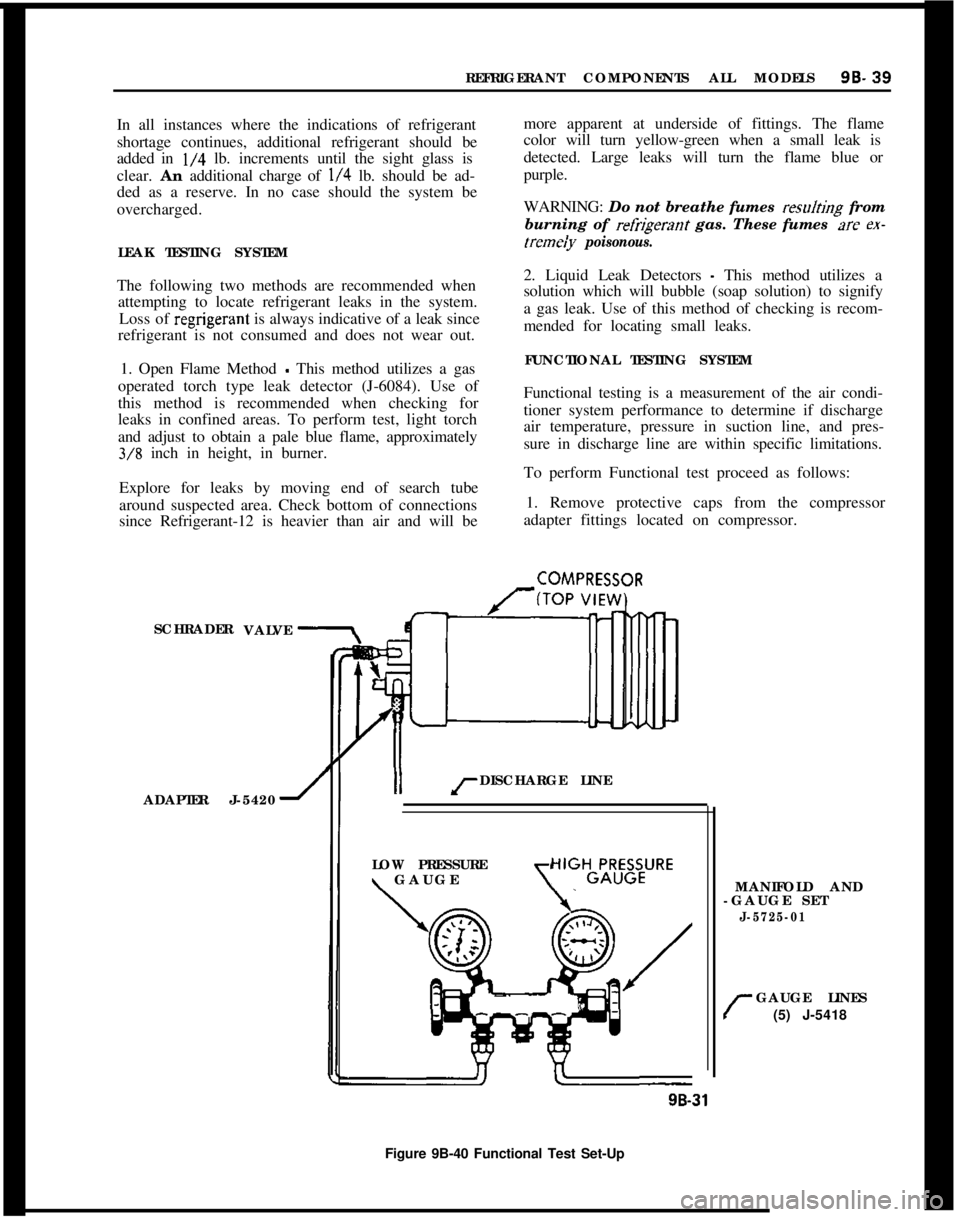
FUNCTIONAL TESTING SYSTEM
Functional testing is a measurement of the air condi-
tioner system performance to determine if discharge
air temperature, pressure in suction line, and pres-
sure in discharge line are within specific limitations.
To perform Functional test proceed as follows:
1. Remove protective caps from the compressor
adapter fittings located on compressor.
SCHRADER
ADAPTER J-5420
1II rDISCHARGE LINE
COMPRESSOR
VALVE
LOW PRESSURE
\ GAUGE\
HIGHGLR;B;URE
MANIFOLD AND
-GAUGE SET
J-5725-01
r
GAUGE LINES
(5) J-5418
9B-31
Figure 9B-40 Functional Test Set-Up