headlamp OPEL AGILA 2009 User Guide
[x] Cancel search | Manufacturer: OPEL, Model Year: 2009, Model line: AGILA, Model: OPEL AGILA 2009Pages: 153, PDF Size: 1.82 MB
Page 114 of 153
10-14 Vehicle care
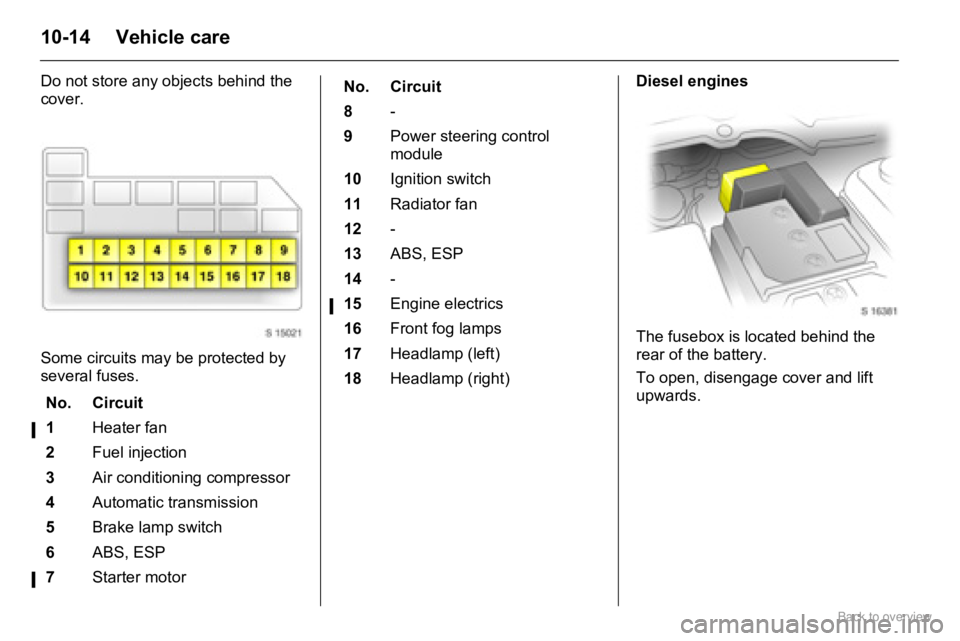
Do not store any objects behind the
cover.
Some circuits may be protected by
several fuses.Diesel engines
The fusebox is located behind the
rear of the battery.
To open, disengage cover and lift
upwards.
No. Circuit
1Heater fan
2Fuel injection
3Air conditioning compressor
4Automatic transmission
5Brake lamp switch
6ABS, ESP
7Starter motor
8-
9Power steering control
module
10Ignition switch
11Radiator fan
12-
13ABS, ESP
14-
15Engine electrics
16Front fog lamps
17Headlamp (left)
18Headlamp (right) No. Circuit
Page 115 of 153
10-15Vehicle care
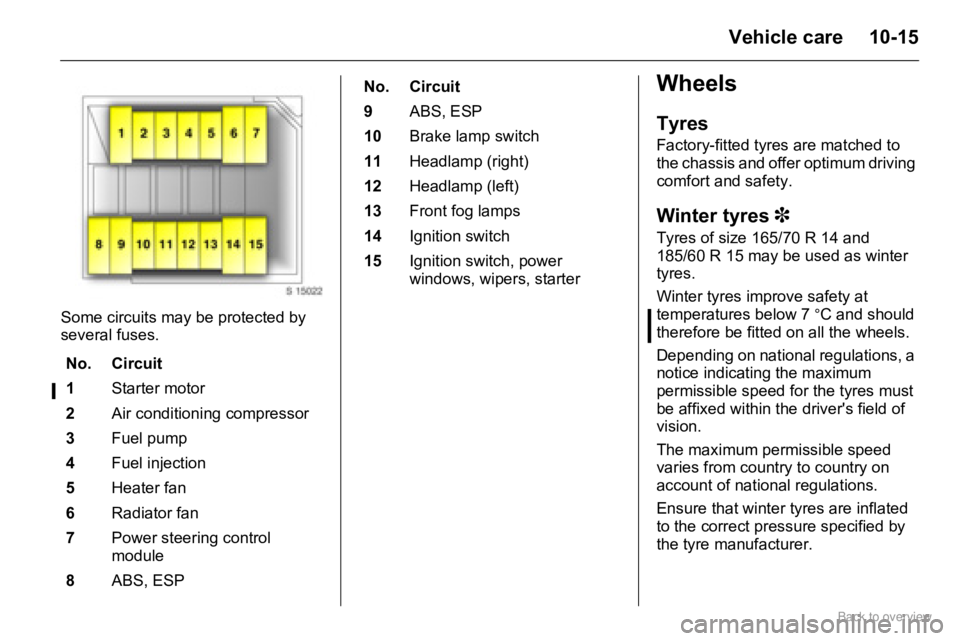
Some circuits may be protected by
several fuses.
Wheels
Tyres
Factory-fitted tyres are matched to
the chassis and offer optimum driving
comfort and safety.
Winter tyres 3
Tyres of size 165/70 R 14 and
185/60 R 15 may be used as winter
tyres.
Winter tyres improve safety at
temperatures below 7
°C and should
therefore be fitted on all the wheels.
Depending on national regulations, a
notice indicating the maximum
permissible speed for the tyres must
be affixed within the driver's field of
vision.
The maximum permissible speed
varies from country to country on
account of national regulations.
Ensure that winter tyres are inflated
to the correct pressure specified by
the tyre manufacturer. No. Circuit
1Starter motor
2Air conditioning compressor
3Fuel pump
4Fuel injection
5Heater fan
6Radiator fan
7Power steering control
module
8ABS, ESP
9ABS, ESP
10Brake lamp switch
11Headlamp (right)
12Headlamp (left)
13Front fog lamps
14Ignition switch
15Ignition switch, power
windows, wipers, starter No. Circuit
Page 130 of 153

10-30 Vehicle care
Exterior care
Locks
The locks are lubricated with a high-
grade lock cylinder grease at the
factory.
Only use de-icing agents in
emergencies, as they have a
degreasing effect and will impair the
function of the locks. After using a
de-icing agent, have the locks
regreased. Seek the assistance of a
workshop.
Washing the vehicle
The paintwork of your vehicle is
exposed to environmental influences,
e.g. continuous changes in weather
conditions, industrial waste gases
and dust or thawing salts, so wash
and wax your vehicle regularly. When
using automatic car washes, select a
program which includes waxing.
Bird droppings, dead insects, resin,
pollen and the like should be cleaned
off immediately, as they contain
aggressive constituents which can
cause paint damage.If using a car wash, comply with the
pertinent instructions of the car wash
manufacturer. The windscreen
wipers and rear window wiper must
be switched off 3 5-2, 5-3. Remove
detachable rod antenna by
unscrewing it.
Do not use high-pressure jet
cleaners.
If you wash your vehicle by hand,
make sure that the insides of the
wings are also thoroughly rinsed out.
Do not use household dishwashing
liquid, to avoid removing wax from the
paintwork.
Clean edges and folds on opened
doors and flaps as well as the areas
they cover.
Thoroughly rinse off and leather-off
the vehicle. Rinse leather frequently.
Use separate leathers for paint and
window surfaces; remnants of wax on
the windows will impair vision.
Also wash aluminium trim parts,
avoiding the use of abrasive
materials such as automotive or chrome polish, steam or caustic
soap. Washing with water is normally
sufficient.
Observe national regulations.
Exterior lamps/lenses
Headlamp and other protective lamp
bezels are made of plastic. If they
require additional cleaning after the
vehicle has been washed, clean them
with Car Shampoo. Do not use any
abrasive or caustic agents, do not
use an ice scraper, and do not clean
them dry.
Waxing
Wax your vehicle regularly, in
particular after it has been washed
using Car Shampoo and at the latest
when water no longer forms beads on
the paintwork, otherwise the
paintwork will dry out.
Also wax aluminium trim parts, edges
and folds on opened doors and flaps
as well as the areas they cover.
Page 136 of 153

11-4 Service and maintenance
⊕Additional operations.o Under extreme operating conditions and if required by country-specific conditions, the intervals are reduced.
Service operations by year 1)
km ( x 1000)1)
miles ( x 1000)1)
1
15
102
30
203
45
304
60
405
75
506
90
60
o⊕Automatic transmission fluid level: check correct x x x
Fluid hose: inspectx
Fluid: change every 165,000 km/110,000 miles
Engine, transmission, A/C compressor: check for leaks x x x x x x
oBrake drum: remove, clean, visual check x
Steering system boots, track rods, final drive: visual check x x
Track rod end and supporting ball joint: check x x x
⊕Brake and clutch fluid: change every 2 years
Wheel fastening: loosen and tighten to torque
Tyre condition and pressures: check, correctxxxxxx
First aid kit: visual check every 2 years
Headlamp aiming: check, adjust x x x
Door hinges, door stop, lock cylinder, lock striker, bonnet catch, tailgate
hinges and check links: lubricate xxx
Test drive, final check
Service interval display and oil life monitor: reset - if applicablexxxxxx
1)Whichever occurs first.
Page 149 of 153

13-2Index
Changing the battery
Remote control ....................... 2-2
Changing tyre/wheel type
...... 10-17
Changing wheels
................... 10-22
Charging system ........................ 5-9
Chassis number, see Vehicle
Identification Number
......12-1, 12-2
Child restraint systems ............... 3-9
Child safety locks
....................... 2-4
Cigarette lighter
.......................... 5-5
Cleaning ................................. 10-30
Climate controls
......................... 8-1
Clock
.......................................... 5-3
Clutch fluid ............................... 10-6
Clutch operation
..................9-2, 9-6
Cold starts
.................................. 9-8
Control indicators ....................... 5-5
ABS
........................................ 5-9
Airbags
................................... 5-9
Belt tensioners ........................ 5-9
Brake system
.......................... 5-9
Charging system
..................... 5-9
Diesel particle filter ........5-13, 9-7
Door ajar
........................2-5, 5-12
Driver’s seat belt
..............3-7, 5-9
Electronic Stability Program .5-10
Engine coolant temperature
.5-11
Engine electronics
................ 5-13
Engine oil change ........5-12, 5-14Engine oil pressure
............... 5-11
ESP .............................5-10, 9-11
Exhaust
................................. 5-11
Exhaust emissions
................ 5-11
Front fog lamps ..............5-12, 6-3
Fuel level
............. 5-7, 5-11, 5-13
Headlamp range adjustment
5-12
High beam .....................5-12, 6-2
Immobiliser
....................2-7, 5-12
Passenger airbag status
....... 3-18
Power steering ...................... 5-10
Preheating
............................ 5-11
Rear fog lamp
................5-12, 6-3
Service transmission .......5-9, 9-5
Service vehicle soon
............. 5-12
Theft-deterrent
...............2-7, 5-12
Traction Control Support
System off
....................5-10, 9-11
Turn signal lamps
................. 5-13
Coolant ............................10-4, 11-6
Coolant level
............................ 10-4
Coolant temperature
................ 5-11
Cooling ....................................... 8-3
Cooling fan
................ 9-3, 9-7, 10-1
Correcting time
........................... 5-3
Corrosion
protection
............ 10-4, 10-31, 11-6
Courtesy lamps
.......................... 6-4
Bulb replacement ................ 10-11Cup holders
................................4-1
Curtain airbags .........................3-16
D
Dashboard - see
Instrument panel
........................1-5
Data
..........................................12-1
Demisting and defrosting
...........8-2
Diesel .......................................9-12
Diesel fuel system
....................10-7
Diesel particle filter (DPF)
5-13, 9-7
Dimensions ..............................12-6
Dipped beam
..............................6-2
Bulb replacement
..................10-7
Display ............................... 5-6, 5-7
Door locks
..............................10-30
Doors
................................ 2-5, 5-12
Driver’s airbag ..........................3-13
Driving abroad
............................6-3
Driving hints
...............................9-1
E
Electric throttle body system
....5-11
Electrical system
....................10-11
Electronic Stability Program .....9-10
Emissions
....................... 9-13, 12-4
Engine braking assistance
.........9-4
Engine code ................... 12-2, 12-3
Engine coolant temperature
.....5-11
Engine data
..............................12-3
Page 150 of 153

13-3 Index
Engine oil ........................ 10-3, 11-6
Additives ............................... 11-6
Topping up
.................. 10-3, 11-6
Viscosity
............................... 11-6
Engine oil level and
consumption
............................ 10-3
Engine oil life monitor
.............. 5-14
Engine oil pressure .................. 5-11
Engine speed
............................. 5-6
Engine wash
.......................... 10-32
Environmental protection ....... 10-30
ESP (Electronic Stability
Program)
.................................. 9-10
Exhaust gases ........................... 9-8
Exhaust system
......................... 9-8
Exterior care
.......................... 10-30
Exterior lamps ............................ 6-1
Exterior mirrors
.......................... 2-8
F
Fan
............................................ 8-2
Filling station
Capacities
............................ 12-5
Engine oil level ..................... 10-3
Fuel
............................. 9-12, 12-3
Opening the bonnet
.............. 10-2
Tyre pressure ....................... 12-8
Vehicle data
......................... 12-1
Windscreen washer system
. 10-5
First aid kit ................................. 4-5Flat tyre
.................................. 10-24
Foot brake ................................. 9-9
Front airbags
........................... 3-13
Front fog lamps
.......................... 6-3
Bulb replacement ................. 10-8
Front passenger’s airbag
......... 3-13
Deactivation
......................... 3-17
Front turn signal lamps
Bulb replacement
................. 10-8
Fuel
.......................................... 9-12
Fuel consumption ........... 9-13, 12-4
Fuel filler cap
........................... 9-13
Fuel gauge
................................. 5-7
Fuse extractor ........................ 10-12
Fuses
..................................... 10-11
G
Gears
......................................... 9-6
Generator, see Charging system
5-9
Glove box
.................................. 4-1
Gross Vehicle Weight ..... 9-12, 12-7
H
Hand brake, see Parking brake
.9-9
Hazard warning lamps ............... 6-2
Head restraints
.......................... 3-1
Headlamp flash
.......................... 6-2
Headlamp range adjustment ..... 6-1Headlamps
................................ 6-1
Bulb replacement ................. 10-7
Driving abroad
........................ 6-3
Front fog lamps
...................... 6-3
Warning chime ..................... 5-13
Heated exterior mirrors
.............. 8-5
Heated rear window
................... 8-5
Heating ...................................... 8-1
Exterior mirrors
....................... 8-5
Rear window
.......................... 8-5
Height adjustment
Head restraints
....................... 3-1
Seat belts
............................... 3-8
Steering wheel ....................... 5-1
High beam
................................. 6-2
Bulb replacement
................. 10-7
High-pressure cleaners 10-30, 10-31
Horn
........................................... 5-2
I
Identification plate
.................... 12-1
Ignition switch
............................ 9-1
Ignition system
........................... 9-2
Immobiliser ................................ 2-7
Infotainment system
.................. 7-1
Instrument cluster
...................... 5-8
Instrument panel ........................ 1-5
Instruments
................................ 5-1
Interior care
........................... 10-29