fuel OPEL AGILA 2009 Owners Manual
[x] Cancel search | Manufacturer: OPEL, Model Year: 2009, Model line: AGILA, Model: OPEL AGILA 2009Pages: 153, PDF Size: 1.82 MB
Page 2 of 153

0-1 Introduction
Introduction
Vehicle specific data
Please enter your vehicle’s data here to keep it easily accessible. This information is available under the chapters
“Service and maintenance” and "Technical data" as well as on the identification plate.
FuelDesignation
Engine oil
Grade
Viscosity
Tyre pressureTyre size with up to 3 persons with full load
Summer tyres Front Rear Front Rear
Winter tyres Front Rear Front Rear
WeightsPermissible Gross
Vehicle Weight
– EC kerb
weight
= Payload
Page 11 of 153

1-6In brief
1Side air vents .................... 3 8-5
2Door window defroster
vents ................................. 3 8-5
3Steering wheel mounted
remote control 3............... 3 7-2
4Parking lamps ................... 3 6-1
Turn signal lamps .............. 3 6-2
High beam......................... 3 6-2
Dipped beam ..................... 3 6-2
Headlamp flash ................. 3 6-2
Rear fog lamp ................... 3 6-3
5Central information display
for time and outside
temperature .............. 3 5-3, 5-4
Instrument cluster ............. 3 5-8
Speedometer .................... 3 5-5
Odometer ......................... 3 5-6
Fuel gauge ........................ 3 5-7
Service interval display 3 3 5-14
Transmission display 3..... 3 5-7
Trip computer 3.............. 3 5-146Driver’s airbag ................. 3 3-13
Horn .................................. 3 5-2
7Windscreen wiper/washer . 3 5-2
Rear window wiper/washer 3 5-3
8Tachometer ....................... 3 5-6
9Centre air vents ................. 3 8-4
10Hazard warning ................. 3 6-2
Control indicator for
front passenger airbag
deactivation 3................. 3
3-18
11Upper tray ......................... 3 4-2
12Infotainment system .......... 3 7-1
13Front passenger’s airbag 3 3-13
14Storage tray....................... 3 4-2
15Passenger airbag deactivation
switch 3........................... 3 3-17
16Glove box .......................... 3 4-1
17Climate controls................ 3 8-1
18Power outlet ...................... 3 5-4
Cigarette lighter 3............. 3 5-519Gearshift lever ........... 3 9-4, 9-6
20Storage tray
21Ignition switch................... 3 9-1
22Steering wheel adjustment 3 5-1
23Fuse box ...................... 3 10-12
24Bonnet release ............... 3 10-2
25Front fog lamps 3............. 3 6-3
Headlamp range
adjustment 3.................... 3 6-1
TCSS deactivation 3...... 3 9-11
Page 57 of 153
5-7Instruments and controls
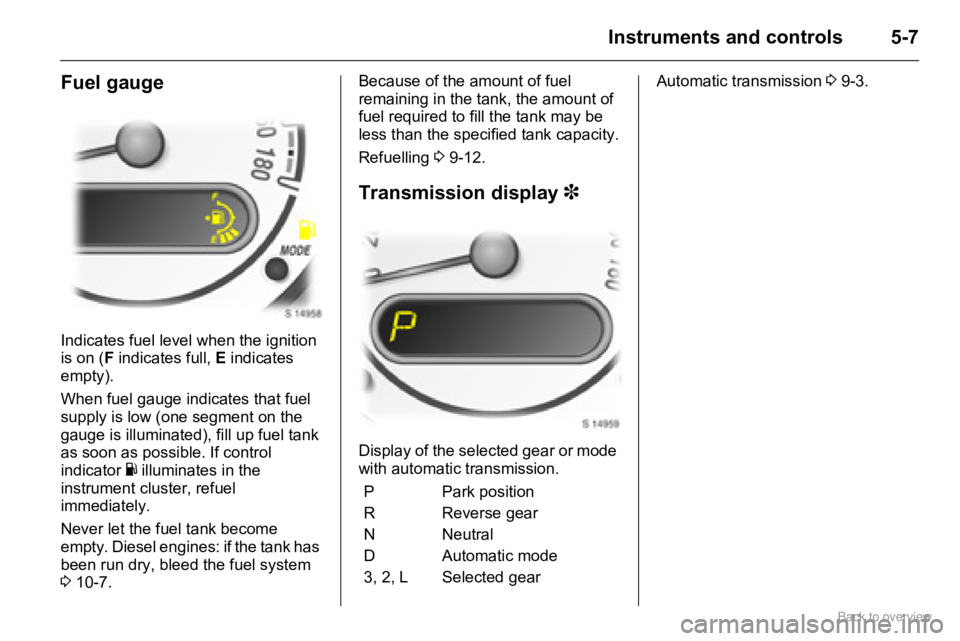
Fuel gauge
Indicates fuel level when the ignition
is on (F indicates full, E indicates
empty).
When fuel gauge indicates that fuel
supply is low (one segment on the
gauge is illuminated), fill up fuel tank
as soon as possible. If control
indicator
Y illuminates in the
instrument cluster, refuel
immediately.
Never let the fuel tank become
empty. Diesel engines: if the tank has
been run dry, bleed the fuel system
310-7.Because of the amount of fuel
remaining in the tank, the amount of
fuel required to fill the tank may be
less than the specified tank capacity.
Refuelling 39-12.
Transmission display 3
Display of the selected gear or mode
with automatic transmission.Automatic transmission 39-3.
P Park position
R Reverse gear
N Neutral
D Automatic mode
3, 2, L Selected gear
Page 61 of 153

5-11Instruments and controls
If it stays lit or illuminates during
driving, there is a fault with ESP®.
The vehicle’s brake system remains
operational without ESP
® regulation.
Seek the assistance of a workshop to
have the cause of the fault remedied.
Further information 3 9-10.
W Engine coolant
temperature
Will illuminate briefly in red when
ignition is switched on.
If it illuminates or flashes when the
engine is running: stop vehicle and
switch off engine. Coolant
temperature is too high; danger of
engine damage. Check coolant level.
Further information 3 10-4.
N Preheating for diesel
engines 3
Will illuminate during engine
preheating.
Preheating system switches on only if
outside temperature is low.
If it illuminates during driving or if the
engine cannot be started, seek the
assistance of a workshop as soon as
possible.
Starting the engine 3 9-2.
Z Exhaust emissions
Will illuminate in yellow when ignition
is switched on. Extinguishes after
engine is started.
If it illuminates when the engine is
running: fault in emission control
system. The permitted emission
limits may be exceeded. Fuel
economy and vehicle driveability may
be impaired. Seek the assistance of a
workshop immediately.Diesel engines: The engine stops and
control indicator Z illuminates if the
fuel level is too low. If the tank has
been run dry, bleed the fuel system 3
10-7.
Vehicles with electric throttle body
system 3: If the battery has been
disconnected, the system must be
recalibrated upon reconnection of the
battery. Hold ignition key in ON
position for 5 seconds without
running the engine. Control indicator
Z remains illuminated after the
engine is started if the procedure is
not successful.
I Engine oil pressure
Will illuminate in red when ignition is
switched on. Extinguishes after
engine is started.
If it illuminates during driving; engine
oil pressure may be dangerously low,
interrupting engine lubrication and
resulting in damage to the engine
and/or locking of the drive wheels:
„Move out of the flow of traffic as
quickly as possible without
impeding other vehicles,
9 Warning
Allow engine to cool down before
removing coolant filler cap.
Page 63 of 153

5-13Instruments and controls
If it illuminates when the engine is
running; there may be a fault in the
engine electronics: interrupt your
journey and seek the assistance of a
workshop.
If regeneration of the diesel particle
filter is not successful or possible (3
5-13 “8 Diesel particle filter 3“), the
control indicator may illuminate and
the vehicle goes into limp home
mode: interrupt your journey and
seek the assistance of a workshop
immediately.
Further information 3 9-7.
Y Low fuel
If it illuminates during driving; fuel
level is low: fill up fuel tank as soon
as possible.
Never let the tank run dry!
Erratic fuel supply can cause catalytic
converter to overheat 3 9-8.
Diesel engines: The engine stops and
control indicator Z illuminates if the
fuel level is too low (3 5-11 “Z
Exhaust emissions”). If the tank has
been run dry, bleed the fuel system 3
10-7.Refuelling 3 9-12, fuel tank capacity
3 12-5.
8 Diesel particle filter 3
Will illuminate briefly in yellow when
the ignition is switched on.
If it illuminates during driving, the
diesel particle filter requires cleaning.
As soon as the road and traffic
situation permits it, increase speed to
more than 75 km/h (50 mph) for
approx. 30 minutes. The control
indicator extinguishes as soon as
cleaning is complete.
If regeneration of the diesel particle
filter is not successful or possible (3
5-12 “A Service vehicle soon 3“),
control indicator A may illuminate
and the vehicle goes into limp home
mode: interrupt your journey and
seek the assistance of a workshop
immediately.
Further information 3 9-7.
O Turn signal lamps
The appropriate control indicator will
flash in green when the turn signal is
on. Rapid flash; failure of a turn signal
bulb or the corresponding fuse.
Both control indicators flash when the
hazard warning lamps are active.
Turn signal lamps 3 6-2, bulb
replacement 3 10-7, fuses 3 10-11.
Warning chimes
While driving:
„when operating the turn signals.
„if driver’s seat belt is not engaged
and vehicle speed exceeds approx.
15 km/h (9 mph).
When the vehicle is parked and
driver’s door is opened:
„with exterior lamps switched on
(and ignition key removed).
„when the key is in the ignition
switch.
Seat belt warning chime 33-7.
Driving hints 3 9-1.
Page 64 of 153
5-14 Instruments and controls
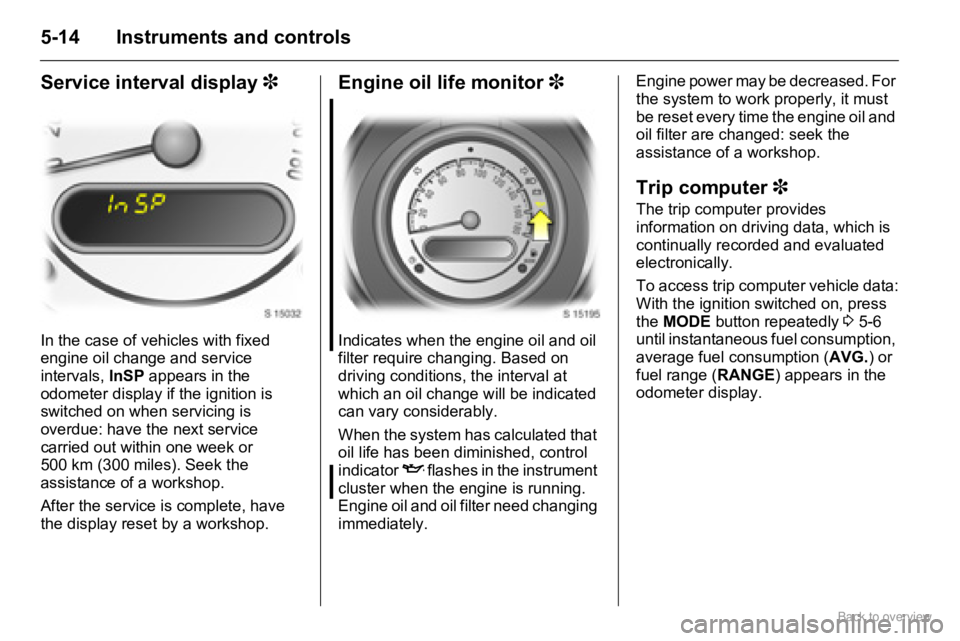
Service interval display 3
In the case of vehicles with fixed
engine oil change and service
intervals, InSP appears in the
odometer display if the ignition is
switched on when servicing is
overdue: have the next service
carried out within one week or
500 km (300 miles). Seek the
assistance of a workshop.
After the service is complete, have
the display reset by a workshop.
Engine oil life monitor 3
Indicates when the engine oil and oil
filter require changing. Based on
driving conditions, the interval at
which an oil change will be indicated
can vary considerably.
When the system has calculated that
oil life has been diminished, control
indicator
I flashes in the instrument
cluster when the engine is running.
Engine oil and oil filter need changing
immediately. Engine power may be decreased. For
the system to work properly, it must
be reset every time the engine oil and
oil filter are changed: seek the
assistance of a workshop.
Trip computer 3
The trip computer provides
information on driving data, which is
continually recorded and evaluated
electronically.
To access trip computer vehicle data:
With the ignition switched on, press
the MODE button repeatedly 3 5-6
until instantaneous fuel consumption,
average fuel consumption (AVG.) or
fuel range (RANGE) appears in the
odometer display.
Page 65 of 153
5-15Instruments and controls
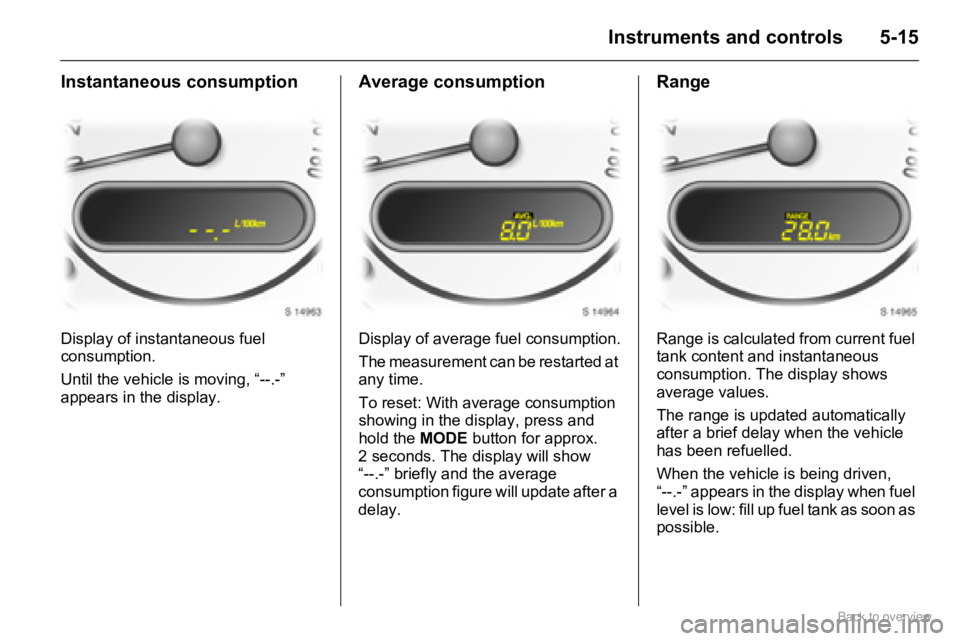
Instantaneous consumption
Display of instantaneous fuel
consumption.
Until the vehicle is moving, “--.-”
appears in the display.
Average consumption
Display of average fuel consumption.
The measurement can be restarted at
any time.
To reset: With average consumption
showing in the display, press and
hold the MODE button for approx.
2 seconds. The display will show
“--.-” briefly and the average
consumption figure will update after a
delay.
Range
Range is calculated from current fuel
tank content and instantaneous
consumption. The display shows
average values.
The range is updated automatically
after a brief delay when the vehicle
has been refuelled.
When the vehicle is being driven,
“--.-” appears in the display when fuel
level is low: fill up fuel tank as soon as
possible.
Page 66 of 153

5-16 Instruments and controls
If control indicator Y illuminates in the
instrument cluster, refuel
immediately, regardless of the value
shown in the range display.
Setting units of measure
You can select which units of
measure are to be used for fuel
consumption figures.
With the vehicle stationary and with
instantaneous consumption showing
in the display, press and hold the
MODE button for approx. 2 seconds
to toggle between L/100km and
km/L.
Interruption of power supply
If the power supply has been
interrupted or if the battery voltage
has dropped too low, the values
stored in the trip computer will be lost.
Page 84 of 153
8-3 Climate controls
For simultaneous warming of the
footwell, set air distribution rotary
knob to J.
Switch on air conditioning 3 to
improve defrosting efficiency when
position J or V is selected.
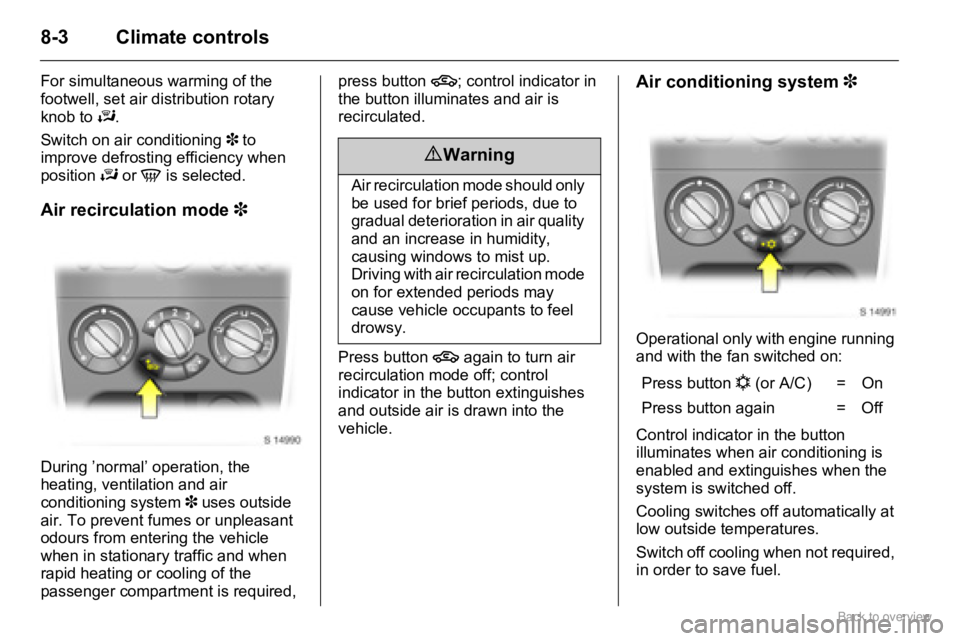
Air recirculation mode 3
During ’normal’ operation, the
heating, ventilation and air
conditioning system 3 uses outside
air. To prevent fumes or unpleasant
odours from entering the vehicle
when in stationary traffic and when
rapid heating or cooling of the
passenger compartment is required, press button 4; control indicator in
the button illuminates and air is
recirculated.
Press button 4 again to turn air
recirculation mode off; control
indicator in the button extinguishes
and outside air is drawn into the
vehicle.
Air conditioning system 3
Operational only with engine running
and with the fan switched on:
Control indicator in the button
illuminates when air conditioning is
enabled and extinguishes when the
system is switched off.
Cooling switches off automatically at
low outside temperatures.
Switch off cooling when not required,
in order to save fuel.
9 Warning
Air recirculation mode should only
be used for brief periods, due to
gradual deterioration in air quality
and an increase in humidity,
causing windows to mist up.
Driving with air recirculation mode
on for extended periods may
cause vehicle occupants to feel
drowsy.
Press button n (or A/C) = On
Press button again = Off
Page 88 of 153

9-1 Driving and operating
Driving and
operatingStarting the vehicle
Driving hints
During the first 1000 km (600 miles),
drive your vehicle at various speeds.
Do not use full throttle. Never allow
the engine to labour at low revs.
Make good use of all gears. Depress
the accelerator pedal a maximum of
around three quarters of the available
pedal travel in all gears and drive
ranges.
Do not brake unnecessarily hard for
the first 200 km (125 miles).
When the vehicle is driven for the first
time, wax and oil on the exhaust
system may evaporate, producing
smoke-like emissions which should
not be inhaled. Allow wax and oil to
evaporate while the vehicle is in the
open air.
Never coast with engine not running
as many units may then not function
(e.g. brake servo unit, power
steering, airbag system). Driving in
this manner is a danger to yourself
and others.Pedals
To ensure the pedal travel is
uninhibited, there must be no mats in
the area of the pedals.
Ignition positionsStarting the vehicle ............... 9-1
Transmission ........................ 9-3
Engine exhaust..................... 9-7
Brakes .................................. 9-9
Ride control systems ............ 9-10
Fuel ...................................... 9-12
LOCK = Ignition off
ACC = Steering unlocked,
ignition off
ON = Ignition on, with
diesel engine:
preheating
START = Start (transmission in
neutral)