battery OPEL ANTARA 2009 User Guide
[x] Cancel search | Manufacturer: OPEL, Model Year: 2009, Model line: ANTARA, Model: OPEL ANTARA 2009Pages: 234, PDF Size: 3.01 MB
Page 128 of 234

Driving and operation128
Switching off the engine
If the engine temperature is very high, e.g.
after driving in mountainous terrain: allow
engine to idle for approx. 2 minutes, in
order to prevent heat accumulation.
When you switch off, fans in the engine
compartment may continue running for a
time, to cool the engine.
Vehicles with turbocharger 3
In order to protect the turbocharger, after
running at high engine speeds or high
engine loads, operate the engine briefly at
a low load or run in neutral for approx.
30 seconds before switching off.
Save energy – more kilometres/miles
Please observe the running-in hints on the
previous page and the tips for energy
saving on the following pages.
Good, technically correct and economical
driving ensures maximum durability and
performance for your vehicle.
Overrun
The fuel supply is automatically shut off
during overrun, e.g. when the vehicle is
being driven down long gradients or during
braking. To enable the overrun cut-off to
come into action, do not accelerate or
declutch during overrun. Engine rpm
Under all driving conditions, drive in a
favourable engine speed range.
Warming up
Allow engine to warm up while driving. Do
not warm it up by le
tting it run at idling
speed. Do not apply full throttle until
engine reaches operating temperature.
After a cold start, automatic
transmission 3 does not shift into higher
gears until higher engine speeds have been
reached. This allows the catalytic converter
to quickly reach the temperature required
for optimum pollutant reduction.
Correct gear selection
Do not race your engine whilst in neutral or
with a low gear selected. Driving too fast in
individual gears or drive ranges as well as
stop-and-go traffic in crease engine wear
and fuel consumption.
Change down
When decreasing speed, shift down into
the next lowest gear. Do not slip the clutch
with a high-revving engine. This is
especially important when hill climbing. Clutch operation
3
Always depress the clutch pedal hard to
the floor, to prevent shifting difficulties and
transmission damage. There must be no
mats in the area of the pedals.
When driving, do not use the clutch pedal
as a foot rest; this will cause substantial
clutch wear.
Pedals
Do not place any objects in the footwell
which could slip under the pedals and
inhibit the pedal travel.
To ensure the pedal travel is uninhibited,
there must be no mats in the area of the
pedals.
When driving, do not use the brake pedal
as a foot rest; this will cause substantial
wear to brake components and cause
overheating, resultin g in longer braking
distances.
Battery care whilst driving
When driving slowly or when the vehicle
is stationary, e.g. in slow urban traffic,
stop-and-go traffic or traffic jams, turn off
all unnecessary electrical loads where
possible (e.g. heated rear window,
auxiliary headlamps).
When starting the engine, depress the
clutch pedal so that transmission
resistance is elimin ated and the starter
motor and battery are relieved.
Page 171 of 234

Self-help, vehicle care171
Self-help, vehicle care
Diesel fuel system, bleeding
Never let the fuel tank run dry. If control
indicator Y illuminates, refuel as soon as
possible.
It is possible to restart the engine if the tank
has been run dry. A delayed start can be
expected. Switch on the ignition three times
for approx. 15 seconds. Then try to start
the engine for no more than 40 seconds. If
the engine will not start, wait at least
10 seconds before trying again. If the
engine will still not start, consult a
workshop.
Bonnet
To open the bonnet, pull release lever /
located on the left-hand side below the
instrument panel.
The bonnet will then be unlocked and will
partially open. Return release lever to its
original position.
Do not pull release lever while the vehicle is
moving.
Diesel fuel system, bleeding .............. 171
Bonnet ................................................. 171
Starting ................................................ 172
Starting the engine with jump leads
3 172
Towing ................................................. 174
Jack and vehicle tools ........................ 176
Warning triangle ¨ 3 ,
First aid kit +3................................ 177
Temporary spare wheel ..................... 177
Wheel changing .................................. 178
Electrical system ................................. 181
Fuses and the most important circuits they protect ...................................... 182
Bulb replacement ............................... 185
Opel genuine parts and accessories . 191
A note on safety ................................. 191
Checking and topping up fluids ........ 191
Windscreen wipers .............................. 198
Windscreen washer system ................ 199
Battery ................................................. 200
Protection of electr onic components 201
Vehicle storage ................................... 201
Vehicle care......................................... 201
9 Warning
Disregard of the instructions may lead to
injuries or endanger life. Vehicle
passengers must be informed
accordingly.
Page 172 of 234

Self-help, vehicle care172
To open completely, locate the safety
catch, found slightly left of centre on the
underside of the bonnet, push the catch
upwards and lift the bonnet gently. The
bonnet is held open automatically.
When the bonnet is opened, leaves, dirt or
snow on the bonnet can slide down and
obstruct the air intake. Remove any leaves,
dirt or snow. Air intake - see page 114.
Never drive with bonnet open.
To close bonnet, lower it gradually,
allowing it to drop from a height of approx.
30 cm.
Check that the bonnet is locked in position
before driving, by pulling at its front edge.
If it is not engaged, repeat closing
procedure.
Starting
Do not start with quick charger
This prevents damage to electronic
components.
Do not start by pushing or towing
Because your vehicle is fitted with a
catalytic converter, it must not be started
by pushing or towing - see page 133.
The vehicle can only be started using jump
leads - see following pages.
Starting the engine with jump
leads 3
A vehicle with a discha rged battery can be
started using jump leads and the battery of
another vehicle.
Start attempts should be made at intervals
of 1 minute and should not last longer than
15 seconds.
9 Warning
If the vehicle battery requires charging
whilst still in the vehicle, ensure there is
adequate ventilation in and around the
battery compartment, to prevent risk of
explosion.
9 Warning
This must be done with extreme care. Any
deviation from the following instructions
could lead to personal injury or damage
resulting from battery explosion, as well
as to damage to the electrical systems in
both vehicles.
Page 173 of 234
Self-help, vehicle care173
zNever expose the battery to naked
flames or sparks.
z A discharged battery can freeze at
temperatures of 0
°C. Defrost the battery
in a warm room before connecting the
jump leads.
z Do not allow battery fluid to contact
eyes, skin, fabrics or painted surfaces.
The fluid contains sulphuric acid which
can cause injuries and damage in the
event of direct contact.
z Wear eye protection and protective
clothing when handling a battery. z
Use auxiliary battery with same voltage
(12 volts). Its capacity (Ah) must not be
considerably less than that of the
discharged battery. Voltage and
capacity information can be found on
the batteries.
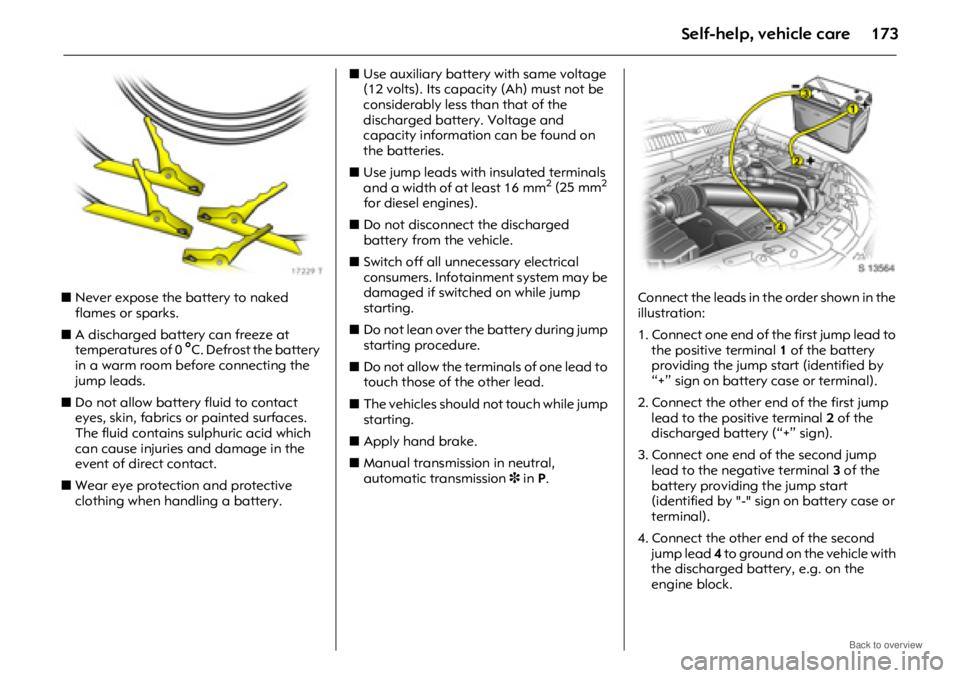
z Use jump leads with insulated terminals
and a width of at least 16 mm
2 (25 mm2
for diesel engines).
z Do not disconnect the discharged
battery from the vehicle.
z Switch off all unnecessary electrical
consumers. Infotainment system may be
damaged if switched on while jump
starting.
z Do not lean over the battery during jump
starting procedure.
z Do not allow the terminals of one lead to
touch those of the other lead.
z The vehicles should not touch while jump
starting.
z Apply hand brake.
z Manual transmissi on in neutral,
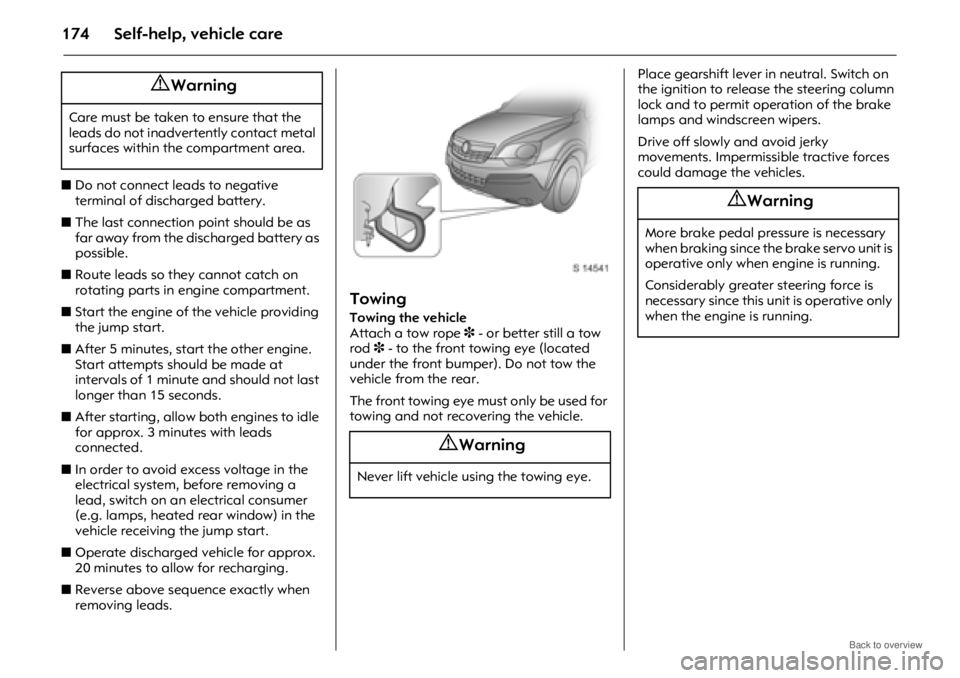
automatic transmission 3 in P. Connect the leads in th
e order shown in the
illustration:
1. Connect one end of the first jump lead to the positive terminal 1 of the battery
providing the jump start (identified by
“+” sign on battery case or terminal).
2. Connect the other end of the first jump lead to the positive terminal 2 of the
discharged battery (“+” sign).
3. Connect one end of the second jump lead to the negative terminal 3 of the
battery providing the jump start
(identified by "-" sign on battery case or
terminal).
4. Connect the other end of the second jump lead 4 to ground on the vehicle with
the discharged battery, e.g. on the
engine block.
Page 174 of 234
Self-help, vehicle care174
zDo not connect leads to negative
terminal of discharged battery.
z The last connection point should be as
far away from the discharged battery as
possible.
z Route leads so they cannot catch on
rotating parts in engine compartment.
z Start the engine of the vehicle providing
the jump start.
z After 5 minutes, start the other engine.
Start attempts shou ld be made at
intervals of 1 minute and should not last
longer than 15 seconds.
z After starting, allow both engines to idle
for approx. 3 minutes with leads
connected.
z In order to avoid excess voltage in the
electrical system, before removing a
lead, switch on an electrical consumer
(e.g. lamps, heated rear window) in the
vehicle receiving the jump start.
z Operate discharged vehicle for approx.
20 minutes to allow for recharging.
z Reverse above sequence exactly when
removing leads.
Towing
Towing the vehicle
Attach a tow rope 3 - or better still a tow
rod 3 - to the front towing eye (located
under the front bumper). Do not tow the
vehicle from the rear.
The front towing eye must only be used for
towing and not recovering the vehicle. Place gearshift lever in neutral. Switch on
the ignition to release the steering column
lock and to permit operation of the brake
lamps and windscreen wipers.
Drive off slowly and avoid jerky
movements. Impermissible tractive forces
could damage
the vehicles.
9 Warning
Care must be taken to ensure that the
leads do not inadvertently contact metal
surfaces within the compartment area.
9 Warning
Never lift vehicle using the towing eye.
9 Warning
More brake pedal pressure is necessary
when braking since the brake servo unit is
operative only when engine is running.
Considerably greater steering force is
necessary since this unit is operative only
when the engine is running.
Page 185 of 234
Self-help, vehicle care185
Bulb replacement
Before replacing a bulb , switch off ignition
and relevant switch.
Only hold new bulbs at base! Do not touch
the bulb glass with bare hands, otherwise
fingerprints on the glass evaporate and
residue builds up on the reflector
eventually resulting in a dull reflector.
Inadvertently stained bulbs may be
cleaned with a clean lint-free cloth, using
alcohol or white spirit.
Replacement bulb must be in accordance
with data on base of defective bulb. Do not
exceed wattage given on bulb base.
Headlamp aiming
We recommend that headlamp aiming be
carried out by a work shop, which will have
special equipment.
When aiming your headlamps, the manual
headlamp range adjustment 3 must be set
to 7. Headlamp removal
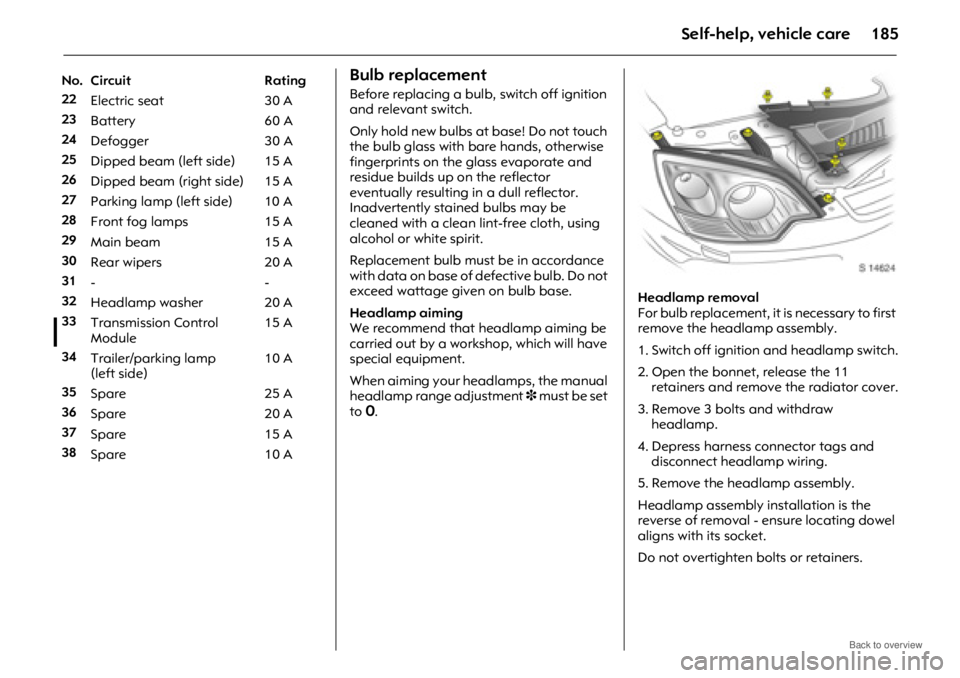
For bulb replacement, it is necessary to first
remove the headlamp assembly.
1. Switch off ignition and headlamp switch.
2. Open the bonnet, release the 11
retainers and remove the radiator cover.
3. Remove 3 bolts and withdraw headlamp.
4. Depress harness connector tags and disconnect head lamp wiring.
5. Remove the headlamp assembly.
Headlamp assembly installation is the
reverse of removal - ensure locating dowel
aligns with its socket.
Do not overtighten bolts or retainers.
No. Circuit Rating
22
Electric seat 30 A
23 Battery 60 A
24 Defogger 30 A
25 Dipped beam (left side) 15 A
26 Dipped beam (right side) 15 A
27 Parking lamp (left side) 10 A
28 Front fog lamps 15 A
29 Main beam 15 A
30 Rear wipers 20 A
31 --
32 Headlamp washer 20 A
33 Transmission Control
Module 15 A
34 Trailer/parking lamp
(left side) 10 A
35 Spare 25 A
36 Spare 20 A
37 Spare 15 A
38 Spare 10 A
Page 200 of 234
Self-help, vehicle care200
Battery
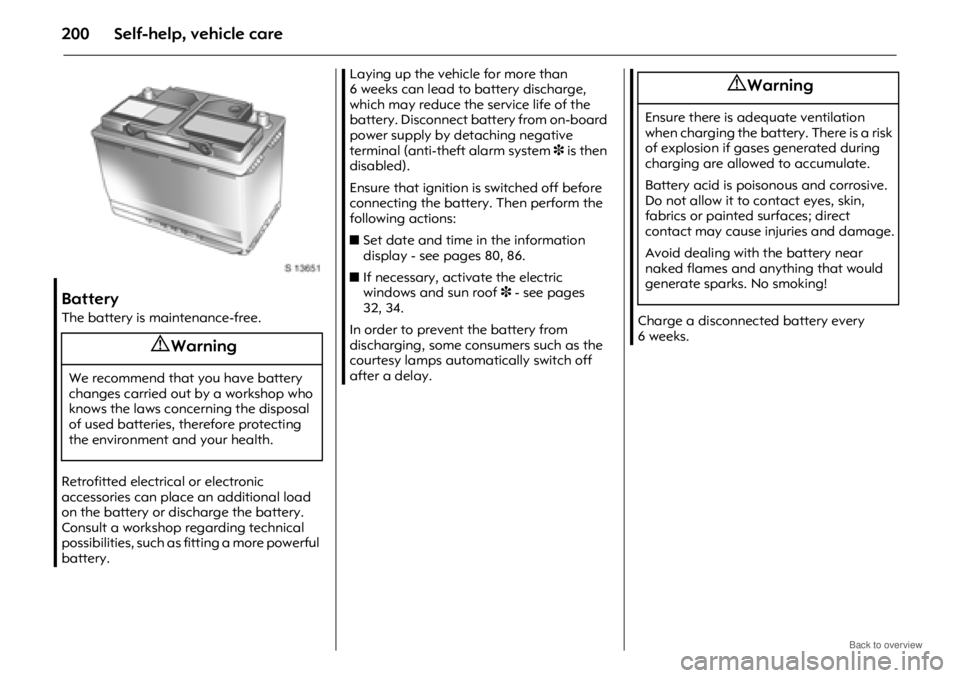
The battery is maintenance-free.
Retrofitted electrical or electronic
accessories can place an additional load
on the battery or discharge the battery.
Consult a workshop regarding technical
possibilities, such as fitting a more powerful
battery.Laying up the vehicle for more than
6 weeks can lead to battery discharge,
which may reduce the service life of the
battery. Disconnect battery from on-board
power supply by detaching negative
terminal (anti-theft alarm system
3 is then
disabled).
Ensure that ignition is switched off before
connecting the battery. Then perform the
following actions:
z Set date and time in the information
display - see pages 80, 86.
z If necessary, activate the electric
windows and sun roof 3 - see pages
32, 34.
In order to prevent the battery from
discharging, some consumers such as the
courtesy lamps automatically switch off
after a delay. Charge a disconnected battery every
6 weeks.
9 Warning
We recommend that you have battery
changes carried out by a workshop who
knows the laws concerning the disposal
of used batteries, therefore protecting
the environment and your health.
9 Warning
Ensure there is adequate ventilation
when charging the batt
ery. There is a risk
of explosion if gases generated during
charging are allowed to accumulate.
Battery acid is poisonous and corrosive.
Do not allow it to contact eyes, skin,
fabrics or painted surfaces; direct
contact may cause injuries and damage.
Avoid dealing with the battery near
naked flames and anything that would
generate sparks. No smoking!
Page 201 of 234
Self-help, vehicle care201
Protection of electronic
components
In order to avoid the breakdown of
electronic components within the electrical
system, never disconnect the battery with
the engine running. Never start the engine
while the battery is disconnected (e.g.
when using jump leads).
To avoid damaging the vehicle, do not
make any modifications to the electrical
system, e.g. connecting additional
consumers or tampering with electronic
control units (chip tuning). Disconnecting/connecting the battery
from/to the electrical system
Disconnect the battery from the vehicle
electrical system before charging:
first detach the negative and then the
positive lead.
Do not reverse the polarity of the battery,
i.e. do not confuse the terminals for the
positive and negative leads. When
connecting, start with the positive lead and
then connect the negative lead.
Vehicle storage
If your vehicle is to be stored for long
periods without use, we recommend you
consult a workshop for advice.
Vehicle care
In caring for your vehicle, observe all
national environmental regulations,
particularly when washing your vehicle.
Regular, thorough care contributes to
improving the appearance of your vehicle
and maintaining its va
lue. It is also a
prerequisite for clai ms made under the
warranty, in the event of paint or corrosion
damage. In the following pages, we give
you tips for vehicle care which, with correct
use, will help to ward off unavoidable and
harmful environmental influences.
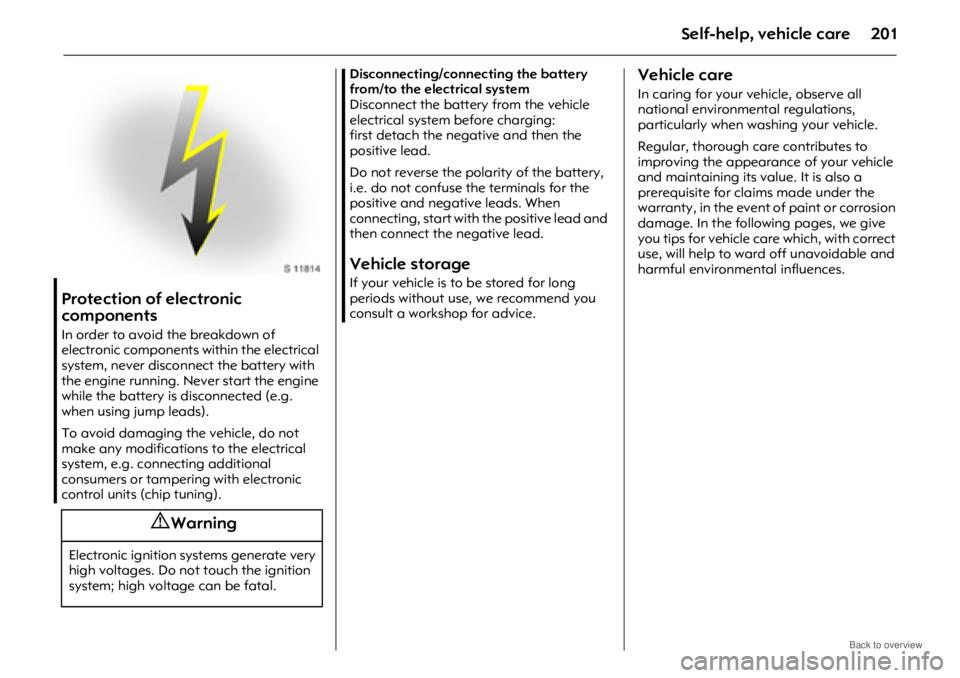
9 Warning
Electronic ignition systems generate very
high voltages. Do not touch the ignition
system; high voltage can be fatal.
Page 207 of 234

Service, maintenance 207
European service schedule
(Antara Z 20 DM, Z 20 DMH, Z 24 XE, Z 32 SE) Service operations by year 1)
km ( x 1000)1)
miles ( x 1000)1)
1)Whichever occurs first.
15
101
30
20 45
30 2
60
40 75
50 3
90
60
Controls, lighting, signalling equi pment and airbags: visual check
steering lock and ignition lock: check xxx
Remote control batteries: replace Every 2 years
Windscreen wipers, windscreen washer system: check, correct xxx
Coolant level and antifreeze: check, correct
Hoses: check for tightness and secure seating xxx
Brake fluid level: check, correct xxx
Battery terminals: check for secu re connections and battery eye xxx
Vehicle system check with TECH2 xxx
Pollen filter: replace xxx
oMore often for when dust, sand or polle n is in the air Agreement with customer
Air cleaner element: replace
xxx
⊕Spark plugs and plug leads: replace Every 90 000 km/60 000 miles
Ribbed V-belt: visual check xxx
⊕Toothed belt and tension roller: visual check xxx
Toothed belt and tension roller: replace - Z 24 XE Every 8 years/120 000 km/80 000 miles
Toothed belt and tension roller: replace - Z 20 DM, Z 20 DMH Every 6 years/90 000 km/60 000 miles
Power steering system: check for leak s. Fluid level: check, correct xxx
Engine oil and oil filter: replace - fixed interval Z 24 XE
2)
2)On vehicles with oil life monitoring, it may be necessary to change the engine oil earlier (control indicator illuminates).
xxxxxx
Z 20 DM, Z 20 DMH, Z 32 SE, except2)xxx
Page 209 of 234

Service, maintenance 209
International service schedule
(All except Z 24 XE) Service operations by year 1)
km ( x 1000)1)
miles ( x 1000)1)
1)Whichever occurs first.
15
101
30
20 45
30 2
60
40 75
50 3
90
60
Controls, lighting, signalling equi pment and airbags: visual check
steering lock and ignition lock: check xxxxxx
Remote control batteries: replace Every 2 years
Windscreen wipers, windscreen wa sher system: check, correct x x x x x x
Coolant level and antifreeze: check, correct
Hoses: check for tightness and secure seating Annually
Brake fluid level: check, correct xx
Battery terminals: check for secure connections and battery eye Annually
Vehicle system check with TECH2 Annually
Pollen filter: replace xxx
oMore often for when dust, sand or pollen is in the air Annually/15 000 km/10 000 miles
Air cleaner element: replace
xxx
oMore often for when dust or sand is in the air Annually/15 000 km/10 000 miles
⊕Spark plugs and plug leads: replace Every 90 000 km/60 000 miles
Ribbed V-belt: visual check xxx
⊕Toothed belt and tension roller: visual check Annually/15 000 km/10 000 miles
Toothed belt and tension roller: replace - Z 20 DM, Z 20 DMH Every 6 years/90 000 km/60 000 miles
Power steering system: check for leaks. Fluid level: check, correct Annually
Engine oil and oil filter: replace x x x x x x