brake fluid OPEL ANTARA 2009 User Guide
[x] Cancel search | Manufacturer: OPEL, Model Year: 2009, Model line: ANTARA, Model: OPEL ANTARA 2009Pages: 234, PDF Size: 3.01 MB
Page 197 of 234
Self-help, vehicle care197
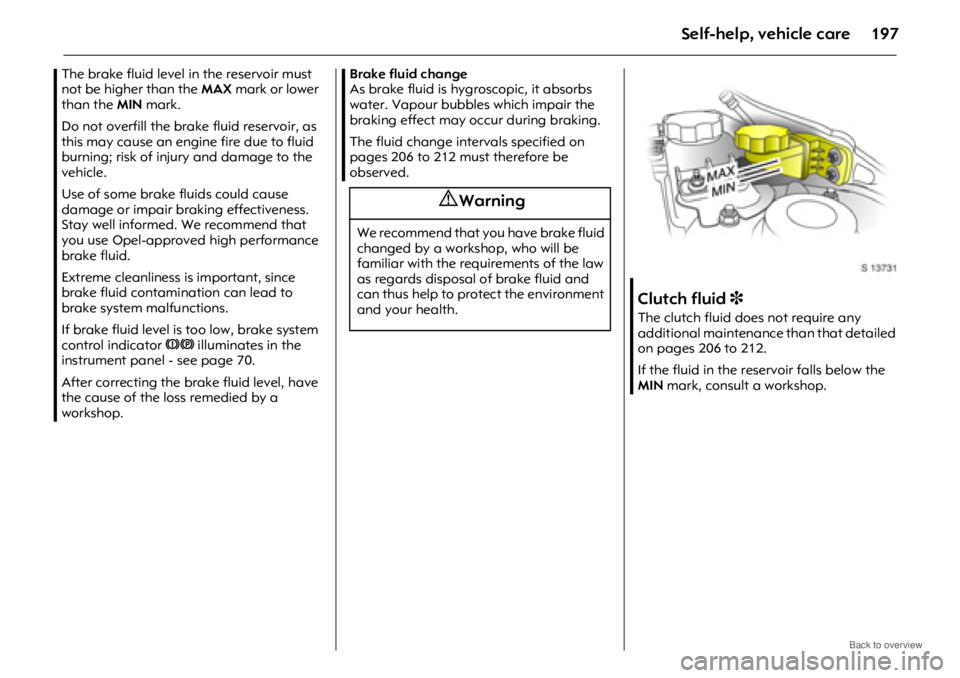
The brake fluid level in the reservoir must
not be higher than the MAX mark or lower
than the MIN mark.
Do not overfill the brak e fluid reservoir, as
this may cause an engine fire due to fluid
burning; risk of injury and damage to the
vehicle.
Use of some brake fluids could cause
damage or impair br aking effectiveness.
Stay well informed. We recommend that
you use Opel-approve d high performance
brake fluid.
Extreme cleanliness is important, since
brake fluid contamination can lead to
brake system malfunctions.
If brake fluid level is too low, brake system
control indicator 4 illuminates in the
instrument panel - see page 70.
After correcting the brake fluid level, have
the cause of the loss remedied by a
workshop. Brake fluid change
As brake fluid is hygroscopic, it absorbs
water. Vapour bubbles which impair the
braking effect may occur during braking.
The fluid change intervals specified on
pages 206 to 212 must therefore be
observed.
Clutch fluid
3
The clutch fluid does not require any
additional maintenanc e than that detailed
on pages 206 to 212.
If the fluid in the reservoir falls below the
MIN mark, consult a workshop.
9 Warning
We recommend that you have brake fluid
changed by a workshop, who will be
familiar with the requ irements of the law
as regards disposal of brake fluid and
can thus help to protect the environment
and your health.
Page 205 of 234

Self-help, vehicle care205
Windscreen wiper blades
Wax, such as that used in car washes, can
cause streaks to form on the windscreen
when the wipers are used.
Smearing wiper blades can be cleaned with
a soft cloth and Opel Cleaning Solvent and
Antifreeze, and replaced if necessary –
see page 198. Do not use abrasive
cleaners.
Locks
The locks are lubricated with a high-grade
lock cylinder grease at the factory. Opel
Lock Cylinder Grease prevents the locks
from freezing up.
Only use de-icing agents in emergencies,
as they have a degreasing effect and will
impair the function of the locks. After using
a de-icing agent, have the locks re-greased
by a workshop. Engine compartment
Areas of the engine compartment that are
painted in the same colour as the vehicle
must be looked after
like any other painted
surface.
It is advisable to wash the engine
compartment before and after winter and
preserve it with wax. Cover alternator and
fluid reservoirs with plastic sheets before
washing the engine.
When washing the engine with a steam-jet
cleaner, do not direct the steam-jet at
components of the Anti-lock Brake System
(ABS), the air conditioning system or the
belt drive and its components.
Protective wax that has been applied is
also removed during the engine wash. For
this reason, have the engine, brake system
components in the engine compartment,
axle components with steering, body parts
and cavities thoroughly preserved with
protective wax after the wash.
An engine wash can be performed in the
spring in order to remove dirt that has
adhered to the engine compartment,
which may also have a high salt content.
Check protective wax layer and make good
if necessary. Underbody
Your vehicle has a factory-applied PVC
undercoating in the wheel arches
(including the longitudinal members) which
provides permanent protection and needs
no special maintenance. The surfaces of
the vehicle underbody not covered by PVC
are provided with a durable protective wax
coating in critical areas.
On vehicles which are washed frequently
in automatic car wash
es with underbody
washing facility, the protective wax
coating may be impaire d by dirt-dissolving
additives. Check the underbody after
washing and have it waxed if necessary.
Before the start of the cold weather season,
check the PVC coating and protective wax
coating and, if necessary, have them
restored to perfect condition.
Caution
– commercially available bitumen/
rubber materials can damage the PVC
coating. We recommend that you have
underbody work carried out by a
workshop, who knows the prescribed
materials and has experience in the use
thereof.
The underbody should be washed
following the end of the cold weather
season to remove any dirt adhering to the
underbody since this may also contain salt.
Check protective wax coating and, if
necessary, have it restored to perfect
condition.
Page 207 of 234

Service, maintenance 207
European service schedule
(Antara Z 20 DM, Z 20 DMH, Z 24 XE, Z 32 SE) Service operations by year 1)
km ( x 1000)1)
miles ( x 1000)1)
1)Whichever occurs first.
15
101
30
20 45
30 2
60
40 75
50 3
90
60
Controls, lighting, signalling equi pment and airbags: visual check
steering lock and ignition lock: check xxx
Remote control batteries: replace Every 2 years
Windscreen wipers, windscreen washer system: check, correct xxx
Coolant level and antifreeze: check, correct
Hoses: check for tightness and secure seating xxx
Brake fluid level: check, correct xxx
Battery terminals: check for secu re connections and battery eye xxx
Vehicle system check with TECH2 xxx
Pollen filter: replace xxx
oMore often for when dust, sand or polle n is in the air Agreement with customer
Air cleaner element: replace
xxx
⊕Spark plugs and plug leads: replace Every 90 000 km/60 000 miles
Ribbed V-belt: visual check xxx
⊕Toothed belt and tension roller: visual check xxx
Toothed belt and tension roller: replace - Z 24 XE Every 8 years/120 000 km/80 000 miles
Toothed belt and tension roller: replace - Z 20 DM, Z 20 DMH Every 6 years/90 000 km/60 000 miles
Power steering system: check for leak s. Fluid level: check, correct xxx
Engine oil and oil filter: replace - fixed interval Z 24 XE
2)
2)On vehicles with oil life monitoring, it may be necessary to change the engine oil earlier (control indicator illuminates).
xxxxxx
Z 20 DM, Z 20 DMH, Z 32 SE, except2)xxx
Page 208 of 234

208 Service, maintenance
Service operations by year 1)
km ( x 1000)1)
miles ( x 1000)1)
1)Whichever occurs first.
⊕ Additional operations.
o Under extreme operating conditions and if required by country-specific conditions, the intervals are reduced.
15
10 1
30
20 45
30 2
60
40 75
50 3
90
60
⊕o Diesel fuel filter: drain water
(If relative humidity is high an
d/or fuel is of lower quality) Annually
Fuel filter: replace and drain water - diesel (g rade EN 590) Every 2 years/60 000 km/40 000 miles
Parking brake: check and adjust
Wheel mounting and suspension front an d rear, brake lines, brake pressure
hoses, fuel lines and exhaust system: visual check xxx
Corrosion protection: check and record in Service and Warranty Booklet Annually
Front and rear wheel br akes: check visually xxx
o
⊕Annual service check if annual mileage exceeds 20 000 km Annually
Engine, transmission, PTO, rear differential, A/C compressor: check for leaks xxx
Steering system boots, track rods , final drive: visual check xxx
Track rod end and supporting ball joint: check xxx
⊕Brake and clutch fluid: change Every 2 years
Wheel fastening: loosen and tighten to torque
Tyre condition and pressures: check, correct xxx
⊕Annual service check if annual
mileage exceeds 20 000 km Annually
First aid kit, tyre repair kit and lash ing eyes: visual check Every 2 years
Headlamp aiming: check, adjust x x x
Door hinges, door stop, lock cylinder, lock striker, bonnet catch, tailgate
hinges and check links: lubricate xxx
Test drive, final check
Service interval display and oil life monitor: reset - if applicable xxx
Page 209 of 234

Service, maintenance 209
International service schedule
(All except Z 24 XE) Service operations by year 1)
km ( x 1000)1)
miles ( x 1000)1)
1)Whichever occurs first.
15
101
30
20 45
30 2
60
40 75
50 3
90
60
Controls, lighting, signalling equi pment and airbags: visual check
steering lock and ignition lock: check xxxxxx
Remote control batteries: replace Every 2 years
Windscreen wipers, windscreen wa sher system: check, correct x x x x x x
Coolant level and antifreeze: check, correct
Hoses: check for tightness and secure seating Annually
Brake fluid level: check, correct xx
Battery terminals: check for secure connections and battery eye Annually
Vehicle system check with TECH2 Annually
Pollen filter: replace xxx
oMore often for when dust, sand or pollen is in the air Annually/15 000 km/10 000 miles
Air cleaner element: replace
xxx
oMore often for when dust or sand is in the air Annually/15 000 km/10 000 miles
⊕Spark plugs and plug leads: replace Every 90 000 km/60 000 miles
Ribbed V-belt: visual check xxx
⊕Toothed belt and tension roller: visual check Annually/15 000 km/10 000 miles
Toothed belt and tension roller: replace - Z 20 DM, Z 20 DMH Every 6 years/90 000 km/60 000 miles
Power steering system: check for leaks. Fluid level: check, correct Annually
Engine oil and oil filter: replace x x x x x x
Page 210 of 234

210 Service, maintenance
Service operations by year 1)
km ( x 1000)1)
miles ( x 1000)1)
1)Whichever occurs first.
⊕ Additional operations.
o Under extreme operating conditions and if required by country-specific conditions, the intervals are reduced.
15
10 1
30
20 45
30 2
60
40 75
50 3
90
60
⊕o Diesel fuel filter: drain water
(If relative humidity is high an
d/or fuel is of lower quality) Annually
Fuel filter: replace and drain water - diesel (g rade EN 590) Every 2 years/60 000 km/40 000 miles
Parking brake: check and adjust
Wheel mounting and suspension front an d rear, brake lines, brake pressure
hoses, fuel lines and exhaust system: visual check Every 2 years/60 000 km/40 000 miles
Corrosion protection: check and record in Service and Warranty Booklet Annually
Front and rear wheel brakes: check visually Every 2 years/60 000 km/40 000 miles
o
⊕Annual service check if annual mileage exceeds 20 000 km Annually
o
⊕Automatic transmission oil: change Every 4 years/60 000 km/40 000 miles
Engine, transmission, A/C compressor: check for leaks Annually
Steering system boots, track rods, final drive: visual check Annually
Track rod end and supporting ball joint: check Annually
⊕Brake and clutch fluid: change Every 2 years
Wheel fastening: loosen and tighten to torque
Tyre condition and pressures: check, correct Every 2 years/60 000 km/40 000 miles
⊕Annual service check if annual
mileage exceeds 20 000 km Annually
First aid kit, tyre repair kit and lash ing eyes: visual check Every 2 years
Headlamp aiming: check, adjust Every 2 years/60 000 km/40 000 miles
Door hinges, door stop, lock cylinder, lock striker, bonnet catch, tailgate
hinges and check links: lubricate Every 2 years/60 000 km/40 000 miles
Test drive, final check
Service interval display and oil life monitor: reset - if applicable xxxxxx
Page 211 of 234

Service, maintenance 211
International service schedule
(Antara Z 24 XE) Service operations by month 1)
km ( x 1000)1)
miles ( x 1000)1)
1)Whichever occurs first.
6
10
6.5 12
20
1318
30
2024
40
26.5 30
50
3336
60
40
Controls, lighting, signalling equi pment and airbags: visual check
steering lock and ignition lock: check xxx
Remote control batteries: replace Every 2 years
Windscreen wipers, windscreen washer system: check, correct xxx
Coolant level and antifreeze: check, correct
Hoses: check for tightness and secure seating xxx
Brake fluid level: check, correct xxx
Battery terminals: check for secu re connections and battery eye xxx
Vehicle system check with TECH2 xxx
Pollen filter: replace Annually/30 000 km/20 000 miles
oMore often for when dust, sand or pollen is in the air Agreement with customer
Air cleaner element: replace
Annually/30 000 km/20 000 miles
⊕Spark plugs and plug leads: replace Every 90 000 km/60 000 miles
Ribbed V-belt: visual check xxx
⊕Toothed belt and tension roller: visual check Annually/30 000 km/20 000 miles
Toothed belt and tension roller: replace Every 8 years/120 000 km/80 000 miles
Power steering system: check for leak s. Fluid level: check, correct xxx
Engine oil and oil filter: replace - fixed interval
2)
2)On vehicles with oil life monitoring, it may be necessary to change the engine oil earlier (control indicator illuminates).
xxxxxx
Page 212 of 234

212 Service, maintenance
Service operations by month 1)
km ( x 1000)1)
miles ( x 1000)1)
1)Whichever occurs first.
⊕ Additional operations.
o Under extreme operating conditions and if required by country-specific conditions, the intervals are reduced.
6
10
6.5 12
20
1318
30
2024
40
26.5 30
50
3336
60
40
Parking brake: check and adjust
Wheel mounting and suspension front an d rear, brake lines, brake pressure
hoses, fuel lines and exhaust system: visual check xxx
Corrosion protection: check and record in Service and Warranty Booklet Annually
Front and rear wheel br akes: check visually x x x
Engine, transmission, PTO, rear differential, A/C compressor: check for leaks xxx
Steering system boots, track rods , final drive: visual check xxx
Track rod end and supporting ball joint: check xxx
⊕Brake and clutch fluid: change Every 2 years
Wheel fastening: loosen and tighten to torque
Tyre condition and pressures: check, correct xxx
First aid kit, tyre repair kit and lash ing eyes: visual check Every 2 years
Headlamp aiming: check, adjust xxx
Door hinges, door stop, lock cylinder, lock striker, bonnet catch, tailgate
hinges and check links: lubricate xxx
Test drive, final check
Service interval display and oil life monitor: reset - if applicable xxx
Page 214 of 234

Service, maintenance214
Not every engine oil available on the
market meets the quality requirements,
always check the required specification
and rating is marked on the container.
If engine oil of the required quality is not
available, a maximum of 1 litre of ACEA
A3/B4 or A3/B3 grade may be used (only
once between each oil change). The
viscosity should be of the correct rating.
Use of ACEA A1/B1 and A5/B5 engine oil is
expressly forbidden, since they can cause
long-term engine damage under certain
operating conditions.
Engine oil additives
The use of engine oil additives could cause
damage and invalidate the warranty.
Engine oil viscosity
SAE 0W-30, 0W-40, 5W-30 or 5W-40 The SAE viscosity rating defines the ability
of an oil to flow. When cold, oil is more
viscous than when hot.
Multigrade oil is indicated by two figures.
The first figure, followed by a W, indicates
low temperature viscosity and the second
figure the high temperature viscosity.
Coolant and antifreeze
Use antifreeze of recommended
specification: silicate-free LLC (Long Life
Coolant).
The system is factory-filled with coolant
designed for frost protection down to
approx. -28 °C. This concentration should
be maintained all year-round.
Coolant additives intended to give
additional corrosion protection or seal
against minor leaks can cause function
problems. Liability for consequences
resulting from the use
of coolant additives
will be rejected.
Brake and clutch fluid
Only use DOT4 brake fluid.
Over time, brake fluid absorbs moisture
which will reduce braking effectiveness.
The brake fluid should therefore be
replaced at the specified interval.
Brake fluid should be stored in a sealed
container to avoid water absorption.
Ensure it does not become contaminated
with fluids containing mineral oil (oil,
petrol, cleaner) as this can damage the
seals and sleeves of the brake system.
9 Warning
Brake fluid is poisonous!
9 Warning
Due to its corrosive nature, it must not
come in contact with the paintwork. Flush
any escaped brake fluid with plenty of
water.
Page 215 of 234
Technical data215
Technical data
Vehicle documents,
identification plate
The technical data is determined in
accordance with European Community
standards. We reserve the right to make
modifications. Specifications in the vehicle
documents always have priority over those
given in this manual.
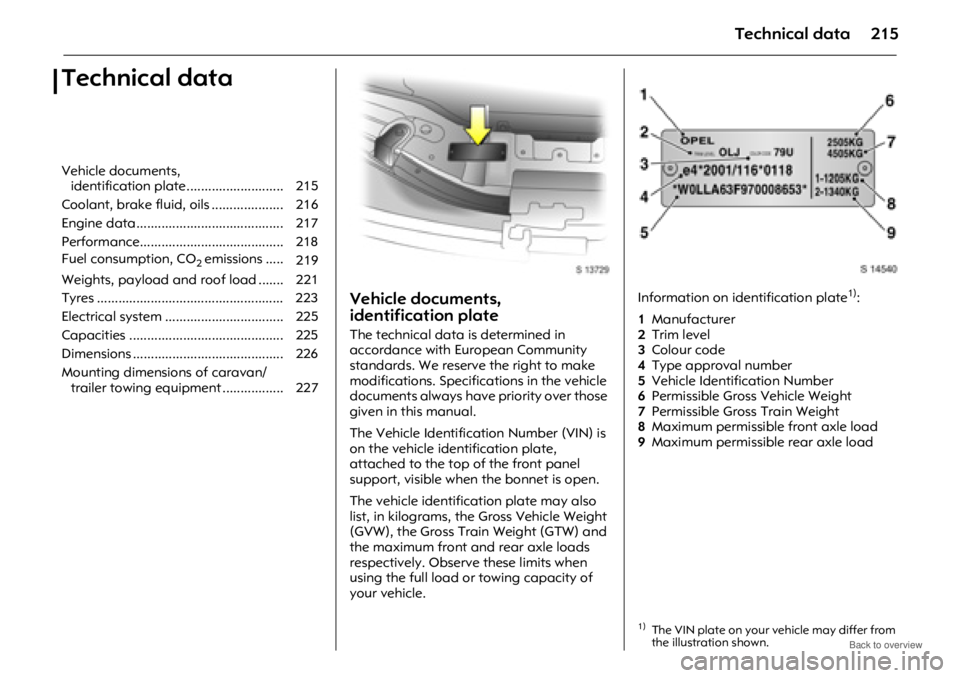
The Vehicle Identification Number (VIN) is
on the vehicle identification plate,
attached to the top of the front panel
support, visible when the bonnet is open.
The vehicle identification plate may also
list, in kilograms, the Gross Vehicle Weight
(GVW), the Gross Train Weight (GTW) and
the maximum front and rear axle loads
respectively. Observe these limits when
using the full load or towing capacity of
your vehicle. Information on identification plate
1):
1 Manufacturer
2 Trim level
3 Colour code
4 Type approval number
5 Vehicle Identifi cation Number
6 Permissible Gross Vehicle Weight
7 Permissible Gross Train Weight
8 Maximum permissible front axle load
9 Maximum permissible rear axle load
Vehicle documents,
identification plate........................... 215
Coolant, brake fluid, oils .................... 216
Engine data......................................... 217
Performance........................................ 218
Fuel consumption, CO
2emissions ..... 219
Weights, payload and roof load ....... 221
Tyres .................................................... 223
Electrical system ................................. 225
Capacities ........................................... 225
Dimensions .......................................... 226
Mounting dimensions of caravan/ trailer towing equipment ................. 227
1)The VIN plate on your ve hicle may differ from
the illustration shown.