ignition OPEL ANTARA 2009 User Guide
[x] Cancel search | Manufacturer: OPEL, Model Year: 2009, Model line: ANTARA, Model: OPEL ANTARA 2009Pages: 234, PDF Size: 3.01 MB
Page 30 of 234
Locks, doors, windows30
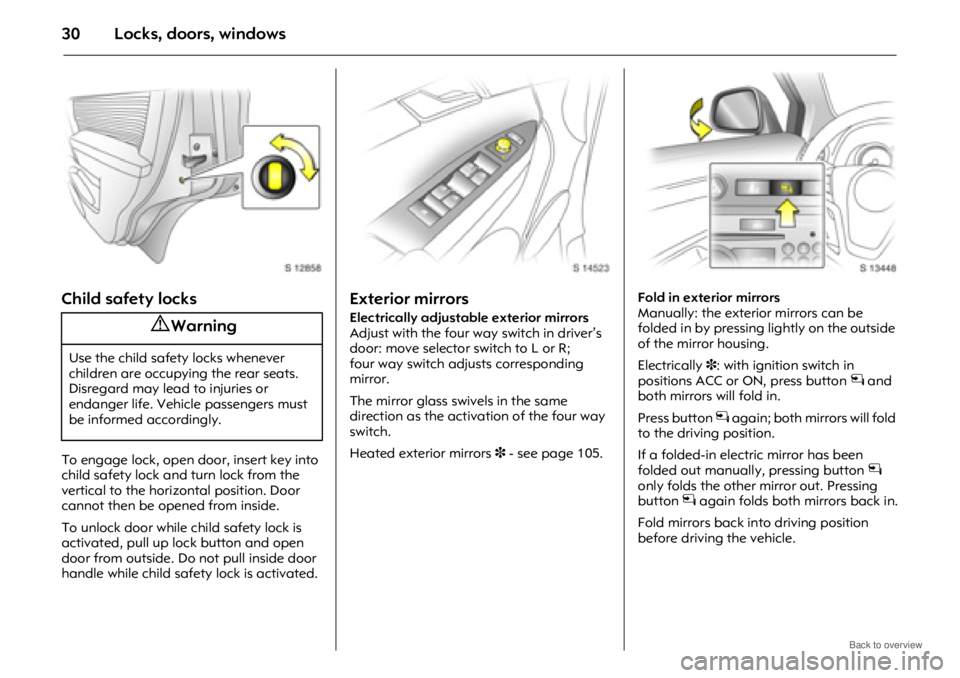
Child safety locks
To engage lock, open door, insert key into
child safety lock and turn lock from the
vertical to the horizontal position. Door
cannot then be opened from inside.
To unlock door while child safety lock is
activated, pull up lock button and open
door from outside. Do not pull inside door
handle while child safety lock is activated.
Exterior mirrors
Electrically adjustable exterior mirrors
Adjust with the four way switch in driver’s
door: move selector switch to L or R;
four way switch adjusts corresponding
mirror.
The mirror glass swivels in the same
direction as the activation of the four way
switch.
Heated exterior mirrors 3 - see page 105. Fold in exterior mirrors
Manually: the exterior mirrors can be
folded in by pressing lightly on the outside
of the mirror housing.
Electrically
3: with ignition switch in
positions ACC or ON, press button n and
both mirrors will fold in.
Press button n again; both mirrors will fold
to the driving position.
If a folded-in electric mirror has been
folded out manually, pressing button n
only folds the other mirror out. Pressing
button n again folds both mirrors back in.
Fold mirrors back in to driving position
before driving the vehicle.9 Warning
Use the child safety locks whenever
children are occupying the rear seats.
Disregard may lead to injuries or
endanger life. Vehicle passengers must
be informed accordingly.
Page 32 of 234

Locks, doors, windows32
Automatic anti-dazzle interior mirror 3
Dazzle is automatically reduced.
With the ignition off, the mirror does not
dim.
Press button on mirror housing to turn
function on. Button will illuminate.
Press button again to turn off.
There are two light sensors in the mirror
housing. To avoid interference and loss of
function, do not cover the sensors or hang
anything on the mirror.
Electric windows
Operational with key in ignition switch
positions ACC or ON. If key is in LOCK
position or removed, windows can be
operated for 10 minutes or until driver’s
door is opened.
Operated via four switches located in the
driver’s door.
For incremental operation, briefly pull or
press the switch.
For automatic 3 opening or closing, pull or
press the switch longer. Pull or press the
switch again to stop the movement.
9 Warning
Care must be taken when operating the
electrically operated door windows.
There is a risk of injury, particularly for
children, and a danger that articles could
become trapped. Vehicle passengers
must be informed accordingly.
If there are children on the rear seats,
press the switch in the driver’s door to
lock rear window operation. Rear
windows can then only be operated via
the driver’s door switches.
Keep a close watch on the windows when
closing them. Ensu re that nothing
becomes trapped in them as they move.
Before leaving the vehicle, remove the
ignition key in order to prevent
unauthorized operation.
Page 34 of 234

Locks, doors, windows34
Sun visors
Use the sun visor to protect from glare by
pulling it up, down or swivelling it to the
side.
Sun visors have vanity mirrors and a ticket
holder 3 on the rear.
When the vanity mirror covers are opened,
the sun visor lamp 3 will illuminate.
Slide/tilt sun roof 3
Operated via switch in roof lining when the
ignition switch is in positions ACC or ON.
With key in LOCK position in the ignition
switch or removed, the slide/tilt sun roof
can be adjusted for up to 10 minutes or
until a door is opened.
For incremental operation, briefly press the
button. For automatic opening or closing,
press and hold the switch. To open
Press switch rearwards; it will open
automatically unless th
e switch is pressed
again in another dire ction, or released.
To close
Press and hold switch forwards. Release
switch when sun roof reaches desired
position.
To tilt
Press and hold switch upwards. Release
switch when sun roof reaches desired
position.
To return sun roof to its original position,
press and hold switch downwards. Release
switch when sun roof reaches desired
position.
Page 45 of 234

Seats, interior45
Belt tensioners control indicatorThe seat belt tensioners are monitored
electronically together with the airbags,
and their operational readiness shown by
the red control indicator v in the
instrument panel.
When the ignition is switched on, the
control indicator flashes several times then
extinguishes. If it does not flash, stays lit,
illuminates or flashes whilst driving, there is
a fault with the belt tensioners or in the
airbag systems. The systems might not
therefore be triggered in the event of an
accident (see also page 56). The system’s integrated self-diagnostics
allows faults to be quickly remedied.
Important
z
Accessories not released for your vehicle
type and other objects must not be fixed
or placed within the action zone of the
belt tensioners, as they may result in
injury if the belt tensioners are triggered.
z Do not make any modifications to the
components of the belt tensioners, as
this may result in unintended actuation
of the belt tensioners, rendering the
vehicle unroadwor thy and causing
serious personal injury. z
The belt tensioner and airbag system
control electronics can be found in the
centre console area. In order to avoid
malfunctions, do not store magnetic
objects in this area.
z When using the rear seats, ensure that
the front seat belt components are not
damaged by shoes or other objects.
Avoid dirt getting in the retractors.
z The belt tensioners only actuate once,
indicated by continuous illumination of
control indicator v in the instrument
panel. Deployed belt tensioners must be
replaced by a workshop.
z When disposing of the vehicle, observe
the applicable safety regulations. Take
the vehicle to a recycling company for
disposal.
9 Warning
Have the cause of the fault remedied by
a workshop.
9 Warning
Improper handling (e.g. removal or
installation) can activate the belt
tensioners – risk of injury.
Page 46 of 234

Seats, interior46
Using the belts
Fitting the belt
Pull the belt out evenly from the retractor
and guide it over the shoulder, making
certain that it is not twisted.
Insert the latch plate into the buckle.
The seat backrest must not be tilted back
too far (the recommended maximum tilting
angle is approx. 25°).
The lap belt must not be twisted and must
fit snugly across the body. Tension the belt
frequently whilst driving by tugging the
diagonal part of the belt. Keep knees pointing straight forward so
that driver’s side knee bolsters can help
prevent submarining under the seat belt in
the event of a collision.
Bulky clothing prevents
the belt from fitting
properly. The belt must not rest against
hard or fragile objects in the pockets of
your clothing (e.g. ballpoint pens, keys,
spectacles) because these could cause
injury in the event of a collision. Do not
place any objects (e.g. handbags) between
the belt and your body. Front passenger’s seat belt reminder
k3Illuminates for approx. 4 seconds when
ignition is switched on.
When the engine is running, if the front
passenger’s seat is occupied and the belt is
not engaged, the control indicator will
flash for approx. 90 seconds and then
illuminate until the
belt is fastened
correctly (control indicator will extinguish
immediately).
If vehicle speed exceeds approx. 22 km/h
(14 mph), the control indicator will flash for
approx. 90 seconds along with a warning
chime, and then illuminate until front
passenger’s seat belt is fastened.
Control indicator X for driver’s seat belt
reminder - see page 72.9 Warning
On pregnant women in particular,
the lap belt must be positioned as low as
possible across the pelvis in order to
prevent pressure on the abdomen.
Page 53 of 234

Seats, interior53
The front airbag system is triggered:
zdepending on the severity of the
accident,
z depending on the type of impact,
z within the range shown in the illustration,
z independently of the side airbag 3 and
curtain airbag systems.
Examples:
z Impact against a non-yielding obstacle;
the front airbags are triggered at low
vehicle speeds,
z Impact against a yielding obstacle (such
as another vehicle); the front airbags are
only triggered at a higher vehicle speed. When triggered, the driver’s and front
passenger’s airbags inflate in milliseconds
and form safety cushions for the driver and
front passenger. Forward movement of
driver and front passenger is checked and
the risk of injuries to the upper body and
head thereby subs
tantially reduced.
z No impairment of view will occur, as
airbags inflate and deflate so quickly. The front airbag system will not be
triggered in the event of:
z
the ignition being switched off,
z minor frontal collisions,
z accidents in which the vehicle overturns,
z collisions involving a si de or rear impact
where it would not be of benefit to the
occupants.
9 Warning
The front airbag system provides
optimum protection when the seat, seat
belt, backrest and head restraint are
correctly adjusted.
Adjust the driver's seat according to the
occupant's height such that, with the
driver sitting upright, the steering wheel is
held in the area of its upper spokes with
the driver's arms slightly bent.
T h e d r i v e r ’ s s e a t s h o u l d b e a s f a r b a c k a s
possible without compromising the
driver’s ability to reach the pedals,
steering wheel or controls.
The front passenger’s seat should be as
far back as possible, with the backrest
upright. Do not place the head, body,
hands or feet on the cover of the airbag
system.
Do not place objects, children or pets in
the area in which the airbags inflate.
9 Warning
Seat belts must therefore always be worn.
The front airbag system serves to
supplement the three-point seat belts.
If you do not wear your seat belt, you risk
being seriously injure d, or even thrown
from the vehicle, in the event of an
accident.
The belts help to ma intain occupants in
the correct seating position for the front
airbag system to provide effective
protection in the event of an accident.
Page 55 of 234

Seats, interior55
The side airbags will not be triggered in the
event of:
zthe ignition being switched off,
z frontal collisions,
z accidents in which the vehicle overturns,
if lateral impact is insufficient for side
airbag deployment,
z collisions involving a rear impact,
z collisions involving a side impact outside
the passenger cell.
Curtain airbags
The curtain airbag system is identified by
the word "Airbag" on the roof frame, and
protects front seat and rear outboard seat
occupants in the event of a severe side
impact.
The curtain airbag system comprises:
zan airbag with inflator in the roof frame
above the doors on the driver’s and
passenger’s side respectively,
z the control electronics,
z the side impact sensors,
z the airbag systems control indicator v in
the instrument panel. The curtain airbag system will be triggered:
z
depending on the severity of the
accident,
z depending on the type of impact,
z within the range shown in the illustration,
z together with the side airbag system,
z independently of the front airbag
system.
Page 56 of 234

Seats, interior56
When triggered, the curtain airbag inflates
in milliseconds and provides a safety
barrier in the head area on the respective
side of the vehicle. This reduces the risk of
injury to the head considerably in the event
of a side impact.The curtain airbags will not be triggered in
the event of:
z
the ignition being switched off,
z frontal collisions,
z accidents in which the vehicle overturns,
if lateral impact is insufficient for curtain
airbag deployment,
z collisions involving a rear impact,
z collisions involving a side impact outside
the passenger cell.
Airbag control indicator v
The front airbag system, side airbag
system 3 and curtain airbag system
are monitored electronically together with
the belt tensioners, and their operational
readiness is shown by the red control
indicator v in the instrument panel.
When the ignition is switched on, the
control indicator flashes several times then
extinguishes. If it does not flash, stays lit,
illuminates or flashes whilst driving, there is
a fault in the airbag systems or with the
belt tensioners. The systems might not
therefore be triggered in the event of an
accident (see also page 45).
9 Warning
There must be no objects in the area in
which the airbag inflates. Do not place
hands, arms or other body parts on the
covers of the airbag systems.
Never secure anything to the roof by
routing ropes through the doors or
windows, to avoid obst ructing inflation of
the curtain airbags.
Important information – see page 57.
The three-point seat belt must always be
correctly fitted – see page 43.
Page 68 of 234

Seats, interior68
Portable front ashtray 3Located in front drink holder.
To open: gently lift up lid. Illuminates
depending on outside light conditions.
To empty: rotate upper part of ashtray
anti-clockwise and remove.
After use, close lid firmly.
To replace battery: remove screw on
ashtray lid and replace with CR2032
(or equivalent) battery.
Warning triangle ¨ 3 ,
First aid kit
+3
Your first aid kit and warning triangle can
be accommodated below the floor cover in
the luggage compartment.
Power outlets
Cigarette lighter )
With ignition switch in positions ACC or ON,
push the cigarette lighter in all the way.
Heating up ceases once element is
glowing; cigarette lighter pops up
automatically. Withdraw lighter.
Page 69 of 234

Seats, interior69
Accessory sockets
Located in the rear centre console between
the front seats and in the right-hand side of
the luggage compartment 3.
Operational with ignition switch in
positions ACC or ON.
Pull the cap out to use the accessory
socket, and replace it when not in use.
The socket for the cigarette lighter can also
be used to connect electrical accessories
when the ignition is switched on.
Use of accessory sockets while the engine is
not running will discharge the battery. The maximum power requirement of
electrical accessories must not exceed
120 watts.
Do not connect any current delivering
accessories, e.g. el
ectrical charging
devices or batteries.
Connected electrical accessories must
comply with the EC standard in terms of
electromagnetic compatibility
requirements laid down in DIN VDE 40 839,
otherwise vehicle malfunctions may occur.
The use of non-authorised accessories may
cause damage to the socket.Assist grips
Located above the driver’s door 3, the
front passenger’s door and both rear
doors.
Pull grip down and ho ld to assist when
entering or exiting the vehicle. Grips swing
back up automatically when released.
Rear door assist grips also include coat
hangers.