instrument panel OPEL ANTARA 2009 User Guide
[x] Cancel search | Manufacturer: OPEL, Model Year: 2009, Model line: ANTARA, Model: OPEL ANTARA 2009Pages: 234, PDF Size: 3.01 MB
Page 64 of 234

Seats, interior64
zClose the luggage compartment cover to
prevent the objects from being reflected
in the rear window.
z If the backrests are not folded down
when transporting objects in the
luggage compartment, they must be
engaged in their upright position -
see page 41.
z Do not allow the load to protrude above
the upper edge of the rear seat
backrests, or if the rear seat backrests
have been folded down onto the seat
cushions, above the upper edge of the
front seat backrests.
z The warning triangle 3 and first aid kit 3
should always be freely accessible.
z No objects should be placed on the
luggage compartment cover or the
instrument panel. They are reflected in
the glass, obstruct the driver’s view and
will be thrown through the vehicle in the
event of heavy braking, for example.
z No objects should be stored in any of the
airbag inflation zones, as injuries may be
caused when the airbag is triggered. z
The load must not obstruct the operation
of the pedals, hand brake and gearshift
lever or hinder the freedom of movement
of the driver. Do not place any unsecured
objects in the interior.
z Bulky objects should not be transported
with the tailgate open or ajar, otherwise
poisonous exhaust fumes may enter the
vehicle.
z Weights, payload and roof load -
see page 221.
z Driving with a roof load (see also
page 127) increases the sensitivity of the
vehicle to crosswinds and has a
detrimental effect on vehicle handling
owing to the higher centre of gravity of
the vehicle. Stowage compartments
Glove compartment
To open, pull handle upwards.
The glove compartment will illuminate
when opened.
The glove compartment partition can be
removed from its groove.
Store the partition in the groove on the far
left-hand side of the glove compartment.
Glove compartment cooling
3 -
see page 105.
9 Warning
Disregard of these instructions may lead
to injuries or endanger life. Vehicle
passengers must be informed
accordingly.
9 Warning
Do not drive with glove compartment
open; risk of injury in the event of heavy
braking or a collision.
Page 67 of 234

Seats, interior67
Card holderLocated below instrument panel on driver’s
side. Insert a card into the slot for
convenient use.
Coin storage
Open by pulling handle on coin storage
door (located below card holder) towards
you. Push door firmly to close.
Drink holders
Located in the front 3 and rear of the
centre console.
The front drink holder is a fixed size.
The rear drink holder is flexible, allowing
different size drink cont ai ners to be stored.
To open: press button above rear drink
holder.
Ashtrays 3
To be used only for ash and not for
combustible rubbish.
9 Warning
Disregard of these instructions may lead
to injuries or endanger life. Vehicle
passengers must be informed
accordingly.
Page 94 of 234

Lighting94
Lighting
Exterior lamps
Turn light switch:
In positions 8 and 9, the tail lamps,
license plate lamps and instrument panel
lamps are also on. Daytime running lamps
3
Come on automatically when engine is
started.
They will turn off wh en the parking lamps
or dipped beam are on, or when the engine
is stopped.
Follow the regulations of the country in
which you are driving when using daytime
running lamps and front fog lamps.
Driving abroad - see page 100.
Lamps on reminder
If the driver’s door is opened when the light
switch is in position 8 or 9 and the
ignition is off, a warning chime will sound.
If the lamps are then switched off and back
on again, the warning chime will not sound.
Wiper activated lighting 3
With light switch in AUTO position,
if windscreen wipers are operated for
8 cycles or more, the exterior lamps
illuminate automatically.
Approach lighting 3
Depending upon outside light conditions,
when you press q on the remote control,
the hazard warning lamps flash twice and
the exterior lamps illuminate for approx.
20 seconds.
Main beam, headlamp flash ............. 95
Automatic dipped beam activation
3 95
Turn signal lamps ............................... 95
Front fog lamps >............................. 96
Fog tail lamp r.................................. 96
Reversing lamps.................................. 96
Centre high-mounted stop lamp ....... 96
Hazard warning lamps ...................... 97
Headlamp range adjustment q........ 97
Peripheral lighting .............................. 98
Instrument illumination, information display illumination .......................... 98
Interior courtesy lamps....................... 98
Battery discharge protection ............. 100
Headlamps when driving abroad ..... 100 7
=Off
8 = Parking lamps
9 = Dipped beam or main
beam
AUTO = Automatic dipped beam
activation 3
Page 95 of 234

Lighting95
Main beam, headlamp flash
To switch from dipped beam to main
beam, push lever forwards.
To switch back to dipped beam, pull lever
back towards steering wheel.
To activate the headlamp flash, pull lever
towards steering wheel. Main beam is
engaged for the duration of activation.
The blue control indicator P is illuminated
when main beam or headlamp flash is on.
Automatic dipped beam
activation 3
Light switch to AUTO; dipped beam comes
on automatically when the engine is
running, depending on outside light
conditions.
For reasons of safety, the light switch
should always remain in the AUTO
position.
To ensure automatic dipped beam
activation functions properly, do not cover
the light sensor on top of the instrument
panel.
Turn signal lamps
To activate, press lever up or down lightly.
When the steering wheel is turned back, the
lever automatically returns to its rest
position. This will not happen when making
a minor steering manoeuvre such as lane
changing.
Tap signal: briefly move lever to resistance
point. The turn signal then flashes three
times when changing lanes or the like.
Hold the lever if you want the turn signals
to flash for longer. When released, the lever
will spring back to rest position.
The volume of the turn signal lamps’
audible warning is dependent upon vehicle
speed.
Lever up = Right turn
Lever down = Left turn
Page 96 of 234

Lighting96
Front fog lamps
>
The front fog lamps can only be switched
on when both the ignition and headlamps
are on.
With automatic dipped beam activation 3,
parking lamps and dipped beam come on
simultaneously when the front fog lamps
are switched on.
Follow the regulations of the country in
which you are driving when using front fog
lamps.Fog tail lamp r
The fog tail lamp can only be switched on
when the ignition is on and the light switch
is in position 9, or the front fog lamps are
on and the light switch is in position 8.
With automatic dipped beam activation 3,
parking lamps and dipped beam come on
simultaneously when the fog tail lamp is
switched on.
Reversing lamps
Come on when reverse gear is engaged
and ignition is switched on.
Centre high-mounted stop lamp
Comes on when the brakes are applied,
acting as a third stop lamp, to supplement
the brake lamps.
On = Press button >, >
illuminates in instrument
panel.
Off = Press button > again, >
extinguishes in instrument
panel.
On = Press button r, r
illuminates in instrument
panel.
Off = Press button r again, r
extinguishes in instrument
panel.
Page 97 of 234

Lighting97
Hazard warning lamps
To switch on, press button ¨.
To switch off, press button ¨ again.
To aid location of the pushbutton, the red
surface is illuminated when the ignition is
switched on. When the button is pressed,
its control indicator flashes in unison with
the hazard warning lamps.
Headlamp range adjustment q
Manual headlamp range adjustment 3
With dipped beam switched on, adjust
headlamp range to suit vehicle load.
Correct adjustment of the headlamp range
reduces dazzle for other road users.
Automatic level control system 3 -
see page 143.
Vehicles without level control system Vehicles with level control system
Automatic headlamp range
adjustment
3
On vehicles with Xenon headlamps, the
range of the headlamps is adjusted
automatically based on vehicle load.
If control indicator q for automatic
headlamp range adjustment illuminates in
the instrument panel while driving, a fault
has occurred.
Have the cause of the fault remedied
immediately. Consult a workshop.
z Front seats occupied = 0
z All seats occupied = 1
z All seats occupied and load in
luggage compartment =2
z Driver’s seat occupied and load
in luggage compartment =3
z
Front seats occupied = 0
z All seats occupied = 1
z All seats occupied and load in
luggage compartment =1
z Driver’s seat occupied and load
in luggage compartment =2
Page 98 of 234

Lighting98
Peripheral lighting
The dipped beam and reversing lamps
illuminate for approx. 30 seconds after the
driver exits the vehicle and closes the door.
To activate function:
If the driver’s door is left open, the lamps
will extinguish after two minutes.
Peripheral lighting can be deactivated by
inserting the key in the ignition switch or by
pulling the turn signal lever towards the
steering wheel again while the driver’s door
is open.
Instrument illumination,
information display illumination
Comes on when ignition is switched on.
Brightness can be adjusted when the
exterior lamps are on: turn wheel to the
right or left until the desired brightness is
obtained.
If driver’s door is opened or q is pressed on
the remote control, instrument panel lamps
will illuminate automatically and stay on
for approx. 30 seconds until ignition switch
is turned to the ACC position.
Display mode 3 - see page 87.
Interior courtesy lamps
Front reading lamps, rear interior lamps
and luggage compartm ent lamps function
as courtesy lighting and illuminate when
the doors or tailgate are opened.
If doors or tailgate remain opened, the
lamps stay illuminated for approx.
10 minutes.
Once all doors and the tailgate are closed,
the courtesy lamps dim gradually after
approx. 10 seconds.
By pressing button d, both front reading
lamps and the rear interior lamps
illuminate.
Press the button again to turn the lamps
off.
1. Switch off ignition.
2. Remove ignition key.
3. Open driver’s door.
4. Pull turn signal lever towards
steering wheel.
Page 110 of 234
Climate control110
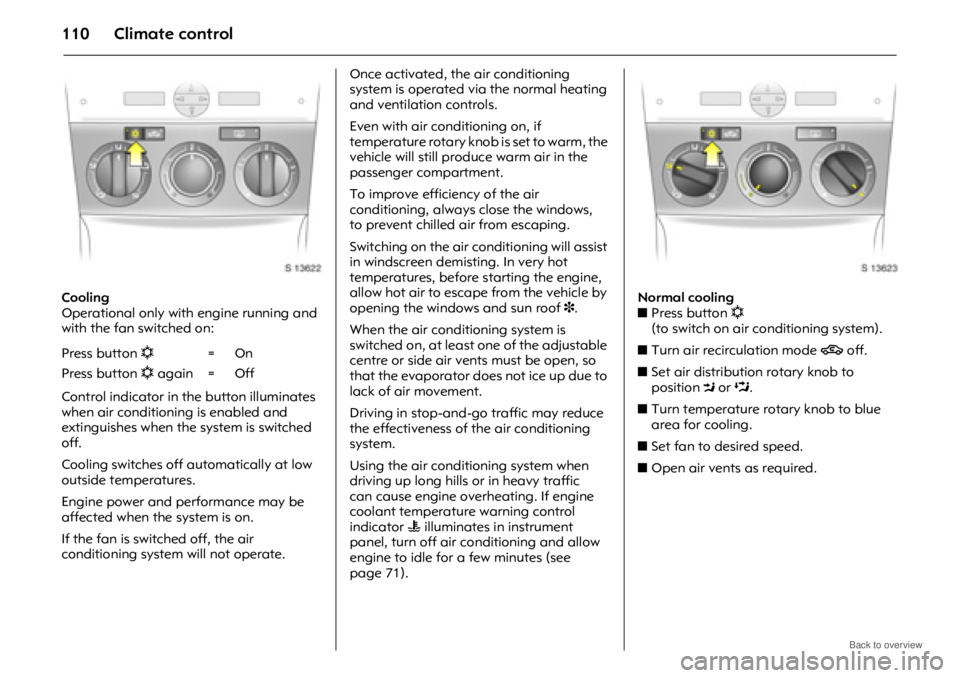
Cooling
Operational only with engine running and
with the fan switched on:
Control indicator in the button illuminates
when air conditioning is enabled and
extinguishes when the system is switched
off.
Cooling switches off automatically at low
outside temperatures.
Engine power and performance may be
affected when the system is on.
If the fan is switched off, the air
conditioning system will not operate. Once activated, the air conditioning
system is operated via the normal heating
and ventilation controls.
Even with air conditioning on, if
temperature rotary knob is set to warm, the
vehicle will still produce warm air in the
passenger compartment.
To improve efficiency of the air
conditioning, always close the windows,
to prevent chilled air from escaping.
Switching on the air conditioning will assist
in windscreen demisting. In very hot
temperatures, before starting the engine,
allow hot air to escape from the vehicle by
opening the windows and sun roof
3.
When the air conditioning system is
switched on, at least one of the adjustable
centre or side air vents must be open, so
that the evaporator does not ice up due to
lack of air movement.
Driving in stop-and-go traffic may reduce
the effectiveness of the air conditioning
system.
Using the air conditioning system when
driving up long hills or in heavy traffic
can cause engine overheating. If engine
coolant temperature warning control
indicator W illuminates in instrument
panel, turn off air co nditioning and allow
engine to idle for a few minutes (see
page 71). Normal cooling
z
Press button n
(to switch on air co nditioning system).
z Turn air recirculation mode 4 off.
z Set air distribution rotary knob to
position M or L.
z Turn temperature rotary knob to blue
area for cooling.
z Set fan to desired speed.
z Open air vents as required.
Press button
n=On
Press button n again = Off
Page 117 of 234
Driving and operation117
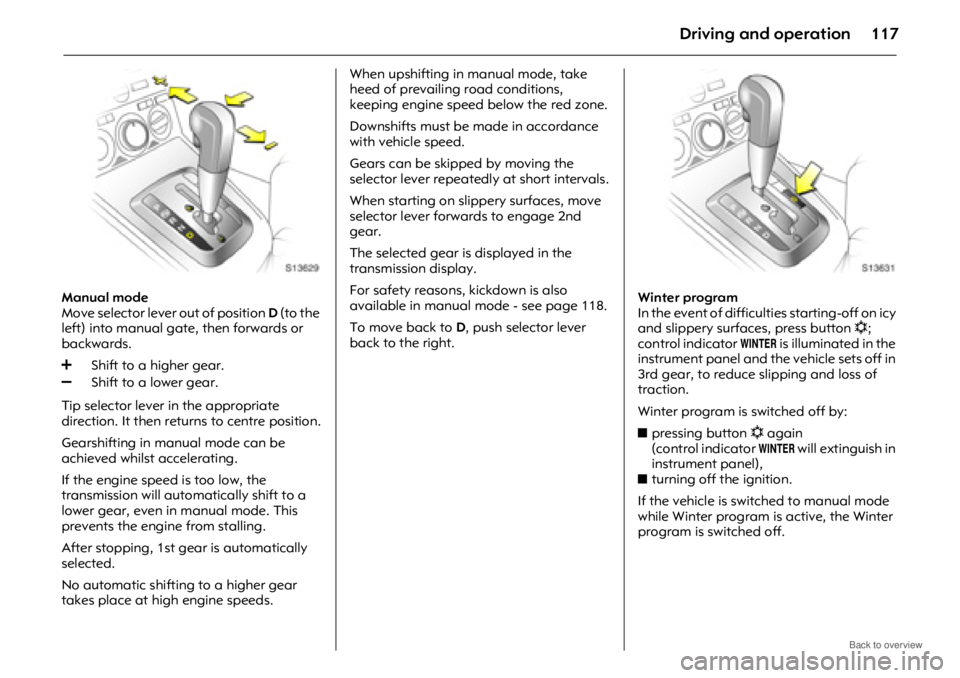
Manual mode
Move selector lever out of position D (to the
left) into manual gate, then forwards or
backwards.
Tip selector lever in the appropriate
direction. It then returns to centre position.
Gearshifting in manual mode can be
achieved whilst accelerating.
If the engine speed is too low, the
transmission will automatically shift to a
lower gear, even in manual mode. This
prevents the engine from stalling.
After stopping, 1st gear is automatically
selected.
No automatic shifting to a higher gear
takes place at high engine speeds. When upshifting in manual mode, take
heed of prevailing road conditions,
keeping engine speed below the red zone.
Downshifts must be made in accordance
with vehicle speed.
Gears can be skipped by moving the
selector lever repeated
ly at short intervals.
When starting on slippery surfaces, move
selector lever forwards to engage 2nd
gear.
The selected gear is displayed in the
transmission display.
For safety reasons, kickdown is also
available in manual mode - see page 118.
To move back to D, push selector lever
back to the right. Winter program
In the event of difficult
ies starting-off on icy
and slippery surfac es, press button n;
control indicator
0 is illuminated in the
instrument panel and the vehicle sets off in
3rd gear, to reduce slipping and loss of
traction.
Winter program is switched off by:
z pressing button n again
(control indicator
0 will extinguish in
instrument panel),
z turning off the ignition.
If the vehicle is switched to manual mode
while Winter program is active, the Winter
program is switched off.
Page 120 of 234
Driving and operation120
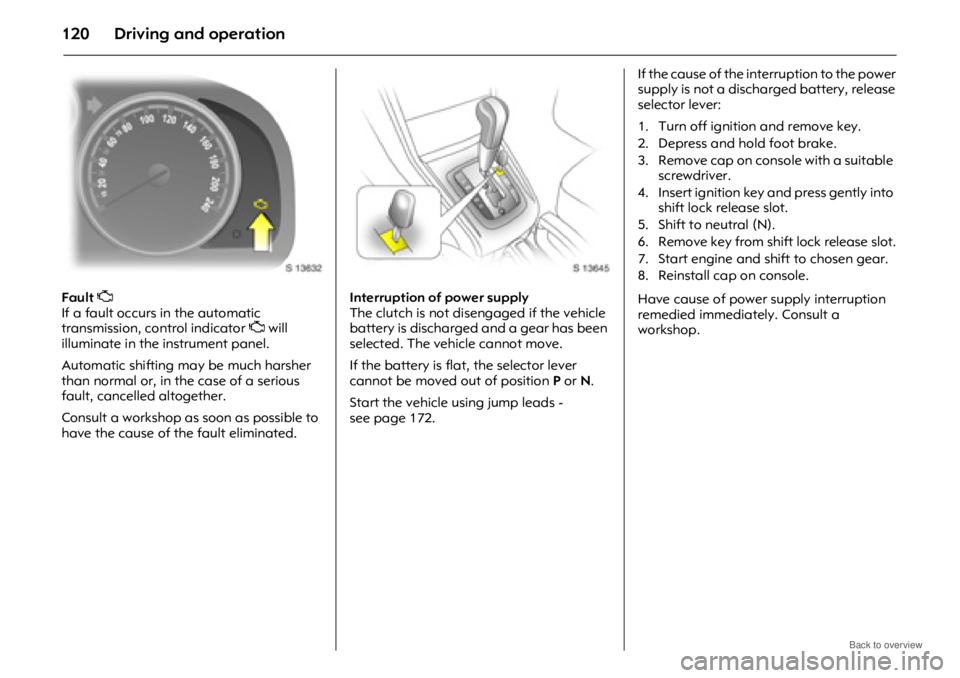
Fault Z
If a fault occurs in the automatic
transmission, control indicator Z will
illuminate in the instrument panel.
Automatic shifting may be much harsher
than normal or, in the case of a serious
fault, cancelled altogether.
Consult a workshop as soon as possible to
have the cause of the fault eliminated. Interruption of power supply
The clutch is not disengaged if the vehicle
battery is discharged and a gear has been
selected. The vehicle cannot move.
If the battery is flat, the selector lever
cannot be moved out of position
P or N.
Start the vehicle using jump leads -
see page 172. If the cause of the interruption to the power
supply is not a discharged battery, release
selector lever:
Have cause of power supply interruption
remedied immediately. Consult a
workshop.
1. Turn off ignition and remove key.
2. Depress and hold foot brake.
3. Remove cap on console with a suitable
screwdriver.
4. Insert ignition key and press gently into shift lock release slot.
5. Shift to neutral (N).
6. Remove key from shift lock release slot.
7. Start engine and shift to chosen gear.
8. Reinstall cap on console.