trailer OPEL ANTARA 2009 User Guide
[x] Cancel search | Manufacturer: OPEL, Model Year: 2009, Model line: ANTARA, Model: OPEL ANTARA 2009Pages: 234, PDF Size: 3.01 MB
Page 169 of 234

Driving and operation169
Driving characteristics, towing tips
In the case of caravans/trailers with
brakes3, attach the breakaway stopping
cable to the eye 3 or loop around coupling
ball bar if no eye is available.
Ensure cable is crossed under the coupling
socket to ensure the caravan/trailer nose
cannot drop to the ground if it becomes
separated from the trailer hitch.
Do not allow the cable to drag along the
ground and always allow enough slack to
permit full turning. Fo llow the instructions
supplied with the towing equipment.
Before coupling the caravan/trailer,
lubricate the ball of the caravan/trailer
towing device. However, do not do so if a
stabilizer which acts on the coupling ball is
being used to damp rolling motions.
Handling is greatly influenced by the
loading of the caravan/trailer. Loads
should therefore be secured so that they
cannot slip and should be placed in the
centre of the caravan/trailer if possible,
i.e. above the axle.
Opel genuine parts an d accessories which
can be subsequently fitted aid trailer
operation, e.g. larg e mirrors for wide
caravans/trailers. In the case of caravans/trailers with low
directional stability, it is advisable to use a
friction-type stabilizer to damp rolling
motions.
Do not drive faster than 80 km/h (50 mph),
even in countries where higher speeds are
permitted.
When driving uphill, do not drive faster
than 30 km/h (20 mph) in 1st gear, or
50 km/h (30 mph) in 2nd gear.
Make sure that you have enough room
when cornering and avoid sudden
manoeuvres.
If the caravan/trailer starts to sway, drive
more slowly, do not attempt to correct the
steering and brake sharply if necessary.
If it is necessary to apply the brakes fully,
depress the brake pedal as hard as
possible.
The cooling fan is electrically operated.
The fan cooling capacity is not, therefore,
dependent on engine speed. It is not
necessary, when drivin
g uphill, to shift
down into a lower gear if the vehicle can
climb in a higher gear. When coupled to a caravan/trailer, the
vehicle requires more
braking effort when
driving down long grad ients, so select the
same gear as you would when driving
uphill and drive at roughly the same speed.
Automatic transmission in automatic mode
will select the drivin g program with the
optimum engine braking effect.
Remember that brak ing distances for
vehicles towing carava ns/trailers with and
without brakes is always greater than for
vehicles not towing a caravan/trailer. For
caravans/trailers with brakes, follow the
instructions carefully. Do not make any
modifications to the brake system.
Always check lamps on caravans/trailers
before towing. Ensure national regulations
are observed.
The fog tail lamp on the vehicle is
deactivated when towing a caravan/
trailer.
When reversing, if possible, have someone
provide assistance.
Drive slowly and shift down into a lower
gear when descending steep gradients
rather than holding the foot brake
depressed, to avoid overheating and
reduced brake efficiency.
Page 170 of 234
Driving and operation170
Block the wheels of both the caravan/trailer
and the vehicle when parking and always
apply the hand brake firmly. If possible, do
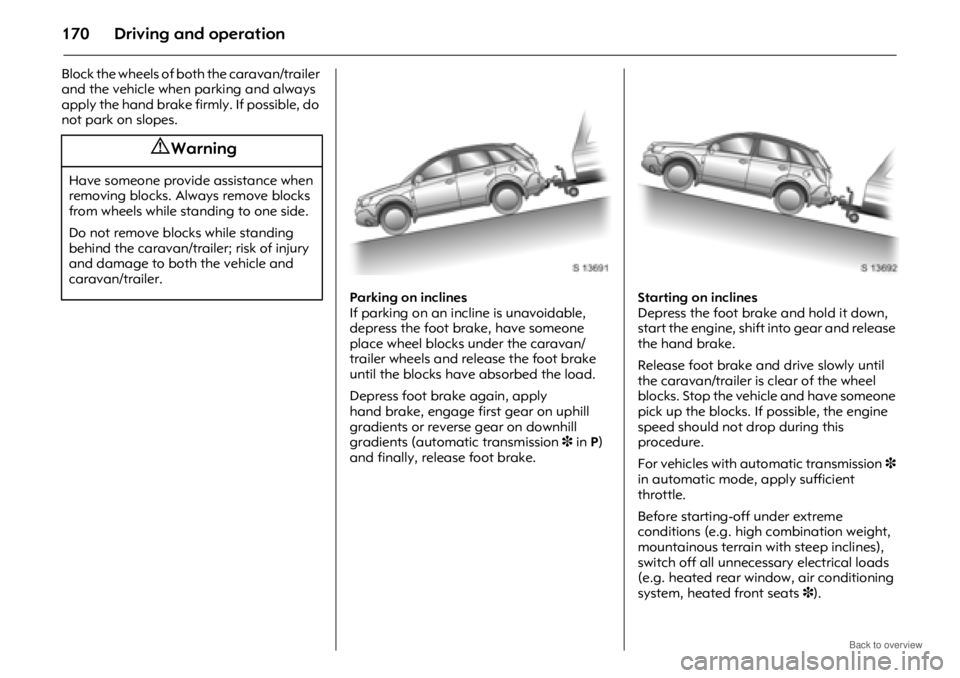
not park on slopes. Parking on inclines
If parking on an incline is unavoidable,
depress the foot brake, have someone
place wheel blocks under the caravan/
trailer wheels and release the foot brake
until the blocks have absorbed the load.
Depress foot brake again, apply
hand brake, engage first gear on uphill
gradients or reverse gear on downhill
gradients (automatic transmission 3 in P)
and finally, release foot brake. Starting on inclines
Depress the foot brake and hold it down,
start the engine, shift into gear and release
the hand brake.
Release foot brake and drive slowly until
the caravan/trailer is clear of the wheel
blocks. Stop the vehicle and have someone
pick up the blocks. If possible, the engine
speed should not drop during this
procedure.
For vehicles with automatic transmission
3
in automatic mode, apply sufficient
throttle.
Before starting-off under extreme
conditions (e.g. high combination weight,
mountainous terrain with steep inclines),
switch off all unnecessary electrical loads
(e.g. heated rear window, air conditioning
system, heated front seats 3).
9 Warning
Have someone provide assistance when
removing blocks. Always remove blocks
from wheels while standing to one side.
Do not remove blocks while standing
behind the caravan/trailer; risk of injury
and damage to both the vehicle and
caravan/trailer.
Page 183 of 234
Self-help, vehicle care 183
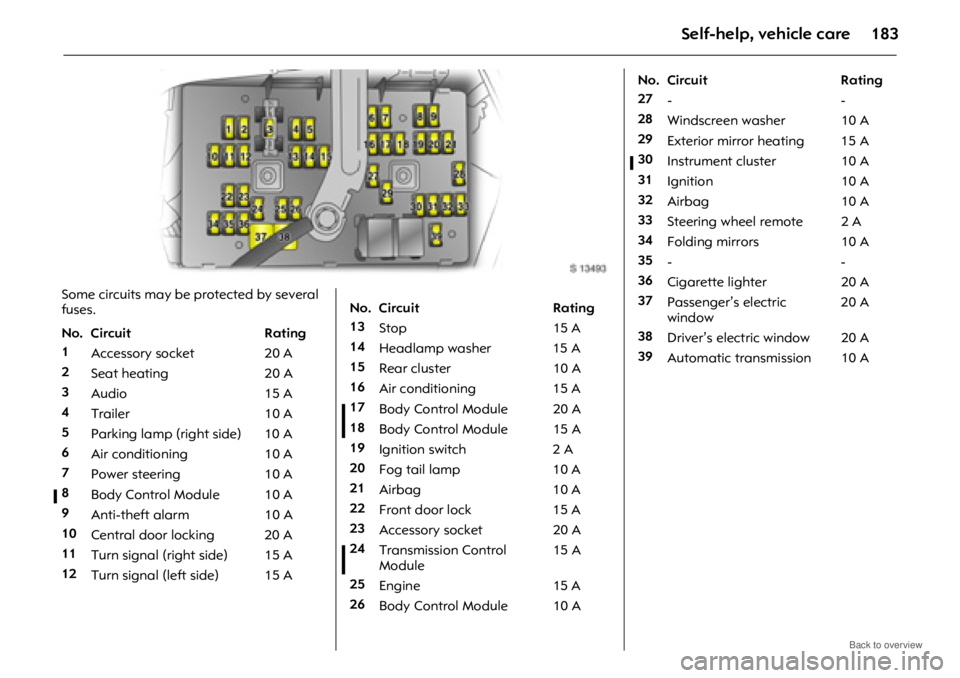
Some circuits may be protected by several
fuses.
No. Circuit Rating
1Accessory socket 20 A
2 Seat heating 20 A
3 Audio 15 A
4 Trailer 10 A
5 Parking lamp (right side) 10 A
6 Air conditioning 10 A
7 Power steering 10 A
8 Body Control Module 10 A
9 Anti-theft alarm 10 A
10 Central door locking 20 A
11 Turn signal (right side) 15 A
12 Turn signal (left side) 15 ANo. Circuit Rating
13 Stop 15 A
14 Headlamp washer 15 A
15 Rear cluster 10 A
16 Air conditioning 15 A
17 Body Control Module 20 A
18 Body Control Module 15 A
19 Ignition switch 2 A
20 Fog tail lamp 10 A
21 Airbag 10 A
22 Front door lock 15 A
23 Accessory socket 20 A
24 Transmission Control
Module 15 A
25 Engine 15 A
26 Body Control Module 10 A
No. Circuit Rating
27 --
28 Windscreen washer 10 A
29 Exterior mirror heating 15 A
30 Instrument cluster 10 A
31 Ignition 10 A
32 Airbag 10 A
33 Steering wheel remote 2 A
34 Folding mirrors 10 A
35 --
36 Cigarette lighter 20 A
37 Passenger’s electric
window 20 A
38 Driver’s electric window 20 A
39 Automatic transmission 10 A
Page 185 of 234
Self-help, vehicle care185
Bulb replacement
Before replacing a bulb , switch off ignition
and relevant switch.
Only hold new bulbs at base! Do not touch
the bulb glass with bare hands, otherwise
fingerprints on the glass evaporate and
residue builds up on the reflector
eventually resulting in a dull reflector.
Inadvertently stained bulbs may be
cleaned with a clean lint-free cloth, using
alcohol or white spirit.
Replacement bulb must be in accordance
with data on base of defective bulb. Do not
exceed wattage given on bulb base.
Headlamp aiming
We recommend that headlamp aiming be
carried out by a work shop, which will have
special equipment.
When aiming your headlamps, the manual
headlamp range adjustment 3 must be set
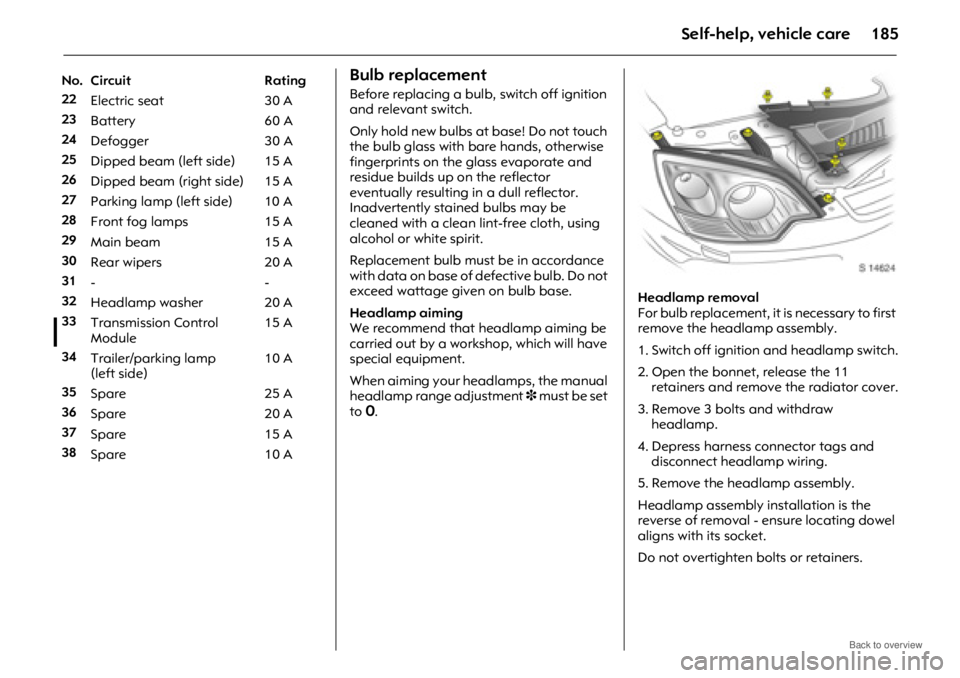
to 7. Headlamp removal
For bulb replacement, it is necessary to first
remove the headlamp assembly.
1. Switch off ignition and headlamp switch.
2. Open the bonnet, release the 11
retainers and remove the radiator cover.
3. Remove 3 bolts and withdraw headlamp.
4. Depress harness connector tags and disconnect head lamp wiring.
5. Remove the headlamp assembly.
Headlamp assembly installation is the
reverse of removal - ensure locating dowel
aligns with its socket.
Do not overtighten bolts or retainers.
No. Circuit Rating
22
Electric seat 30 A
23 Battery 60 A
24 Defogger 30 A
25 Dipped beam (left side) 15 A
26 Dipped beam (right side) 15 A
27 Parking lamp (left side) 10 A
28 Front fog lamps 15 A
29 Main beam 15 A
30 Rear wipers 20 A
31 --
32 Headlamp washer 20 A
33 Transmission Control
Module 15 A
34 Trailer/parking lamp
(left side) 10 A
35 Spare 25 A
36 Spare 20 A
37 Spare 15 A
38 Spare 10 A
Page 213 of 234

Service, maintenance213
Additional servicing
Additional operations ⊕
Additional work is work that is not required
every service but can be performed in
conjunction with a regular service.
Time allowances for such work are not
included in the scope of regular services
and will be charged for additionally. It is
more economic if these operations are
performed as part of a scheduled service
than having them performed separately.
Severe operating conditions o
Operating conditions are classified as
severe when one or more of the following
occurs frequently:
z cold starts,
z stop and go,
z trailer/caravan towing,
z gradients and/or high altitudes,
z poor road surfaces,
z sand and dust,
z extreme temperature fluctuations.
Police vehicles, taxis and driving school
vehicles are also cla ssified as operating
under severe conditions.
Under severe operating conditions, it may
be necessary to have certain scheduled
service work done more frequently than the
scheduled intervals.
For example, if fuel is used that does not
comply with required standards, the fuel
filter may need more frequent draining or
replacement and it may also be necessary
to change other components more often
(e.g. spark plugs). It is recommended to seek technical advice
on the servicing requirements dependent
on the specific operating conditions of your
vehicle.
Recommended fluids and
lubricants
Only use products that have been tested
and approved. Damage resulting from the
use of non-approved materials will not be
covered by the warranty.
Checking and topping up fluids
see page 191.
Engine oil
Engine oil is identified by its quality and
also its viscosity. Quality is more important
than viscosity when selecting which engine
oil to use.
Engine oil quality
European specifications
Opel engine oil m
eets classifications
GM-LL-A-025 and GM-LL-B-025 and is
therefore suitable for both petrol and
diesel engines.
International specifications
The above specification is valid only if the
service interval is reduced to that shown for
the international service schedule -
see pages 209 to 212.
Topping up engine oil
Oils of different manufacturers and brands
can be mixed as long as you comply with
the specified engine oil criteria (quality and
viscosity).
9 Warning
Operating materials are hazardous and
must be handled with the appropriate
level of care. If consumed, seek medical
attention immediatel y. Do not inhale
fumes and avoid skin contact. Keep out
of reach of children. Do not allow
operating materials to contaminate the
sewage system, surface water, ground
water or soil. Dispose of empty containers
properly. Always bear in mind that
operating materials are hazardous to
your health.
GM-LL-A-025: Petrol engines
GM-LL-B-025: Diesel engines without DPF
ACEA-C3 Diesel engines with DPF
GM General Motors Europe
LL Longlife
A or B Engine oil quality specification
025 Validity index
ACEA-A3: Petrol engines
ACEA-B4: Diesel engines without DPF
ACEA-C3: Diesel engines with DPF
Page 215 of 234
Technical data215
Technical data
Vehicle documents,
identification plate
The technical data is determined in
accordance with European Community
standards. We reserve the right to make
modifications. Specifications in the vehicle
documents always have priority over those
given in this manual.
The Vehicle Identification Number (VIN) is
on the vehicle identification plate,
attached to the top of the front panel
support, visible when the bonnet is open.
The vehicle identification plate may also
list, in kilograms, the Gross Vehicle Weight
(GVW), the Gross Train Weight (GTW) and
the maximum front and rear axle loads
respectively. Observe these limits when
using the full load or towing capacity of
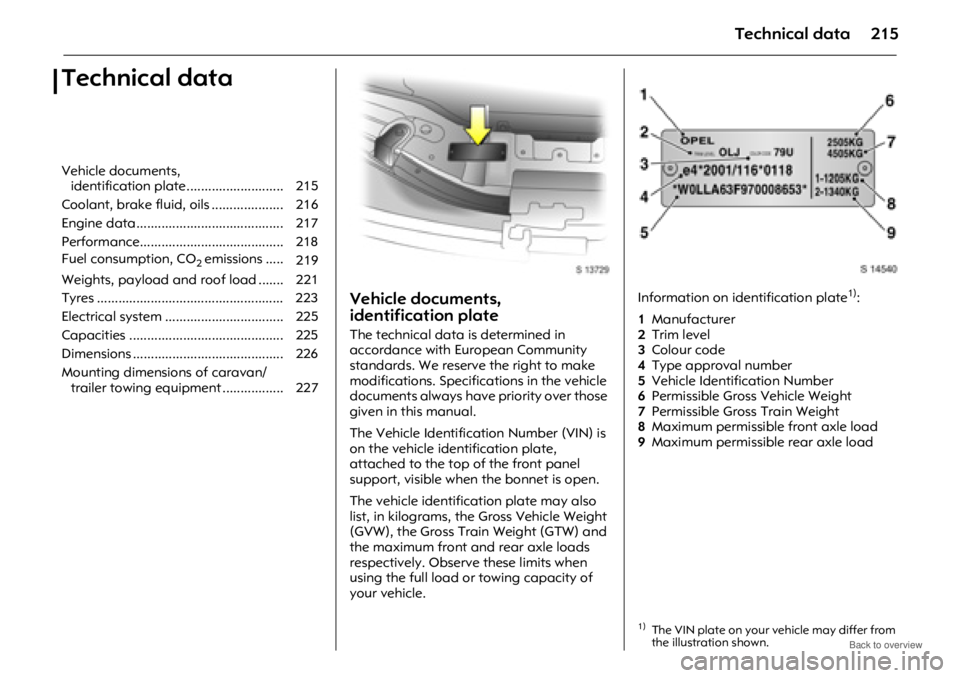
your vehicle. Information on identification plate
1):
1 Manufacturer
2 Trim level
3 Colour code
4 Type approval number
5 Vehicle Identifi cation Number
6 Permissible Gross Vehicle Weight
7 Permissible Gross Train Weight
8 Maximum permissible front axle load
9 Maximum permissible rear axle load
Vehicle documents,
identification plate........................... 215
Coolant, brake fluid, oils .................... 216
Engine data......................................... 217
Performance........................................ 218
Fuel consumption, CO
2emissions ..... 219
Weights, payload and roof load ....... 221
Tyres .................................................... 223
Electrical system ................................. 225
Capacities ........................................... 225
Dimensions .......................................... 226
Mounting dimensions of caravan/ trailer towing equipment ................. 227
1)The VIN plate on your ve hicle may differ from
the illustration shown.
Page 217 of 234

Technical data 217
Engine data
Sales designation
Engine stamp
Engine identifier code 2.4 Petrol
Z 24 SE
Z 24 XE3.2 V6 Petrol
10 HM
Z 32 SE 2.0 Diesel
Z 20 S
Z 20 DMH2.0 Diesel
Z 20 S
Z 20 DM
Number of cylinders 4644
Bore dia. (mm) 87.589.0 83.083.0
Stroke (mm) 100.085.6 92.092.0
Piston displacement (cm
3) 2405 3195 1991 1991
Max. engine power (kW) at rpm 103
5200167
6600 110
400093
4000
Torque (Nm) at rpm 220
2400297
3200 320
2000295
2000
Compression ratio 9.6 10.3 17.5 17.5
Fuel type Petrol Petrol Diesel Diesel
Cetane requirement (CN) --49 (D)
1)
1)Standard high-quality fuels: D = Diesel.
49 (D)1)
Octane requirement (RON)2)
unleaded
or unleaded
2)Standard high-quality fuels, e.g. unleaded DIN EN 228; value printed in bold: recommended fuel.
913)4)
953)
3)Knock control system automatically adjusts ignition timing according to type of fuel used (octane number).4)Use of 91 RON fuel reduces power and torque. If no unleaded Premium fuel is available, 91 RON can be used, taking care to avoid high engine load
or full load as well as driving in mountainous terrain with a caravan/trailer load or high payload.
913)4)
953)-
- -
-
Max. permissible engine speed, continuous operation (rpm) approx. 6200 6700 4750
5)/45006)
5)Manual transmission.6)Automatic transmission.
4750
Engine oil consumption (l/1000 km) 0.60.60.60.6
Page 221 of 234

Technical data221
Weights, payload and roof load
The payload is the difference between the
permissible Gross Vehicle Weight (see
vehicle identification plate on page 215)
and the EC kerb weight.
To calculate the EC kerb weight, enter the
data from your vehicle below:
is the EC kerb weight.
Optional equipmen t and accessories
increase the kerb weight and in some cases
also the permissible Gross Vehicle Weight,
which means that the payload will also
change slightly.
Note the weights given on the vehicle
identification plate. The combined total of front and rear axle
loads must not exceed the permissible
Gross Vehicle Weight. For example, if the
front axle load is being fully utilized, the
rear axle can only bear a load that is equal
to the Gross Vehicle Weight minus the front
axle load.
See the vehicle identi
fication plate on
page 215 or the vehicle documents for
permissible axle loads. Roof load
The maximum permissible roof load
is 100 kg.
The roof load is the combined weight of the
roof rack and the load.
Driving hints – page 127.
Roof racks, caravan and trailer towing -
see page 153, 167.
z
Kerb weight from
page 222 + ............. kg
z Weight of heavy
accessories + ............. kg
The total = ............. kg
Page 227 of 234
Technical data 227
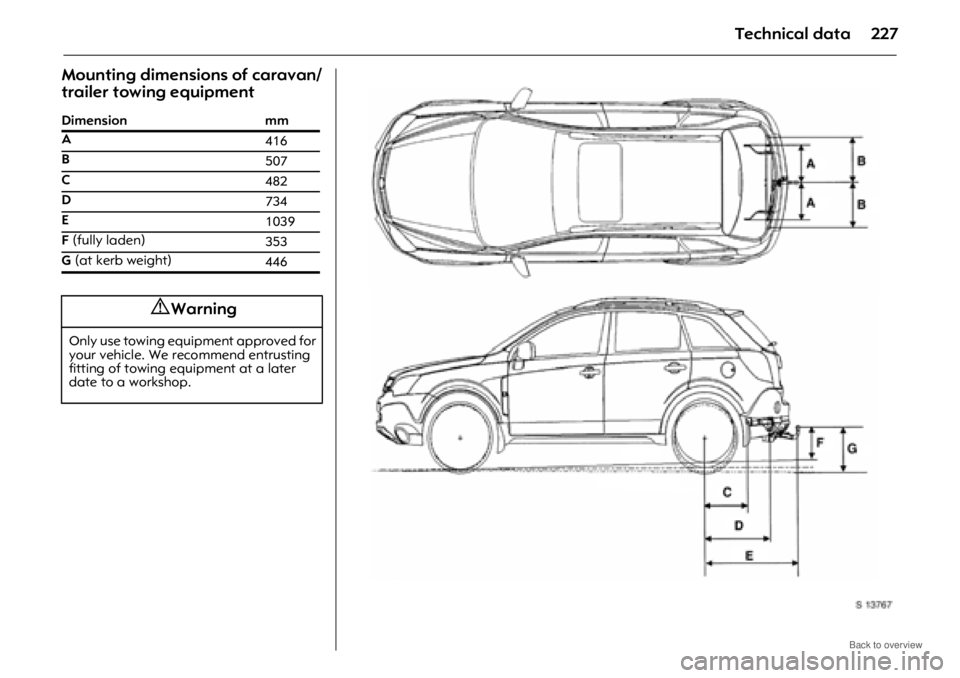
Mounting dimensions of caravan/
trailer towing equipment
Dimension mm
A 416
B 507
C 482
D 734
E 1039
F (fully laden)
353
G (at kerb weight)
446
9 Warning
Only use towing equipment approved for
your vehicle. We recommend entrusting
fitting of towing equipment at a later
date to a workshop.
Page 229 of 234

Index229
Brakes ..................................................... 145
ABS
..................................................... 148
Brake assist
........................................ 146
Brake fluid
.......................................... 196
Brake lamps
....................................... 188
Brake servo unit
................................. 127
Foot brake
.......................................... 146
Hand brake
........................................ 147
Bulb replacement
.................................. 185
Bulbs
....................................................... 185
C
Capacities .............................................. 225
Car Pass
................................................... 21
Caravan/trailer towing
.................. 127, 167
Card holder
.............................................. 67
Care
........................................................ 201
Catalytic converter
............... 133, 135, 172
Central locking switch
............................. 25
Central locking system
............................ 25
Centre high-mounted stop lamp Bulb replacement
.............................. 191
Changing the battery Remote control
.................................... 24
Changing tyre/wheel type
.................... 149
Changing wheels
................................... 178
Chassis number, see Vehicle
Identification Number
................... 215, 216
Check control
........................................... 91
Child restraint system
....................... 47, 58
Child safety locks
.................................... 30
Cigarette lighter
...................................... 68
Cleaning
................................................. 201
Climate control
...................................... 103 Clock
......................................................... 76
Clutch fluid
............................................. 197
Clutch operation
................................... 128
CO
2 emissions ........................................ 219
Coin storage
............................................ 67
Cold starts
...................................... 128, 133
Colour information display
............... 77, 83
Console box
............................................. 65
Console net
.............................................. 66
Contrast
................................................... 87
Control indicators
.............................. 12, 70
ABS
............................................... 70, 148
Airbags
........................................... 56, 72
All Wheel Drive
............................ 71, 121
Alternator
............................................. 74
Anti-theft alarm system
.......... 28, 29, 74
Automatic headlamp
range adjustment
.......................... 71, 97
Automatic transmission
.................... 120
Belt tensioners
............................... 45, 72
Brake system
....................... 70, 147, 197
Change engine oil
....................... 73, 194
Coolant temperature
.................. 71, 196
Cruise control
............................... 73, 140
Descent Control System
...... 71, 138, 139
Diesel particle filter
..................... 73, 135
Doors
.................................................... 72
Driver’s seat belt reminder
................. 72
Electronic immobiliser
................... 22, 72
Electronic Stability Control
......... 71, 136
Engine electronics
....................... 72, 134
Engine oil level
..................................... 73
Engine oil pressure
.............................. 74
Exhaust
........................................ 74, 134 Fog tail lamp
................................. 73, 96
Front fog lamps
............................. 73, 96
Front passenger’s seat belt reminder
46
Fuel level
........................................ 72, 76
Headlamp main beam
................. 73, 95
Park pilot
...................................... 71, 143
Power steering
..................................... 73
Preheating
........................................... 73
Tailgate
................................................ 72
Trailer
................................................... 70
Transmission electronics
..................... 72
Turn signal lamps
................................ 72
Water in diesel fuel
..................... 73, 195
Windscreen washer fluid
............ 73, 199
Winter program
........................... 74, 117
Coolant
.................................. 195, 214, 216
Coolant level
......................................... 195
Coolant temperature
...................... 71, 195
Cooled glove compartment
................. 105
Cooling
........................................... 110, 111
Correcting time
....................................... 86
Corrosion protection
............................. 214
Coupling socket load
............................ 168
Courtesy lamps
....................................... 98
Bulb replacement
.............................. 189
Switching off
........................................ 99
Cruise control
........................................ 140
Curtain airbags
....................................... 55