belt OPEL ANTARA 2009 Owner's Manual
[x] Cancel search | Manufacturer: OPEL, Model Year: 2009, Model line: ANTARA, Model: OPEL ANTARA 2009Pages: 234, PDF Size: 3.01 MB
Page 74 of 234

Instruments, controls74
aAnti-theft alarm system activation
without monitoring of passenger
compartment and vehicle tilt 3
see page 28.
IEngine oil pressure
Illuminates in red when ignition is switched
on. Extinguishes after engine is started.
Can illuminate intermit tently when idling
with hot engine; must extinguish when
engine speed is increased.
If
it illuminates during driving;
engine oil pressure may be dangerously
low, interrupting engine lubrication and
resulting in damage to the engine and/or
locking of the driving wheels:
z Move out of the flow of traffic as quickly
as possible without impeding other
vehicles,
z Depress clutch,
z Move gearshift lever to neutral
(automatic transmission to N),
z Switch off ignition. Check engine oil level before consulting
a workshop. If the oil level is low, top up
using the specified engine oil - see pages
192, 213, 217.
If the oil level is normal, have a workshop
check the vehicle’s lubricating system.
pAlternator
Illuminates in red when ignition is switched
on. Extinguishes after engine is started.
If
it illuminates during driving:
stop vehicle and switch off engine. The
battery is not being charged and the
engine cooling may be interrupted. The
brake servo unit may cease to be effective.
Interrupt your journey immediately.
Remove key and check drive belt condition
and tensioning before consulting a
workshop.
ZExhaust emissions
Illuminates in yellow when ignition is
switched on. Extinguishes after engine is
started. Can illuminate briefly when
driving; this is normal and does not
indicate a system fault.
If it illuminates when the engine is running
;
fault in emission control system.
The permitted emission limits may be
exceeded. Fuel economy and vehicle
driveability may be impaired.
The control indicator also illuminates if
there is a fault in the diesel particle filter 3.
Consult a workshop as soon as possible.
If it flashes when the engine is running
;
for a fault that can lead to destruction of
the catalytic converter, see page 134.
Consult a workshop as soon as possible.
0Winter program 3
Illuminates in yellow when Winter program
for the automatic transmission is enabled -
see page 117.
9 Warning
When the engine is off, considerably
greater force will be required for braking
and steering.
Do not remove key until vehicle has come
to a standstill, otherwise the steering
column lock could engage unexpectedly.
Page 92 of 234

Instruments, controls92
Warning buzzers
While driving:
z when operating th e turn signals.
z if driver’s or passenger’s seat belt 3 is
not engaged when the seat is occupied
and vehicle speed exceeds approx.
22 km/h (14 mph).
When the vehicle is parked and driver’s
door is opened:
z with exterior lamps switched on.
z when the key is in the ignition switch.
6 Seat belt warning chimes -
see pages 46, 72,
driving hints - see page 127,
save fuel, protect the environment -
see page 129.
Windscreen wipers
To activate, move lever upwards.
Press lever down from position J:
single swipe.
Further information - see pages 198, 202,
205. Adjustable wiper interval
To set the wiping interval to a value
between 1 and 10 seconds:
Switch on ignition.
Push lever down from position
J.
Wait the desired interval.
Set the lever to adjustable timed interval
wiper position $.
The interval remains stored until the next
change or the ignition is switched off.
Switching the ignition on and moving the
lever to $ sets the interval to 3.5 seconds.
In this mode, wiping frequency is also
affected by vehicle speed. As vehicle speed
increases, wiping will become more
frequent.
J
=Off
$ =Timed interval wipe
% =Slow
& =Fast
Page 122 of 234

Driving and operation122
Always exercise caution when in slippery
conditions (caused by sand, gravel, water,
snow or ice on the road), in order to
maintain vehicle control.
Use the accelerator to control the vehicle -
keep brake pedal use to a minimum.
zDo not slip the clutch.
z Do not spin the wheels.
z Do not make exaggerated or jerky
steering movements.
Driving a vehicle in snow and ice should be
undertaken with extreme caution:
z Select a gear suitable for the conditions.
z Start the vehicle moving with minimal
engine revs, low gear and combined
clutch and accelerator control.
z Change to a higher gear as quickly as
possible, to keep the engine revs low.
z With automatic transmission 3, select
drive range D and press button n, to
activate the Winter program. Off-road driving
During off-road drivin
g, you will encounter
a variety of driving conditions and
circumstances too numerous to list here.
Always use good judgement and common
sense. If you feel uncomfortable about
tackling a given situation, do not attempt
it.
Avoid protruding objects (such as rocks or
tree stumps) that may damage the
underbody and tyres of your vehicle.
Test the brakes after operating in mud, to
clear excess mud from the braking
surfaces.
Gripping the steering wheel
Terrain conditions can cause rapid and
unexpected movement in the steering,
especially rough terrain. Preparation
The duration, distance and conditions of
the off-road activity determine the extent
of the preparation th
at is required. The
following are given as guidelines.
Know the area where you will be driving,
either by inspection or from terrain maps.
Decide your route in advance and ensure
that it is a vehicular right of way
1).
Make a thorough check of the vehicle.
Check the following:
z Oil, water, fuel, brake and clutch fluid
levels,
z Drive belts,
z Windscreen wipers and washer system,
z Lamps.
Maintenance - see pages 126, 206.
9 Warning
Be ready to deal with these movements
by having a firm grip on the outer rim of
the steering wheel with the thumbs
outside the spokes, to guard against
injury from kickback.
1)Observe national regulations.
Page 152 of 234
Driving and operation152
Tyre designations
Meanings:
e.g. 235/60 R 17 102 H
Speed code letters: Winter tyres
3
See page 223 for restrictions.
Winter tyres improve safety at extremely
low outside temperatures and should
therefore be fitted on all wheels.
The design of summer tyres means they
have limited qualities for winter driving.
If the maximum permissible speed for the
winter tyres is less than that of the vehicle,
a notice indicating the maximum
permissible speed for the tyres must be
affixed within the driver's field of vision 3
1).
If you use the spare wheel when it is fitted
with a summer tyre; the vehicle's
driveability may be affected, especially on
slippery road surfaces. Obtain a
replacement for the faulty tyre as soon as
possible, and have the wheel balanced
and fitted to the vehicle.
Ensure that winter tyres are inflated to the
correct pressure specified by the tyre
manufacturer.
If winter tyres are installed that have not
been approved for your vehicle, ESC
performance may be affected. Consult a
workshop regarding availability of
approved winter tyres.
Wheel trims 3
If the wheel trims and tyres used are not
Opel-approved, make sure the tyres do not
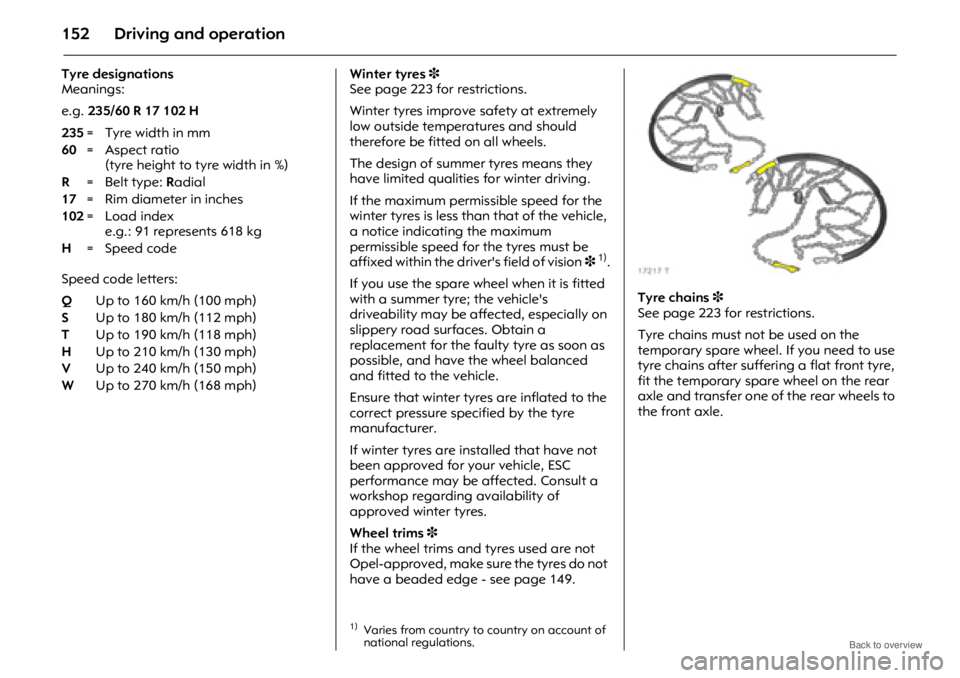
have a beaded edge - see page 149. Tyre chains
3
See page 223 for restrictions.
Tyre chains must not be used on the
temporary spare wheel. If you need to use
tyre chains after suffering a flat front tyre,
fit the temporary spare wheel on the rear
axle and transfer one of the rear wheels to
the front axle.
235
=Tyre width inmm
60 =Aspect ratio
(tyre height to tyre width in %)
R =Belt type: Radial
17 = Rim diameter in inches
102 =Load index
e.g.: 91 represents 618 kg
H = Speed code
Q Up to 160 km/h (100 mph)
S Up to 180 km/h (112 mph)
T Up to 190 km/h (118 mph)
H Up to 210 km/h (130 mph)
V Up to 240 km/h (150 mph)
W Up to 270 km/h (168 mph)
1)Varies from country to country on account of
national regulations.
Page 204 of 234

Self-help, vehicle care204
Plastic and rubber parts
For additional cleaning of plastic and
rubber parts, use a cleaner suitable for
vehicle interiors. Do not use any other
agent, and in particular do not use solvents
or petrol.
Wheels and tyres
Do not use high-pressure jet cleaners on
wheels and tyres.
Interior and upholstery
Clean the vehicle interior regularly,
including the instrument panel fascia,
using Interior/Upholstery Cleaner.
Clean fabric upholstery with a vacuum
cleaner and brush. To remove stains, use a
cleaner that is suitable for both fabrics and
vinyl.
Open Velcro fastener s on clothing could
damage seat upholstery. Make sure that
Velcro fasteners are closed.
Do not use cleaning agents such as
acetone, carbon te trachloride, paint
thinner, paint remover, nail varnish
remover, washing powder or bleach to
clean fabrics, carpets, the instrument panel
or leather trim 3 in the vehicle interior.
Benzine, petrol, naphth a, enamel reducers
and lacquer thinners are also unsuitable. Avoid over-exposure to vapours from
cleaning agents and
other chemicals when
cleaning. Whenever possible, avoid using
such cleaning agents in small, unventilated
spaces, to avoid inhalation of dangerous
vapours. Open the doors.
If the front seats are equipped with side
airbags 3, do not use chemical solvents or
strong detergents on the seat covers.
Do not saturate the seat covers with
Interior/Upholstery Cleaner, to avoid
contaminating the airbag system,
otherwise the side airbags 3 may not
trigger in the event of a collision. Seat belts
Always keep seat be
lts clean and dry.
Clean seat belts only with lukewarm water
or Interior/Upholstery Cleaner.
Periodically check the seat belts and
replace immediately with new seat belts if
damage or weakening of the belts has
occurred.
Windows
When cleaning the heated rear window,
make sure that the heating element on the
inside of the window is not damaged.
Never place stickers on the inside of the
rear window.
Use a soft, lint-fr ee cloth or chamois
leather, in conjunction with Window
Cleaning Spray and Insect Remover. Do not
use sharp instruments or abrasive cleaners.
Opel Cleaning Solvent and Antifreeze is
suitable for de-icing windows.
For mechanical removal of ice, use a
commercially available sharp-edged ice
scraper. Press the scraper firmly against
the glass so that no dirt can get under it
and scratch the glass.
Page 205 of 234

Self-help, vehicle care205
Windscreen wiper blades
Wax, such as that used in car washes, can
cause streaks to form on the windscreen
when the wipers are used.
Smearing wiper blades can be cleaned with
a soft cloth and Opel Cleaning Solvent and
Antifreeze, and replaced if necessary –
see page 198. Do not use abrasive
cleaners.
Locks
The locks are lubricated with a high-grade
lock cylinder grease at the factory. Opel
Lock Cylinder Grease prevents the locks
from freezing up.
Only use de-icing agents in emergencies,
as they have a degreasing effect and will
impair the function of the locks. After using
a de-icing agent, have the locks re-greased
by a workshop. Engine compartment
Areas of the engine compartment that are
painted in the same colour as the vehicle
must be looked after
like any other painted
surface.
It is advisable to wash the engine
compartment before and after winter and
preserve it with wax. Cover alternator and
fluid reservoirs with plastic sheets before
washing the engine.
When washing the engine with a steam-jet
cleaner, do not direct the steam-jet at
components of the Anti-lock Brake System
(ABS), the air conditioning system or the
belt drive and its components.
Protective wax that has been applied is
also removed during the engine wash. For
this reason, have the engine, brake system
components in the engine compartment,
axle components with steering, body parts
and cavities thoroughly preserved with
protective wax after the wash.
An engine wash can be performed in the
spring in order to remove dirt that has
adhered to the engine compartment,
which may also have a high salt content.
Check protective wax layer and make good
if necessary. Underbody
Your vehicle has a factory-applied PVC
undercoating in the wheel arches
(including the longitudinal members) which
provides permanent protection and needs
no special maintenance. The surfaces of
the vehicle underbody not covered by PVC
are provided with a durable protective wax
coating in critical areas.
On vehicles which are washed frequently
in automatic car wash
es with underbody
washing facility, the protective wax
coating may be impaire d by dirt-dissolving
additives. Check the underbody after
washing and have it waxed if necessary.
Before the start of the cold weather season,
check the PVC coating and protective wax
coating and, if necessary, have them
restored to perfect condition.
Caution
– commercially available bitumen/
rubber materials can damage the PVC
coating. We recommend that you have
underbody work carried out by a
workshop, who knows the prescribed
materials and has experience in the use
thereof.
The underbody should be washed
following the end of the cold weather
season to remove any dirt adhering to the
underbody since this may also contain salt.
Check protective wax coating and, if
necessary, have it restored to perfect
condition.
Page 207 of 234

Service, maintenance 207
European service schedule
(Antara Z 20 DM, Z 20 DMH, Z 24 XE, Z 32 SE) Service operations by year 1)
km ( x 1000)1)
miles ( x 1000)1)
1)Whichever occurs first.
15
101
30
20 45
30 2
60
40 75
50 3
90
60
Controls, lighting, signalling equi pment and airbags: visual check
steering lock and ignition lock: check xxx
Remote control batteries: replace Every 2 years
Windscreen wipers, windscreen washer system: check, correct xxx
Coolant level and antifreeze: check, correct
Hoses: check for tightness and secure seating xxx
Brake fluid level: check, correct xxx
Battery terminals: check for secu re connections and battery eye xxx
Vehicle system check with TECH2 xxx
Pollen filter: replace xxx
oMore often for when dust, sand or polle n is in the air Agreement with customer
Air cleaner element: replace
xxx
⊕Spark plugs and plug leads: replace Every 90 000 km/60 000 miles
Ribbed V-belt: visual check xxx
⊕Toothed belt and tension roller: visual check xxx
Toothed belt and tension roller: replace - Z 24 XE Every 8 years/120 000 km/80 000 miles
Toothed belt and tension roller: replace - Z 20 DM, Z 20 DMH Every 6 years/90 000 km/60 000 miles
Power steering system: check for leak s. Fluid level: check, correct xxx
Engine oil and oil filter: replace - fixed interval Z 24 XE
2)
2)On vehicles with oil life monitoring, it may be necessary to change the engine oil earlier (control indicator illuminates).
xxxxxx
Z 20 DM, Z 20 DMH, Z 32 SE, except2)xxx
Page 209 of 234

Service, maintenance 209
International service schedule
(All except Z 24 XE) Service operations by year 1)
km ( x 1000)1)
miles ( x 1000)1)
1)Whichever occurs first.
15
101
30
20 45
30 2
60
40 75
50 3
90
60
Controls, lighting, signalling equi pment and airbags: visual check
steering lock and ignition lock: check xxxxxx
Remote control batteries: replace Every 2 years
Windscreen wipers, windscreen wa sher system: check, correct x x x x x x
Coolant level and antifreeze: check, correct
Hoses: check for tightness and secure seating Annually
Brake fluid level: check, correct xx
Battery terminals: check for secure connections and battery eye Annually
Vehicle system check with TECH2 Annually
Pollen filter: replace xxx
oMore often for when dust, sand or pollen is in the air Annually/15 000 km/10 000 miles
Air cleaner element: replace
xxx
oMore often for when dust or sand is in the air Annually/15 000 km/10 000 miles
⊕Spark plugs and plug leads: replace Every 90 000 km/60 000 miles
Ribbed V-belt: visual check xxx
⊕Toothed belt and tension roller: visual check Annually/15 000 km/10 000 miles
Toothed belt and tension roller: replace - Z 20 DM, Z 20 DMH Every 6 years/90 000 km/60 000 miles
Power steering system: check for leaks. Fluid level: check, correct Annually
Engine oil and oil filter: replace x x x x x x
Page 211 of 234

Service, maintenance 211
International service schedule
(Antara Z 24 XE) Service operations by month 1)
km ( x 1000)1)
miles ( x 1000)1)
1)Whichever occurs first.
6
10
6.5 12
20
1318
30
2024
40
26.5 30
50
3336
60
40
Controls, lighting, signalling equi pment and airbags: visual check
steering lock and ignition lock: check xxx
Remote control batteries: replace Every 2 years
Windscreen wipers, windscreen washer system: check, correct xxx
Coolant level and antifreeze: check, correct
Hoses: check for tightness and secure seating xxx
Brake fluid level: check, correct xxx
Battery terminals: check for secu re connections and battery eye xxx
Vehicle system check with TECH2 xxx
Pollen filter: replace Annually/30 000 km/20 000 miles
oMore often for when dust, sand or pollen is in the air Agreement with customer
Air cleaner element: replace
Annually/30 000 km/20 000 miles
⊕Spark plugs and plug leads: replace Every 90 000 km/60 000 miles
Ribbed V-belt: visual check xxx
⊕Toothed belt and tension roller: visual check Annually/30 000 km/20 000 miles
Toothed belt and tension roller: replace Every 8 years/120 000 km/80 000 miles
Power steering system: check for leak s. Fluid level: check, correct xxx
Engine oil and oil filter: replace - fixed interval
2)
2)On vehicles with oil life monitoring, it may be necessary to change the engine oil earlier (control indicator illuminates).
xxxxxx
Page 228 of 234

Index228
IndexA
ABS ......................................................... 148
Accessories
......... 45, 57, 69, 169, 191, 200
Accessory sockets
................................... 69
Active Rollover Protection (ARP)
.......... 138
Air conditioning system
................ 103, 109
Air distribution
....................................... 106
Air intake
............................................... 114
Air quality sensor
.................................. 112
Air recirculation mode
.......................... 109
Air vents
................................................. 104
Airbags
.................................. 42, 52, 54, 55
Alarm
....................................................... 29
Alarm system
........................................... 27
All Wheel Drive (AWD)
.......................... 121
Alternator
................................................ 74
Antenna
......................................... 101, 202
Antifreeze
...................................... 195, 214
Antifreeze protection
.................... 195, 199
Anti-knock quality of fuel
..................... 131
Octane number
................................. 217
Anti-lock Brake System (ABS)
.............. 148
Anti-theft alarm system
.......................... 27
Anti-theft locking system
........................ 27
Towing equipment
............................ 166
Approach lighting
................................... 94
Aquaplaning
......................................... 151
Armrests
............................................. 40, 42
Ashtrays
................................................... 67
Illumination
........................................ 100
Assist grips
............................................... 69
Automatic air recirculation
.................. 112
Automatic anti-dazzle exterior mirrors
.31 Automatic anti-dazzle interior mirror
... 32
Automatic dipped beam activation
...... 95
Automatic level control
.................. 97, 143
Automatic transmission
................. 18, 115
Automatic mode
............................... 116
Engine braking assistance
............... 118
Fault
................................................... 120
Interruption of power supply
............ 120
Kickdown
................................... 117, 118
Manual mode
.................................... 117
Rocking the vehicle
........................... 119
Selector lever
..................................... 116
Transmission display
........................ 116
Winter program
................................. 117
B
Battery ................................................... 200
Interruption of power supply
............ 120
Battery discharge protection
............... 100
Before starting-off
.................................. 18
Belt force limiters
.................................... 44
Belt tensioners
......................................... 44
Belts
....................................... 8, 42, 43, 204
Bleeding, diesel fuel system
................. 171
Board information display
............... 76, 78
Bonnet
.................................................... 171
Boot, see Luggage compartment
......... 41
Brake assist
........................................... 146
Brake fluid
............................................. 214
Brake system
......................................... 145