fuel OPEL ANTARA 2009 Owner's Manual
[x] Cancel search | Manufacturer: OPEL, Model Year: 2009, Model line: ANTARA, Model: OPEL ANTARA 2009Pages: 234, PDF Size: 3.01 MB
Page 130 of 234

Driving and operation130
Overrun
zThe fuel supply is automatically shut off
during overrun, e.g. when the vehicle is
being driven down long gradients or
during braking - see page 128.
z To enable the overrun cut-off to take
effect and save fuel, do not accelerate or
declutch.
Correct gear selection
z High revs increase engine wear and fuel
consumption.
z Do not race your engine. Avoid driving at
high engine speeds.
Driving with an eye on the tachometer
saves fuel. If possible, drive at low revs in
each gear and at a constant speed.
Drive in top gear as much as possible,
shift up as soon as possible and do not
shift down prematurely.
High speed
z The faster the speed, the higher the fuel
consumption and noise level. Driving at
full throttle uses up a great deal of fuel
and generates excessive noise and high
emission levels.
z Slightly releasing the accelerator pedal
results in distinct fu el savings with no
major loss of speed.
Drive at no more than around three
quarters of maximum speed and you will
use up to 50% less fuel, without losing a
great deal of time. Tyre pressure
z
Inadequate tyre pressure, leading to
higher road resistance, costs money in
two ways; for more fuel and increased
tyre wear.
z Regular checks (every 14 days) pay off.
Electrical loads
z The power consumption of electrical
equipment increases fuel consumption.
z Switch off all additional consumers (e.g.
air conditioning, heated rear window)
when they are no longer required.
Roof racks 3
z Roof racks can increase fuel
consumption by approx. 1 l/100 km
(3.5 gal./1000 miles) due to air
resistance.
z Remove them if they are not being used. Repair and maintenance
z
Improper repairs or adjustment and
maintenance work can increase fuel
consumption. Do not carry out work on
the engine yourself.
You may, out of ignorance, infringe
environmental laws by not disposing of
materials properly.
Appropriate parts might not be recycled.
Contact with some of the materials
involved may pose a health hazard.
z We recommend that repairs and
maintenance be entrusted to an
Opel Partner.
Extreme driving conditions
z Driving up steep gradients, cornering,
driving on poor roads, and winter driving
all increase fuel consumption.
Fuel consumption increases dramatically
in urban traffic and at winter
temperatures, especially on short trips
when the engine operating temperature
is not reached.
z Follow the hints given above to keep fuel
consumption to a minimum under such
conditions.
Page 131 of 234

Driving and operation131
Fuels, refuelling
Fuel consumption
Optional equipment (e.g. wide tyres,
towing equipment) increases the kerb
weight and, in some cases, also the
permissible Gross Vehicle Weight.
This in turn increases fuel consumption and
reduces the maximum speed of the vehicle.
When the vehicle is new, there is increased
friction between the engine and
transmission components lasting for
several thousand kilometres. This also
increases fuel consumption. Fuel for petrol engines
Commercially available high-quality fuels
are suitable (see page 217). Fuel quality
has a decisive influence on the power
output, driveability and life of the engine.
The additives contained in the fuel play an
important role in this
regard. You should
therefore use only high-quality fuels
containing additives.
Petrol with too low an octane number can
cause pinking. Opel cannot be held liable
for resulting damage.
Petrol with a higher octane number can
always be used.
A dispensing pump for leaded fuel cannot
be inserted in the fuel tank of a vehicle that
must be operated on unleaded fuel only.
Use of petrol with an octane rating of 95
will ensure economical driving Fuel for diesel engines
Diesel engines must be operated only on
commercially available diesel fuel meeting
the specifications of DIN EN 590.
Marine diesel fuel, fuel oils, diesel fuels,
which are entirely or partially plant based
such as rape seed oil or bio-diesel,
Aquazole and similar diesel-water
emulsions must not be used.
The flow and filterability of diesel fuels are
insufficient at low temperatures, as a result
of crystallized paraffins.
Diesel fuels with improved low-
temperature properties are therefore
available on the market during the winter
months. Make sure that you use winter fuel
before the start of the cold weather
season.
Use of diesel fuels with manufacturer-
guaranteed winter properties eliminates
the need for additives.
Page 132 of 234
Driving and operation132
Fuel filler cap
If replacing the fuel filler cap, be sure to use
the original fuel filler cap for your model, to
ensure full functionality.
Refuelling
Ensure suitable fuel is available before
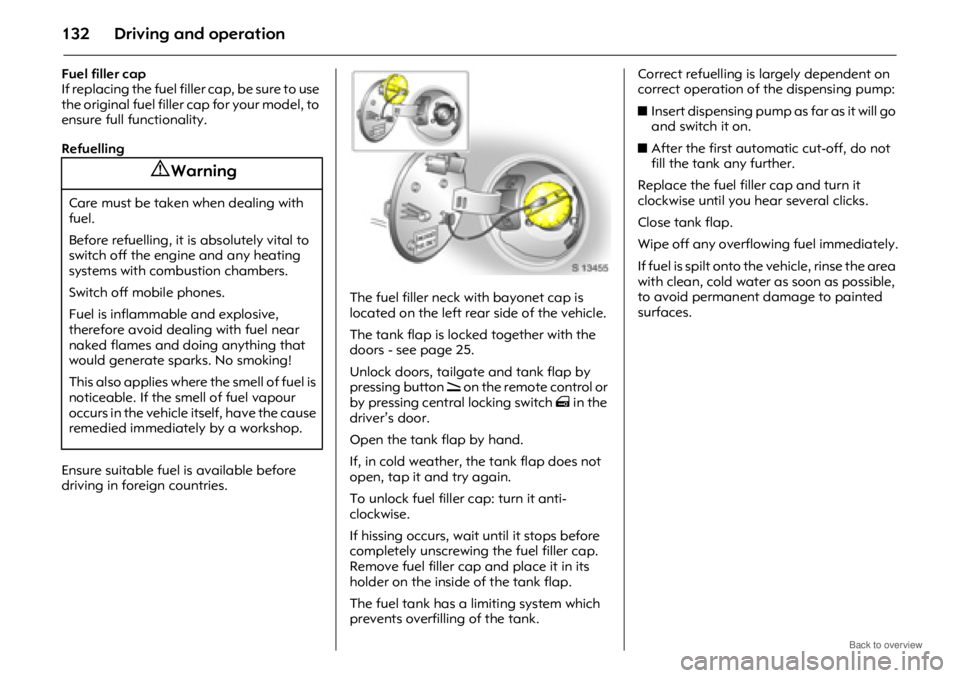
driving in foreign countries. The fuel filler neck with bayonet cap is
located on the left rear side of the vehicle.
The tank flap is locked together with the
doors - see page 25.
Unlock doors, tailgate and tank flap by
pressing button q
on the remote control or
by pressing central locking switch m in the
driver’s door.
Open the tank flap by hand.
If, in cold weather, the tank flap does not
open, tap it and try again.
To unlock fuel filler cap: turn it anti-
clockwise.
If hissing occurs, wait until it stops before
completely unscrewing the fuel filler cap.
Remove fuel filler cap and place it in its
holder on the inside of the tank flap.
The fuel tank has a limiting system which
prevents overfilling of the tank. Correct refuelling is largely dependent on
correct operation of the dispensing pump:
z
Insert dispensing pump as far as it will go
and switch it on.
z After the first automatic cut-off, do not
fill the tank any further.
Replace the fuel filler cap and turn it
clockwise until you hear several clicks.
Close tank flap.
Wipe off any overflowing fuel immediately.
If fuel is spilt onto the vehicle, rinse the area
with clean, cold water as soon as possible,
to avoid permanent damage to painted
surfaces.
9 Warning
Care must be taken when dealing with
fuel.
Before refuelling, it is absolutely vital to
switch off the engi ne and any heating
systems with combustion chambers.
Switch off mobile phones.
Fuel is inflammable and explosive,
therefore avoid dealing with fuel near
naked flames and doing anything that
would generate sparks. No smoking!
This also applies where the smell of fuel is
noticeable. If the smell of fuel vapour
occurs in the vehicle itself, have the cause
remedied immediately by a workshop.
Page 133 of 234
Driving and operation133
Catalytic converter, exhaust
emissions
Catalytic converter for petrol engines
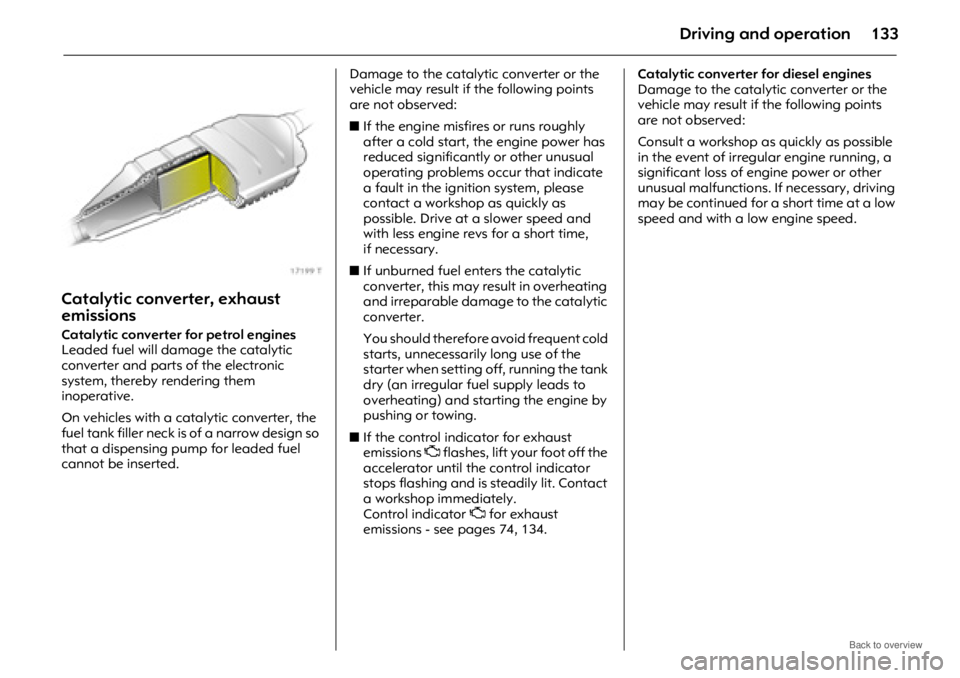
Leaded fuel will damage the catalytic
converter and parts of the electronic
system, thereby rendering them
inoperative.
On vehicles with a catalytic converter, the
fuel tank filler neck is of a narrow design so
that a dispensing pump for leaded fuel
cannot be inserted. Damage to the catalytic converter or the
vehicle may result if the following points
are not observed:
z
If the engine misfires or runs roughly
after a cold start, the engine power has
reduced significantly or other unusual
operating problems occur that indicate
a fault in the ignition system, please
contact a workshop as quickly as
possible. Drive at a slower speed and
with less engine revs for a short time,
if necessary.
z If unburned fuel enters the catalytic
converter, this may re sult in overheating
and irreparable damage to the catalytic
converter.
You should therefore avoid frequent cold
starts, unnecessarily long use of the
starter when setting off, running the tank
dry (an irregular fuel supply leads to
overheating) and starting the engine by
pushing or towing.
z If the control indicator for exhaust
emissions Z flashes, lift your foot off the
accelerator until th e control indicator
stops flashing and is steadily lit. Contact
a workshop immediately.
Control indicator Z for exhaust
emissions - see pages 74, 134. Catalytic converter for diesel engines
Damage to the catalytic converter or the
vehicle may result if the following points
are not observed:
Consult a workshop as quickly as possible
in the event of irregular engine running, a
significant loss of engine power or other
unusual malfunctions. If necessary, driving
may be continued for a
short time at a low
speed and with a low engine speed.
Page 134 of 234
Driving and operation134
Controlling exhaust emission
Through design-related measures,
primarily in the fuel injection and ignition
systems (in combination with the catalytic
converter), the proportion of noxious
materials in the exhaust, such as carbon
monoxide (CO), hydrocarbons (CH) and
nitrogen oxides (NO
x), is reduced to a
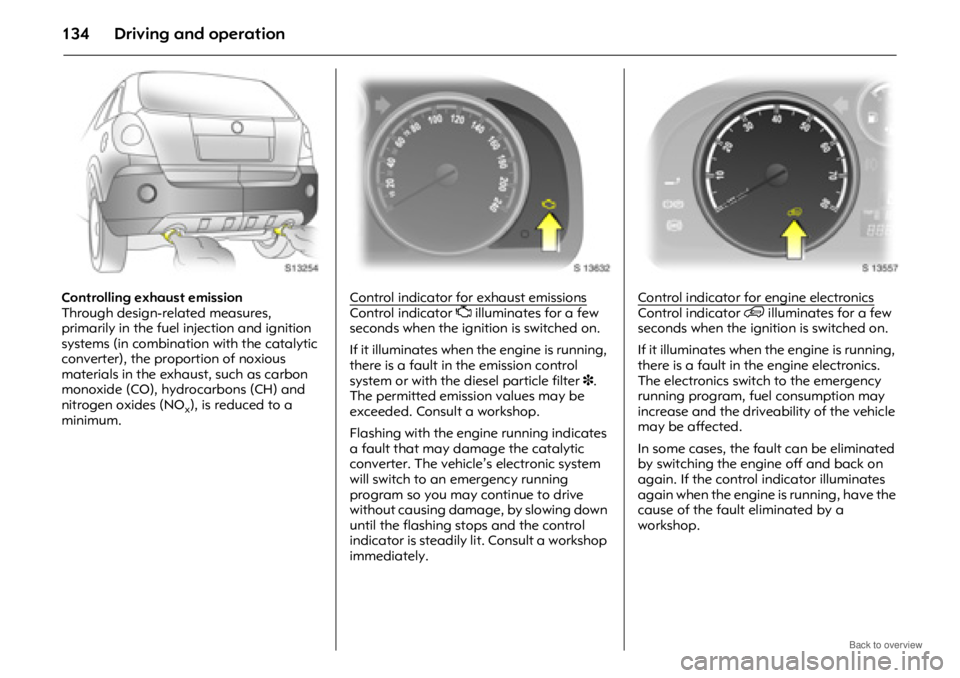
minimum. Control indicator for exhaust emissions
Control indicator
Z illuminates for a few
seconds when the ignition is switched on.
If it illuminates when the engine is running,
there is a fault in the emission control
system or with the diesel particle filter 3.
The permitted emission values may be
exceeded. Consult a workshop.
Flashing with the engine running indicates
a fault that may damage the catalytic
converter. The vehicle’ s electronic system
will switch to an emergency running
program so you may continue to drive
without causing damage, by slowing down
until the flashing stops and the control
indicator is steadily lit. Consult a workshop
immediately. Control indicator for engine electronicsControl indicator
3 illuminates for a few
seconds when the ignition is switched on.
If it illuminates when the engine is running,
there is a fault in the engine electronics.
The electronics switch to the emergency
running program, fuel consumption may
increase and the driveability of the vehicle
may be affected.
In some cases, the fault can be eliminated
by switching the engi ne off and back on
again. If the control indicator illuminates
again when the engine is running, have the
cause of the fault eliminated by a
workshop.
Page 135 of 234

Driving and operation135
Exhaust gases
Do not run engine in enclosed spaces, e.g.
in a garage, or sit in a parked vehicle for an
extended period with the engine running.
Do not drive with tailgate open. If driving
with the tailgate open is necessary, set fan
to highest speed, close windows and
ensure air recirculation mode is off, to allow
entry of outside air.
If the underbody or rear of vehicle is
damaged or corroded, you notice a
change in the sound of the exhaust system,
or whenever you suspect exhaust gases are
penetrating the vehicle interior, consult a
workshop immediately.
When the vehicle is driven for the first time,
wax and oil on the exhaust system may
evaporate, producing smoke-like emissions
which should not be inhaled. Allow wax
and oil to evaporate while the vehicle is in
the open air. Diesel particle filter (DPF) 3
The diesel particle filter removes polluting
soot particles out of the exhaust.
The system contains a self-cleaning
function at certain intervals. The filter is
cleaned by burning the soot particles at
high temperature. This procedure runs
automatically under certain vehicle
conditions and can take up to 15 minutes,
during which time fuel consumption may
increase. The smell and the noise that
occur are normal.
The system cannot automatically clean
itself under certain vehicle conditions, such
as driving short distances.
If control indicator
I illuminates, you
should continue driving, and as soon as the
road and traffic situation permits it,
increase speed to more than 50 km/h
(30 mph) and diesel particle filter cleaning
will start.
Cleaning is quicker at faster speeds and
under load. The engine speed should not
drop below 2000 rpm. The control indicator
extinguishes as soon as cleaning is
complete.
We recommend that you do not turn the
ignition off during cleaning. Maintenance
Have all maintenance work carried out at
the intervals specified by Opel. We
recommend that you entrust this work to
your Opel Partner, who has proper
equipment and trained personnel
available. Electronic testing of systems
permits rapid diagnosis and remedy of
faults. This way, you can be certain that all
components of the vehicle’s electrical,
injection and ignition systems operate
correctly, that your ve
hicle has a low level
of pollutant emission and that the catalytic
converter system will have a long service
life.
You are thereby making an important
contribution towards keeping the air clean
and compliance with emissions legislation.
Checking and adjustment of the fuel-
injection and ignition systems is part of the
scope of a Service. For this reason, you
should have all maintenance work carried
out at the intervals specified in the chapter
"Service, Maintanance" on page 206.
9 Warning
Engine exhaust gases contain poisonous
carbon monoxide, which has no colour or
odour and can be lethal if inhaled.
If exhaust fumes penetrate the vehicle
interior, open the windows and consult a
workshop immediately.
Page 150 of 234
Driving and operation150
Tyre pressure
Check tyre pressures when cold, at least
every 14 days and prior to any long
journey. Don't forget to check the spare.
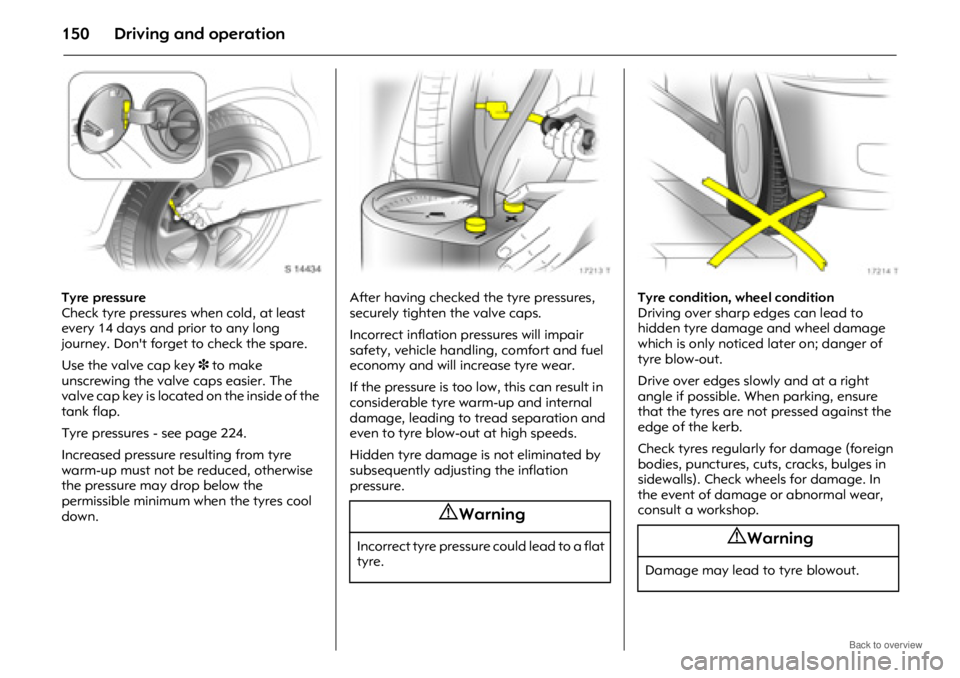
Use the valve cap key 3 to make
unscrewing the valve caps easier. The
valve cap key is located on the inside of the
tank flap.
Tyre pressures - see page 224.
Increased pressure resulting from tyre
warm-up must not be reduced, otherwise
the pressure may drop below the
permissible minimum when the tyres cool
down. After having checked the tyre pressures,
securely tighten the valve caps.
Incorrect inflation pressures will impair
safety, vehicle handling, comfort and fuel
economy and will increase tyre wear.
If the pressure is too low, this can result in
considerable tyre warm-up and internal
damage, leading to tread separation and
even to tyre blow-out at high speeds.
Hidden tyre damage is not eliminated by
subsequently adjusting the inflation
pressure.
Tyre condition, wheel condition
Driving over sharp edges can lead to
hidden tyre damage and wheel damage
which is only noticed later on; danger of
tyre blow-out.
Drive over edges slowly and at a right
angle if possible. When parking, ensure
that the tyres are not pressed against the
edge of the kerb.
Check tyres regularly for damage (foreign
bodies, punctures, cuts, cracks, bulges in
sidewalls). Check wheels for damage. In
the event of damage
or abnormal wear,
consult a workshop.
9 Warning
Incorrect tyre pressure could lead to a flat
tyre.9 Warning
Damage may lead to tyre blowout.
Page 171 of 234

Self-help, vehicle care171
Self-help, vehicle care
Diesel fuel system, bleeding
Never let the fuel tank run dry. If control
indicator Y illuminates, refuel as soon as
possible.
It is possible to restart the engine if the tank
has been run dry. A delayed start can be
expected. Switch on the ignition three times
for approx. 15 seconds. Then try to start
the engine for no more than 40 seconds. If
the engine will not start, wait at least
10 seconds before trying again. If the
engine will still not start, consult a
workshop.
Bonnet
To open the bonnet, pull release lever /
located on the left-hand side below the
instrument panel.
The bonnet will then be unlocked and will
partially open. Return release lever to its
original position.
Do not pull release lever while the vehicle is
moving.
Diesel fuel system, bleeding .............. 171
Bonnet ................................................. 171
Starting ................................................ 172
Starting the engine with jump leads
3 172
Towing ................................................. 174
Jack and vehicle tools ........................ 176
Warning triangle ¨ 3 ,
First aid kit +3................................ 177
Temporary spare wheel ..................... 177
Wheel changing .................................. 178
Electrical system ................................. 181
Fuses and the most important circuits they protect ...................................... 182
Bulb replacement ............................... 185
Opel genuine parts and accessories . 191
A note on safety ................................. 191
Checking and topping up fluids ........ 191
Windscreen wipers .............................. 198
Windscreen washer system ................ 199
Battery ................................................. 200
Protection of electr onic components 201
Vehicle storage ................................... 201
Vehicle care......................................... 201
9 Warning
Disregard of the instructions may lead to
injuries or endanger life. Vehicle
passengers must be informed
accordingly.
Page 184 of 234
184 Self-help, vehicle care
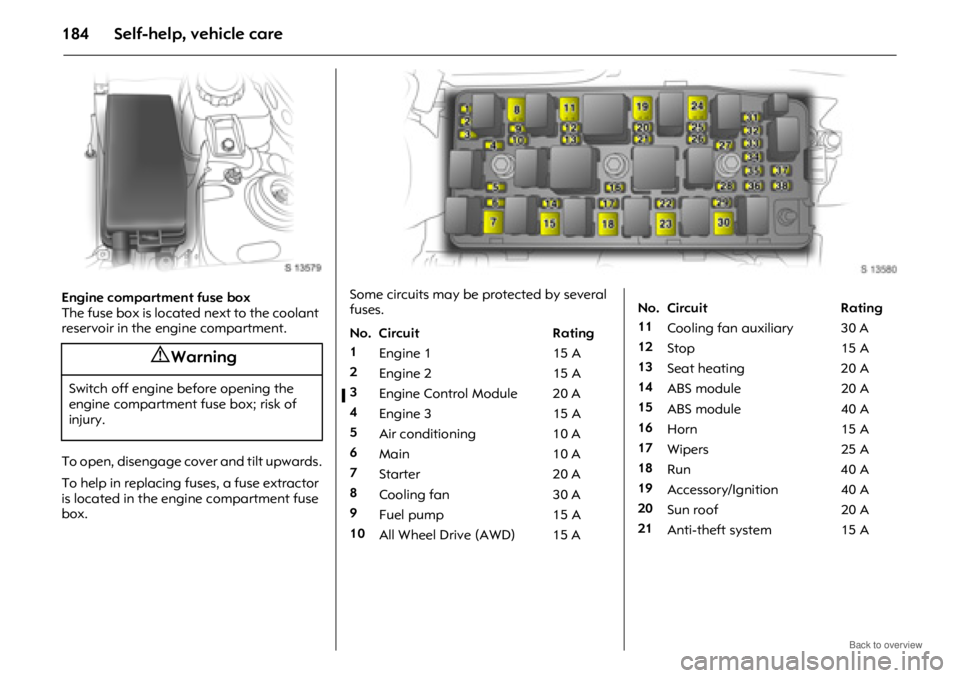
Engine compartment fuse box
The fuse box is located next to the coolant
reservoir in the engine compartment.
To open, disengage cover and tilt upwards.
To help in replacing fuses, a fuse extractor
is located in the engine compartment fuse
box.
9 Warning
Switch off engine before opening the
engine compartment fuse box; risk of
injury.
Some circuits may be protected by several
fuses.
No. Circuit Rating
1 Engine 1 15 A
2 Engine 2 15 A
3 Engine Control Module 20 A
4 Engine 3 15 A
5 Air conditioning 10 A
6 Main 10 A
7 Starter 20 A
8 Cooling fan 30 A
9 Fuel pump 15 A
10 All Wheel Drive (AWD) 15 ANo. Circuit Rating
11 Cooling fan auxiliary 30 A
12 Stop 15 A
13 Seat heating 20 A
14 ABS module 20 A
15 ABS module 40 A
16 Horn 15 A
17 Wipers 25 A
18 Run 40 A
19 Accessory/Ignition 40 A
20 Sun roof 20 A
21 Anti-theft system 15 A
Page 194 of 234
Self-help, vehicle care194
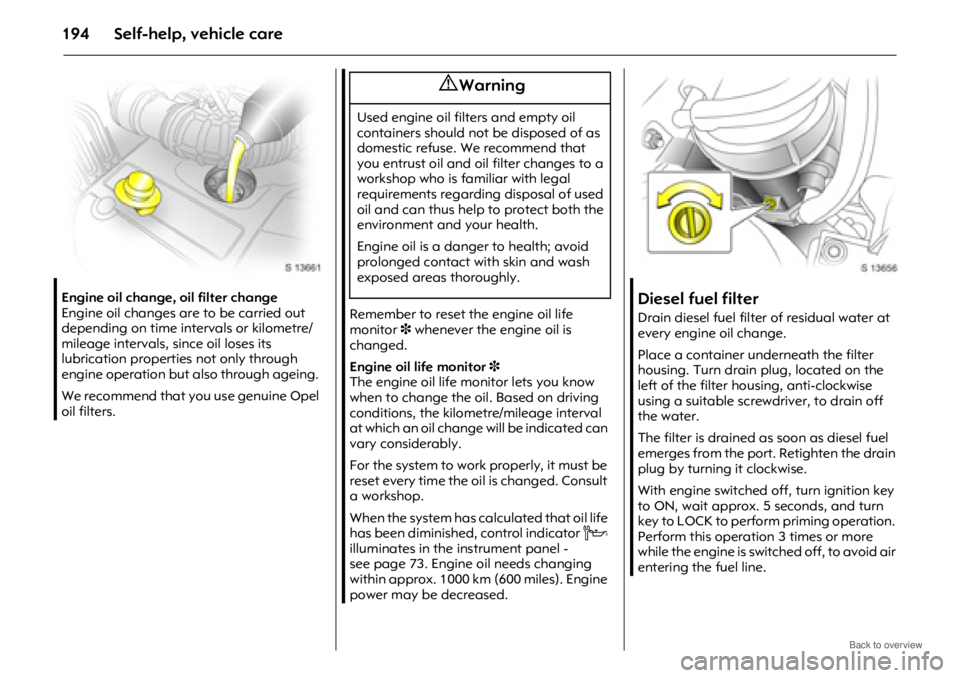
Engine oil change, oil filter change
Engine oil changes are to be carried out
depending on time intervals or kilometre/
mileage intervals, since oil loses its
lubrication properties not only through
engine operation but also through ageing.
We recommend that you use genuine Opel
oil filters.
Remember to reset the engine oil life
monitor 3 whenever the engine oil is
changed.
Engine oil life monitor 3
The engine oil life monitor lets you know
when to change the oil. Based on driving
conditions, the kilometre/mileage interval
at which an oil change will be indicated can
vary considerably.
For the system to work properly, it must be
reset every time the oil is changed. Consult
a workshop.
When the system has calculated that oil life
has been diminished, control indicator C
illuminates in the instrument panel -
see page 73. Engine oil needs changing
within approx. 1000 km (600 miles). Engine
power may be decreased.Diesel fuel filter
Drain diesel fuel filter of residual water at
every engine oil change.
Place a container underneath the filter
housing. Turn drain plug, located on the
left of the filter housing, anti-clockwise
using a suitable screwdriver, to drain off
the water.
The filter is drained as soon as diesel fuel
emerges from the port. Retighten the drain
plug by turning it clockwise.
With engine switched off, turn ignition key
to ON, wait approx. 5 seconds, and turn
key to LOCK to perform priming operation.
Perform this operation 3 times or more
while the engine is switched off, to avoid air
entering the fuel line.
9 Warning
Used engine oil filters and empty oil
containers should not be disposed of as
domestic refuse. We recommend that
you entrust oil and oil filter changes to a
workshop who is familiar with legal
requirements regarding disposal of used
oil and can thus help to protect both the
environment and your health.
Engine oil is a danger to health; avoid
prolonged contact with skin and wash
exposed areas thoroughly.