ignition OPEL ANTARA 2009 Repair Manual
[x] Cancel search | Manufacturer: OPEL, Model Year: 2009, Model line: ANTARA, Model: OPEL ANTARA 2009Pages: 234, PDF Size: 3.01 MB
Page 175 of 234
Self-help, vehicle care175
Keep tow rope 3 clear of front bumper,
and ensure it is secure ly fixed to the towing
eye at both ends. Pull on the tow rope 3 to
check.
To prevent entry of exhaust fumes from
towing vehicle, switch on air recirculation
mode (see page 109) and close the
windows.
Never let passengers ride in a vehicle that
is being towed.
Never tow a vehicle with damaged parts
that are not secured to the vehicle or if
wheels, brakes or steering are damaged.
Do not tow the vehicle with a tow rope 3 or
tow rod 3 for extended periods, to avoid
damage to the vehicle. Only tow in this
manner on hard-surfaced roads.
For vehicles with automatic transmission 3:
use flatbed or wheel lift equipment only.
Towing can cause severe damage to the
transmission.
Seek the assistance of a workshop. Towing service
Entrust your vehicle only to the towing
service of your choice and obtain an
estimate on towing costs before employing
any towing service. This will prevent
unnecessary expense and possible
insurance problems during claim
processing.
Use flatbed equipment whenever possible.
If vehicle is to be towed using a wheel lift,
tow with all wheels off the road, using a
towing dolly.
Never use sling-type equipment to tow the
vehicle or tow the vehicle with the front or
rear wheels on the road, to avoid causing
serious damage to the vehicle.
Place the gearshift lever in neutral
(automatic transmission 3
in N), switch on
hazard warning lamps, turn key to ignition
switch position ACC and release the
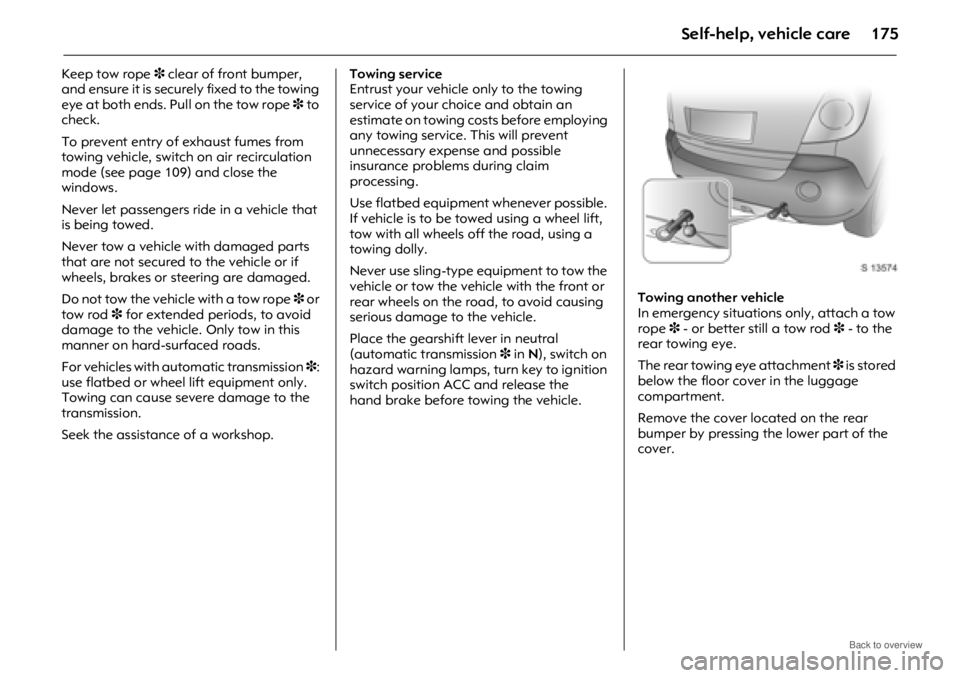
hand brake before towing the vehicle. Towing another vehicle
In emergency situations only, attach a tow
rope
3 - or better still a tow rod 3 - to the
rear towing eye.
The rear towing eye attachment 3 is stored
below the floor cover in the luggage
compartment.
Remove the cover located on the rear
bumper by pressing the lower part of the
cover.
Page 181 of 234

Self-help, vehicle care181
Electrical system
Fuses
There are two fuse boxes in the vehicle:
the instrument panel fu se box is located on
the left-hand side of the front passenger’s
footwell, the engine compartment fuse box
is located next to the coolant reservoir.
It is advisable to carry a full set of fuses.
Spare fuses are kept in the engine
compartment fuse box.
7. Change the wheel.
Notes on spare wheel - see page 178.
8. Screw on wheel nuts and tighten slightly by hand until wheel is held
against the hub.
9. Rotate wrench anti-clockwise and lower vehicle to the ground.
10. Tighten wheel nuts in a cross wise sequence, putting the wrench on as far
as possible.
11. Stow replaced wheel in luggage compartment.
12. Stow the jacking equipment and warning triangle 3 - see pages 176,
177.
13. Check the tyre pressure of the newly fitted wheel - see page 224. Adjust as
necessary.
14. Have the new wheel balanced on the vehicle and have the tightening torque
of the wheel nuts checked as soon as
possible, and if necessary, corrected.
Tightening torque - see page 223.
15. Replace defective tyre on the wheel that was removed.
16. Replace temporary spare wheel with a full specification wheel without delay.
9 Warning
Electronic ignition systems generate very
high voltages. Do not touch the ignition
system; high voltage can be fatal.
Page 182 of 234
Self-help, vehicle care182
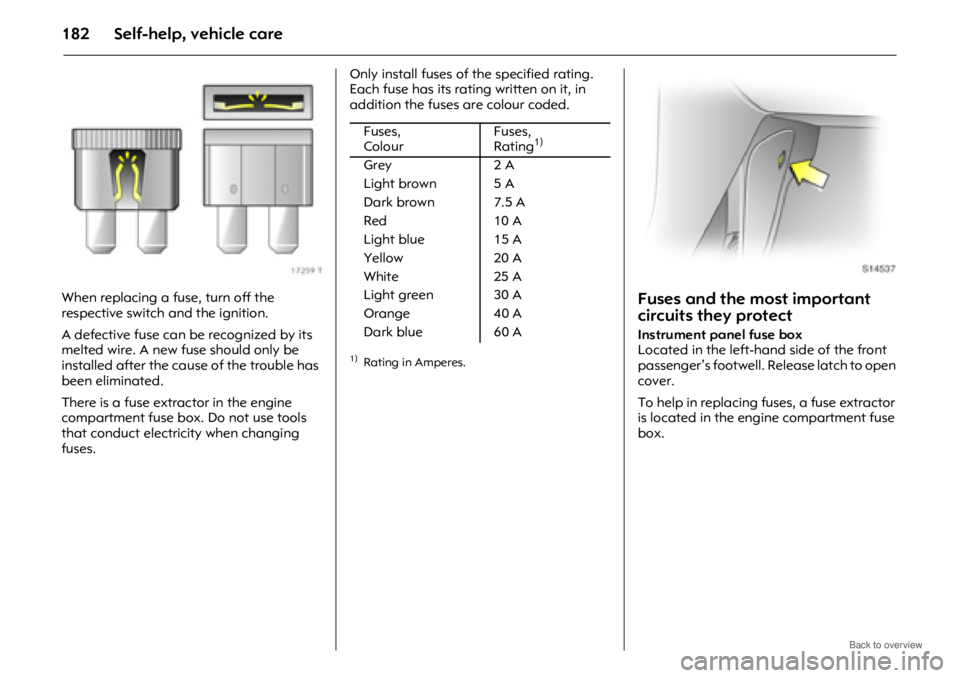
When replacing a fuse, turn off the
respective switch and the ignition.
A defective fuse can be recognized by its
melted wire. A new fuse should only be
installed after the cause of the trouble has
been eliminated.
There is a fuse extractor in the engine
compartment fuse box. Do not use tools
that conduct electricity when changing
fuses.Only install fuses of the specified rating.
Each fuse has its rating written on it, in
addition the fuses are colour coded.Fuses and the most important
circuits they protect
Instrument panel fuse box
Located in the left-hand side of the front
passenger’s footwell. Release latch to open
cover.
To help in replacing fu
ses, a fuse extractor
is located in the engine compartment fuse
box.
Fuses,
Colour Fuses,
Rating1)
1)Rating in Amperes.
Grey
2 A
Light brown 5 A
Dark brown 7.5 A
Red 10 A
Light blue 15 A
Yellow 20 A
White 25 A
Light green 30 A
Orange 40 A
Dark blue 60 A
Page 183 of 234
Self-help, vehicle care 183
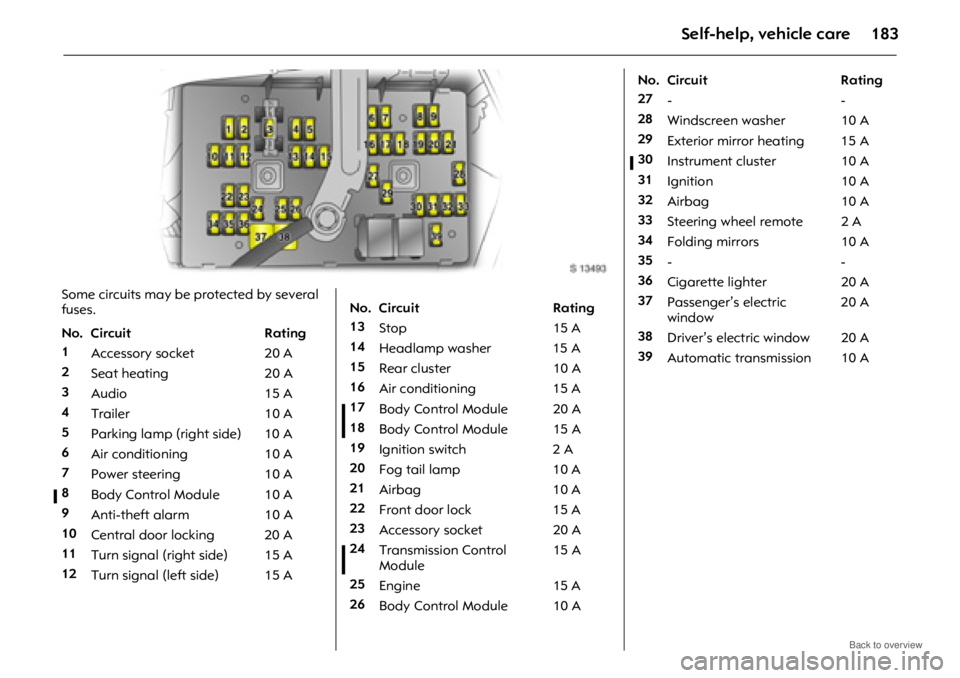
Some circuits may be protected by several
fuses.
No. Circuit Rating
1Accessory socket 20 A
2 Seat heating 20 A
3 Audio 15 A
4 Trailer 10 A
5 Parking lamp (right side) 10 A
6 Air conditioning 10 A
7 Power steering 10 A
8 Body Control Module 10 A
9 Anti-theft alarm 10 A
10 Central door locking 20 A
11 Turn signal (right side) 15 A
12 Turn signal (left side) 15 ANo. Circuit Rating
13 Stop 15 A
14 Headlamp washer 15 A
15 Rear cluster 10 A
16 Air conditioning 15 A
17 Body Control Module 20 A
18 Body Control Module 15 A
19 Ignition switch 2 A
20 Fog tail lamp 10 A
21 Airbag 10 A
22 Front door lock 15 A
23 Accessory socket 20 A
24 Transmission Control
Module 15 A
25 Engine 15 A
26 Body Control Module 10 A
No. Circuit Rating
27 --
28 Windscreen washer 10 A
29 Exterior mirror heating 15 A
30 Instrument cluster 10 A
31 Ignition 10 A
32 Airbag 10 A
33 Steering wheel remote 2 A
34 Folding mirrors 10 A
35 --
36 Cigarette lighter 20 A
37 Passenger’s electric
window 20 A
38 Driver’s electric window 20 A
39 Automatic transmission 10 A
Page 184 of 234
184 Self-help, vehicle care
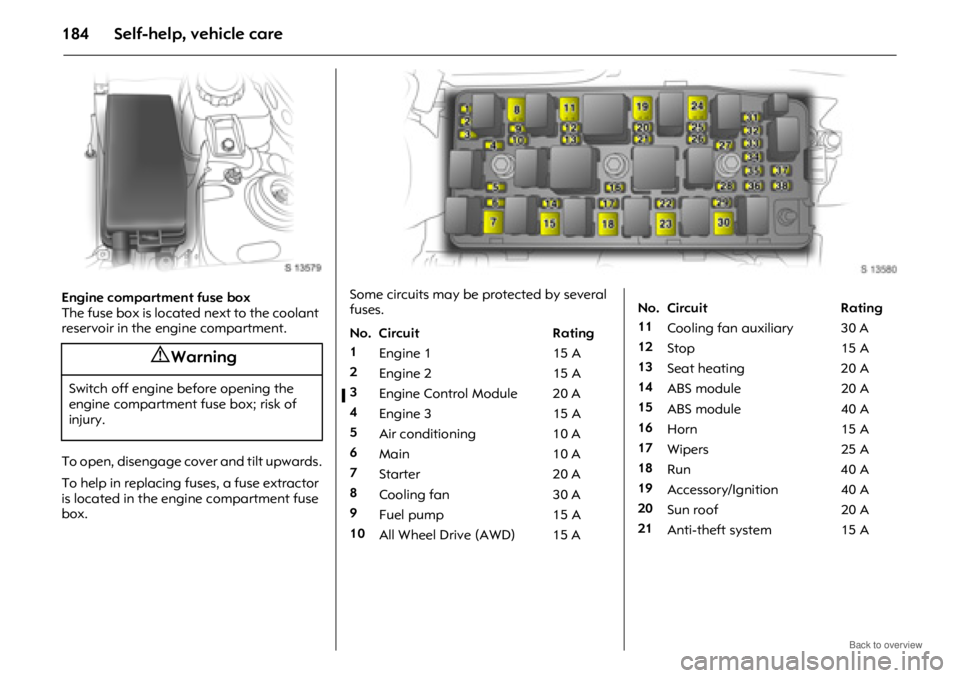
Engine compartment fuse box
The fuse box is located next to the coolant
reservoir in the engine compartment.
To open, disengage cover and tilt upwards.
To help in replacing fuses, a fuse extractor
is located in the engine compartment fuse
box.
9 Warning
Switch off engine before opening the
engine compartment fuse box; risk of
injury.
Some circuits may be protected by several
fuses.
No. Circuit Rating
1 Engine 1 15 A
2 Engine 2 15 A
3 Engine Control Module 20 A
4 Engine 3 15 A
5 Air conditioning 10 A
6 Main 10 A
7 Starter 20 A
8 Cooling fan 30 A
9 Fuel pump 15 A
10 All Wheel Drive (AWD) 15 ANo. Circuit Rating
11 Cooling fan auxiliary 30 A
12 Stop 15 A
13 Seat heating 20 A
14 ABS module 20 A
15 ABS module 40 A
16 Horn 15 A
17 Wipers 25 A
18 Run 40 A
19 Accessory/Ignition 40 A
20 Sun roof 20 A
21 Anti-theft system 15 A
Page 185 of 234
Self-help, vehicle care185
Bulb replacement
Before replacing a bulb , switch off ignition
and relevant switch.
Only hold new bulbs at base! Do not touch
the bulb glass with bare hands, otherwise
fingerprints on the glass evaporate and
residue builds up on the reflector
eventually resulting in a dull reflector.
Inadvertently stained bulbs may be
cleaned with a clean lint-free cloth, using
alcohol or white spirit.
Replacement bulb must be in accordance
with data on base of defective bulb. Do not
exceed wattage given on bulb base.
Headlamp aiming
We recommend that headlamp aiming be
carried out by a work shop, which will have
special equipment.
When aiming your headlamps, the manual
headlamp range adjustment 3 must be set
to 7. Headlamp removal
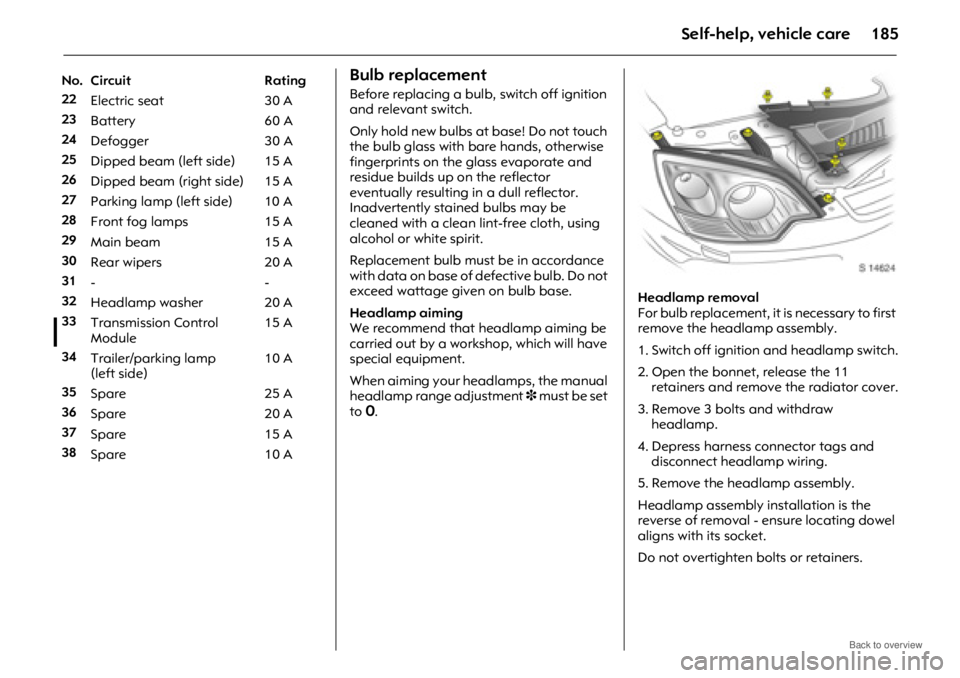
For bulb replacement, it is necessary to first
remove the headlamp assembly.
1. Switch off ignition and headlamp switch.
2. Open the bonnet, release the 11
retainers and remove the radiator cover.
3. Remove 3 bolts and withdraw headlamp.
4. Depress harness connector tags and disconnect head lamp wiring.
5. Remove the headlamp assembly.
Headlamp assembly installation is the
reverse of removal - ensure locating dowel
aligns with its socket.
Do not overtighten bolts or retainers.
No. Circuit Rating
22
Electric seat 30 A
23 Battery 60 A
24 Defogger 30 A
25 Dipped beam (left side) 15 A
26 Dipped beam (right side) 15 A
27 Parking lamp (left side) 10 A
28 Front fog lamps 15 A
29 Main beam 15 A
30 Rear wipers 20 A
31 --
32 Headlamp washer 20 A
33 Transmission Control
Module 15 A
34 Trailer/parking lamp
(left side) 10 A
35 Spare 25 A
36 Spare 20 A
37 Spare 15 A
38 Spare 10 A
Page 191 of 234

Self-help, vehicle care191
Centre high-mounted stop lamp,
instrument panel and glove compartment
illumination
We recommend having bulb replacements
carried out by a workshop.
Opel genuine parts and
accessories
We recommend the use of “Opel genuine
parts and accessories” and conversion
parts released expressly for your vehicle
type. These parts have undergone special
tests to establish their reliability, safety and
specific suitability for your vehicle. Despite
continuous market monitoring, we cannot
assess or guarantee these attributes for
other products, even if they have been
granted approval by the relevant
authorities or in some other form.
“Opel genuine parts and accessories” and
conversion parts approved by Opel can be
obtained from your Op el Partner, who can
provide comprehensive advice about
permitted technical changes and ensure
that the part is installed correctly.
A note on safety
To avoid the possibility of injury, only carry
out engine compartment checks (e.g.
checking the brake fluid level or the engine
oil level) when the igni tion is switched off. Never carry out any re
pairs or adjustment
and maintenance work on the vehicle
yourself. This especially applies to the
engine, chassis and safety parts. You may,
out of ignorance, infringe the provisions of
the law and, by not performing the work
properly, you may endanger yourself and
other road users.
Checking and topping up fluids
To aid identification, the engine oil filler
cap, the coolant filler cap, the lid of the
fluid container for the windscreen washer
system and the handle of the engine oil
gauge (dipstick) may be coloured yellow.
9 Warning
The cooling fan may be operated by a
thermoswitch and can therefore start to
operate unexpectedly, even when the
ignition is switched off; risk of injury.
Electronic ignition systems generate very
high voltages. Do not touch the ignition
system; high voltage can be fatal.
Page 194 of 234
Self-help, vehicle care194
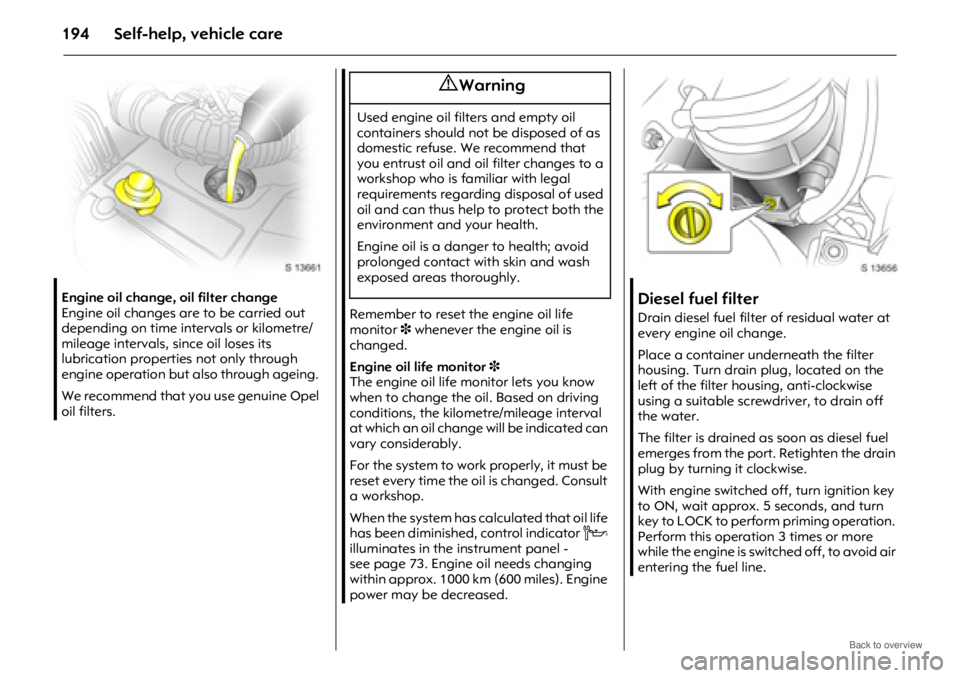
Engine oil change, oil filter change
Engine oil changes are to be carried out
depending on time intervals or kilometre/
mileage intervals, since oil loses its
lubrication properties not only through
engine operation but also through ageing.
We recommend that you use genuine Opel
oil filters.
Remember to reset the engine oil life
monitor 3 whenever the engine oil is
changed.
Engine oil life monitor 3
The engine oil life monitor lets you know
when to change the oil. Based on driving
conditions, the kilometre/mileage interval
at which an oil change will be indicated can
vary considerably.
For the system to work properly, it must be
reset every time the oil is changed. Consult
a workshop.
When the system has calculated that oil life
has been diminished, control indicator C
illuminates in the instrument panel -
see page 73. Engine oil needs changing
within approx. 1000 km (600 miles). Engine
power may be decreased.Diesel fuel filter
Drain diesel fuel filter of residual water at
every engine oil change.
Place a container underneath the filter
housing. Turn drain plug, located on the
left of the filter housing, anti-clockwise
using a suitable screwdriver, to drain off
the water.
The filter is drained as soon as diesel fuel
emerges from the port. Retighten the drain
plug by turning it clockwise.
With engine switched off, turn ignition key
to ON, wait approx. 5 seconds, and turn
key to LOCK to perform priming operation.
Perform this operation 3 times or more
while the engine is switched off, to avoid air
entering the fuel line.
9 Warning
Used engine oil filters and empty oil
containers should not be disposed of as
domestic refuse. We recommend that
you entrust oil and oil filter changes to a
workshop who is familiar with legal
requirements regarding disposal of used
oil and can thus help to protect both the
environment and your health.
Engine oil is a danger to health; avoid
prolonged contact with skin and wash
exposed areas thoroughly.
Page 200 of 234
Self-help, vehicle care200
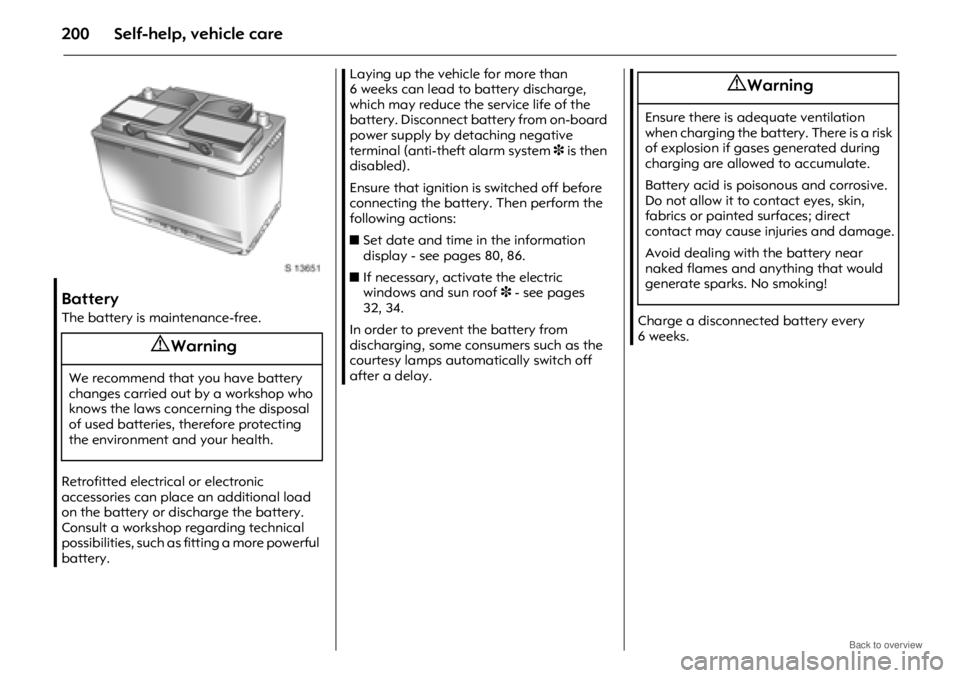
Battery
The battery is maintenance-free.
Retrofitted electrical or electronic
accessories can place an additional load
on the battery or discharge the battery.
Consult a workshop regarding technical
possibilities, such as fitting a more powerful
battery.Laying up the vehicle for more than
6 weeks can lead to battery discharge,
which may reduce the service life of the
battery. Disconnect battery from on-board
power supply by detaching negative
terminal (anti-theft alarm system
3 is then
disabled).
Ensure that ignition is switched off before
connecting the battery. Then perform the
following actions:
z Set date and time in the information
display - see pages 80, 86.
z If necessary, activate the electric
windows and sun roof 3 - see pages
32, 34.
In order to prevent the battery from
discharging, some consumers such as the
courtesy lamps automatically switch off
after a delay. Charge a disconnected battery every
6 weeks.
9 Warning
We recommend that you have battery
changes carried out by a workshop who
knows the laws concerning the disposal
of used batteries, therefore protecting
the environment and your health.
9 Warning
Ensure there is adequate ventilation
when charging the batt
ery. There is a risk
of explosion if gases generated during
charging are allowed to accumulate.
Battery acid is poisonous and corrosive.
Do not allow it to contact eyes, skin,
fabrics or painted surfaces; direct
contact may cause injuries and damage.
Avoid dealing with the battery near
naked flames and anything that would
generate sparks. No smoking!
Page 201 of 234
Self-help, vehicle care201
Protection of electronic
components
In order to avoid the breakdown of
electronic components within the electrical
system, never disconnect the battery with
the engine running. Never start the engine
while the battery is disconnected (e.g.
when using jump leads).
To avoid damaging the vehicle, do not
make any modifications to the electrical
system, e.g. connecting additional
consumers or tampering with electronic
control units (chip tuning). Disconnecting/connecting the battery
from/to the electrical system
Disconnect the battery from the vehicle
electrical system before charging:
first detach the negative and then the
positive lead.
Do not reverse the polarity of the battery,
i.e. do not confuse the terminals for the
positive and negative leads. When
connecting, start with the positive lead and
then connect the negative lead.
Vehicle storage
If your vehicle is to be stored for long
periods without use, we recommend you
consult a workshop for advice.
Vehicle care
In caring for your vehicle, observe all
national environmental regulations,
particularly when washing your vehicle.
Regular, thorough care contributes to
improving the appearance of your vehicle
and maintaining its va
lue. It is also a
prerequisite for clai ms made under the
warranty, in the event of paint or corrosion
damage. In the following pages, we give
you tips for vehicle care which, with correct
use, will help to ward off unavoidable and
harmful environmental influences.
9 Warning
Electronic ignition systems generate very
high voltages. Do not touch the ignition
system; high voltage can be fatal.