lock OPEL ANTARA 2009 Repair Manual
[x] Cancel search | Manufacturer: OPEL, Model Year: 2009, Model line: ANTARA, Model: OPEL ANTARA 2009Pages: 234, PDF Size: 3.01 MB
Page 183 of 234
Self-help, vehicle care 183
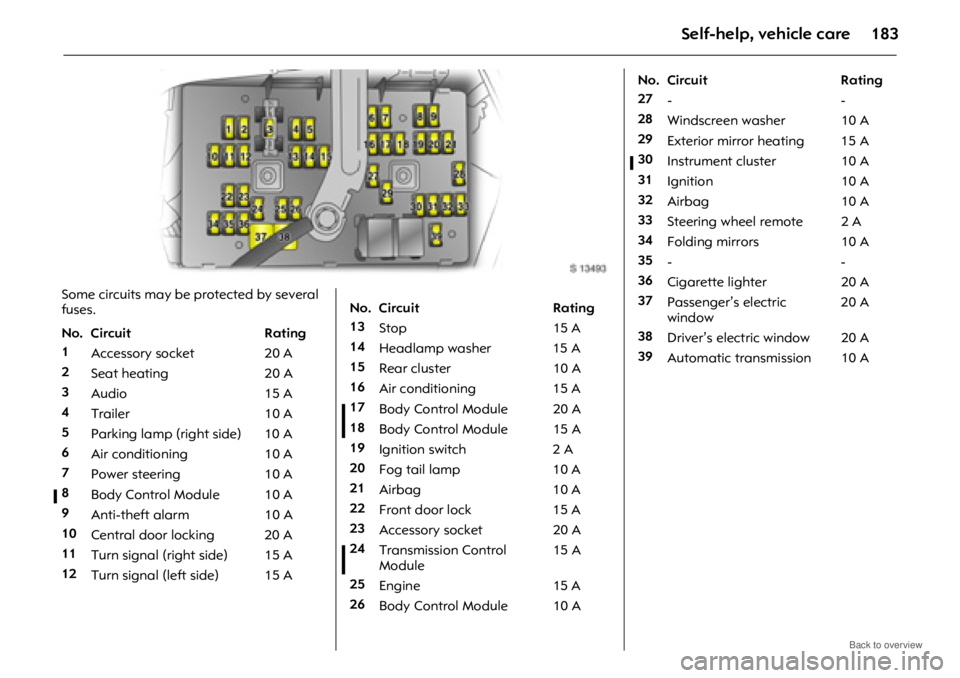
Some circuits may be protected by several
fuses.
No. Circuit Rating
1Accessory socket 20 A
2 Seat heating 20 A
3 Audio 15 A
4 Trailer 10 A
5 Parking lamp (right side) 10 A
6 Air conditioning 10 A
7 Power steering 10 A
8 Body Control Module 10 A
9 Anti-theft alarm 10 A
10 Central door locking 20 A
11 Turn signal (right side) 15 A
12 Turn signal (left side) 15 ANo. Circuit Rating
13 Stop 15 A
14 Headlamp washer 15 A
15 Rear cluster 10 A
16 Air conditioning 15 A
17 Body Control Module 20 A
18 Body Control Module 15 A
19 Ignition switch 2 A
20 Fog tail lamp 10 A
21 Airbag 10 A
22 Front door lock 15 A
23 Accessory socket 20 A
24 Transmission Control
Module 15 A
25 Engine 15 A
26 Body Control Module 10 A
No. Circuit Rating
27 --
28 Windscreen washer 10 A
29 Exterior mirror heating 15 A
30 Instrument cluster 10 A
31 Ignition 10 A
32 Airbag 10 A
33 Steering wheel remote 2 A
34 Folding mirrors 10 A
35 --
36 Cigarette lighter 20 A
37 Passenger’s electric
window 20 A
38 Driver’s electric window 20 A
39 Automatic transmission 10 A
Page 186 of 234
Self-help, vehicle care186
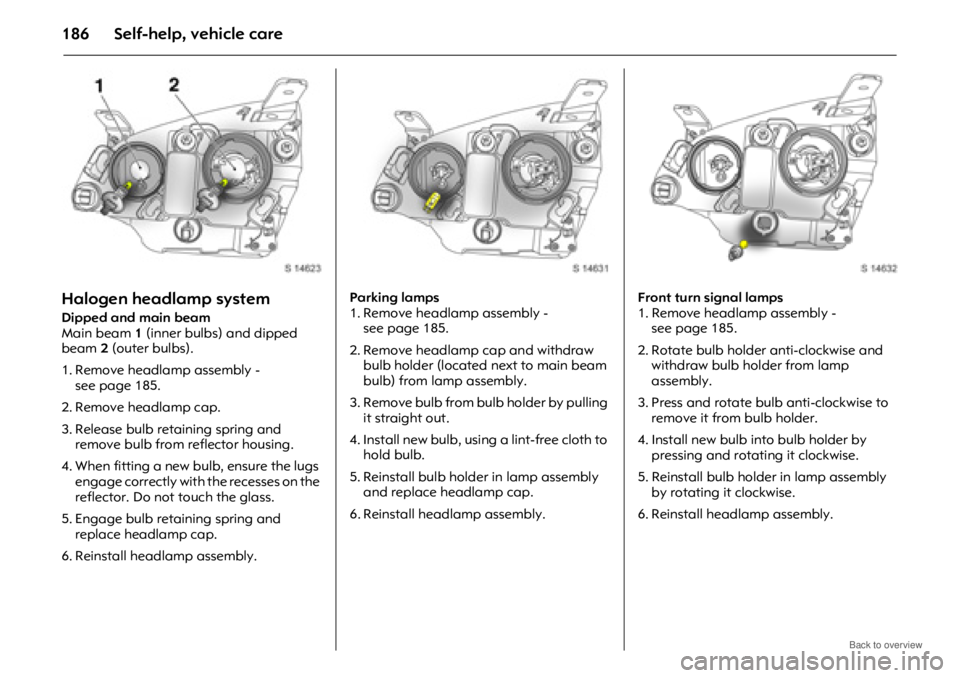
Halogen headlamp system
Dipped and main beam
Main beam 1 (inner bulbs) and dipped
beam 2 (outer bulbs).
1. Remove headlamp assembly - seepage185.
2. Remove headlamp cap.
3. Release bulb retaining spring and remove bulb from reflector housing.
4. When fitting a new bulb, ensure the lugs engage correctly with the recesses on the
reflector. Do not touch the glass.
5. Engage bulb retaining spring and replace headlamp cap.
6. Reinstall headlamp assembly. Parking lamps
1. Remove headlamp assembly -
seepage185.
2. Remove headlamp cap and withdraw bulb holder (located next to main beam
bulb) from lamp assembly.
3. Remove bulb from bulb holder by pulling it straight out.
4. Install new bulb, using a lint-free cloth to hold bulb.
5. Reinstall bulb holder in lamp assembly and replace headlamp cap.
6. Reinstall headlamp assembly. Front turn signal lamps
1. Remove headlamp assembly -
see page 185.
2. Rotate bulb holder anti-clockwise and withdraw bulb holder from lamp
assembly.
3. Press and rotate bulb anti-clockwise to remove it from bulb holder.
4. Install new bulb into bulb holder by pressing and rotating it clockwise.
5. Reinstall bulb holder in lamp assembly
by rotating it clockwise.
6. Reinstall headlamp assembly.
Page 187 of 234
Self-help, vehicle care187
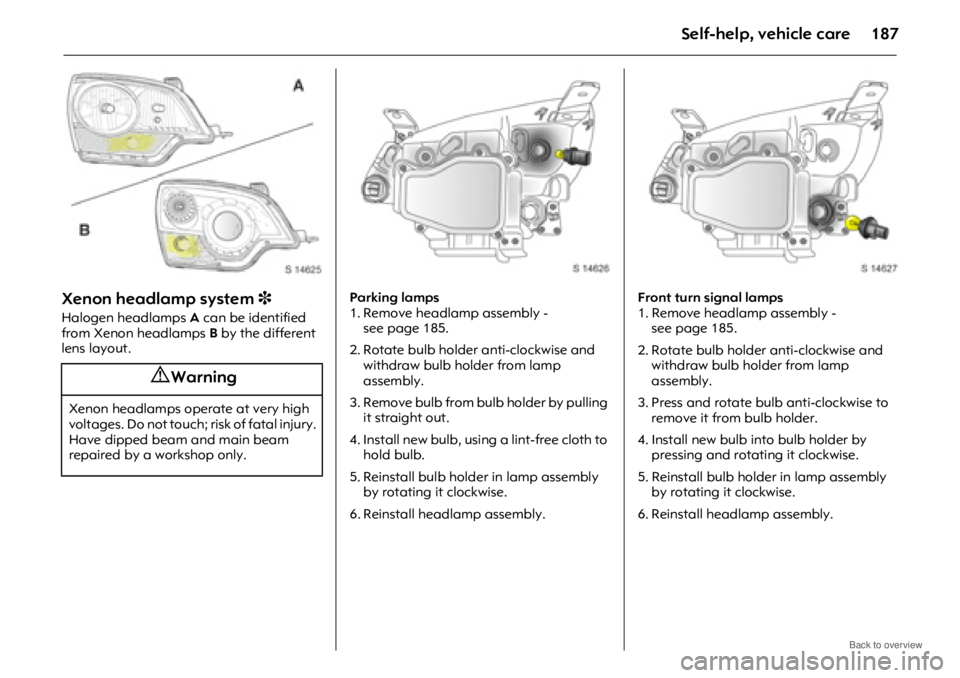
Xenon headlamp system 3
Halogen headlamps A can be identified
from Xenon headlamps B by the different
lens layout. Parking lamps
1. Remove headlamp assembly -
seepage185.
2. Rotate bulb holder anti-clockwise and withdraw bulb holder from lamp
assembly.
3. Remove bulb from bulb holder by pulling it straight out.
4. Install new bulb, using a lint-free cloth to hold bulb.
5. Reinstall bulb holder in lamp assembly by rotating it clockwise.
6. Reinstall headlamp assembly. Front turn signal lamps
1. Remove headlamp assembly -
see page 185.
2. Rotate bulb holder anti-clockwise and withdraw bulb holder from lamp
assembly.
3. Press and rotate bulb anti-clockwise to remove it from bulb holder.
4. Install new bulb into bulb holder by pressing and rotating it clockwise.
5. Reinstall bulb holder in lamp assembly
by rotating it clockwise.
6. Reinstall headlamp assembly.
9 Warning
Xenon headlamps operate at very high
voltages. Do not touch; risk of fatal injury.
Have dipped beam and main beam
repaired by a workshop only.
Page 188 of 234
Self-help, vehicle care188
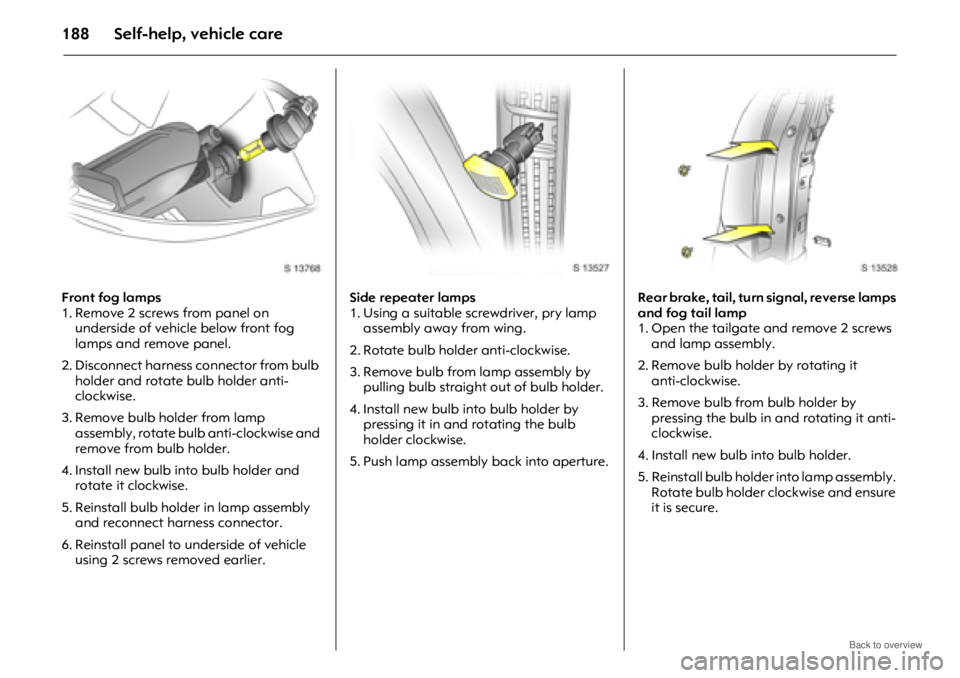
Front fog lamps
1. Remove 2 screws from panel on underside of vehicle below front fog
lamps and remove panel.
2. Disconnect harness connector from bulb holder and rotate bulb holder anti-
clockwise.
3. Remove bulb holder from lamp assembly, rotate bulb anti-clockwise and
remove from bulb holder.
4. Install new bulb in to bulb holder and
rotate it clockwise.
5. Reinstall bulb holder in lamp assembly
and reconnect harness connector.
6. Reinstall panel to underside of vehicle using 2 screws removed earlier. Side repeater lamps
1. Using a suitable screwdriver, pry lamp
assembly away from wing.
2. Rotate bulb holder anti-clockwise.
3. Remove bulb from lamp assembly by pulling bulb straight out of bulb holder.
4. Install new bulb into bulb holder by pressing it in and rotating the bulb
holder clockwise.
5. Push lamp assembly back into aperture. Rear brake, tail, turn signal, reverse lamps
and fog tail lamp
1. Open the tailgate and remove 2 screws
and lamp assembly.
2. Remove bulb holder by rotating it anti-clockwise.
3. Remove bulb from bulb holder by pressing the bulb in and rotating it anti-
clockwise.
4. Install new bulb into bulb holder.
5. Reinstall bulb holder into lamp assembly. Rotate bulb holder clockwise and ensure
it is secure.
Page 189 of 234
Self-help, vehicle care189
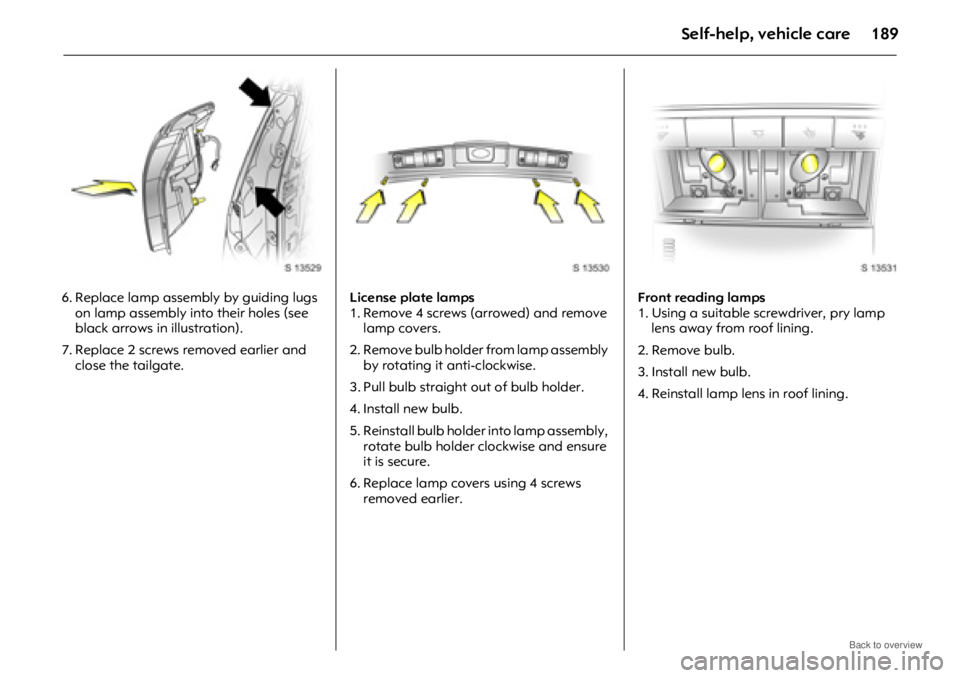
6. Replace lamp assembly by guiding lugs on lamp assembly into their holes (see
black arrows in illustration).
7. Replace 2 screws removed earlier and close the tailgate. License plate lamps
1. Remove 4 screws (arrowed) and remove
lamp covers.
2. Remove bulb holder from lamp assembly by rotating it anti-clockwise.
3. Pull bulb straight out of bulb holder.
4. Install new bulb.
5. Reinstall bulb holder into lamp assembly, rotate bulb holder clockwise and ensure
it is secure.
6. Replace lamp covers using 4 screws removed earlier. Front reading lamps
1. Using a suitable screwdriver, pry lamp
lens away from roof lining.
2. Remove bulb.
3. Install new bulb.
4. Reinstall lamp lens in roof lining.
Page 194 of 234
Self-help, vehicle care194
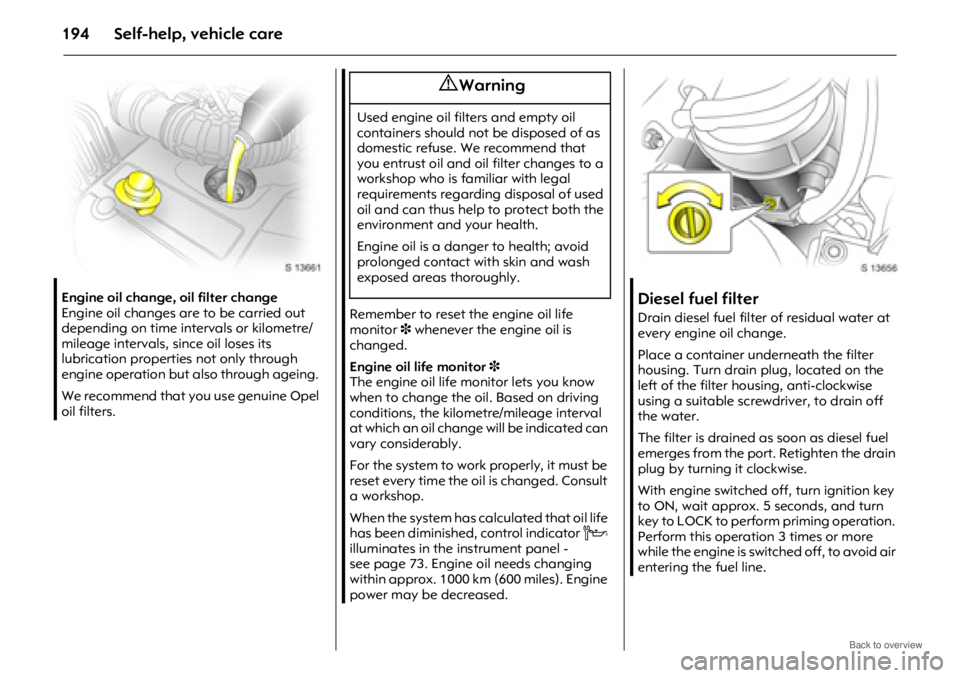
Engine oil change, oil filter change
Engine oil changes are to be carried out
depending on time intervals or kilometre/
mileage intervals, since oil loses its
lubrication properties not only through
engine operation but also through ageing.
We recommend that you use genuine Opel
oil filters.
Remember to reset the engine oil life
monitor 3 whenever the engine oil is
changed.
Engine oil life monitor 3
The engine oil life monitor lets you know
when to change the oil. Based on driving
conditions, the kilometre/mileage interval
at which an oil change will be indicated can
vary considerably.
For the system to work properly, it must be
reset every time the oil is changed. Consult
a workshop.
When the system has calculated that oil life
has been diminished, control indicator C
illuminates in the instrument panel -
see page 73. Engine oil needs changing
within approx. 1000 km (600 miles). Engine
power may be decreased.Diesel fuel filter
Drain diesel fuel filter of residual water at
every engine oil change.
Place a container underneath the filter
housing. Turn drain plug, located on the
left of the filter housing, anti-clockwise
using a suitable screwdriver, to drain off
the water.
The filter is drained as soon as diesel fuel
emerges from the port. Retighten the drain
plug by turning it clockwise.
With engine switched off, turn ignition key
to ON, wait approx. 5 seconds, and turn
key to LOCK to perform priming operation.
Perform this operation 3 times or more
while the engine is switched off, to avoid air
entering the fuel line.
9 Warning
Used engine oil filters and empty oil
containers should not be disposed of as
domestic refuse. We recommend that
you entrust oil and oil filter changes to a
workshop who is familiar with legal
requirements regarding disposal of used
oil and can thus help to protect both the
environment and your health.
Engine oil is a danger to health; avoid
prolonged contact with skin and wash
exposed areas thoroughly.
Page 202 of 234

Self-help, vehicle care202
Vehicle care aids 3
Vehicle wash:
z Car Shampoo
z Sponges
z Chamois Leather
z Wheel Cleaners
z Engine Cleaners
z Glass Cleaners
Exterior care:
z Touch-up Applicator
z Spray and Touch-up Paint
z Car Polishes/Colour Restorers
z Car Waxes/Sealers
z Alloy Wheel Cleaner
z Alloy Wheel Preserver
z Metallic Paintwork Wax
z Rust Preventative
z Lubricant Sprays
z Lock Cylinder Grease
z De-icer Sprays
z Tar Removal Spray
z Insect Remover
z Window Cleaning Spray
z Cleaning Solvent and Antifreeze
Interior care:
z Interior/Upholstery Cleaner Washing
The paintwork of your vehicle is exposed to
environmental influences, e.g. continuous
changes in weather conditions, industrial
waste gases and dust or thawing salts, so
wash and wax your vehicle regularly. When
using automatic car washes, select a
program which includes waxing.
Bird droppings, dead insects, resin, pollen
and the like should be cleaned off
immediately, as they contain aggressive
constituents which can cause paint
damage.
If using a car wash, comply with the
pertinent instructions of the car wash
manufacturer. The windscreen wipers and
tailgate wipers must be switched off –
see pages 92, 93. Remove detachable rod
antenna by unscrewing it.
Do not use high-pressure jet cleaners.
If you wash your vehicle by hand, make
sure that the insides of the wings are also
thoroughly rinsed out. Do not use
household dishwashing liquid, to avoid
removing wax from the paintwork.
Clean edges and folds on opened doors
and flaps as well as the areas they cover.
Thoroughly rinse off and leather-off the
vehicle. Rinse leather frequently. Use
separate leathers for paint and window
surfaces; remnants of wax on the windows
will impair vision.
Also wash aluminium trim parts, avoiding
the use of abrasive materials such as
automotive or chrome polish, steam or
caustic soap. Washing with water is
normally sufficient.
Observe national regulations.
Page 205 of 234

Self-help, vehicle care205
Windscreen wiper blades
Wax, such as that used in car washes, can
cause streaks to form on the windscreen
when the wipers are used.
Smearing wiper blades can be cleaned with
a soft cloth and Opel Cleaning Solvent and
Antifreeze, and replaced if necessary –
see page 198. Do not use abrasive
cleaners.
Locks
The locks are lubricated with a high-grade
lock cylinder grease at the factory. Opel
Lock Cylinder Grease prevents the locks
from freezing up.
Only use de-icing agents in emergencies,
as they have a degreasing effect and will
impair the function of the locks. After using
a de-icing agent, have the locks re-greased
by a workshop. Engine compartment
Areas of the engine compartment that are
painted in the same colour as the vehicle
must be looked after
like any other painted
surface.
It is advisable to wash the engine
compartment before and after winter and
preserve it with wax. Cover alternator and
fluid reservoirs with plastic sheets before
washing the engine.
When washing the engine with a steam-jet
cleaner, do not direct the steam-jet at
components of the Anti-lock Brake System
(ABS), the air conditioning system or the
belt drive and its components.
Protective wax that has been applied is
also removed during the engine wash. For
this reason, have the engine, brake system
components in the engine compartment,
axle components with steering, body parts
and cavities thoroughly preserved with
protective wax after the wash.
An engine wash can be performed in the
spring in order to remove dirt that has
adhered to the engine compartment,
which may also have a high salt content.
Check protective wax layer and make good
if necessary. Underbody
Your vehicle has a factory-applied PVC
undercoating in the wheel arches
(including the longitudinal members) which
provides permanent protection and needs
no special maintenance. The surfaces of
the vehicle underbody not covered by PVC
are provided with a durable protective wax
coating in critical areas.
On vehicles which are washed frequently
in automatic car wash
es with underbody
washing facility, the protective wax
coating may be impaire d by dirt-dissolving
additives. Check the underbody after
washing and have it waxed if necessary.
Before the start of the cold weather season,
check the PVC coating and protective wax
coating and, if necessary, have them
restored to perfect condition.
Caution
– commercially available bitumen/
rubber materials can damage the PVC
coating. We recommend that you have
underbody work carried out by a
workshop, who knows the prescribed
materials and has experience in the use
thereof.
The underbody should be washed
following the end of the cold weather
season to remove any dirt adhering to the
underbody since this may also contain salt.
Check protective wax coating and, if
necessary, have it restored to perfect
condition.
Page 207 of 234

Service, maintenance 207
European service schedule
(Antara Z 20 DM, Z 20 DMH, Z 24 XE, Z 32 SE) Service operations by year 1)
km ( x 1000)1)
miles ( x 1000)1)
1)Whichever occurs first.
15
101
30
20 45
30 2
60
40 75
50 3
90
60
Controls, lighting, signalling equi pment and airbags: visual check
steering lock and ignition lock: check xxx
Remote control batteries: replace Every 2 years
Windscreen wipers, windscreen washer system: check, correct xxx
Coolant level and antifreeze: check, correct
Hoses: check for tightness and secure seating xxx
Brake fluid level: check, correct xxx
Battery terminals: check for secu re connections and battery eye xxx
Vehicle system check with TECH2 xxx
Pollen filter: replace xxx
oMore often for when dust, sand or polle n is in the air Agreement with customer
Air cleaner element: replace
xxx
⊕Spark plugs and plug leads: replace Every 90 000 km/60 000 miles
Ribbed V-belt: visual check xxx
⊕Toothed belt and tension roller: visual check xxx
Toothed belt and tension roller: replace - Z 24 XE Every 8 years/120 000 km/80 000 miles
Toothed belt and tension roller: replace - Z 20 DM, Z 20 DMH Every 6 years/90 000 km/60 000 miles
Power steering system: check for leak s. Fluid level: check, correct xxx
Engine oil and oil filter: replace - fixed interval Z 24 XE
2)
2)On vehicles with oil life monitoring, it may be necessary to change the engine oil earlier (control indicator illuminates).
xxxxxx
Z 20 DM, Z 20 DMH, Z 32 SE, except2)xxx
Page 208 of 234

208 Service, maintenance
Service operations by year 1)
km ( x 1000)1)
miles ( x 1000)1)
1)Whichever occurs first.
⊕ Additional operations.
o Under extreme operating conditions and if required by country-specific conditions, the intervals are reduced.
15
10 1
30
20 45
30 2
60
40 75
50 3
90
60
⊕o Diesel fuel filter: drain water
(If relative humidity is high an
d/or fuel is of lower quality) Annually
Fuel filter: replace and drain water - diesel (g rade EN 590) Every 2 years/60 000 km/40 000 miles
Parking brake: check and adjust
Wheel mounting and suspension front an d rear, brake lines, brake pressure
hoses, fuel lines and exhaust system: visual check xxx
Corrosion protection: check and record in Service and Warranty Booklet Annually
Front and rear wheel br akes: check visually xxx
o
⊕Annual service check if annual mileage exceeds 20 000 km Annually
Engine, transmission, PTO, rear differential, A/C compressor: check for leaks xxx
Steering system boots, track rods , final drive: visual check xxx
Track rod end and supporting ball joint: check xxx
⊕Brake and clutch fluid: change Every 2 years
Wheel fastening: loosen and tighten to torque
Tyre condition and pressures: check, correct xxx
⊕Annual service check if annual
mileage exceeds 20 000 km Annually
First aid kit, tyre repair kit and lash ing eyes: visual check Every 2 years
Headlamp aiming: check, adjust x x x
Door hinges, door stop, lock cylinder, lock striker, bonnet catch, tailgate
hinges and check links: lubricate xxx
Test drive, final check
Service interval display and oil life monitor: reset - if applicable xxx