Distribution OPEL ANTARA 2009 Owners Manual
[x] Cancel search | Manufacturer: OPEL, Model Year: 2009, Model line: ANTARA, Model: OPEL ANTARA 2009Pages: 234, PDF Size: 3.01 MB
Page 17 of 234

In brief17
Drying misted up or iced up
windows:
Set air distribution to positionl,
set the temperature rotary knob
to red and fan to position 4,
switch on heated rear window Ü
Close centre air vents, open side air vents
and direct them towards the door windows.
6 Heating, ventilation and air conditioning
system - see pages 106, 109.
To set automatic mode of
Electronic Climate Control 3:
Press AUTO button,
set temperature using
rotary knob
Open all air vents.
6 Electronic Climate Control (ECC) -
see page 111.
Manual transmission:
Only engage reverse gear when the vehicle
is stationary.
1 to 5 = 1st to 5th gear
R = Reverse gear
Page 103 of 234
Climate control103
Climate control
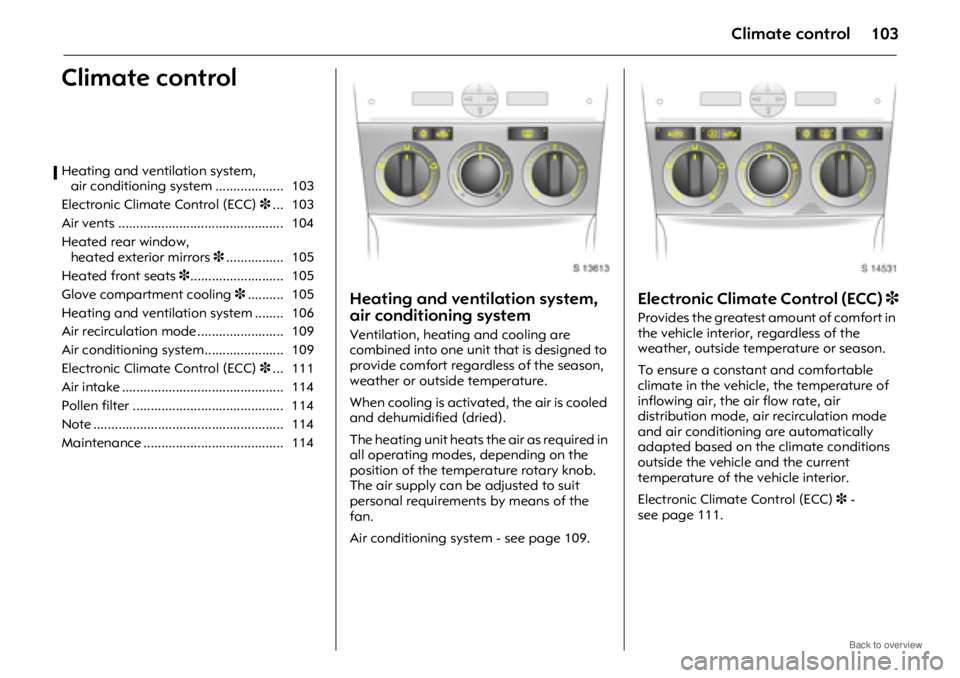
Heating and ventilation system,
air conditioning system
Ventilation, heating and cooling are
combined into one unit that is designed to
provide comfort regardless of the season,
weather or outside temperature.
When cooling is activated, the air is cooled
and dehumidified (dried).
The heating unit heats the air as required in
all operating modes, depending on the
position of the temperature rotary knob.
The air supply can be adjusted to suit
personal requirements by means of the
fan.
Air conditioning system - see page 109.
Electronic Climate Control (ECC) 3
Provides the greatest amount of comfort in
the vehicle interior, regardless of the
weather, outside temperature or season.
To ensure a constant and comfortable
climate in the vehicle, the temperature of
inflowing air, the air flow rate, air
distribution mode, air recirculation mode
and air conditioning are automatically
adapted based on the climate conditions
outside the vehicle and the current
temperature of the vehicle interior.
Electronic Climate Control (ECC) 3 -
see page 111.
Heating and ventilation system,
air conditioning system ................... 103
Electronic Climate Control (ECC) 3... 103
Air vents .............................................. 104
Heated rear window, heated exterior mirrors 3................ 105
Heated front seats 3.......................... 105
Glove compartment cooling 3.......... 105
Heating and ventilation system ........ 106
Air recirculation mode ........................ 109
Air conditioning system...................... 109
Electronic Climate Control (ECC) 3... 111
Air intake ............................................. 114
Pollen filter .......................................... 114
Note ..................................................... 114
Maintenance ....................................... 114
Page 104 of 234
Climate control104
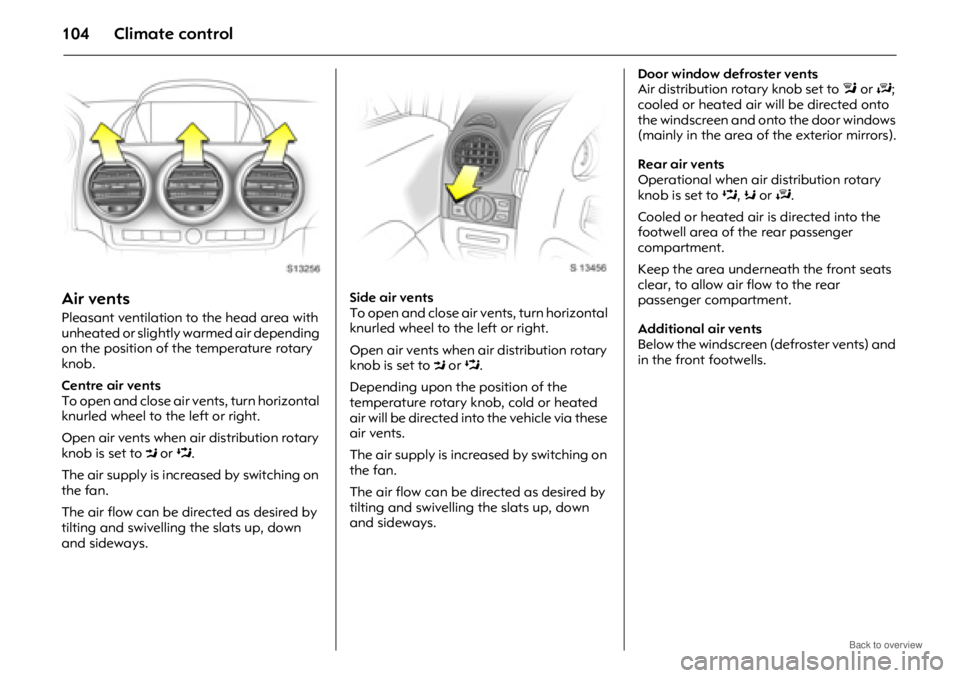
Air vents
Pleasant ventilation to the head area with
unheated or slightly warmed air depending
on the position of the temperature rotary
knob.
Centre air vents
To open and close air vents, turn horizontal
knurled wheel to the left or right.
Open air vents when air distribution rotary
knob is set to M or L.
The air supply is increased by switching on
the fan.
The air flow can be directed as desired by
tilting and swivelling the slats up, down
and sideways. Side air vents
To open and close air ve
nts, turn horizontal
knurled wheel to the left or right.
Open air vents when air distribution rotary
knob is set to M or L.
Depending upon the position of the
temperature rotary knob, cold or heated
air will be directed into the vehicle via these
air vents.
The air supply is increased by switching on
the fan.
The air flow can be directed as desired by
tilting and swivelling the slats up, down
and sideways. Door window defroster vents
Air distribution rotary knob set to
l or J ;
cooled or heated air wi ll be directed onto
the windscreen and onto the door windows
(mainly in the area of the exterior mirrors).
Rear air vents
Operational when air distribution rotary
knob is set to L, K or J .
Cooled or heated air is directed into the
footwell area of the rear passenger
compartment.
Keep the area underneath the front seats
clear, to allow air flow to the rear
passenger compartment.
Additional air vents
Below the windscreen (defroster vents) and
in the front footwells.
Page 106 of 234
Climate control106
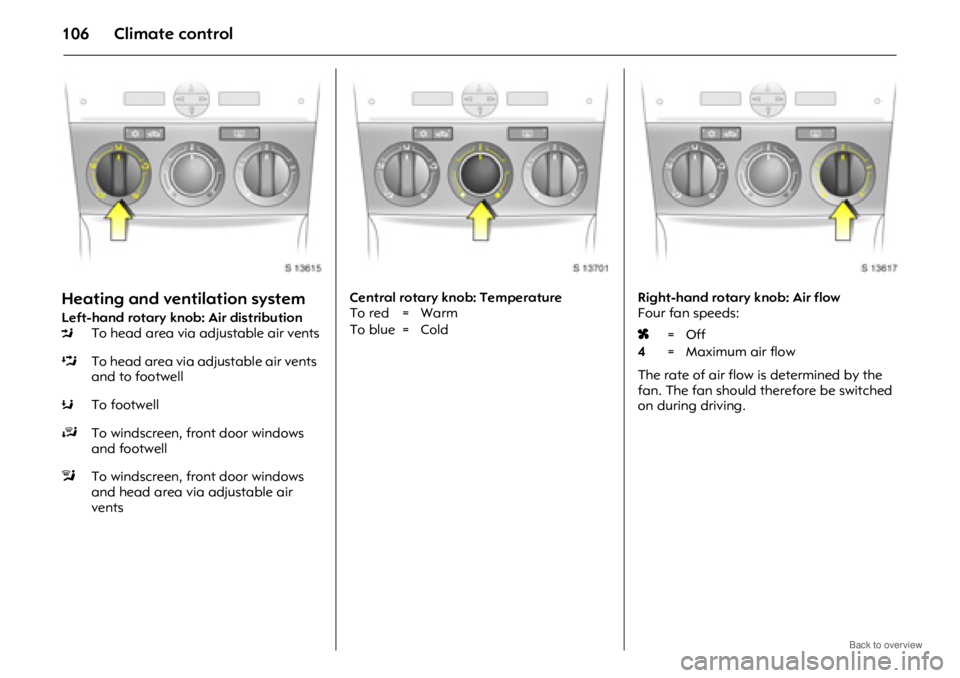
Heating and ventilation system
Left-hand rotary knob: Air distributionCentral rotary knob: Temperature Right-hand rotary knob: Air flow
Four fan speeds:
The rate of air flow is determined by the
fan. The fan should therefore be switched
on during driving.
M
To head area via adjustable air vents
L To head area via adjustable air vents
and to footwell
K To footwell
J To windscreen, front door windows
and footwell
l To windscreen, front door windows
and head area via adjustable air
ventsTo red = Warm
To blue = Cold
x=Off
4 = Maximum air flow
Page 107 of 234
Climate control107
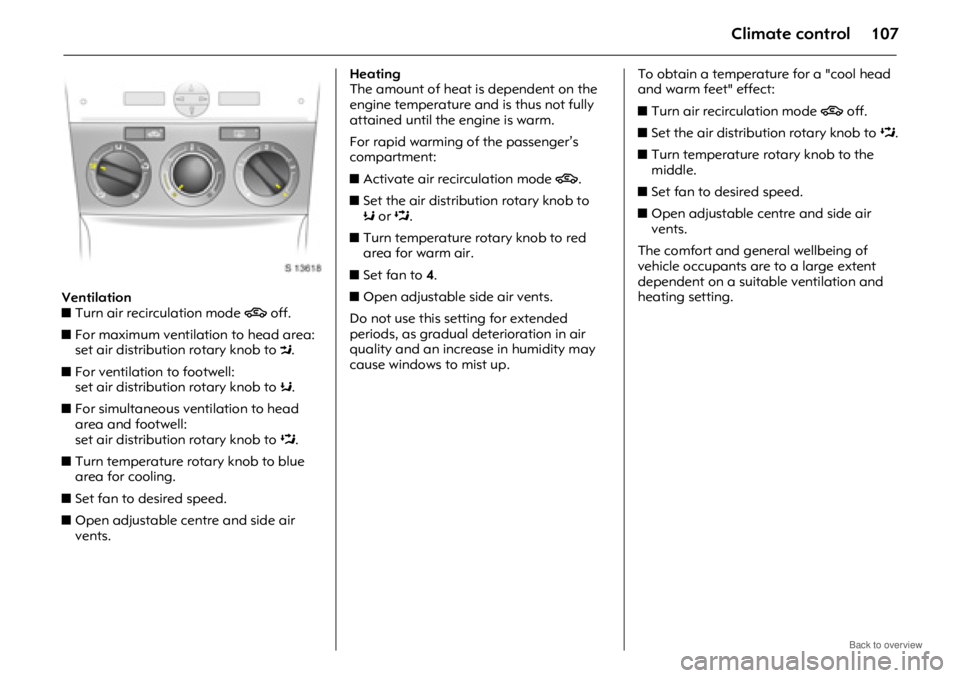
Ventilation
zTurn air recirculation mode 4 off.
z For maximum ventilation to head area:
set air distribution rotary knob to M.
z For ventilation to footwell:
set air distribution rotary knob to K.
z For simultaneous ventilation to head
area and footwell:
set air distribution rotary knob to L.
z Turn temperature rotary knob to blue
area for cooling.
z Set fan to desired speed.
z Open adjustable centre and side air
vents. Heating
The amount of heat is dependent on the
engine temperature and is thus not fully
attained until the engine is warm.
For rapid warming of the passenger’s
compartment:
z
Activate air recirculation mode 4.
z Set the air distribution rotary knob to
K or L .
z Turn temperature ro tary knob to red
area for warm air.
z Set fan to 4 .
z Open adjustable side air vents.
Do not use this setting for extended
periods, as gradual deterioration in air
quality and an increase in humidity may
cause windows to mist up. To obtain a temperat
ure for a "cool head
and warm feet" effect:
z Turn air recirculation mode 4 off.
z Set the air distribution rotary knob to L.
z Turn temperature rotary knob to the
middle.
z Set fan to desired speed.
z Open adjustable centre and side air
vents.
The comfort and general wellbeing of
vehicle occupants are to a large extent
dependent on a suitab le ventilation and
heating setting.
Page 108 of 234
Climate control108
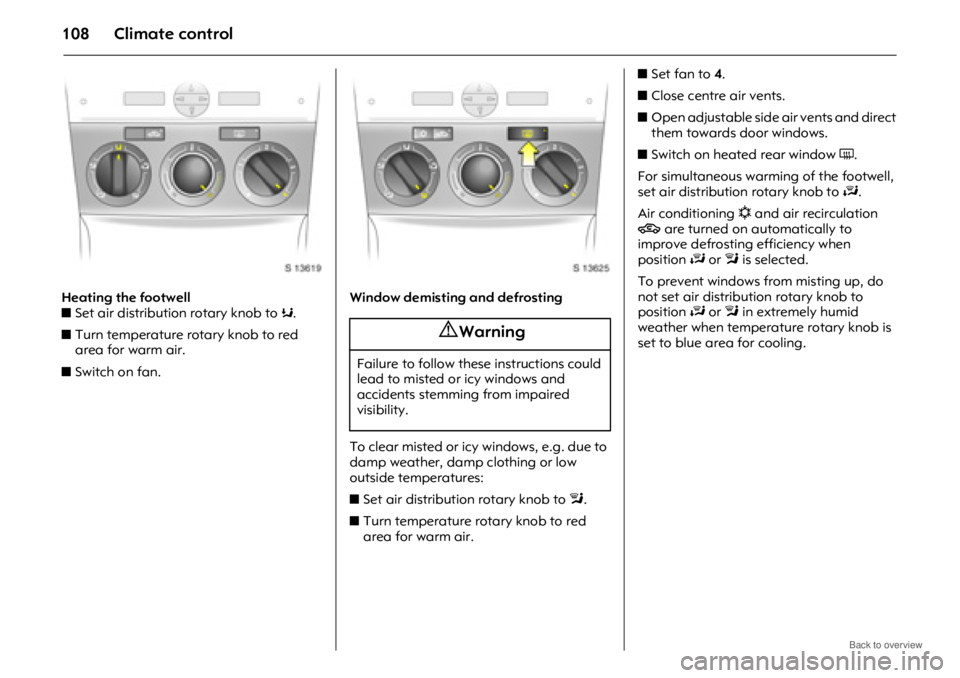
Heating the footwell
zSet air distribution rotary knob to K.
z Turn temperature rotary knob to red
area for warm air.
z Switch on fan. Window demisting and defrosting
To clear misted or icy
windows, e.g. due to
damp weather, damp clothing or low
outside temperatures:
z Set air distribution rotary knob to l.
z Turn temperature ro tary knob to red
area for warm air. z
Set fan to 4.
z Close centre air vents.
z Open adjustable side air vents and direct
them towards door windows.
z Switch on heated rear window Ü.
For simultaneous warming of the footwell,
set air distribution rotary knob to J.
Air conditioning n and air recirculation
4 are turned on automatically to
improve defrosting efficiency when
position J or l is selected.
To prevent windows from misting up, do
not set air distribution rotary knob to
position J or l in extremely humid
weather when temperature rotary knob is
set to blue area for cooling.
9 Warning
Failure to follow thes e instructions could
lead to misted or icy windows and
accidents stemming from impaired
visibility.
Page 110 of 234
Climate control110
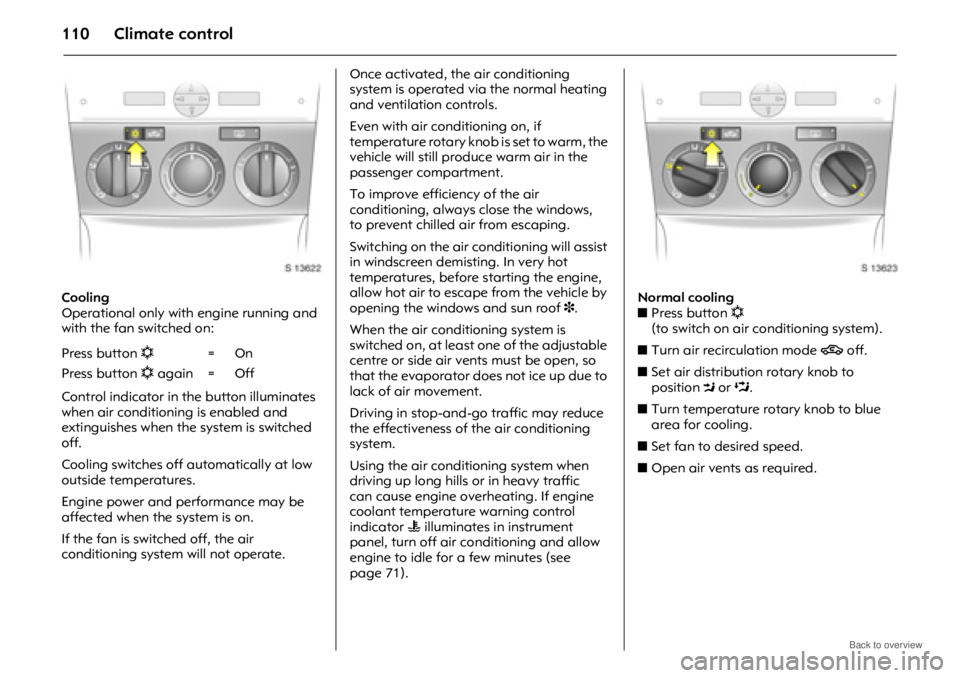
Cooling
Operational only with engine running and
with the fan switched on:
Control indicator in the button illuminates
when air conditioning is enabled and
extinguishes when the system is switched
off.
Cooling switches off automatically at low
outside temperatures.
Engine power and performance may be
affected when the system is on.
If the fan is switched off, the air
conditioning system will not operate. Once activated, the air conditioning
system is operated via the normal heating
and ventilation controls.
Even with air conditioning on, if
temperature rotary knob is set to warm, the
vehicle will still produce warm air in the
passenger compartment.
To improve efficiency of the air
conditioning, always close the windows,
to prevent chilled air from escaping.
Switching on the air conditioning will assist
in windscreen demisting. In very hot
temperatures, before starting the engine,
allow hot air to escape from the vehicle by
opening the windows and sun roof
3.
When the air conditioning system is
switched on, at least one of the adjustable
centre or side air vents must be open, so
that the evaporator does not ice up due to
lack of air movement.
Driving in stop-and-go traffic may reduce
the effectiveness of the air conditioning
system.
Using the air conditioning system when
driving up long hills or in heavy traffic
can cause engine overheating. If engine
coolant temperature warning control
indicator W illuminates in instrument
panel, turn off air co nditioning and allow
engine to idle for a few minutes (see
page 71). Normal cooling
z
Press button n
(to switch on air co nditioning system).
z Turn air recirculation mode 4 off.
z Set air distribution rotary knob to
position M or L.
z Turn temperature rotary knob to blue
area for cooling.
z Set fan to desired speed.
z Open air vents as required.
Press button
n=On
Press button n again = Off
Page 111 of 234
Climate control111
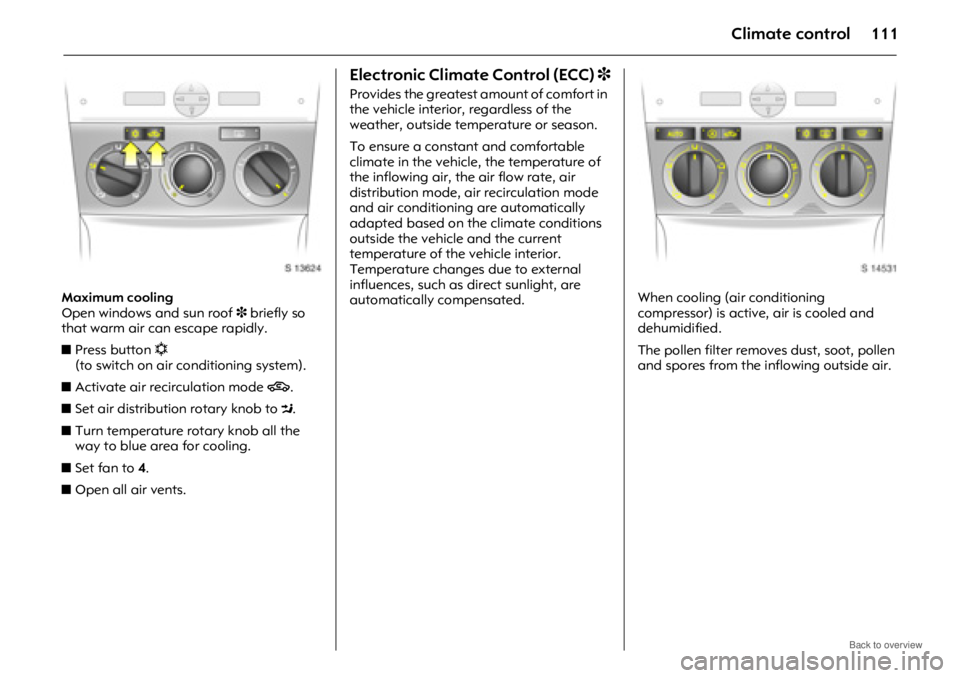
Maximum cooling
Open windows and sun roof 3 briefly so
that warm air can escape rapidly.
z Press button n
(to switch on air co nditioning system).
z Activate air recirculation mode 4.
z Set air distribution rotary knob to M.
z Turn temperature rotary knob all the
way to blue area for cooling.
z Set fan to 4.
z Open all air vents.
Electronic Climate Control (ECC) 3
Provides the greatest amount of comfort in
the vehicle interior, regardless of the
weather, outside temperature or season.
To ensure a constant and comfortable
climate in the vehicle, the temperature of
the inflowing air, the air flow rate, air
distribution mode, air recirculation mode
and air conditioning are automatically
adapted based on the climate conditions
outside the vehicle and the current
temperature of the vehicle interior.
Temperature changes due to external
influences, such as direct sunlight, are
automatically compensated. When cooling (air conditioning
compressor) is active, air is cooled and
dehumidified.
The pollen filter removes dust, soot, pollen
and spores from the
inflowing outside air.
Page 113 of 234
Climate control113
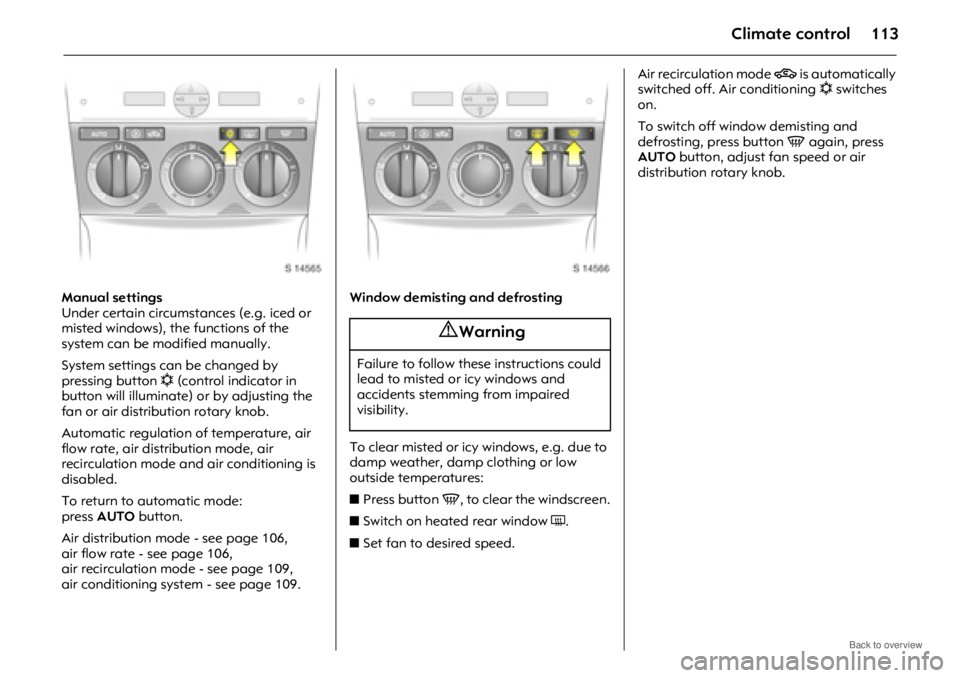
Manual settings
Under certain circumstances (e.g. iced or
misted windows), the functions of the
system can be modified manually.
System settings can be changed by
pressing button n (control indicator in
button will illuminate) or by adjusting the
fan or air distribution rotary knob.
Automatic regulation of temperature, air
flow rate, air distribution mode, air
recirculation mode and air conditioning is
disabled.
To return to automatic mode:
press AUTO button.
Air distribution mode - see page 106,
air flow rate - see page 106,
air recirculation mode - see page 109,
air conditioning system - see page 109. Window demisting and defrosting
To clear misted or icy
windows, e.g. due to
damp weather, damp clothing or low
outside temperatures:
z Press button V, to clear the windscreen.
z Switch on heated rear window Ü.
z Set fan to desired speed. Air recirculation mode
4 is automatically
switched off. Air conditioning n switches
on.
To switch off window demisting and
defrosting, press button V again, press
AUTO button, adjust fan speed or air
distribution rotary knob.
9 Warning
Failure to follow thes e instructions could
lead to misted or icy windows and
accidents stemming from impaired
visibility.
Page 168 of 234
Driving and operation168
Coupling socket load
The coupling socket load is the load
exerted by the caravan/trailer on the
coupling ball. It can be varied by changing
the weight distribution when loading the
caravan/trailer.
The maximum permissible coupling socket
load for the towing vehicle (80 kg) is stated
on the towing equipment identification
plate and should always be aimed for,
particularly in the case of heavy caravans/
trailers. The coupling socket load should
never be below 25 kg.
When measuring the coupling socket load,
make sure that the drawbar of the loaded
caravan/trailer is at the same height as it
will be when the carava n/trailer is coupled
with the towing vehicle loaded. This is
particularly important for caravans/trailers
with tandem axle. Rear axle load during towing
When the caravan/trailer is coupled and
the towing vehicle fully
loaded (including
all occupants), the permissible rear axle
load must not be exceeded.
National regulations regarding maximum
speeds for vehicles towing a caravan/
trailer must be observed.
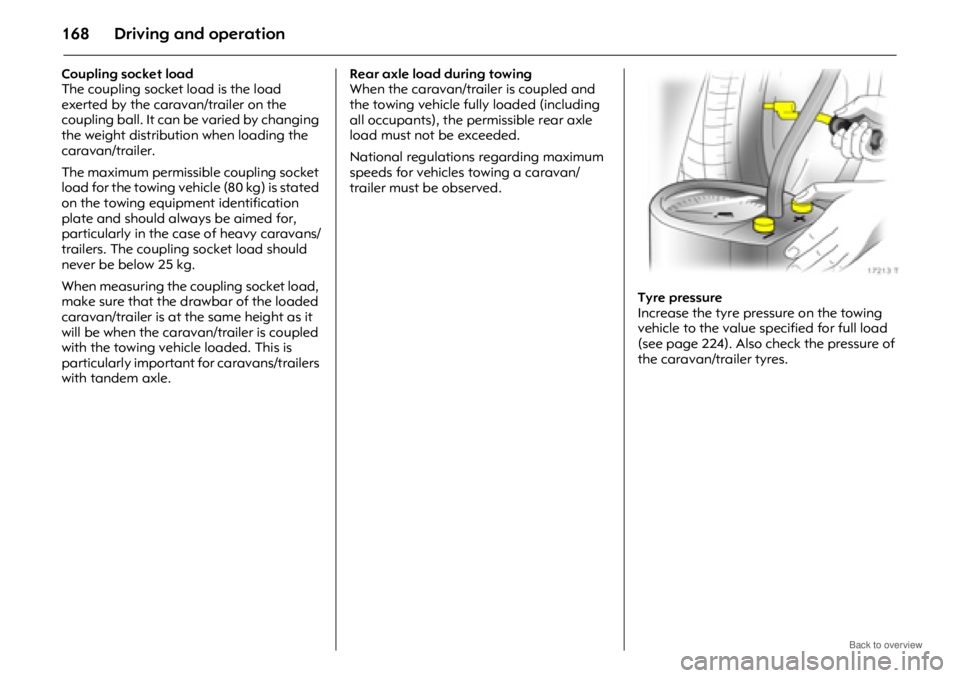
Tyre pressure
Increase the tyre pressure on the towing
vehicle to the value specified for full load
(see page 224). Also check the pressure of
the caravan/trailer tyres.