clutch OPEL ANTARA 2009 Owners Manual
[x] Cancel search | Manufacturer: OPEL, Model Year: 2009, Model line: ANTARA, Model: OPEL ANTARA 2009Pages: 234, PDF Size: 3.01 MB
Page 11 of 234

In brief11
Page
1 Side air vents ................................... 104
2 Door window defroster vents ......... 104
3 Headlamp flash and main beam .... 14
turn signal lamps .............................. 14
Peripheral lighting............................. 98
cruise control 3............................... 140
4 Infotainment system
remote control buttons ................... 101
Trip computer 3.......................... 81, 88
5 Horn ................................................... 15
6 Instruments ........................................ 70
7 Windscreen and tailgate
wipers and washers .................... 15, 16
headlamp washers 3........................ 16
8 Central information display for time,
date, outside temperature,
Infotainment system,
check control 3................................. 91
Trip computer 3.......................... 81, 88 Page
9 Centre air vents ............................... 104
10 Hazard warning ................................ 14
Park pilot 3..................................... 142
Descent Control System (DCS) ....... 138
Electronic Stability Control (ESC) ... 136
Front passenger’s
seat belt reminder 3......................... 46
Fold in exterior mirrors 3................. 30
Control indicator for
anti-theft alarm system 3................ 29
11 Infotainment system ....................... 101
12 Front passenger’s airbag ................. 52
13 Glove compartment.................. 64, 105
14 Fuse box .......................................... 182
15 Climate control................................ 103
16 Ignition switch ................................... 13 Page
17 Accelerator pedal ........................... 127
18 Driver’s airbag .................................. 52
19 Brake pedal............................. 127, 146
20 Clutch pedal 3........................ 127, 128
21 Steering wheel adjustment .............. 13
22 Bonnet release ................................ 171
23 Coin storage...................................... 67
24 Card holder ....................................... 67
25 Parking lamps ................................... 94
dipped beam .............................. 14, 95
automatic dipped beam
activation 3...................................... 95
headlamp range adjustment 3....... 97
front fog lamps ................................. 96
fog tail lamp ..................................... 96
instrument illumination .................... 98
Page 19 of 234

In brief19
Starting the engine:
Manual transmission in neutral,
Depress clutch and foot brake,
Automatic transmission in P or N,
Do not accelerate
Petrol engines:
TurnkeytoSTARTand release it
Diesel engines:
Turn key to ON, when preheating
control indicator N
extinguishes
1), turn key to START
and release it
Key returns automatically to ON position
when released. Start attempts should not last longer than
15 seconds. If engine does not start, wait
10 seconds before repeating starting
procedure.
The increased engine
speed automatically
returns to normal idling speed as the
engine temperature rises.
Drive at a moderate speed, especially in
cold weather, until normal engine
operating temperatures have been
reached.
6 Electronic immobiliser - see page 22,
diesel fuel system - see page 171,
further information - see pages 127, 129,
131.
Releasing the hand brake:
Raise lever slightly,
press release button,
lower lever fully
To reduce operating forces, depress foot
brake at the same time.
Do not drive with hand brake on, to avoid
damage to brakes on the rear wheels. Do
not apply hand brake while vehicle is in
motion or as a substitute for the foot brake.
Drive carefully, economically and with the
environment in mind. While driving, do not
do anything that could distract you.
6 Hand brake - see page 147.
1)Preheating system switches on only if outside
temperature is low.
Page 74 of 234

Instruments, controls74
aAnti-theft alarm system activation
without monitoring of passenger
compartment and vehicle tilt 3
see page 28.
IEngine oil pressure
Illuminates in red when ignition is switched
on. Extinguishes after engine is started.
Can illuminate intermit tently when idling
with hot engine; must extinguish when
engine speed is increased.
If
it illuminates during driving;
engine oil pressure may be dangerously
low, interrupting engine lubrication and
resulting in damage to the engine and/or
locking of the driving wheels:
z Move out of the flow of traffic as quickly
as possible without impeding other
vehicles,
z Depress clutch,
z Move gearshift lever to neutral
(automatic transmission to N),
z Switch off ignition. Check engine oil level before consulting
a workshop. If the oil level is low, top up
using the specified engine oil - see pages
192, 213, 217.
If the oil level is normal, have a workshop
check the vehicle’s lubricating system.
pAlternator
Illuminates in red when ignition is switched
on. Extinguishes after engine is started.
If
it illuminates during driving:
stop vehicle and switch off engine. The
battery is not being charged and the
engine cooling may be interrupted. The
brake servo unit may cease to be effective.
Interrupt your journey immediately.
Remove key and check drive belt condition
and tensioning before consulting a
workshop.
ZExhaust emissions
Illuminates in yellow when ignition is
switched on. Extinguishes after engine is
started. Can illuminate briefly when
driving; this is normal and does not
indicate a system fault.
If it illuminates when the engine is running
;
fault in emission control system.
The permitted emission limits may be
exceeded. Fuel economy and vehicle
driveability may be impaired.
The control indicator also illuminates if
there is a fault in the diesel particle filter 3.
Consult a workshop as soon as possible.
If it flashes when the engine is running
;
for a fault that can lead to destruction of
the catalytic converter, see page 134.
Consult a workshop as soon as possible.
0Winter program 3
Illuminates in yellow when Winter program
for the automatic transmission is enabled -
see page 117.
9 Warning
When the engine is off, considerably
greater force will be required for braking
and steering.
Do not remove key until vehicle has come
to a standstill, otherwise the steering
column lock could engage unexpectedly.
Page 115 of 234

Driving and operation115
Driving and operationAutomatic transmission 3
The automatic transmission permits
manual gearshifting (manual mode) or
automatic gearshifting ( automatic mode)
with fully automatic clutch control.
The engine can only be started when the
selector lever is in position P or N. When
starting in P, turn key in ignition switch to
ACC or ON, depress foot brake and press
selector lever button before selecting a
gear.
Do not accelerate whilst gearshifting. If a
gear has been selected and the foot brake
is released without accelerating, the
vehicle will "creep".
Never operate the brake pedal and
accelerator simultaneously. Selecting
D puts the transmission in
automatic mode.
If the selector lever is moved to the left from
position D, manual mode is activated.
Forward gear changes only can then be
made manually by tipping the selector
lever towards + or -.
Automatic transmission
3................. 115
All Wheel Drive.................................... 121
Driving hints ........................................ 127
Save fuel, protect the environment ... 129
Fuels, refuelling ................................... 131
Catalytic converter, exhaust emissions........................................... 133
Drive control systems ......................... 136
Brake system ....................................... 145
Anti-lock Brake System (ABS) u....... 148
Wheels, tyres ....................................... 149
Roof racks 3........................................ 153
Flex-Fix system 3................................ 154
Towing equipment 3 .......................... 164
Towing ................................................. 1679 Warning
Disregard of these instructions may
cause damage to the vehicle and lead to
injuries or endanger life.
Page 118 of 234
Driving and operation118
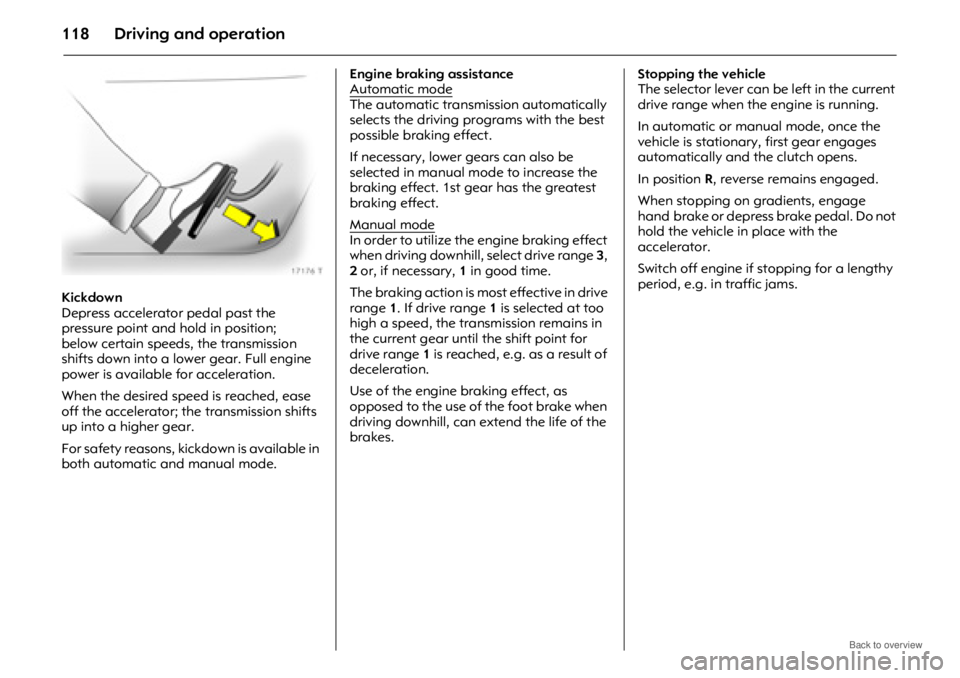
Kickdown
Depress accelerator pedal past the
pressure point and hold in position;
below certain speeds, the transmission
shifts down into a lower gear. Full engine
power is available for acceleration.
When the desired speed is reached, ease
off the accelerator; the transmission shifts
up into a higher gear.
For safety reasons, kickdown is available in
both automatic and manual mode. Engine braking assistance
Automatic mode
The automatic transmi
ssion automatically
selects the driving programs with the best
possible braking effect.
If necessary, lower gears can also be
selected in manual mo de to increase the
braking effect. 1st gear has the greatest
braking effect.
Manual mode
In order to utilize the engine braking effect
when driving downhill, select drive range 3,
2 or, if necessary, 1 in good time.
The braking action is mo st effective in drive
range 1. If drive range 1 is selected at too
high a speed, the transmission remains in
the current gear until the shift point for
drive range 1 is reached, e.g. as a result of
deceleration.
Use of the engine braking effect, as
opposed to the use of the foot brake when
driving downhill, can ex tend the life of the
brakes. Stopping the vehicle
The selector lever can be
left in the current
drive range when the engine is running.
In automatic or manual mode, once the
vehicle is stationary, first gear engages
automatically and the clutch opens.
In position R, reverse remains engaged.
When stopping on gradients, engage
hand brake or depress brake pedal. Do not
hold the vehicle in place with the
accelerator.
Switch off engine if stopping for a lengthy
period, e.g. in traffic jams.
Page 120 of 234
Driving and operation120
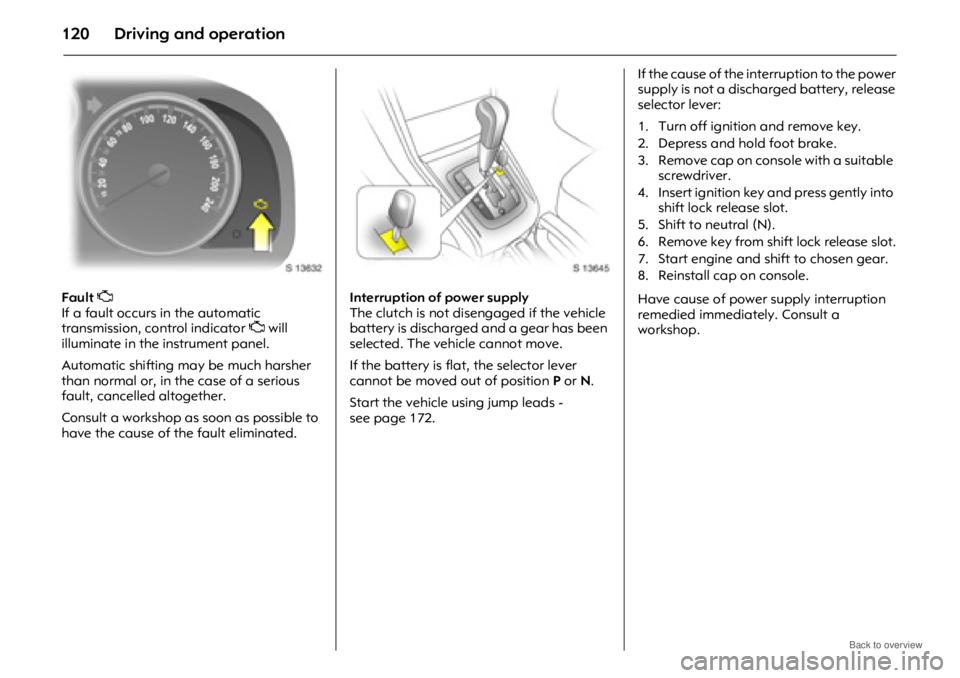
Fault Z
If a fault occurs in the automatic
transmission, control indicator Z will
illuminate in the instrument panel.
Automatic shifting may be much harsher
than normal or, in the case of a serious
fault, cancelled altogether.
Consult a workshop as soon as possible to
have the cause of the fault eliminated. Interruption of power supply
The clutch is not disengaged if the vehicle
battery is discharged and a gear has been
selected. The vehicle cannot move.
If the battery is flat, the selector lever
cannot be moved out of position
P or N.
Start the vehicle using jump leads -
see page 172. If the cause of the interruption to the power
supply is not a discharged battery, release
selector lever:
Have cause of power supply interruption
remedied immediately. Consult a
workshop.
1. Turn off ignition and remove key.
2. Depress and hold foot brake.
3. Remove cap on console with a suitable
screwdriver.
4. Insert ignition key and press gently into shift lock release slot.
5. Shift to neutral (N).
6. Remove key from shift lock release slot.
7. Start engine and shift to chosen gear.
8. Reinstall cap on console.
Page 122 of 234

Driving and operation122
Always exercise caution when in slippery
conditions (caused by sand, gravel, water,
snow or ice on the road), in order to
maintain vehicle control.
Use the accelerator to control the vehicle -
keep brake pedal use to a minimum.
zDo not slip the clutch.
z Do not spin the wheels.
z Do not make exaggerated or jerky
steering movements.
Driving a vehicle in snow and ice should be
undertaken with extreme caution:
z Select a gear suitable for the conditions.
z Start the vehicle moving with minimal
engine revs, low gear and combined
clutch and accelerator control.
z Change to a higher gear as quickly as
possible, to keep the engine revs low.
z With automatic transmission 3, select
drive range D and press button n, to
activate the Winter program. Off-road driving
During off-road drivin
g, you will encounter
a variety of driving conditions and
circumstances too numerous to list here.
Always use good judgement and common
sense. If you feel uncomfortable about
tackling a given situation, do not attempt
it.
Avoid protruding objects (such as rocks or
tree stumps) that may damage the
underbody and tyres of your vehicle.
Test the brakes after operating in mud, to
clear excess mud from the braking
surfaces.
Gripping the steering wheel
Terrain conditions can cause rapid and
unexpected movement in the steering,
especially rough terrain. Preparation
The duration, distance and conditions of
the off-road activity determine the extent
of the preparation th
at is required. The
following are given as guidelines.
Know the area where you will be driving,
either by inspection or from terrain maps.
Decide your route in advance and ensure
that it is a vehicular right of way
1).
Make a thorough check of the vehicle.
Check the following:
z Oil, water, fuel, brake and clutch fluid
levels,
z Drive belts,
z Windscreen wipers and washer system,
z Lamps.
Maintenance - see pages 126, 206.
9 Warning
Be ready to deal with these movements
by having a firm grip on the outer rim of
the steering wheel with the thumbs
outside the spokes, to guard against
injury from kickback.
1)Observe national regulations.
Page 125 of 234

Driving and operation125
Self-help
Recovery and towing
When recovering or towing a vehicle
off-road, observe the following:
zA greater force is required to move a
vehicle from or through mud than when
on a hard surfaced road.
z Attach a tow rope to the towing eye of
the vehicle, not to the axle -
see pages 164, 174.
z Where possible, drive both vehicles
forward to affect a recovery, using an
appropriate gear to avoid wheelspin.
z Avoid the use of reverse gear because of
possible resultant wheelspin.
z Stay clear of the tow rope.
Wheel changing
Place a board or plate beneath the jack, to
prevent it from sinking into soft ground.
Further information - see page 178. Cleaning
Clean the vehicle thoroughly and as soon
as possible after driving off-road.
Do not let mud remain dry on any part of
the vehicle as it becomes abrasive and can
damage paint, glass, seals, bearings and
brake components.
If left to build up, mud can seriously affect
the air flow through and over mechanical
components and cause localised
overheating and failure of parts, especially
in the engine compartment.
Ensure the radiator core and the area
between the radiator and intercooler/oil
cooler (where installed) is cleaned, to
maintain proper cooling air flow.
Check the radiator and cooler cores for
blockage (sand, silt etc.).
Check the tyre treads.
Clean and check the mechanical parts of
the vehicle, particularly the following
areas:
z
Driveshafts, including sealing bellows,
z Front brake calipers, pads and discs,
z Front suspension,
z Clutch fork sealing bellows,
z Rear brake calipers, pads and discs,
z Rear suspension,
z Fuel tank and underguard,
z Breathers, axles and fuel tank,
z Load sensing valve,
z Transfer box and underguard,
z Engine oil pan and underguard.
Observe the following:
z Do not spray high-pressure water
directly at the vehicle seals.
z The wheels must be removed to clean all
mud and stones from the brake calipers
and to check brake pad wear.
z The areas on the upper side of the
underguards must be cleared of stones,
to prevent damage to the engine oil pan
and the fuel tank.
9 Warning
Breaking ropes can cause serious injury.
Page 126 of 234

Driving and operation126
Maintenance
Certain maintenance operations, e.g.
changes of engine oil, oil filter, air cleaner
element and brake pads, are required
more frequently for severe operating
conditions, e.g. driving on unsurfaced
roads, during thick dust or mud
accumulation, etc.
If the vehicle is driven off-road to a great
extent, the chassis will need regular
inspection.
Your Opel Partner will inform you which
additional service is required between the
normal service intervals, after
consideration of the specific operating
conditions of your vehicle.
Further information - see page 206.
Service checks after wading
After wading, check for the ingress of water
into the following:
zBrake fluid reservoir,
z Air cleaner element,
z Engine,
z Transmission,
z Axles,
z Interior of vehicle.
Renew any lubricating oil or hydraulic fluid
that has a milky appearance, indicating
contamination with water. All Wheel Drive summary
Do
z
Check fuel and tyres, water and oil levels
before venturing off-road.
z Survey on foot before driving off-road,
especially when traversing hillsides,
wading, driving in deep snow and over
ridges.
z Select the correct gear for the conditions.
z Use the engine’s power of acceleration
and deceleration with the correct gear,
to control the vehicle.
z Keep a firm grip on the outer rim of the
steering wheel - keep your thumbs away
from the spokes.
z Drive carefully and be prepared for
emergencies.
z Drive slower under crosswind conditions.
z Approach obstacles and conditions
off-road at the correct angles and with
sufficient momentum to negotiate the
obstacle, but do not put undue strain on
the vehicle.
z Use caution - if you are not sure, do not
do it. Don’tz
Do not venture off-road unless you are
certain that the conditions are capable
of being negotiated safely by you and
your vehicle.
z Do not take unnecessary risks.
z Do not use the brakes excessively, to
maintain steering control.
z Do not change gear on difficult terrain -
depressing the clutch may cause the
vehicle to stop because of drag on the
wheels - or accelerate backwards or
forwards when on a hill.
z Do not ride or slip the clutch.
z Do not spin the wheels if stuck in mud,
sand or snow - they will only dig in
deeper.
z Do not drive at an excessive speed,
especially into corners. Your All Wheel
Drive vehicle has a higher centre of
gravity than conventional vehicles.
Sudden changes of direction can lead to
loss of control.
Page 128 of 234

Driving and operation128
Switching off the engine
If the engine temperature is very high, e.g.
after driving in mountainous terrain: allow
engine to idle for approx. 2 minutes, in
order to prevent heat accumulation.
When you switch off, fans in the engine
compartment may continue running for a
time, to cool the engine.
Vehicles with turbocharger 3
In order to protect the turbocharger, after
running at high engine speeds or high
engine loads, operate the engine briefly at
a low load or run in neutral for approx.
30 seconds before switching off.
Save energy – more kilometres/miles
Please observe the running-in hints on the
previous page and the tips for energy
saving on the following pages.
Good, technically correct and economical
driving ensures maximum durability and
performance for your vehicle.
Overrun
The fuel supply is automatically shut off
during overrun, e.g. when the vehicle is
being driven down long gradients or during
braking. To enable the overrun cut-off to
come into action, do not accelerate or
declutch during overrun. Engine rpm
Under all driving conditions, drive in a
favourable engine speed range.
Warming up
Allow engine to warm up while driving. Do
not warm it up by le
tting it run at idling
speed. Do not apply full throttle until
engine reaches operating temperature.
After a cold start, automatic
transmission 3 does not shift into higher
gears until higher engine speeds have been
reached. This allows the catalytic converter
to quickly reach the temperature required
for optimum pollutant reduction.
Correct gear selection
Do not race your engine whilst in neutral or
with a low gear selected. Driving too fast in
individual gears or drive ranges as well as
stop-and-go traffic in crease engine wear
and fuel consumption.
Change down
When decreasing speed, shift down into
the next lowest gear. Do not slip the clutch
with a high-revving engine. This is
especially important when hill climbing. Clutch operation
3
Always depress the clutch pedal hard to
the floor, to prevent shifting difficulties and
transmission damage. There must be no
mats in the area of the pedals.
When driving, do not use the clutch pedal
as a foot rest; this will cause substantial
clutch wear.
Pedals
Do not place any objects in the footwell
which could slip under the pedals and
inhibit the pedal travel.
To ensure the pedal travel is uninhibited,
there must be no mats in the area of the
pedals.
When driving, do not use the brake pedal
as a foot rest; this will cause substantial
wear to brake components and cause
overheating, resultin g in longer braking
distances.
Battery care whilst driving
When driving slowly or when the vehicle
is stationary, e.g. in slow urban traffic,
stop-and-go traffic or traffic jams, turn off
all unnecessary electrical loads where
possible (e.g. heated rear window,
auxiliary headlamps).
When starting the engine, depress the
clutch pedal so that transmission
resistance is elimin ated and the starter
motor and battery are relieved.