fuel pressure OPEL ANTARA 2009 Owners Manual
[x] Cancel search | Manufacturer: OPEL, Model Year: 2009, Model line: ANTARA, Model: OPEL ANTARA 2009Pages: 234, PDF Size: 3.01 MB
Page 2 of 234

2
Data specific to your vehicle
Please enter your vehicle’s data here to keep it easily accessible.
This information is available under the section "Technical data" as well as on the identification plate.
Fuel
Designation
Engine oil
Grade
Viscosity
Tyre pressure
Tyre size for load of up to 4 persons for full load
Summer tyres FrontRear FrontRear
Winter tyres FrontRear FrontRear
Weights
Permissible Gross Vehicle Weight
– EC kerb weight
=L oa din g
Page 12 of 234

In brief12
Control indicators
uABS (Anti-lock Brake System):
see page 148.
gTrailer indicator 3:
see page 70.
4Brake system:
see pages 70, 145.
rPark pilot 3:
see pages 71, 142.
5DCS (Descent Control System):
see pages 71, 138.
BAWD (All Wheel Drive):
see pages 71, 121.
7ESC Active & Warning
(Electronic Stability Control):
see page 136.
AESC Not Ready:
see page 136.
JESC OFF:
see page 136.
qAutomatic headlamp range
adjustment 3 :
see pages 71, 97.
WCoolant temperature:
see pages 71, 195.
oElectronic immobiliser:
see pages 22, 72.
9Door open:
see page 72.
3Engine electronics,
transmission electronics 3:
see pages 72, 134.
vAirbag systems 3,
belt tensioners:
see pages 44, 52.
1Tailgate open:
see page 72.
XDriver’s seat belt reminder:
see page 72.
OTurn signal lamps:
see pages 14, 72, 95.
YLow fuel level:
see pages 72, 76, 132, 225.
>Front fog lamps:
see pages 73, 96.
rFog tail lamp:
see pages 73, 96.
PHeadlamp main beam:
see pages 14, 73, 95.
GLow windscreen washer fluid:
see page 73.
NWater in diesel fuel filter 3:
see pages 73, 194.
CChange engine oil 3:
see page 73.
NPreheating for diesel engines 3:
see pages 19, 73.
IDPF (Diesel particle filter) 3:
see pages 73, 135.
mCruise control 3:
see page 140.
SEngine oil level 3:
see page 73.
2Power steering:
see page 73.
aAnti-theft alarm system activation
without monitoring of passenger
compartment and vehicle tilt 3:
see page 28.
IEngine oil pressure:
see page 74.
pAlternator:
see page 74.
ZExhaust emissions:
see pages 74, 134.
0Winter program:
see pages 74, 117.
Page 74 of 234

Instruments, controls74
aAnti-theft alarm system activation
without monitoring of passenger
compartment and vehicle tilt 3
see page 28.
IEngine oil pressure
Illuminates in red when ignition is switched
on. Extinguishes after engine is started.
Can illuminate intermit tently when idling
with hot engine; must extinguish when
engine speed is increased.
If
it illuminates during driving;
engine oil pressure may be dangerously
low, interrupting engine lubrication and
resulting in damage to the engine and/or
locking of the driving wheels:
z Move out of the flow of traffic as quickly
as possible without impeding other
vehicles,
z Depress clutch,
z Move gearshift lever to neutral
(automatic transmission to N),
z Switch off ignition. Check engine oil level before consulting
a workshop. If the oil level is low, top up
using the specified engine oil - see pages
192, 213, 217.
If the oil level is normal, have a workshop
check the vehicle’s lubricating system.
pAlternator
Illuminates in red when ignition is switched
on. Extinguishes after engine is started.
If
it illuminates during driving:
stop vehicle and switch off engine. The
battery is not being charged and the
engine cooling may be interrupted. The
brake servo unit may cease to be effective.
Interrupt your journey immediately.
Remove key and check drive belt condition
and tensioning before consulting a
workshop.
ZExhaust emissions
Illuminates in yellow when ignition is
switched on. Extinguishes after engine is
started. Can illuminate briefly when
driving; this is normal and does not
indicate a system fault.
If it illuminates when the engine is running
;
fault in emission control system.
The permitted emission limits may be
exceeded. Fuel economy and vehicle
driveability may be impaired.
The control indicator also illuminates if
there is a fault in the diesel particle filter 3.
Consult a workshop as soon as possible.
If it flashes when the engine is running
;
for a fault that can lead to destruction of
the catalytic converter, see page 134.
Consult a workshop as soon as possible.
0Winter program 3
Illuminates in yellow when Winter program
for the automatic transmission is enabled -
see page 117.
9 Warning
When the engine is off, considerably
greater force will be required for braking
and steering.
Do not remove key until vehicle has come
to a standstill, otherwise the steering
column lock could engage unexpectedly.
Page 125 of 234

Driving and operation125
Self-help
Recovery and towing
When recovering or towing a vehicle
off-road, observe the following:
zA greater force is required to move a
vehicle from or through mud than when
on a hard surfaced road.
z Attach a tow rope to the towing eye of
the vehicle, not to the axle -
see pages 164, 174.
z Where possible, drive both vehicles
forward to affect a recovery, using an
appropriate gear to avoid wheelspin.
z Avoid the use of reverse gear because of
possible resultant wheelspin.
z Stay clear of the tow rope.
Wheel changing
Place a board or plate beneath the jack, to
prevent it from sinking into soft ground.
Further information - see page 178. Cleaning
Clean the vehicle thoroughly and as soon
as possible after driving off-road.
Do not let mud remain dry on any part of
the vehicle as it becomes abrasive and can
damage paint, glass, seals, bearings and
brake components.
If left to build up, mud can seriously affect
the air flow through and over mechanical
components and cause localised
overheating and failure of parts, especially
in the engine compartment.
Ensure the radiator core and the area
between the radiator and intercooler/oil
cooler (where installed) is cleaned, to
maintain proper cooling air flow.
Check the radiator and cooler cores for
blockage (sand, silt etc.).
Check the tyre treads.
Clean and check the mechanical parts of
the vehicle, particularly the following
areas:
z
Driveshafts, including sealing bellows,
z Front brake calipers, pads and discs,
z Front suspension,
z Clutch fork sealing bellows,
z Rear brake calipers, pads and discs,
z Rear suspension,
z Fuel tank and underguard,
z Breathers, axles and fuel tank,
z Load sensing valve,
z Transfer box and underguard,
z Engine oil pan and underguard.
Observe the following:
z Do not spray high-pressure water
directly at the vehicle seals.
z The wheels must be removed to clean all
mud and stones from the brake calipers
and to check brake pad wear.
z The areas on the upper side of the
underguards must be cleared of stones,
to prevent damage to the engine oil pan
and the fuel tank.
9 Warning
Breaking ropes can cause serious injury.
Page 127 of 234

Driving and operation127
Driving hints
The first 1000 km (600 miles)
Drive your vehicle at various speeds. Do
not use full throttle. Never allow the engine
to labour at low revs.
Make good use of all gears. Depress the
accelerator pedal a maximum of around
three quarters of the available pedal travel
in all gears and drive ranges.
Do not drive faster than three quarters of
maximum speed.
Avoid quick starts, su dden acceleration
and prolonged high-speed driving, to
avoid engine damage and to conserve
fuel.
Do not brake unnecessarily hard for the
first 200 km (125 miles).
If possible, avoid towing another vehicle.
Never coast with engine not running
Many units may then not function (e.g.
brake servo unit, power steering, airbag
system). Driving in this manner is a danger
to yourself and others. Brake servo unit
With the engine not running, the brake
servo unit is no longer effective once the
brake pedal has been depressed once or
twice. The braking effect is not reduced,
but substantially greater foot pressure is
necessary to stop the vehicle.
Power steering
Never leave the steering wheel on full lock
when the vehicle is stationary, as this may
damage the power steering pump.
If the power steering should fail - e.g. when
the vehicle is being towed with the engine
switched off - the vehicle can still be
properly steered, but considerably greater
effort is necessary.
Driving in mountainous terrain or with a
caravan/trailer
Electrically driven fan; the fan cooling
capacity is not dependent on engine
speed. It is not necessary, therefore, when
driving uphill to shif
t down into a lower
gear if the vehicle can climb in a higher
gear. Driving in extreme conditions
When driving in hazard
ous conditions, e.g.
in snow, ice, mud, sand or water, drive
slowly and cautiously to allow for greater
braking distances.
If stuck, use 2nd gear (automatic
transmission in drive range 2) to avoid
spinning the front wheels.
Use sand, tyre chains or other non-slip
materials to provide traction when stuck in
snow, mud or ice.
Driving through water
Before attempting to drive through water,
check the depth. If the depth is slightly
lower than the underbody of your vehicle,
do not attempt to drive through it.
Driving too quickly through water can
cause water to enter the engine through
the air intake, causing severe damage.
Drive slowly, in a high engine rpm in as low
a gear as possible.
Driving with a roof load
Do not exceed the permissible roof load -
see page 221. For safety reasons,
distribute the load evenly and secure it
tightly with straps so that it cannot slip. Set
the tyre pressure to the value given for full
load. Do not drive faster than 120 km/h
(75 mph). Check and retighten straps at
frequent intervals.
Page 130 of 234

Driving and operation130
Overrun
zThe fuel supply is automatically shut off
during overrun, e.g. when the vehicle is
being driven down long gradients or
during braking - see page 128.
z To enable the overrun cut-off to take
effect and save fuel, do not accelerate or
declutch.
Correct gear selection
z High revs increase engine wear and fuel
consumption.
z Do not race your engine. Avoid driving at
high engine speeds.
Driving with an eye on the tachometer
saves fuel. If possible, drive at low revs in
each gear and at a constant speed.
Drive in top gear as much as possible,
shift up as soon as possible and do not
shift down prematurely.
High speed
z The faster the speed, the higher the fuel
consumption and noise level. Driving at
full throttle uses up a great deal of fuel
and generates excessive noise and high
emission levels.
z Slightly releasing the accelerator pedal
results in distinct fu el savings with no
major loss of speed.
Drive at no more than around three
quarters of maximum speed and you will
use up to 50% less fuel, without losing a
great deal of time. Tyre pressure
z
Inadequate tyre pressure, leading to
higher road resistance, costs money in
two ways; for more fuel and increased
tyre wear.
z Regular checks (every 14 days) pay off.
Electrical loads
z The power consumption of electrical
equipment increases fuel consumption.
z Switch off all additional consumers (e.g.
air conditioning, heated rear window)
when they are no longer required.
Roof racks 3
z Roof racks can increase fuel
consumption by approx. 1 l/100 km
(3.5 gal./1000 miles) due to air
resistance.
z Remove them if they are not being used. Repair and maintenance
z
Improper repairs or adjustment and
maintenance work can increase fuel
consumption. Do not carry out work on
the engine yourself.
You may, out of ignorance, infringe
environmental laws by not disposing of
materials properly.
Appropriate parts might not be recycled.
Contact with some of the materials
involved may pose a health hazard.
z We recommend that repairs and
maintenance be entrusted to an
Opel Partner.
Extreme driving conditions
z Driving up steep gradients, cornering,
driving on poor roads, and winter driving
all increase fuel consumption.
Fuel consumption increases dramatically
in urban traffic and at winter
temperatures, especially on short trips
when the engine operating temperature
is not reached.
z Follow the hints given above to keep fuel
consumption to a minimum under such
conditions.
Page 150 of 234
Driving and operation150
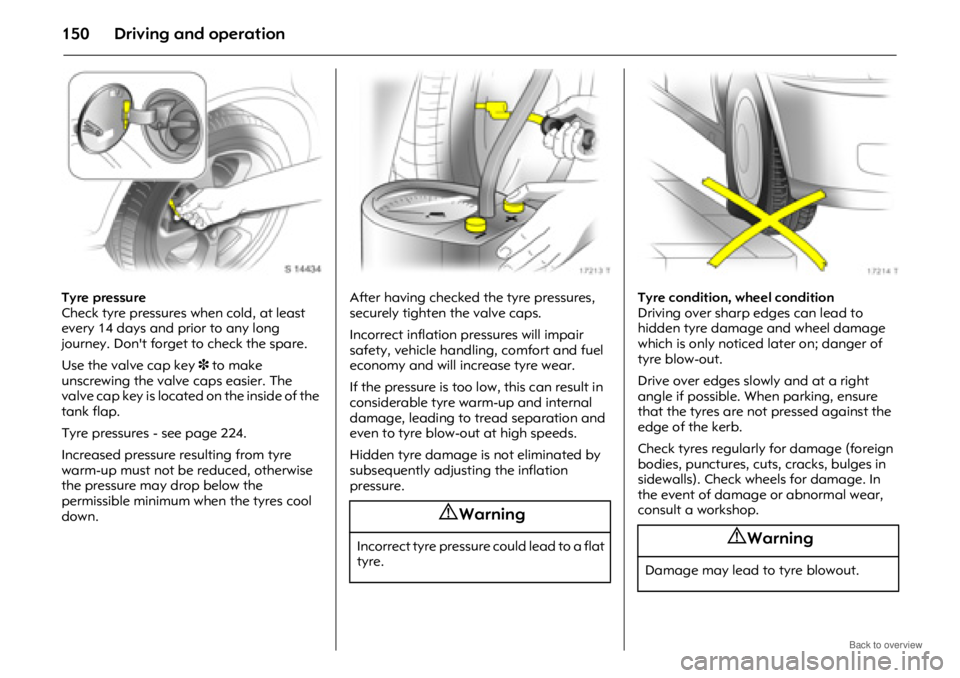
Tyre pressure
Check tyre pressures when cold, at least
every 14 days and prior to any long
journey. Don't forget to check the spare.
Use the valve cap key 3 to make
unscrewing the valve caps easier. The
valve cap key is located on the inside of the
tank flap.
Tyre pressures - see page 224.
Increased pressure resulting from tyre
warm-up must not be reduced, otherwise
the pressure may drop below the
permissible minimum when the tyres cool
down. After having checked the tyre pressures,
securely tighten the valve caps.
Incorrect inflation pressures will impair
safety, vehicle handling, comfort and fuel
economy and will increase tyre wear.
If the pressure is too low, this can result in
considerable tyre warm-up and internal
damage, leading to tread separation and
even to tyre blow-out at high speeds.
Hidden tyre damage is not eliminated by
subsequently adjusting the inflation
pressure.
Tyre condition, wheel condition
Driving over sharp edges can lead to
hidden tyre damage and wheel damage
which is only noticed later on; danger of
tyre blow-out.
Drive over edges slowly and at a right
angle if possible. When parking, ensure
that the tyres are not pressed against the
edge of the kerb.
Check tyres regularly for damage (foreign
bodies, punctures, cuts, cracks, bulges in
sidewalls). Check wheels for damage. In
the event of damage
or abnormal wear,
consult a workshop.
9 Warning
Incorrect tyre pressure could lead to a flat
tyre.9 Warning
Damage may lead to tyre blowout.
Page 208 of 234

208 Service, maintenance
Service operations by year 1)
km ( x 1000)1)
miles ( x 1000)1)
1)Whichever occurs first.
⊕ Additional operations.
o Under extreme operating conditions and if required by country-specific conditions, the intervals are reduced.
15
10 1
30
20 45
30 2
60
40 75
50 3
90
60
⊕o Diesel fuel filter: drain water
(If relative humidity is high an
d/or fuel is of lower quality) Annually
Fuel filter: replace and drain water - diesel (g rade EN 590) Every 2 years/60 000 km/40 000 miles
Parking brake: check and adjust
Wheel mounting and suspension front an d rear, brake lines, brake pressure
hoses, fuel lines and exhaust system: visual check xxx
Corrosion protection: check and record in Service and Warranty Booklet Annually
Front and rear wheel br akes: check visually xxx
o
⊕Annual service check if annual mileage exceeds 20 000 km Annually
Engine, transmission, PTO, rear differential, A/C compressor: check for leaks xxx
Steering system boots, track rods , final drive: visual check xxx
Track rod end and supporting ball joint: check xxx
⊕Brake and clutch fluid: change Every 2 years
Wheel fastening: loosen and tighten to torque
Tyre condition and pressures: check, correct xxx
⊕Annual service check if annual
mileage exceeds 20 000 km Annually
First aid kit, tyre repair kit and lash ing eyes: visual check Every 2 years
Headlamp aiming: check, adjust x x x
Door hinges, door stop, lock cylinder, lock striker, bonnet catch, tailgate
hinges and check links: lubricate xxx
Test drive, final check
Service interval display and oil life monitor: reset - if applicable xxx
Page 210 of 234

210 Service, maintenance
Service operations by year 1)
km ( x 1000)1)
miles ( x 1000)1)
1)Whichever occurs first.
⊕ Additional operations.
o Under extreme operating conditions and if required by country-specific conditions, the intervals are reduced.
15
10 1
30
20 45
30 2
60
40 75
50 3
90
60
⊕o Diesel fuel filter: drain water
(If relative humidity is high an
d/or fuel is of lower quality) Annually
Fuel filter: replace and drain water - diesel (g rade EN 590) Every 2 years/60 000 km/40 000 miles
Parking brake: check and adjust
Wheel mounting and suspension front an d rear, brake lines, brake pressure
hoses, fuel lines and exhaust system: visual check Every 2 years/60 000 km/40 000 miles
Corrosion protection: check and record in Service and Warranty Booklet Annually
Front and rear wheel brakes: check visually Every 2 years/60 000 km/40 000 miles
o
⊕Annual service check if annual mileage exceeds 20 000 km Annually
o
⊕Automatic transmission oil: change Every 4 years/60 000 km/40 000 miles
Engine, transmission, A/C compressor: check for leaks Annually
Steering system boots, track rods, final drive: visual check Annually
Track rod end and supporting ball joint: check Annually
⊕Brake and clutch fluid: change Every 2 years
Wheel fastening: loosen and tighten to torque
Tyre condition and pressures: check, correct Every 2 years/60 000 km/40 000 miles
⊕Annual service check if annual
mileage exceeds 20 000 km Annually
First aid kit, tyre repair kit and lash ing eyes: visual check Every 2 years
Headlamp aiming: check, adjust Every 2 years/60 000 km/40 000 miles
Door hinges, door stop, lock cylinder, lock striker, bonnet catch, tailgate
hinges and check links: lubricate Every 2 years/60 000 km/40 000 miles
Test drive, final check
Service interval display and oil life monitor: reset - if applicable xxxxxx
Page 212 of 234

212 Service, maintenance
Service operations by month 1)
km ( x 1000)1)
miles ( x 1000)1)
1)Whichever occurs first.
⊕ Additional operations.
o Under extreme operating conditions and if required by country-specific conditions, the intervals are reduced.
6
10
6.5 12
20
1318
30
2024
40
26.5 30
50
3336
60
40
Parking brake: check and adjust
Wheel mounting and suspension front an d rear, brake lines, brake pressure
hoses, fuel lines and exhaust system: visual check xxx
Corrosion protection: check and record in Service and Warranty Booklet Annually
Front and rear wheel br akes: check visually x x x
Engine, transmission, PTO, rear differential, A/C compressor: check for leaks xxx
Steering system boots, track rods , final drive: visual check xxx
Track rod end and supporting ball joint: check xxx
⊕Brake and clutch fluid: change Every 2 years
Wheel fastening: loosen and tighten to torque
Tyre condition and pressures: check, correct xxx
First aid kit, tyre repair kit and lash ing eyes: visual check Every 2 years
Headlamp aiming: check, adjust xxx
Door hinges, door stop, lock cylinder, lock striker, bonnet catch, tailgate
hinges and check links: lubricate xxx
Test drive, final check
Service interval display and oil life monitor: reset - if applicable xxx