turn signal OPEL ANTARA 2009 Owners Manual
[x] Cancel search | Manufacturer: OPEL, Model Year: 2009, Model line: ANTARA, Model: OPEL ANTARA 2009Pages: 234, PDF Size: 3.01 MB
Page 11 of 234

In brief11
Page
1 Side air vents ................................... 104
2 Door window defroster vents ......... 104
3 Headlamp flash and main beam .... 14
turn signal lamps .............................. 14
Peripheral lighting............................. 98
cruise control 3............................... 140
4 Infotainment system
remote control buttons ................... 101
Trip computer 3.......................... 81, 88
5 Horn ................................................... 15
6 Instruments ........................................ 70
7 Windscreen and tailgate
wipers and washers .................... 15, 16
headlamp washers 3........................ 16
8 Central information display for time,
date, outside temperature,
Infotainment system,
check control 3................................. 91
Trip computer 3.......................... 81, 88 Page
9 Centre air vents ............................... 104
10 Hazard warning ................................ 14
Park pilot 3..................................... 142
Descent Control System (DCS) ....... 138
Electronic Stability Control (ESC) ... 136
Front passenger’s
seat belt reminder 3......................... 46
Fold in exterior mirrors 3................. 30
Control indicator for
anti-theft alarm system 3................ 29
11 Infotainment system ....................... 101
12 Front passenger’s airbag ................. 52
13 Glove compartment.................. 64, 105
14 Fuse box .......................................... 182
15 Climate control................................ 103
16 Ignition switch ................................... 13 Page
17 Accelerator pedal ........................... 127
18 Driver’s airbag .................................. 52
19 Brake pedal............................. 127, 146
20 Clutch pedal 3........................ 127, 128
21 Steering wheel adjustment .............. 13
22 Bonnet release ................................ 171
23 Coin storage...................................... 67
24 Card holder ....................................... 67
25 Parking lamps ................................... 94
dipped beam .............................. 14, 95
automatic dipped beam
activation 3...................................... 95
headlamp range adjustment 3....... 97
front fog lamps ................................. 96
fog tail lamp ..................................... 96
instrument illumination .................... 98
Page 12 of 234

In brief12
Control indicators
uABS (Anti-lock Brake System):
see page 148.
gTrailer indicator 3:
see page 70.
4Brake system:
see pages 70, 145.
rPark pilot 3:
see pages 71, 142.
5DCS (Descent Control System):
see pages 71, 138.
BAWD (All Wheel Drive):
see pages 71, 121.
7ESC Active & Warning
(Electronic Stability Control):
see page 136.
AESC Not Ready:
see page 136.
JESC OFF:
see page 136.
qAutomatic headlamp range
adjustment 3 :
see pages 71, 97.
WCoolant temperature:
see pages 71, 195.
oElectronic immobiliser:
see pages 22, 72.
9Door open:
see page 72.
3Engine electronics,
transmission electronics 3:
see pages 72, 134.
vAirbag systems 3,
belt tensioners:
see pages 44, 52.
1Tailgate open:
see page 72.
XDriver’s seat belt reminder:
see page 72.
OTurn signal lamps:
see pages 14, 72, 95.
YLow fuel level:
see pages 72, 76, 132, 225.
>Front fog lamps:
see pages 73, 96.
rFog tail lamp:
see pages 73, 96.
PHeadlamp main beam:
see pages 14, 73, 95.
GLow windscreen washer fluid:
see page 73.
NWater in diesel fuel filter 3:
see pages 73, 194.
CChange engine oil 3:
see page 73.
NPreheating for diesel engines 3:
see pages 19, 73.
IDPF (Diesel particle filter) 3:
see pages 73, 135.
mCruise control 3:
see page 140.
SEngine oil level 3:
see page 73.
2Power steering:
see page 73.
aAnti-theft alarm system activation
without monitoring of passenger
compartment and vehicle tilt 3:
see page 28.
IEngine oil pressure:
see page 74.
pAlternator:
see page 74.
ZExhaust emissions:
see pages 74, 134.
0Winter program:
see pages 74, 117.
Page 14 of 234

In brief14
Headlamp flash, main and
dipped beam:
6Main beam, headlamp flash -
see page 95.
Turn signal lamps:
Lever in rest position
6 Turn signal lamps - see page 95.
Hazard warning lamps:
6Hazard warning lamps - see page 97.
Headlamp
flash = Pull lever
towards
steering wheel
Main beam = Push lever forwards
Dipped beam = Pull lever back towards
steering wheelUpwards = Right turn
Downwards = Left turn
On = Press ¨
Off = Press ¨ again
Page 29 of 234
Locks, doors, windows29
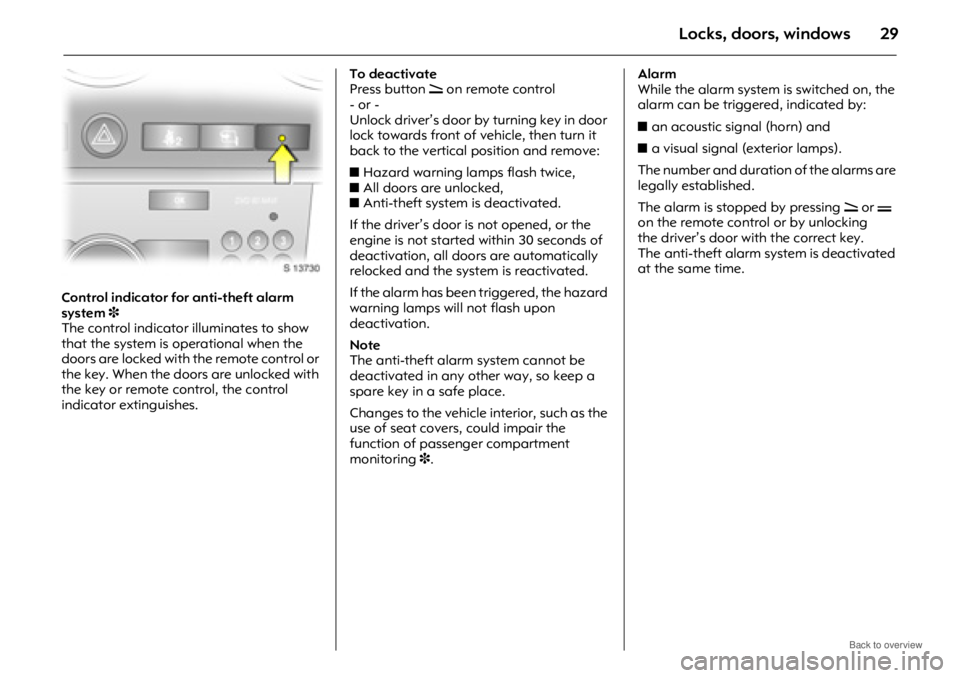
Control indicator for anti-theft alarm
system3
The control indicator illuminates to show
that the system is operational when the
doors are locked with the remote control or
the key. When the doors are unlocked with
the key or remote control, the control
indicator extinguishes. To deactivate
Press button
q on remote control
- or -
Unlock driver’s door by turning key in door
lock towards front of vehicle, then turn it
back to the vertical position and remove:
z Hazard warning lamps flash twice,
z All doors are unlocked,
z Anti-theft system is deactivated.
If the driver’s door is not opened, or the
engine is not started within 30 seconds of
deactivation, all doors are automatically
relocked and the system is reactivated.
If the alarm has been triggered, the hazard
warning lamps will not flash upon
deactivation.
Note
The anti-theft alarm system cannot be
deactivated in any other way, so keep a
spare key in a safe place.
Changes to the vehicle interior, such as the
use of seat covers, could impair the
function of passenger compartment
monitoring 3. Alarm
While the alarm system is switched on, the
alarm can be triggered, indicated by:
z
an acoustic signal (horn) and
z a visual signal (exterior lamps).
The number and duration of the alarms are
legally established.
The alarm is stopped by pressing q or p
on the remote control or by unlocking
the driver’s door with the correct key.
The anti-theft alarm system is deactivated
at the same time.
Page 72 of 234

Instruments, controls72
o
Electronic immobiliser
Illuminates in red when ignition is
switched on, then extinguishes.
If it remains illuminated after the ignition is
on, there is a fault in the immobiliser
system; the engine cannot be started -
see page 22.
9Door open
Illuminates in red when a door is open.
3Engine electronics,
transmission electronics 3
Illuminates in yellow when ignition is
switched on, then extinguishes.
If it illuminates
during driving;
there may be a fault in the engine or
transmission electronics: interrupt your
journey and consult a workshop as soon as
possible.
Further information - see page 134.
vAirbag systems 3 , belt tensioners
see pages 44, 52.
1Tailgate open
Illuminates in red when ignition is
switched on, then extinguishes.
Illuminates when tailgate is open or not
securely latched.
Tailgate - see page 26.
XDriver’s seat belt reminder
Illuminates in red when ignition is
switched on, then extinguishes.
When the engine is runn ing, if driver’s seat
belt is not engaged, it will flash for approx.
90 seconds and then illuminate until
driver’s seat belt is fastened.
If vehicle speed exceeds approx. 22 km/h
(14 mph), control indicator will flash for
approx. 90 seconds along with a warning
chime and then remains illuminated until
driver’s seat belt is fastened.
Seat belts - see page 43.
OTurn signal lamps
The relevant control indicator flashes in
green when the turn signal is on.
Rapid flash; failure of a turn signal bulb or
the corresponding fuse or failure of a trailer
turn signal bulb 3. Both control indicators
flash when the hazard warning lamps are
active.
Further information - see pages 14, 95.
Bulb replacement - see page 185.
Fuses - see page 181.
YLow fuel level
Illuminates in yellow when ignition is
switched on, then extinguishes.
If it illuminates during dr iving; fuel level low:
fill up fuel tank as soon as possible.
Never let the tank run dry.
Erratic fuel supply can cause catalytic
converter to overheat - see page 133.
Diesel engines: if the tank has been run dry,
bleed the fuel system as described on
page 171.
Refuelling - see page 132.
Fuel tank capacity - see page 225.
Page 92 of 234

Instruments, controls92
Warning buzzers
While driving:
z when operating th e turn signals.
z if driver’s or passenger’s seat belt 3 is
not engaged when the seat is occupied
and vehicle speed exceeds approx.
22 km/h (14 mph).
When the vehicle is parked and driver’s
door is opened:
z with exterior lamps switched on.
z when the key is in the ignition switch.
6 Seat belt warning chimes -
see pages 46, 72,
driving hints - see page 127,
save fuel, protect the environment -
see page 129.
Windscreen wipers
To activate, move lever upwards.
Press lever down from position J:
single swipe.
Further information - see pages 198, 202,
205. Adjustable wiper interval
To set the wiping interval to a value
between 1 and 10 seconds:
Switch on ignition.
Push lever down from position
J.
Wait the desired interval.
Set the lever to adjustable timed interval
wiper position $.
The interval remains stored until the next
change or the ignition is switched off.
Switching the ignition on and moving the
lever to $ sets the interval to 3.5 seconds.
In this mode, wiping frequency is also
affected by vehicle speed. As vehicle speed
increases, wiping will become more
frequent.
J
=Off
$ =Timed interval wipe
% =Slow
& =Fast
Page 94 of 234

Lighting94
Lighting
Exterior lamps
Turn light switch:
In positions 8 and 9, the tail lamps,
license plate lamps and instrument panel
lamps are also on. Daytime running lamps
3
Come on automatically when engine is
started.
They will turn off wh en the parking lamps
or dipped beam are on, or when the engine
is stopped.
Follow the regulations of the country in
which you are driving when using daytime
running lamps and front fog lamps.
Driving abroad - see page 100.
Lamps on reminder
If the driver’s door is opened when the light
switch is in position 8 or 9 and the
ignition is off, a warning chime will sound.
If the lamps are then switched off and back
on again, the warning chime will not sound.
Wiper activated lighting 3
With light switch in AUTO position,
if windscreen wipers are operated for
8 cycles or more, the exterior lamps
illuminate automatically.
Approach lighting 3
Depending upon outside light conditions,
when you press q on the remote control,
the hazard warning lamps flash twice and
the exterior lamps illuminate for approx.
20 seconds.
Main beam, headlamp flash ............. 95
Automatic dipped beam activation
3 95
Turn signal lamps ............................... 95
Front fog lamps >............................. 96
Fog tail lamp r.................................. 96
Reversing lamps.................................. 96
Centre high-mounted stop lamp ....... 96
Hazard warning lamps ...................... 97
Headlamp range adjustment q........ 97
Peripheral lighting .............................. 98
Instrument illumination, information display illumination .......................... 98
Interior courtesy lamps....................... 98
Battery discharge protection ............. 100
Headlamps when driving abroad ..... 100 7
=Off
8 = Parking lamps
9 = Dipped beam or main
beam
AUTO = Automatic dipped beam
activation 3
Page 95 of 234

Lighting95
Main beam, headlamp flash
To switch from dipped beam to main
beam, push lever forwards.
To switch back to dipped beam, pull lever
back towards steering wheel.
To activate the headlamp flash, pull lever
towards steering wheel. Main beam is
engaged for the duration of activation.
The blue control indicator P is illuminated
when main beam or headlamp flash is on.
Automatic dipped beam
activation 3
Light switch to AUTO; dipped beam comes
on automatically when the engine is
running, depending on outside light
conditions.
For reasons of safety, the light switch
should always remain in the AUTO
position.
To ensure automatic dipped beam
activation functions properly, do not cover
the light sensor on top of the instrument
panel.
Turn signal lamps
To activate, press lever up or down lightly.
When the steering wheel is turned back, the
lever automatically returns to its rest
position. This will not happen when making
a minor steering manoeuvre such as lane
changing.
Tap signal: briefly move lever to resistance
point. The turn signal then flashes three
times when changing lanes or the like.
Hold the lever if you want the turn signals
to flash for longer. When released, the lever
will spring back to rest position.
The volume of the turn signal lamps’
audible warning is dependent upon vehicle
speed.
Lever up = Right turn
Lever down = Left turn
Page 98 of 234

Lighting98
Peripheral lighting
The dipped beam and reversing lamps
illuminate for approx. 30 seconds after the
driver exits the vehicle and closes the door.
To activate function:
If the driver’s door is left open, the lamps
will extinguish after two minutes.
Peripheral lighting can be deactivated by
inserting the key in the ignition switch or by
pulling the turn signal lever towards the
steering wheel again while the driver’s door
is open.
Instrument illumination,
information display illumination
Comes on when ignition is switched on.
Brightness can be adjusted when the
exterior lamps are on: turn wheel to the
right or left until the desired brightness is
obtained.
If driver’s door is opened or q is pressed on
the remote control, instrument panel lamps
will illuminate automatically and stay on
for approx. 30 seconds until ignition switch
is turned to the ACC position.
Display mode 3 - see page 87.
Interior courtesy lamps
Front reading lamps, rear interior lamps
and luggage compartm ent lamps function
as courtesy lighting and illuminate when
the doors or tailgate are opened.
If doors or tailgate remain opened, the
lamps stay illuminated for approx.
10 minutes.
Once all doors and the tailgate are closed,
the courtesy lamps dim gradually after
approx. 10 seconds.
By pressing button d, both front reading
lamps and the rear interior lamps
illuminate.
Press the button again to turn the lamps
off.
1. Switch off ignition.
2. Remove ignition key.
3. Open driver’s door.
4. Pull turn signal lever towards
steering wheel.
Page 140 of 234
Driving and operation140
Cruise control 3
Cruise control can store and maintain
speeds over approx. 30 km/h (20 mph).
Deviation from the stored speed may occur
when driving uphill or downhill.
For safety reasons, cruise control cannot
be activated until the foot brake has been
depressed once.
Cruise control is operated with buttons
d, c and e on the turn signal lever. Do not use cruise control if it is not
advisable to maintain a constant speed
(e.g. in situations presenting a danger to
yourself and other road users, in heavy
traffic or on winding, slippery or greasy
roads).
With automatic transmission, only use
cruise control while in
D.
When cruise control is active, reaction
times may be increased, due to the
different position of the feet.
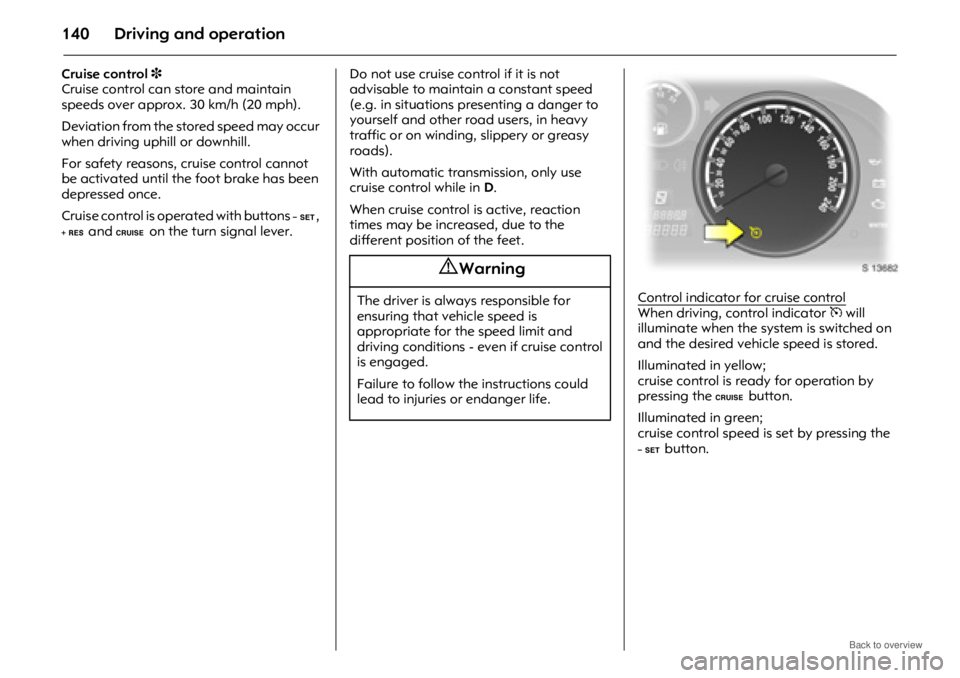
Control indicator for cruise control
When driving, control indicator m will
illuminate when the syst em is switched on
and the desired vehicle speed is stored.
Illuminated in yellow;
cruise control is ready for operation by
pressing the
ebutton.
Illuminated in green;
cruise control speed is set by pressing the
d button.
9 Warning
The driver is always responsible for
ensuring that vehicle speed is
appropriate for the speed limit and
driving conditions - even if cruise control
is engaged.
Failure to follow the instructions could
lead to injuries or endanger life.