automatic transmission OPEL ANTARA 2014 User Guide
[x] Cancel search | Manufacturer: OPEL, Model Year: 2014, Model line: ANTARA, Model: OPEL ANTARA 2014Pages: 217, PDF Size: 6.04 MB
Page 133 of 217
![OPEL ANTARA 2014 User Guide Driving and operating131Manual mode
Move selector lever out of position D
towards the left and then forwards or backwards.
<=Shift to a higher gear.]=Shift to a lower gear.
Tip selector lever in the a](/img/37/58214/w960_58214-132.png "OPEL ANTARA 2014 User Guide Driving and operating131Manual mode
Move selector lever out of position D
towards the left and then forwards or backwards.
<=Shift to a higher gear.]=Shift to a lower gear.
Tip selector lever in the a")
Driving and operating131Manual mode
Move selector lever out of position D
towards the left and then forwards or backwards.
<=Shift to a higher gear.]=Shift to a lower gear.
Tip selector lever in the appropriate
direction. It then returns to the centre
position.
Gearshifting in manual mode can be
achieved whilst accelerating. If the
engine speed is too low, the
transmission will automatically shift to a lower gear, even in manual mode,
to prevent the engine from stalling.
If a higher gear is selected when
vehicle speed is too low, or a lower
gear when vehicle speed is too high,
the shift is not executed.
In manual mode, no automatic
shifting to a higher gear takes place
at high engine revolutions.
Gears can be skipped by moving the selector lever repeatedly at short
intervals.
After stopping, 1st gear is
automatically selected. When starting
on slippery surfaces, tip selector lever forwards to engage 2nd gear.
To move back to position D, move
selector lever back to the right.
Electronic driving
programmes ■ Following a cold start, the operating
temperature programme increasesengine speed to quickly bring the
catalytic converter to the required
temperature.Kickdown
In both automatic and manual modes, if the accelerator pedal is pressed
down completely the transmission
shifts to a lower gear depending on
engine speed. Full engine power is
available for acceleration.
Fuel economy mode
Activate fuel economy mode to allow
the transmission to adapt gearshift
patterns, improving the vehicle's fuel
economy.
Page 134 of 217
132Driving and operating
Activation
In automatic mode, press button
s ; control indicator s
illuminates in the instrument cluster 3 89.
The settings of certain electronic
systems are adapted to reduce fuel
consumption:
■ The engine reacts less quickly to the accelerator pedal.
■ Automatic upshift points occur sooner and downshift points occur
later.
■ The transmission locks itself to the engine at cruising speeds, to
improve efficiency and increase
power and torque.
■ The fuel supply is automatically cut-
off more quickly during vehicle
deceleration. Overrun cut-off
3 125.
Do not use fuel economy mode whilst towing, e.g. a trailer.Deactivation
Fuel economy mode is switched off
by pressing button s again;
control indicator s extinguishes in
the instrument cluster.
Fault
In the event of a fault in the automatic
transmission, control indicator Z
illuminates in the instrument cluster 3 85 . Automatic shifting may be much
harsher than normal or, in the case of
a serious fault, cancelled altogether.
Have the cause of the fault remedied
by a workshop.
If control indicator g illuminates in
the instrument cluster when the
engine is running, this may indicate a
fault in the transmission electronics
3 85. The electronics switch to the
emergency running programme, fuel
consumption may increase and the
driveability of the vehicle may be
affected. Seek the assistance of a
workshop.Interruption of power
supply
The clutch is not disengaged if the
vehicle battery is discharged and a
gear has been selected. The vehicle
cannot move. The selector lever
cannot be moved out of position P or
N .
If the battery is discharged, start the
vehicle using jump leads 3 187.
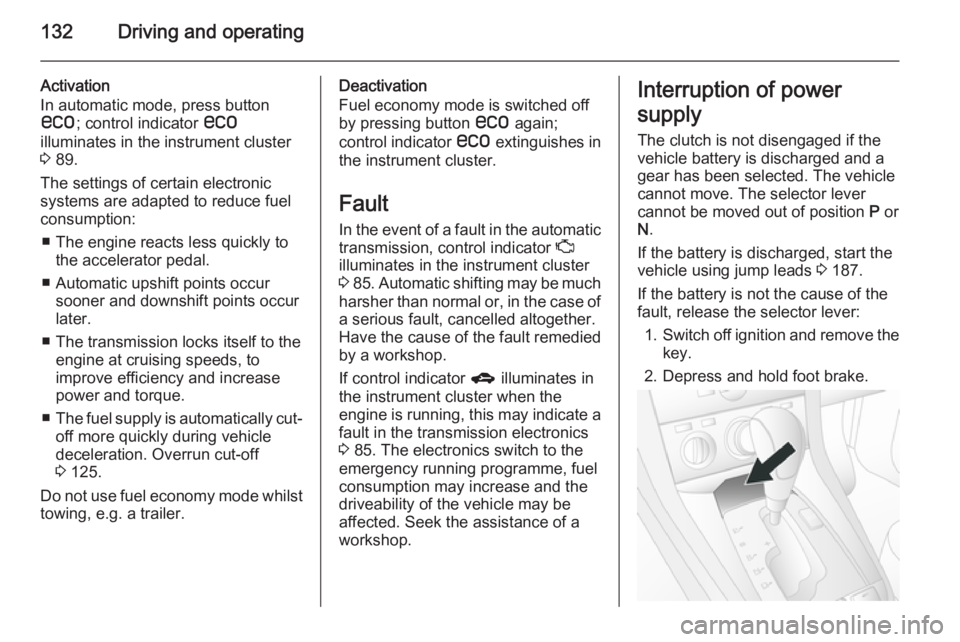
If the battery is not the cause of the
fault, release the selector lever:
1. Switch off ignition and remove the
key.
2. Depress and hold foot brake.
Page 139 of 217
Driving and operating137hard braking, the vehicle can nolonger be steered and may
swerve.
You can continue driving, provided
you drive with care and anticipation.
Have the cause of the fault remedied
by a workshop.
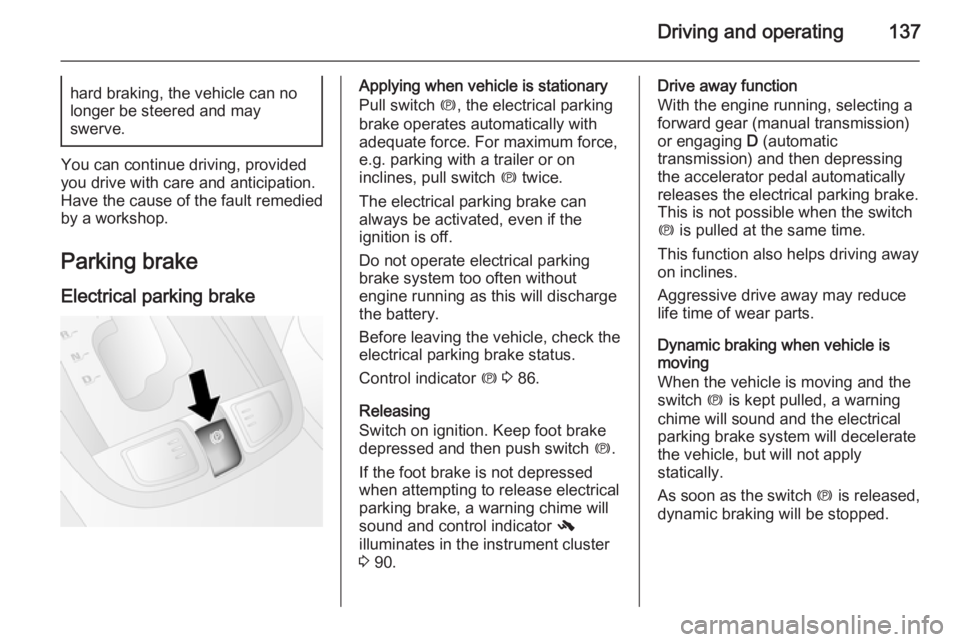
Parking brake Electrical parking brake
Applying when vehicle is stationary
Pull switch m, the electrical parking
brake operates automatically with
adequate force. For maximum force,
e.g. parking with a trailer or on
inclines, pull switch m twice.
The electrical parking brake can
always be activated, even if the
ignition is off.
Do not operate electrical parking
brake system too often without
engine running as this will discharge
the battery.
Before leaving the vehicle, check the
electrical parking brake status.
Control indicator m 3 86.
Releasing
Switch on ignition. Keep foot brake
depressed and then push switch m.
If the foot brake is not depressed
when attempting to release electrical
parking brake, a warning chime will
sound and control indicator -
illuminates in the instrument cluster
3 90.Drive away function
With the engine running, selecting a
forward gear (manual transmission)
or engaging D (automatic
transmission) and then depressing the accelerator pedal automatically
releases the electrical parking brake.
This is not possible when the switch
m is pulled at the same time.
This function also helps driving away
on inclines.
Aggressive drive away may reduce
life time of wear parts.
Dynamic braking when vehicle is
moving
When the vehicle is moving and the
switch m is kept pulled, a warning
chime will sound and the electrical
parking brake system will decelerate
the vehicle, but will not apply
statically.
As soon as the switch m is released,
dynamic braking will be stopped.
Page 143 of 217
Driving and operating141Driver assistance
systems9 Warning
Driver assistance systems are
developed to support the driver
and not to replace the driver's
attention.
The driver accepts full
responsibility when driving the
vehicle.
When using driver assistance
systems, always take care
regarding the current traffic
situation.
Cruise control
The cruise control can store and
maintain speeds above 40 km/h.
Deviations from the stored speeds
may occur when driving uphill or
downhill.
For safety reasons the cruise control
cannot be activated until the foot
brake has been operated once.
Do not use the cruise control if it is not advisable to maintain a constant
speed.
With automatic transmission, only activate cruise control in automatic
mode.
Control indicator m 3 91.
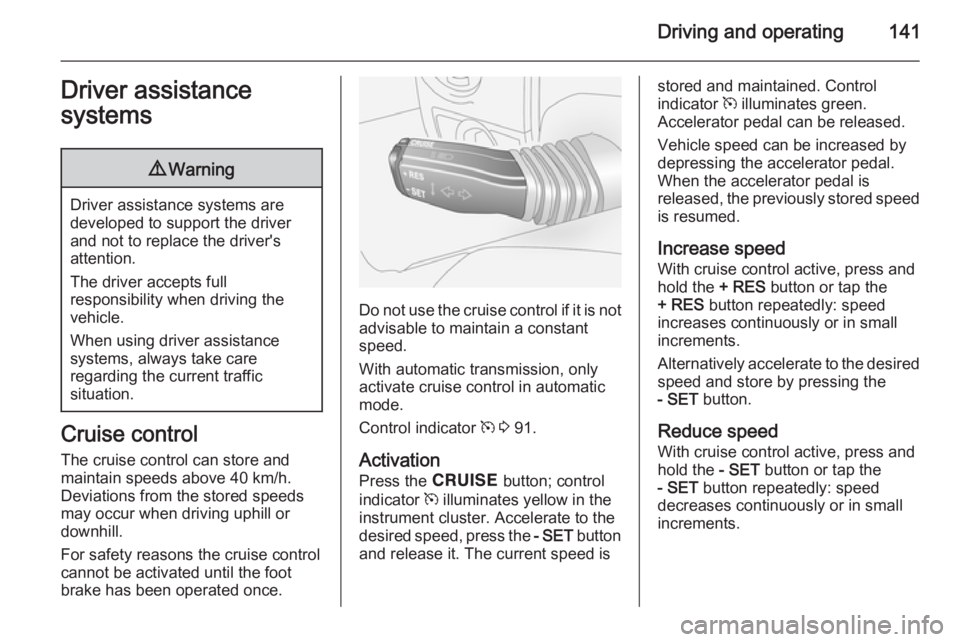
Activation
Press the e button; control
indicator m illuminates yellow in the
instrument cluster. Accelerate to the desired speed, press the - SET button
and release it. The current speed is
stored and maintained. Control
indicator m illuminates green.
Accelerator pedal can be released.
Vehicle speed can be increased by
depressing the accelerator pedal. When the accelerator pedal is
released, the previously stored speed
is resumed.
Increase speed
With cruise control active, press and
hold the + RES button or tap the
+ RES button repeatedly: speed
increases continuously or in small
increments.
Alternatively accelerate to the desired speed and store by pressing the- SET button.
Reduce speed
With cruise control active, press and
hold the - SET button or tap the
- SET button repeatedly: speed
decreases continuously or in small
increments.
Page 145 of 217
Driving and operating143
30 cm, the signal is continuous. The
acoustic signal may differ depending
on the type of object detected.
Deactivation
To deactivate, press the button again
and the LED in the button will
extinguish. The control indicator r
in the instrument cluster will illuminate
until the vehicle speed exceeds
25 km/h.
The system is deactivated
automatically when the vehicle speed is above 8 km/h or when selector
lever is in neutral (automatic
transmission in N or P).
If the b button is pressed again, the
LED in the button will extinguish and
the system will be reactivated as soon
as a forward gear or reverse gear is
engaged and the electrical parking
brake is released.
Fault
In the event of a fault in the system,
control indicator r illuminates in the
instrument cluster.If the acoustic signal sounds 3 times
continuously when there are no
obstacles near the front or rear
bumper, there is a fault in the system. Have the cause of the fault remedied
by a workshop.
Important hints for using the
parking assist system9 Warning
Under certain circumstances,
various reflective surfaces on
objects or clothing as well as
external noise sources may cause the system to fail to detect
obstacles.
Special attention has to be paid to
low obstacles which can damage
the lower part of the bumper.
Caution
Performance of the system can be reduced when sensors are
covered, e.g. by ice or snow.
Performance of the parking assist
system can be reduced due to
heavy loading.
Special conditions apply if there
are taller vehicles in the vicinity
(e.g. off-road vehicles, mini vans,
vans). Object identification and correct distance indication in the
upper part of these vehicles
cannot be guaranteed.
Objects with a very small reflection
cross-section, e.g. objects of
narrow size or soft materials, may
not be detected by the system.
Parking assist systems do not
detect objects outside the
detection range.
Page 189 of 217
Vehicle care187Jump starting
Do not start with quick charger.
A vehicle with a discharged battery
can be started using jump leads and the battery of another vehicle.9 Warning
Be extremely careful when starting
with jump leads. Any deviation
from the following instructions can
lead to injuries or damage caused
by battery explosion or damage to the electrical systems of both
vehicles.
9 Warning
Avoid contact of the battery with
eyes, skin, fabrics and painted
surfaces. The fluid contains
sulphuric acid which can cause
injuries and damage in the event
of direct contact.
■ Never expose the battery to naked flames or sparks.
■ A discharged battery can alreadyfreeze at a temperature of 0 °C.
Defrost the frozen battery before
connecting jump leads.
■ Wear eye protection and protective
clothing when handling a battery.
■ Use a booster battery with the same voltage (12 Volts). Its
capacity (Ah) must not be much less than that of the discharged
battery.
■ Use jump leads with insulated terminals and a cross section of at
least 16 mm 2
(25 mm 2
for diesel
engines).
■ Do not disconnect the discharged battery from the vehicle.
■ Switch off all unnecessary electrical
consumers. The Infotainment
system may be damaged if
switched on while jump starting.
■ Do not lean over the battery during jump starting.
■ Do not allow the terminals of one lead to touch those of the other
lead.■ The vehicles must not come into contact with each other during the
jump starting process.
■ Apply the electrical parking brake 3 137, transmission in neutral,
automatic transmission in P.
■ Open the positive terminal protection caps of both batteries.
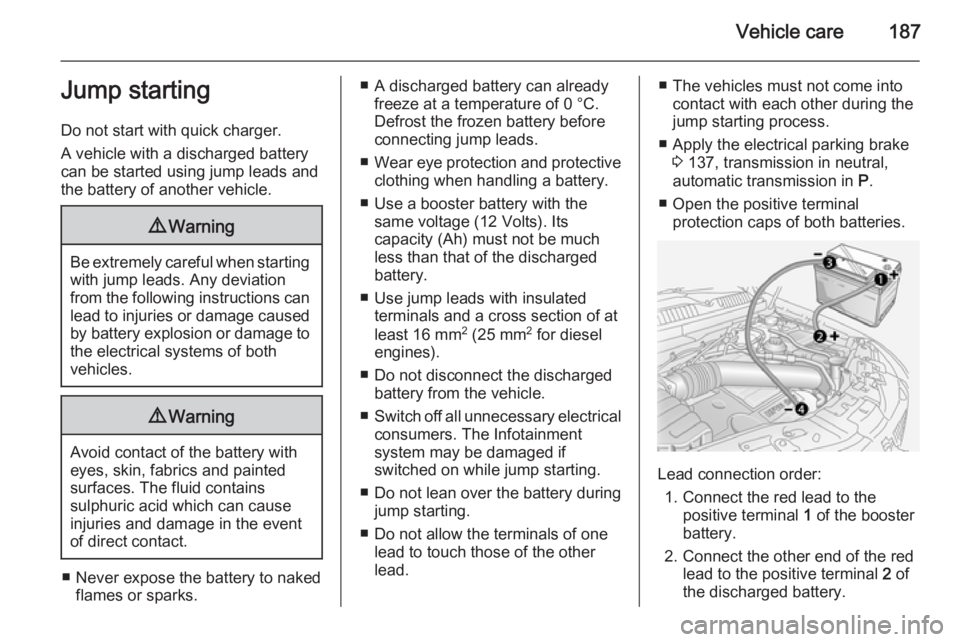
Lead connection order:
1. Connect the red lead to the positive terminal 1 of the booster
battery.
2. Connect the other end of the red lead to the positive terminal 2 of
the discharged battery.
Page 191 of 217
Vehicle care189
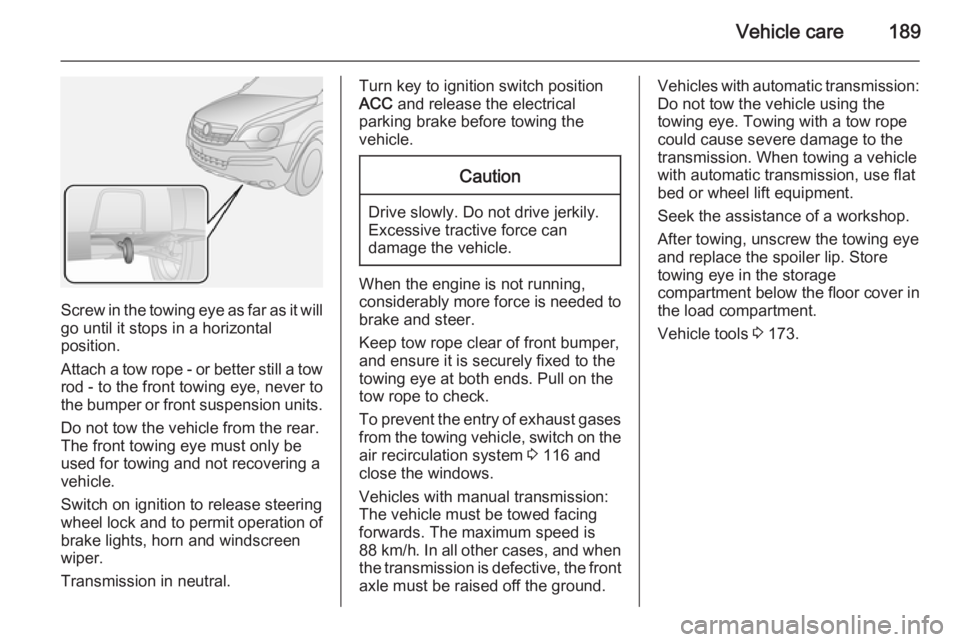
Screw in the towing eye as far as it will
go until it stops in a horizontal
position.
Attach a tow rope - or better still a tow
rod - to the front towing eye, never to
the bumper or front suspension units.
Do not tow the vehicle from the rear.
The front towing eye must only be
used for towing and not recovering a
vehicle.
Switch on ignition to release steering
wheel lock and to permit operation of
brake lights, horn and windscreen
wiper.
Transmission in neutral.
Turn key to ignition switch position
ACC and release the electrical
parking brake before towing the
vehicle.Caution
Drive slowly. Do not drive jerkily.
Excessive tractive force can
damage the vehicle.
When the engine is not running,
considerably more force is needed to
brake and steer.
Keep tow rope clear of front bumper, and ensure it is securely fixed to the
towing eye at both ends. Pull on the tow rope to check.
To prevent the entry of exhaust gases from the towing vehicle, switch on the
air recirculation system 3 116 and
close the windows.
Vehicles with manual transmission:
The vehicle must be towed facing
forwards. The maximum speed is
88 km/h . In all other cases, and when
the transmission is defective, the front axle must be raised off the ground.
Vehicles with automatic transmission:
Do not tow the vehicle using the
towing eye. Towing with a tow rope
could cause severe damage to the
transmission. When towing a vehicle with automatic transmission, use flat
bed or wheel lift equipment.
Seek the assistance of a workshop.
After towing, unscrew the towing eye
and replace the spoiler lip. Store
towing eye in the storage
compartment below the floor cover in the load compartment.
Vehicle tools 3 173.
Page 205 of 217
![OPEL ANTARA 2014 User Guide Technical data203PerformanceAll-wheel driveEngineA 24 XFA 30 XFA 22 DMA 22 DMHMaximum speed 4)
[km/h]Manual transmission186–188200Automatic transmission1751981821914) The maximum speed indicated is](/img/37/58214/w960_58214-204.png "OPEL ANTARA 2014 User Guide Technical data203PerformanceAll-wheel driveEngineA 24 XFA 30 XFA 22 DMA 22 DMHMaximum speed 4)
[km/h]Manual transmission186–188200Automatic transmission1751981821914) The maximum speed indicated is")
Technical data203PerformanceAll-wheel driveEngineA 24 XFA 30 XFA 22 DMA 22 DMHMaximum speed 4)
[km/h]Manual transmission186–188200Automatic transmission1751981821914) The maximum speed indicated is achievable at kerb weight (without driver) plus 200 kg payload. Optional equipment could reduce the specified maximum
speed of the vehicle.
Front-wheel drive
EngineA 24 XFA 30 XFA 22 DMA 22 DMHMaximum speed 4)
[km/h]Manual transmission190–189–Automatic transmission––184–4) The maximum speed indicated is achievable at kerb weight (without driver) plus 200 kg payload. Optional equipment could reduce the specified maximum
speed of the vehicle.
Page 206 of 217
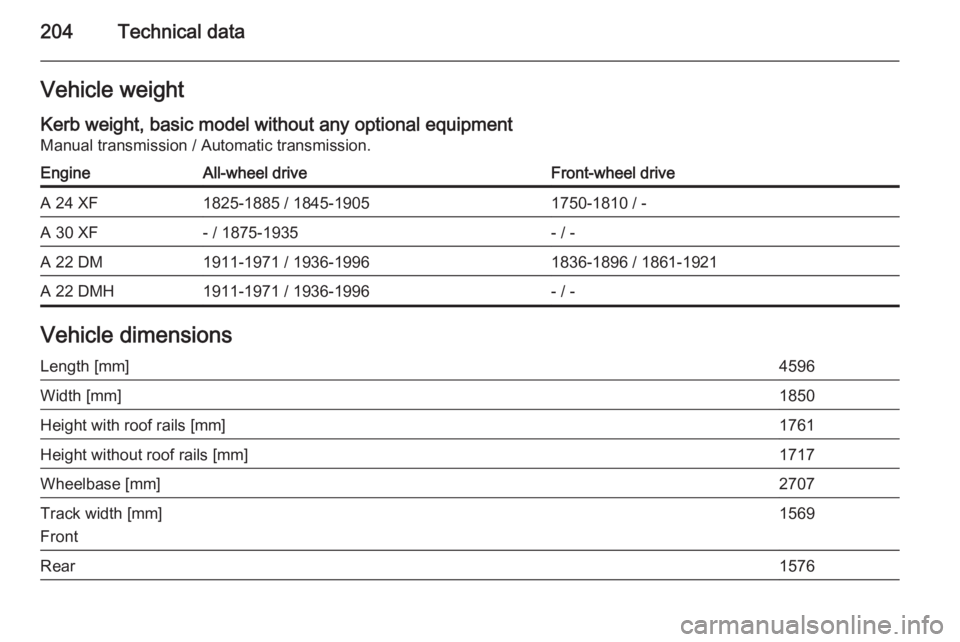
204Technical dataVehicle weight
Kerb weight, basic model without any optional equipment Manual transmission / Automatic transmission.EngineAll-wheel driveFront-wheel driveA 24 XF1825-1885 / 1845-19051750-1810 / -A 30 XF- / 1875-1935- / -A 22 DM1911-1971 / 1936-19961836-1896 / 1861-1921A 22 DMH1911-1971 / 1936-1996- / -Vehicle dimensionsLength [mm]4596Width [mm]1850Height with roof rails [mm]1761Height without roof rails [mm]1717Wheelbase [mm]2707Track width [mm]
Front1569Rear1576
Page 212 of 217
210IndexAAccessories and vehicle modifications .......................... 151
Accessory sockets ........................78
Active head restraints .............34, 35
Adjustable air vents ...................120
Airbag and belt tensioners ...........84
Airbag deactivation ......................49
Airbag label................................... 44 Airbag system .............................. 44
Air conditioning regular operation ................................ 121
Air conditioning system .............. 116
Air intake .................................... 121
Air vents...................................... 120
All wheel drive .....................86, 134
Antilock brake system ................ 136
Antilock brake system (ABS) .......86
Anti-theft alarm system ..........24, 91
Anti-theft locking system .............. 24
Appearance care ........................190
Apply footbrake ............................ 90
Armrest ......................................... 40
Armrest storage ........................... 58
Automatic anti-dazzle ..................29
Automatic dimming ......................29
Automatic headlight levelling system ...................................... 90
Automatic level control .......107, 140Automatic light control ...............106
Automatic transmission ........85, 129
AUX input ..................................... 58
B Battery .......................................... 84
Battery discharge protection ......114
Battery, jump starting.................. 187
Belt pretensioners......................... 41
Belts.............................................. 41
Bicycle rack .................................. 58
Board-Info-Display .......................92
Bonnet ....................................... 153
Bonnet open ................................. 91
Brake and clutch fluid .................195
Brake assist ............................... 138
Brake fluid .................................. 156
Brakes ............................... 136, 156
Brake system ............................... 85
Breakdown.................................. 188
Bulb replacement ....................... 160
C Capacities .................................. 206
Card holder ................................... 57
Car Pass ...................................... 19
Catalytic converter ................85, 129
CD tray ......................................... 57
Central locking system ................21
Centre console storage ...............58