ECU OPEL ANTARA 2014 Owner's Manual
[x] Cancel search | Manufacturer: OPEL, Model Year: 2014, Model line: ANTARA, Model: OPEL ANTARA 2014Pages: 217, PDF Size: 6.04 MB
Page 186 of 217
184Vehicle care
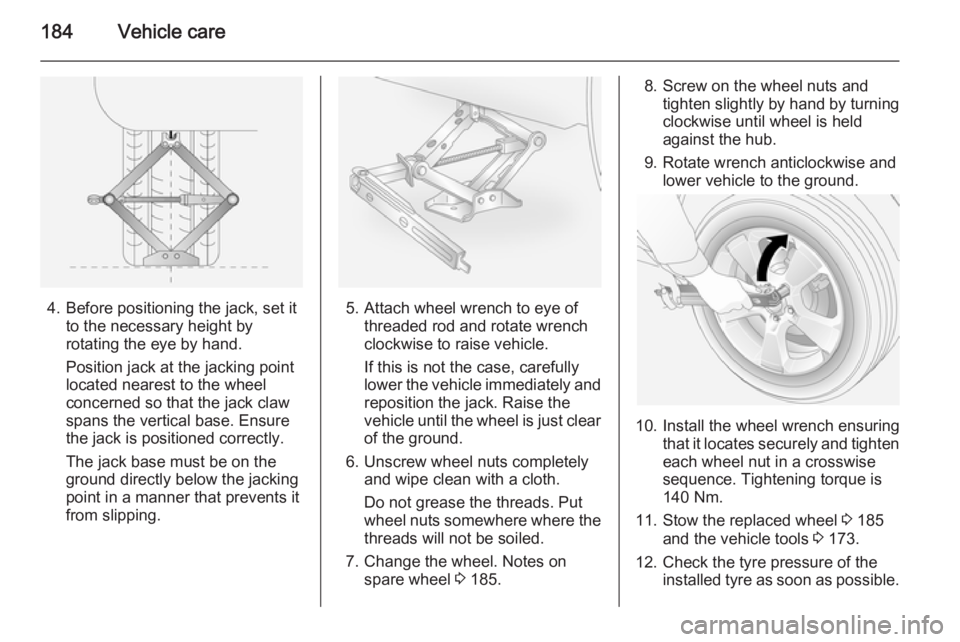
4. Before positioning the jack, set itto the necessary height by
rotating the eye by hand.
Position jack at the jacking point
located nearest to the wheel concerned so that the jack claw
spans the vertical base. Ensure
the jack is positioned correctly.
The jack base must be on the
ground directly below the jacking
point in a manner that prevents it
from slipping.5. Attach wheel wrench to eye of threaded rod and rotate wrench
clockwise to raise vehicle.
If this is not the case, carefully
lower the vehicle immediately and
reposition the jack. Raise the
vehicle until the wheel is just clear of the ground.
6. Unscrew wheel nuts completely and wipe clean with a cloth.
Do not grease the threads. Put
wheel nuts somewhere where the threads will not be soiled.
7. Change the wheel. Notes on spare wheel 3 185.
8. Screw on the wheel nuts and
tighten slightly by hand by turning
clockwise until wheel is held
against the hub.
9. Rotate wrench anticlockwise and lower vehicle to the ground.
10. Install the wheel wrench ensuring that it locates securely and tighten
each wheel nut in a crosswise
sequence. Tightening torque is
140 Nm.
11. Stow the replaced wheel 3 185
and the vehicle tools 3 173.
12. Check the tyre pressure of the installed tyre as soon as possible.
Page 188 of 217

186Vehicle care
The temporary spare wheel is locatedin the load compartment below the
floor cover and is secured with a
screw-in retainer.
Push both levers on the floor cover
towards the handle and pull up the
cover by the handle. Hang the hook
to the upper part of the tailgate
opening.
Vehicle tools 3 173.
Remove the retainer by rotating it
anticlockwise and remove temporary
spare wheel from the spare wheel
well.
Only mount one temporary spare
wheel. Do not drive faster than
80 km/h. Take curves slowly. Do not
use for a long period of time.
When the temporary spare wheel is
fitted, do not take the vehicle through an automatic vehicle wash with guide
rails. The temporary spare wheel may get caught on the rails, causing
damage to the tyre, wheel and other
vehicle parts.
The use of tyre chains is not permitted on the temporary spare wheel.
Tyre chains 3 179.
Directional tyres
Fit directional tyres such that they roll in the direction of travel. The rolling
direction is indicated by a symbol
(e.g. an arrow) on the sidewall.
The following applies to tyres fitted
opposing the rolling direction:
■ Driveability may be affected. Have the defective tyre renewed as soon
as possible and have the wheel
balanced and fitted to the vehicle.■ Do not drive faster than 80 km/h.
■ Drive particularly carefully on wet and snow-covered road surfaces.9 Warning
Storing a jack, a wheel or other
equipment in the load
compartment could cause injury if they are not fixed in place
properly. During a sudden stop or
a collision, loose equipment could
cause personal injury or damage
to the vehicle.
Always store the jack and vehicle
tools in their respective storage
compartments and secure them properly.
Always place the damaged wheel
in the load compartment, secured
in the spare wheel well with the
screw-in retainer.
Page 191 of 217
Vehicle care189
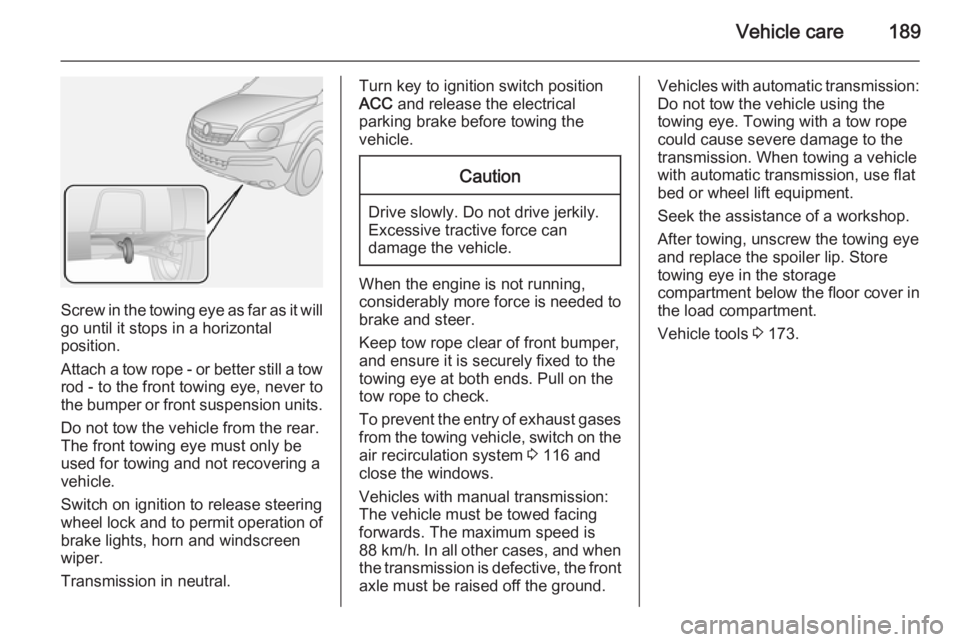
Screw in the towing eye as far as it will
go until it stops in a horizontal
position.
Attach a tow rope - or better still a tow
rod - to the front towing eye, never to
the bumper or front suspension units.
Do not tow the vehicle from the rear.
The front towing eye must only be
used for towing and not recovering a
vehicle.
Switch on ignition to release steering
wheel lock and to permit operation of
brake lights, horn and windscreen
wiper.
Transmission in neutral.
Turn key to ignition switch position
ACC and release the electrical
parking brake before towing the
vehicle.Caution
Drive slowly. Do not drive jerkily.
Excessive tractive force can
damage the vehicle.
When the engine is not running,
considerably more force is needed to
brake and steer.
Keep tow rope clear of front bumper, and ensure it is securely fixed to the
towing eye at both ends. Pull on the tow rope to check.
To prevent the entry of exhaust gases from the towing vehicle, switch on the
air recirculation system 3 116 and
close the windows.
Vehicles with manual transmission:
The vehicle must be towed facing
forwards. The maximum speed is
88 km/h . In all other cases, and when
the transmission is defective, the front axle must be raised off the ground.
Vehicles with automatic transmission:
Do not tow the vehicle using the
towing eye. Towing with a tow rope
could cause severe damage to the
transmission. When towing a vehicle with automatic transmission, use flat
bed or wheel lift equipment.
Seek the assistance of a workshop.
After towing, unscrew the towing eye
and replace the spoiler lip. Store
towing eye in the storage
compartment below the floor cover in the load compartment.
Vehicle tools 3 173.
Page 211 of 217
Customer information209
■ Vehicle reactions in particulardriving situations (e.g. inflation ofan airbag, activation of the stability
regulation system)
■ Environmental conditions (e.g. temperature)
These data are exclusively technical
and help identifying and correcting
errors as well as optimizing vehicle
functions.
Motion profiles indicating travelled
routes cannot be created with these
data.
If services are used (e.g. repair
works, service processes, warranty
cases, quality assurance),
employees of the service network
(manufacturer included) are able to
read out this technical information
from the event and error data storage
modules applying special diagnostic
devices. If required, you will receive
further information at these
workshops. After an error has been
corrected, the data are deleted from
the error storage module or they are
constantly overwritten.When using the vehicle, situations
may occur in which these technical
data related to other information
(accident report, damages on the
vehicle, witness statements etc.) may
be associated with a specific person -
possibly with the assistance of an
expert.
Additional functions contractually
agreed upon with the client (e.g.
vehicle location in emergency cases)
allow the transmission of particular
vehicle data from the vehicle.Radio Frequency
Identification (RFID) RFID technology is used in some
vehicles for functions such as tyre
pressure monitoring and ignition
system security. It is also used in
connection with conveniences such
as radio remote controls for door
locking/unlocking and starting, and in-
vehicle transmitters for garage door
openers. RFID technology in Opel
vehicles does not use or record
personal information or link with any
other Opel system containing
personal information.
Page 216 of 217
214
Tailgate open ............................... 91
Tail lights ................................... 164
Technical data ............................ 202
Three-point seat belt .................... 42
Tools .......................................... 173
Top-tether fastening eyes ............55
Tow bar....................................... 147
Towing ................................ 147, 188
Towing another vehicle .............190
Towing a trailer ........................... 147
Towing equipment .....................148
Towing the vehicle .....................188
Trailer coupling ........................... 147
Trailer indicator ............................ 91
Trailer stability assist .................150
Trailer towing ............................. 147
Transmission ............................... 16
Transmission display ...........81, 129
Tread depth ............................... 178
Trip computer in Board-Info- Display ................................... 101
Trip computer in Graphic-Info- Display or Colour-Info-Display 102
Trip odometer .............................. 80
Turn and lane-change signals ...109
Turn signal ................................... 84
Tyre chains ................................ 179
Tyre changing ............................. 182
Tyre designations ......................175Tyre pressure ....................100, 176
Tyre pressure monitoring system ............................. 100, 176
Tyre pressures ........................... 207
Tyre repair kit ............................. 179
Tyres and wheel size, changing. 178
U Ultrasonic parking assist ...... 87, 142
Underseat storage .......................58
Upholstery, cleaning ...................192
Upshift .......................................... 86
Using this manual ..........................3
V Vehicle battery ........................... 157
Vehicle checks............................ 152
Vehicle data ................................ 199
Vehicle data recording and privacy ..................................... 208
Vehicle dimensions .................... 204
Vehicle Identification Number ....197
Vehicle jack ................................ 173
Vehicle security ............................ 24
Vehicle specific data ......................3
Vehicle storage ........................... 151
Vehicle tools ............................... 173
Vehicle unlocking ........................... 6 Vehicle weight ........................... 204
Ventilation ................................... 115W
Warning chimes ........................... 99
Warning lights ............................... 80
Warning triangle .......................... 70
Washer and wiper systems .........14
Washer fluid ............................... 156
Washing the vehicle ...................190
Welcome lighting ........................113
Wheel changing .........................182
Wheel covers ............................. 179
Wheels and tyres .......................175
Windows ....................................... 30
Windscreen................................... 30
Windscreen wiper/washer ...........74
Winter tyres ............................... 175
Wiper blade replacement ..........160
X
Xenon headlights .......................162