seats OPEL ANTARA 2014 Owner's Manual
[x] Cancel search | Manufacturer: OPEL, Model Year: 2014, Model line: ANTARA, Model: OPEL ANTARA 2014Pages: 217, PDF Size: 6.04 MB
Page 52 of 217
50Seats, restraints
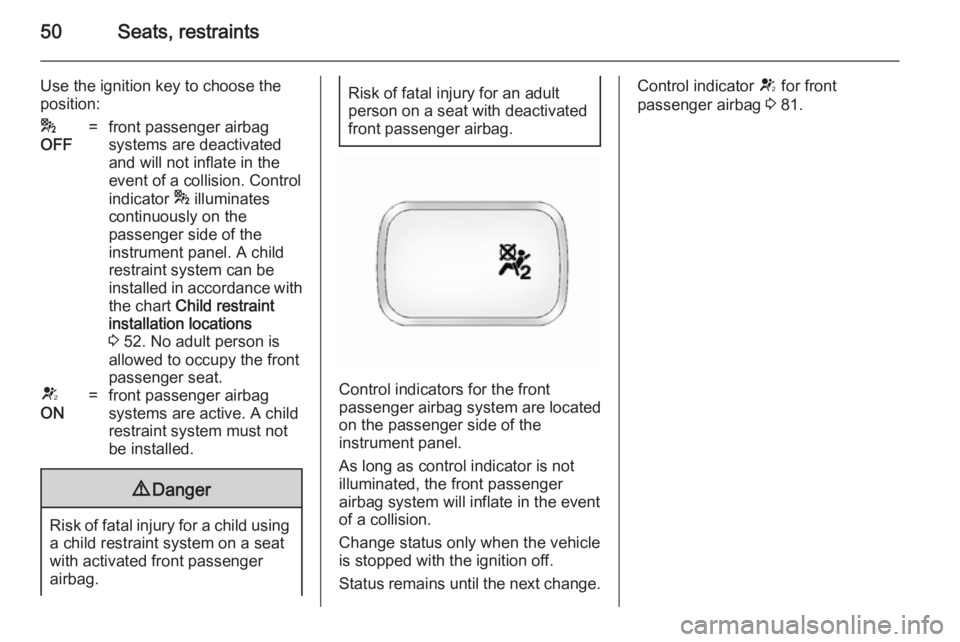
Use the ignition key to choose the
position:*
OFF=front passenger airbag
systems are deactivated
and will not inflate in the
event of a collision. Control
indicator * illuminates
continuously on the
passenger side of the
instrument panel. A child
restraint system can be
installed in accordance with the chart Child restraint
installation locations
3 52. No adult person is
allowed to occupy the front
passenger seat.V
ON=front passenger airbag
systems are active. A child
restraint system must not
be installed.9 Danger
Risk of fatal injury for a child using
a child restraint system on a seat
with activated front passenger
airbag.
Risk of fatal injury for an adult
person on a seat with deactivated
front passenger airbag.
Control indicators for the front
passenger airbag system are located
on the passenger side of the
instrument panel.
As long as control indicator is not illuminated, the front passenger
airbag system will inflate in the event
of a collision.
Change status only when the vehicle
is stopped with the ignition off.
Status remains until the next change.
Control indicator V for front
passenger airbag 3 81.
Page 53 of 217
Seats, restraints51Child restraintsChild restraint systems
We recommend the Opel child
restraint system which is tailored
specifically to the vehicle.
When a child restraint system is being used, pay attention to the following
usage and installation instructions
and also those supplied with the child
restraint system.
Always comply with local or national
regulations. In some countries, the
use of child restraint systems is
forbidden on certain seats.9 Warning
When using a child restraint
system on the front passenger
seat, the airbag systems for the
front passenger seat must be
deactivated; if not, the triggering of the airbags poses a risk of fatal
injury to the child.
This is especially the case if rear-
facing child restraint systems are
used on the front passenger seat.
Airbag deactivation 3 49.
Airbag label 3 44.
Selecting the right system The rear seats are the most
convenient location to fasten a child
restraint system.
Children should travel facing
rearwards in the vehicle as long as
possible. This makes sure that the child's backbone, which is still very
weak, is under less strain in the event
of an accident.
Suitable are restraint systems that
comply with valid UN ECE
regulations. Check local laws and
regulations for mandatory use of child restraint systems.
Ensure that the child restraint system to be installed is compatible with the
vehicle type.
Ensure that the mounting location of
the child restraint system within the
vehicle is correct, see following
tables.
Allow children to enter and exit the
vehicle only on the side facing away
from the traffic.
When the child restraint system is not
in use, secure the seat with a seat belt or remove it from the vehicle.
Note
Do not stick anything on the child
restraint systems and do not cover
them with any other materials.
A child restraint system which has
been subjected to stress in an
accident must be replaced.
Page 54 of 217
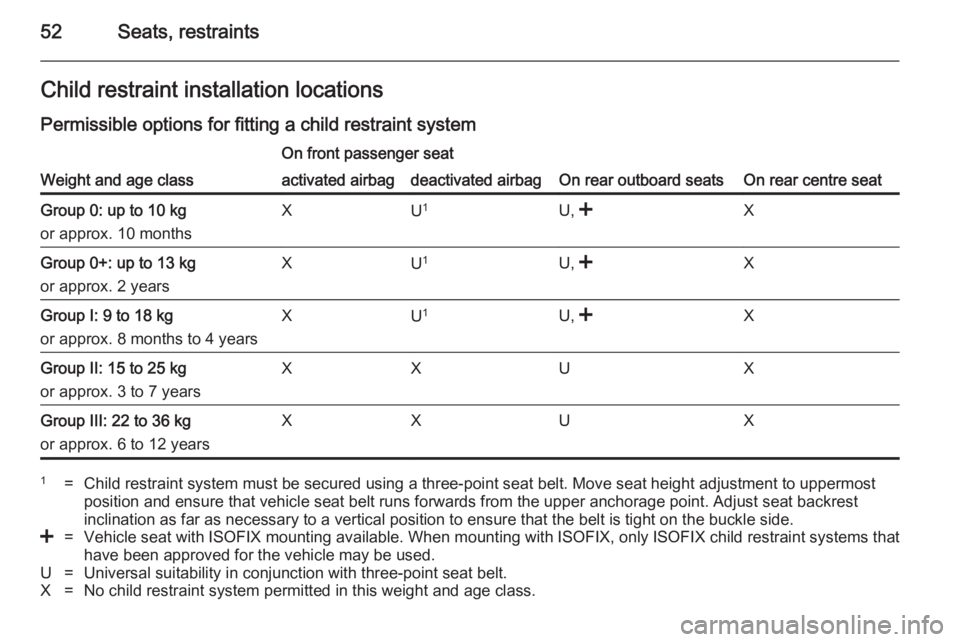
52Seats, restraintsChild restraint installation locationsPermissible options for fitting a child restraint system
Weight and age class
On front passenger seat
On rear outboard seatsOn rear centre seat
activated airbagdeactivated airbagGroup 0: up to 10 kg
or approx. 10 monthsXU 1U,
or approx. 6 to 12 yearsXXUX1=Child restraint system must be secured using a three-point seat belt. Move seat height adjustment to uppermost
position and ensure that vehicle seat belt runs forwards from the upper anchorage point. Adjust seat backrest
inclination as far as necessary to a vertical position to ensure that the belt is tight on the buckle side.<=Vehicle seat with ISOFIX mounting available. When mounting with ISOFIX, only ISOFIX child restraint systems that
have been approved for the vehicle may be used.U=Universal suitability in conjunction with three-point seat belt.X=No child restraint system permitted in this weight and age class.
Page 55 of 217
Seats, restraints53
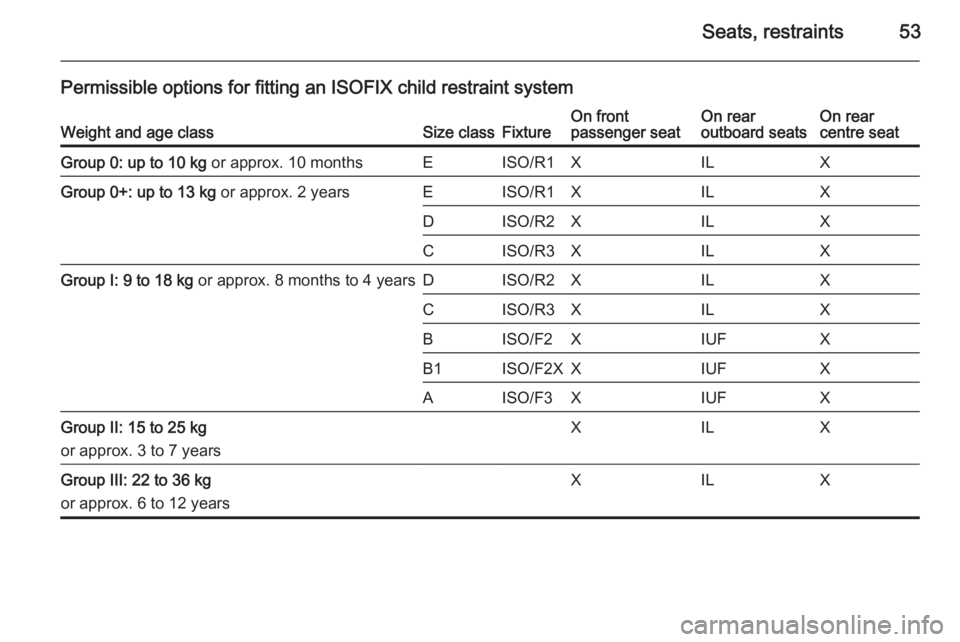
Permissible options for fitting an ISOFIX child restraint systemWeight and age classSize classFixtureOn front
passenger seatOn rear
outboard seatsOn rear
centre seatGroup 0: up to 10 kg or approx. 10 monthsEISO/R1XILXGroup 0+: up to 13 kg or approx. 2 yearsEISO/R1XILXDISO/R2XILXCISO/R3XILXGroup I: 9 to 18 kg or approx. 8 months to 4 yearsDISO/R2XILXCISO/R3XILXBISO/F2XIUFXB1ISO/F2XXIUFXAISO/F3XIUFXGroup II: 15 to 25 kg
or approx. 3 to 7 yearsXILXGroup III: 22 to 36 kg
or approx. 6 to 12 yearsXILX
Page 56 of 217
54Seats, restraints
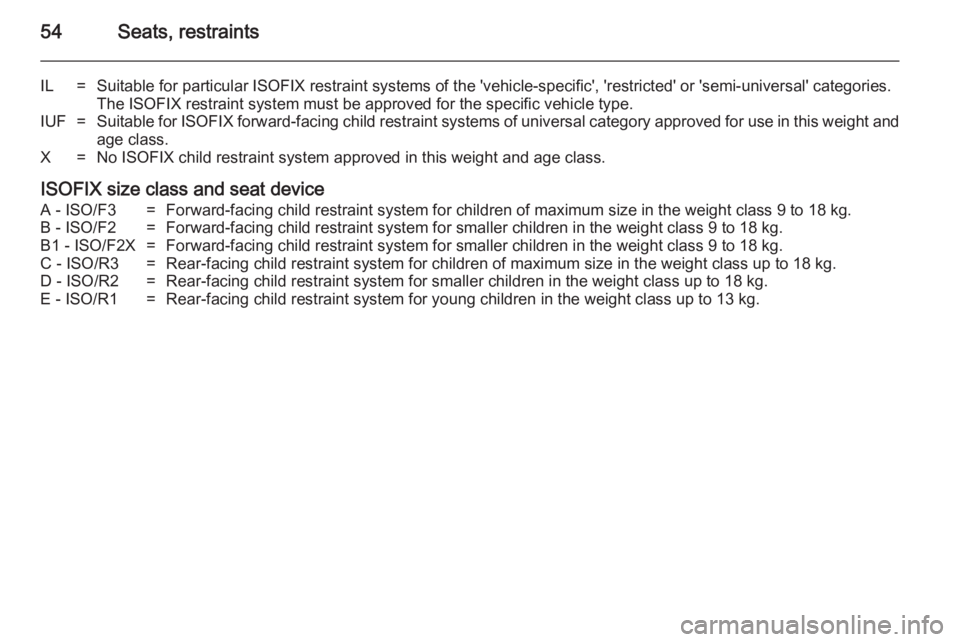
IL=Suitable for particular ISOFIX restraint systems of the 'vehicle-specific', 'restricted' or 'semi-universal' categories.The ISOFIX restraint system must be approved for the specific vehicle type.IUF=Suitable for ISOFIX forward-facing child restraint systems of universal category approved for use in this weight and
age class.X=No ISOFIX child restraint system approved in this weight and age class.
ISOFIX size class and seat device
A - ISO/F3=Forward-facing child restraint system for children of maximum size in the weight class 9 to 18 kg.B - ISO/F2=Forward-facing child restraint system for smaller children in the weight class 9 to 18 kg.B1 - ISO/F2X=Forward-facing child restraint system for smaller children in the weight class 9 to 18 kg.C - ISO/R3=Rear-facing child restraint system for children of maximum size in the weight class up to 18 kg.D - ISO/R2=Rear-facing child restraint system for smaller children in the weight class up to 18 kg.E - ISO/R1=Rear-facing child restraint system for young children in the weight class up to 13 kg.
Page 57 of 217
Seats, restraints55ISOFIX child restraint
systems
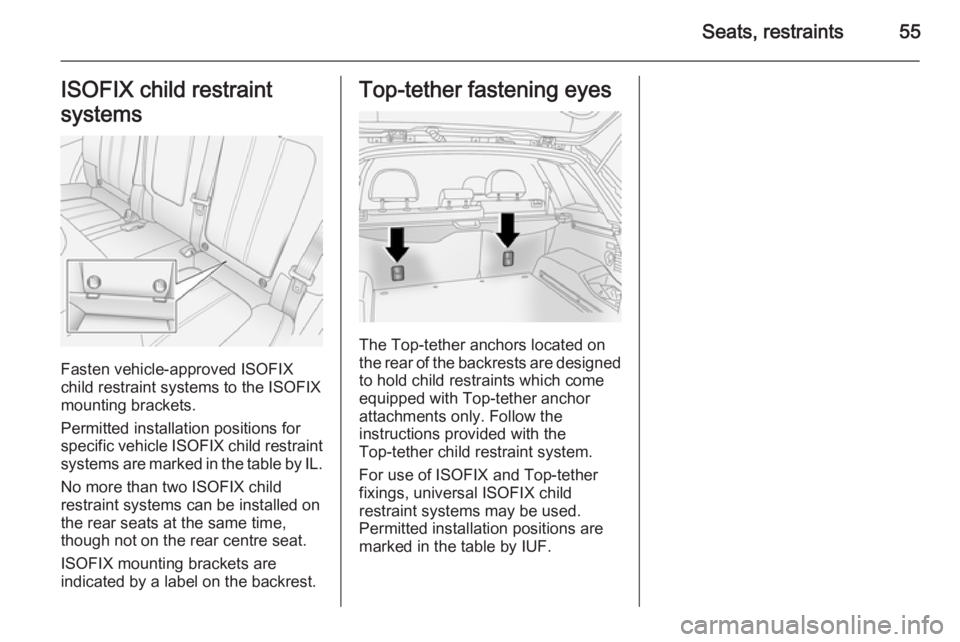
Fasten vehicle-approved ISOFIX
child restraint systems to the ISOFIX
mounting brackets.
Permitted installation positions for specific vehicle ISOFIX child restraint
systems are marked in the table by IL.
No more than two ISOFIX child
restraint systems can be installed on
the rear seats at the same time,
though not on the rear centre seat.
ISOFIX mounting brackets are
indicated by a label on the backrest.
Top-tether fastening eyes
The Top-tether anchors located on
the rear of the backrests are designed
to hold child restraints which come
equipped with Top-tether anchor
attachments only. Follow the
instructions provided with the
Top-tether child restraint system.
For use of ISOFIX and Top-tether
fixings, universal ISOFIX child restraint systems may be used.
Permitted installation positions are
marked in the table by IUF.
Page 72 of 217
70Storage
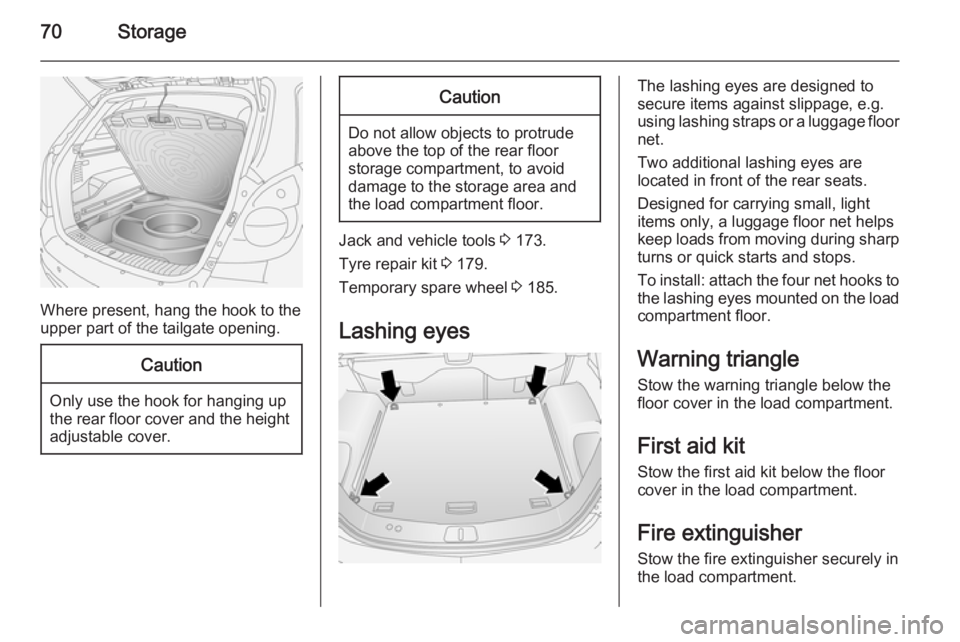
Where present, hang the hook to the
upper part of the tailgate opening.
Caution
Only use the hook for hanging up
the rear floor cover and the height adjustable cover.
Caution
Do not allow objects to protrude
above the top of the rear floor
storage compartment, to avoid
damage to the storage area and
the load compartment floor.
Jack and vehicle tools 3 173.
Tyre repair kit 3 179.
Temporary spare wheel 3 185.
Lashing eyes
The lashing eyes are designed to
secure items against slippage, e.g.
using lashing straps or a luggage floor
net.
Two additional lashing eyes are
located in front of the rear seats.
Designed for carrying small, light
items only, a luggage floor net helps keep loads from moving during sharp turns or quick starts and stops.
To install: attach the four net hooks to
the lashing eyes mounted on the load
compartment floor.
Warning triangle Stow the warning triangle below the
floor cover in the load compartment.
First aid kit Stow the first aid kit below the floor
cover in the load compartment.
Fire extinguisher
Stow the fire extinguisher securely in
the load compartment.
Page 73 of 217
Storage71Roof rack system
Roof rack For safety reasons and to avoiddamage to the roof, the vehicle
approved roof rack system is
recommended. For further
information contact a workshop.
Fasten the roof rack to the roof rails following the instructions that
accompany the system, ensuring that
the roof load is evenly distributed over the side or cross rails.
Loads must not be placed on the roof
surface. To prevent damage or loss,
check frequently that roof loads are
securely fastened.
Driving with a roof load affects the
vehicle centre of gravity; drive
carefully in crosswinds and do not
drive at high speeds.
Remove the roof rack when not in use.Loading information
■ Heavy objects in the load compartment should be evenly
distributed and placed as far
forward as possible. Ensure the
backrests are securely engaged. If
objects can be stacked, the heavier
objects should be placed at the bottom.
With rear seats in the folded
position, objects must not be
stacked higher than the seat
backrests.
■ Secure objects with lashing straps attached to lashing eyes 3 70.
■ Secure loose objects in the load compartment, e.g. with a luggage
floor net, to prevent sliding.
■ When transporting objects in the load compartment, the backrests ofthe rear seats must not be angled
forward.
■ Do not allow the load to protrude above the upper edge of the
backrests.■ Do not place any objects on the load compartment cover or the
instrument panel, and do not cover
the sensor on top of the instrument
panel.
■ The load must not obstruct the operation of the pedals, electrical
parking brake and gear selector, or hinder the freedom of movement ofthe driver. Do not place any
unsecured objects in the interior.
■ Do not drive with an open load compartment.9 Warning
Always make sure that the load in
the vehicle is securely stowed.
Otherwise objects can be thrown
around inside the vehicle and
cause personal injury or damage
to the load or car.
■ The payload is the difference between the permitted gross
vehicle weight (see identification
plate 3 198) and the EC kerb
weight.
Page 86 of 217
84Instruments and controlsTurn signal
O illuminates or flashes green.
The relevant control indicator flashes
when the turn signal is switched on
3 109.
Rapid flashing: failure of a turn signal bulb or the associated fuse or failure
of a turn signal light on trailer.
Both control indicators flash when the
hazard warning flashers are active
3 108.
Bulb replacement 3 160, Fuses
3 166.
Turn signals 3 109.
Seat belt reminder Seat belt reminder for front
seats X for driver's seat illuminates or
flashes red.
k for front passenger's seat
illuminates or flashes red, when the
seat is occupied.When the engine is running, if seat
belt is not engaged, the control
indicator will flash for 100 seconds
then illuminate until seat belt is
fastened.
If vehicle speed exceeds 22 km/h, the
control indicator will flash for
100 seconds along with a warning
chime and remains illuminated until seat belt is fastened.
Fastening the seat belt 3 41.
Front passenger seat belt reminder k
3 42.
Airbag and belt tensioners v illuminates red.
When the ignition is switched on, v
flashes briefly. If it does not flash,
stays lit or flashes during driving,
there is a fault in the airbag system.
Seek the assistance of a workshop.
The airbags and belt pretensioners
may fail to trigger in the event of an
accident.
Deployment of the belt pretensioners
or airbags is indicated by continuous
illumination of v.9
Warning
Have the cause of the fault
remedied immediately by a
workshop.
Belt pretensioners, airbag system
3 41, 3 44.
Charging system
p illuminates red.
Illuminates when the ignition is
switched on and extinguishes shortly
after the engine starts. If it does not
illuminate, seek the assistance of a
workshop.
Illuminates when the engine is running
Stop vehicle and switch off engine.
Battery is not charging. Engine
cooling may be interrupted. The
brake servo unit may cease to be
effective.
Page 110 of 217
108Lighting
Vehicles without automatic level
control system
Turn thumb wheel ? to required
position:0=front seats occupied1=all seats occupied2=all seats occupied and load
compartment laden3=driver's seat occupied and load
compartment laden
Vehicles with automatic level control
system
Turn thumb wheel to required
position:
0=front seats occupied1=all seats occupied1=all seats occupied and load
compartment laden2=driver's seat occupied and load
compartment laden
Automatic level control 3 140.
Automatic headlight range
adjustment On vehicles with Xenon headlights,
the headlight range is adjusted
automatically based on vehicle load.
If control indicator q illuminates in the
instrument cluster while driving, a
fault has occurred. Have the cause of
the fault remedied immediately by a
workshop.
Control indicator q 3 90.
Headlights when driving
abroad The asymmetrical headlight beam
extends visibility at the edge of the
road on the passenger side.
However, when driving in countries
where traffic drives on the opposite
side of the road, have the headlights
adjusted to prevent dazzling of
oncoming traffic. Seek the assistance
of a workshop.
Daytime running lights
Daytime running lights increase
visibility of the vehicle during daylight.
They are switched on automatically
when ignition is on.
Automatic light control 3 106.Hazard warning flashers
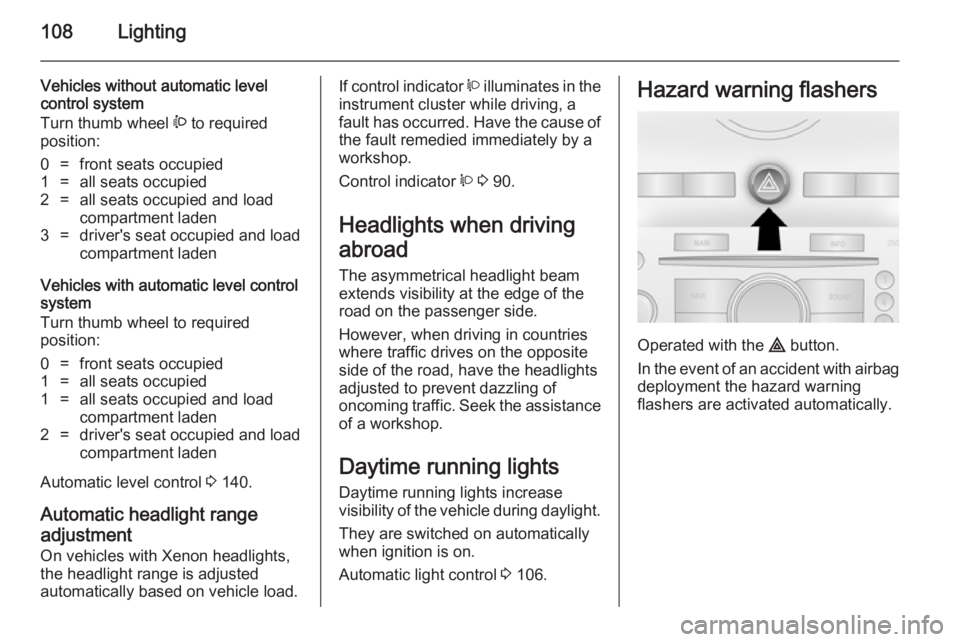
Operated with the ¨ button.
In the event of an accident with airbag
deployment the hazard warning
flashers are activated automatically.