brake OPEL ANTARA 2017 Owner's Guide
[x] Cancel search | Manufacturer: OPEL, Model Year: 2017, Model line: ANTARA, Model: OPEL ANTARA 2017Pages: 225, PDF Size: 6.18 MB
Page 148 of 225
146Driving and operatingTrailer stability assist
If the system detects snaking
movements, engine power is reduced
and the vehicle/trailer combination is
selectively braked until the snaking ceases. While system is working keep
steering wheel as still as possible.
Fault
If there is a fault in the system the
control indicator b illuminates
continuously. The system is not
operational.
Have the cause of the fault remedied
by a workshop.
Descent control system The Descent control system (DCS)
allows the vehicle to travel at a low
speed without depressing the foot
brake. The vehicle will automatically
decelerate to a low speed and remain
at that speed when the system is
activated. Some noise or vibration
from the brake system may be
apparent when the system is active.Caution
Use only when descending steep
grades while driving off-road. Do
not use when driving on normal
road surfaces. Unnecessary
usage of the DCS function, such
as while driving on normal roads,
may damage the brake system
and the ESC function.
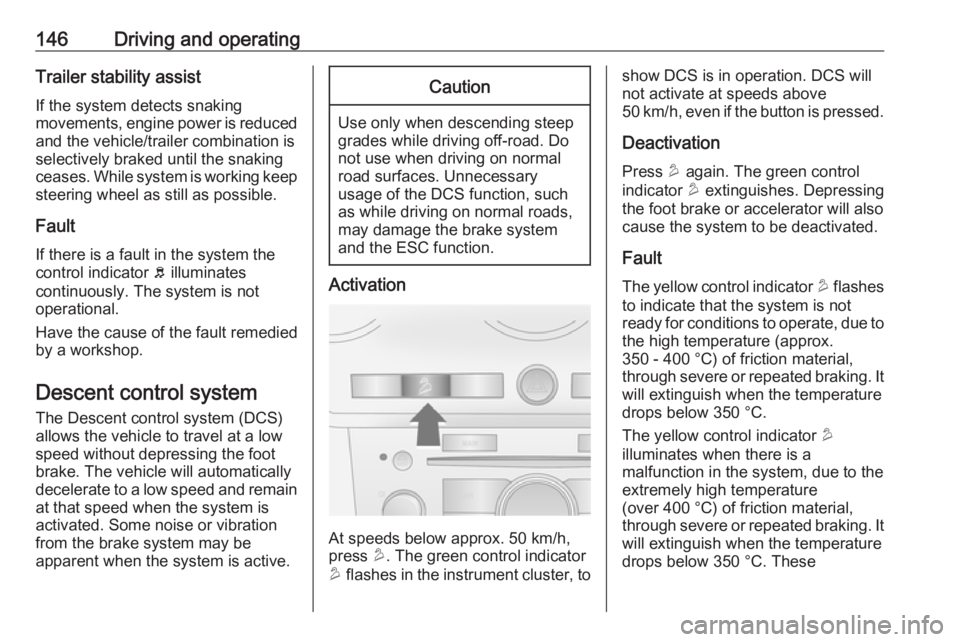
Activation
At speeds below approx. 50 km/h,
press u. The green control indicator
u flashes in the instrument cluster, to
show DCS is in operation. DCS will
not activate at speeds above
50 km/h, even if the button is pressed.
Deactivation
Press u again. The green control
indicator u extinguishes. Depressing
the foot brake or accelerator will also
cause the system to be deactivated.
Fault
The yellow control indicator u flashes
to indicate that the system is not
ready for conditions to operate, due to the high temperature (approx.
350 - 400 °C) of friction material,
through severe or repeated braking. It
will extinguish when the temperature
drops below 350 °C.
The yellow control indicator u
illuminates when there is a
malfunction in the system, due to the
extremely high temperature
(over 400 °C) of friction material,
through severe or repeated braking. It will extinguish when the temperaturedrops below 350 °C. These
Page 149 of 225
Driving and operating147temperatures may differ according to
vehicle conditions or outside
conditions.
Flashing or illumination of the yellow
control indicator u reminds the driver
that the friction material needs to cool
down: drive the vehicle without
braking as much as possible. If the
control indicator does not extinguish,
have the cause of the fault remedied
by a workshop.
DSC control indicators u 3 86.
Automatic level control
The rear level of the vehicle is
automatically adjusted to the load
conditions while driving. Suspension
and ground clearance are increased,
which improves driving conditions.
The automatic level control is
activated after the vehicle has been
driven for some distance, depending
on the vehicle load and the road
conditions.
Do not use full payload in the event of
a fault. Have the cause of the fault
remedied by a workshop.
Headlight range adjustment 3 106.Driver assistance
systems9 Warning
Driver assistance systems are
developed to support the driver
and not to replace the driver's
attention.
The driver accepts full
responsibility when driving the
vehicle.
When using driver assistance
systems, always take care
regarding the current traffic
situation.
Cruise control
The cruise control can store and
maintain speeds above 40 km/h.
Deviations from the stored speeds
may occur when driving uphill or
downhill.
For safety reasons the cruise control
cannot be activated until the foot
brake has been operated once.
Do not use the cruise control if it is not advisable to maintain a constant
speed.
With automatic transmission, only activate cruise control in automatic
mode.
Control indicator m 3 91.
Switching on
Press e ; control indicator m
illuminates yellow in the instrument
cluster.
Page 150 of 225
148Driving and operatingActivation
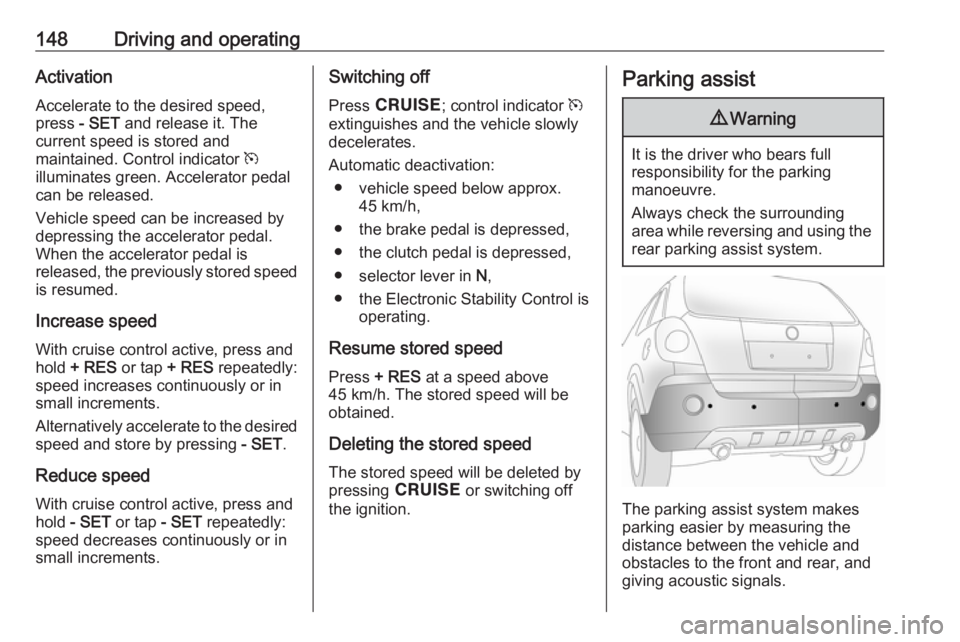
Accelerate to the desired speed,
press - SET and release it. The
current speed is stored and
maintained. Control indicator m
illuminates green. Accelerator pedal
can be released.
Vehicle speed can be increased by
depressing the accelerator pedal.
When the accelerator pedal is
released, the previously stored speed
is resumed.
Increase speed
With cruise control active, press and
hold + RES or tap + RES repeatedly:
speed increases continuously or in
small increments.
Alternatively accelerate to the desired speed and store by pressing - SET.
Reduce speed
With cruise control active, press and
hold - SET or tap - SET repeatedly:
speed decreases continuously or in
small increments.Switching off
Press e ; control indicator m
extinguishes and the vehicle slowly
decelerates.
Automatic deactivation: ● vehicle speed below approx. 45 km/h,
● the brake pedal is depressed,
● the clutch pedal is depressed,
● selector lever in N,
● the Electronic Stability Control is operating.
Resume stored speed
Press + RES at a speed above
45 km/h. The stored speed will be
obtained.
Deleting the stored speed The stored speed will be deleted by
pressing e or switching off
the ignition.Parking assist9 Warning
It is the driver who bears full
responsibility for the parking
manoeuvre.
Always check the surrounding
area while reversing and using the rear parking assist system.
The parking assist system makes
parking easier by measuring the
distance between the vehicle and
obstacles to the front and rear, and
giving acoustic signals.
Page 151 of 225
Driving and operating149The system consists of four ultrasonic
parking sensors in both the front and
rear bumpers.
Control indicator r 3 87.
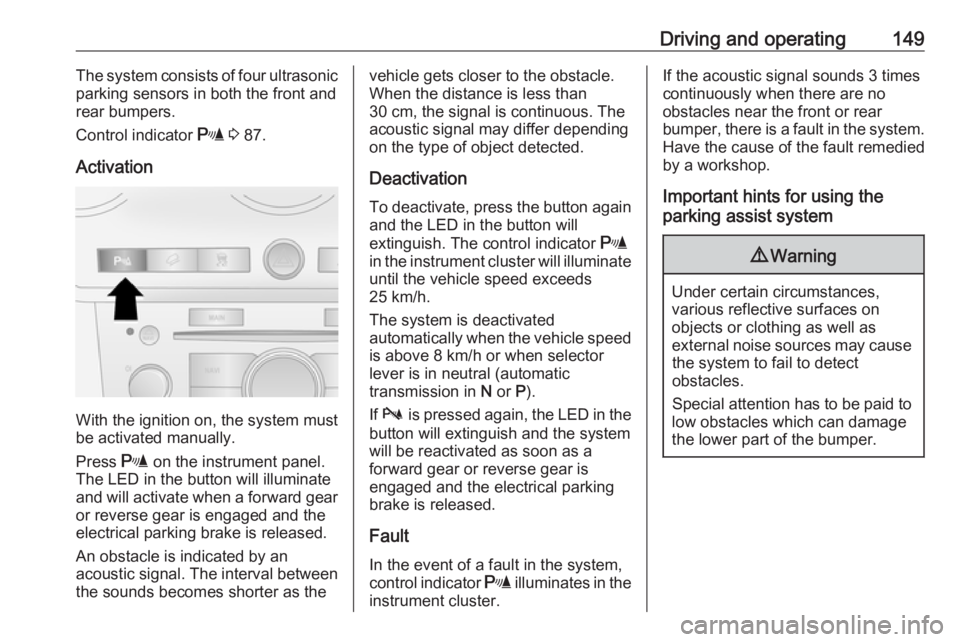
Activation
With the ignition on, the system must
be activated manually.
Press r on the instrument panel.
The LED in the button will illuminate
and will activate when a forward gear
or reverse gear is engaged and the
electrical parking brake is released.
An obstacle is indicated by an
acoustic signal. The interval between
the sounds becomes shorter as the
vehicle gets closer to the obstacle.
When the distance is less than
30 cm, the signal is continuous. The
acoustic signal may differ depending
on the type of object detected.
Deactivation To deactivate, press the button again
and the LED in the button will
extinguish. The control indicator r
in the instrument cluster will illuminate
until the vehicle speed exceeds
25 km/h.
The system is deactivated
automatically when the vehicle speed is above 8 km/h or when selector
lever is in neutral (automatic
transmission in N or P).
If b is pressed again, the LED in the
button will extinguish and the system
will be reactivated as soon as a
forward gear or reverse gear is
engaged and the electrical parking brake is released.
Fault
In the event of a fault in the system,
control indicator r illuminates in the
instrument cluster.If the acoustic signal sounds 3 times
continuously when there are no
obstacles near the front or rear
bumper, there is a fault in the system. Have the cause of the fault remedied
by a workshop.
Important hints for using the
parking assist system9 Warning
Under certain circumstances,
various reflective surfaces on
objects or clothing as well as
external noise sources may cause the system to fail to detect
obstacles.
Special attention has to be paid to
low obstacles which can damage
the lower part of the bumper.
Page 154 of 225
152Driving and operatingconsumption and CO2 figures.
Furthermore, fuel consumption is dependent on personal driving style
as well as road and traffic conditions.Trailer hitch
General information
The coupling ball bar is kept in a bag,
fastened with a strap and is stowed
below the floor cover in the load
compartment.
Only use towing equipment that has
been approved for your vehicle.
Entrust retrofitting of towing
equipment to a workshop. It may be
necessary to make changes that
affect the cooling system, heat
shields or other equipment.
Control indicator á illuminates in the
instrument cluster when a trailer is
connected to the vehicle 3 91.
Driving characteristics and towing tips
In the case of trailers with brakes,
attach the break-away stopping cable
to the eye - not to the coupling ball
bar.
If no eye is available, loop cable
around coupling ball bar. Ensure
cable is crossed under the verticalcoupling socket to ensure the trailer
nose cannot drop to the ground if it
becomes separated from the trailer
hitch. Do not allow the cable to drag
along the ground and always allow
enough slack to permit full turning.
Follow the instructions supplied with
the towing equipment.
Before attaching a trailer, lubricate
the coupling ball. However, do not do so if a stabiliser, which acts on thecoupling ball, is being used to reduce
snaking movements. For trailers with
low driving stability, the use of a
friction-type stabiliser is strongly
recommended.
Do not drive faster than 80 km/h, even in countries where higher speeds are
permitted. When driving uphill, do not drive faster than 30 km/h in 1st gear,or 50 km/h in 2nd gear.
If the trailer starts snaking, drive more slowly, do not attempt to correct the
steering and brake sharply if
necessary.
When driving downhill, drive in the
same gear as if driving uphill and
drive at a similar speed.
Page 157 of 225
Driving and operating155Check that the coupling ball bar is
correctly attached:
● Green marking must be visible on
lever.
● Coupling ball bar must be seated
firmly in coupling housing.
Coupling ball bar must be locked and key must be removed.9 Warning
Towing a trailer is permitted only
when the coupling ball bar is fitted correctly. If the coupling ball bar
cannot be properly attached, seek the assistance of a workshop.
Eye for break-away stopping cable
In the case of trailers with brakes,
attach the break-away stopping cable
to the eye - not to the coupling ball
bar.
Dismounting the coupling ball bar
Unlock coupling ball bar and remove
key. Push lever to the left, towards the
coupling ball bar and turn it
downwards. Pull coupling ball bar out of coupling housing.
Remove any rust or dirt from area
around the coupling housing and
coupling ball bar connection before
inserting sealing plug in the hole.
Place the coupling ball bar in the bag supplied, fasten it with the strap and
stow it below the floor cover in the
load compartment.
Do not use steam-jet cleaners or
other high-pressure cleaners to clean
the coupling ball bar.
Trailer stability assist
If the system detects snaking
movements, engine power is reduced
and the vehicle/trailer combination is
selectively braked until the snaking ceases. While system is working keep
steering wheel as still as possible.
Trailer stability assist (TSA) is a
function of the Electronic Stability
Control 3 145.
Page 158 of 225
156Vehicle careVehicle careGeneral Information...................157
Accessories and vehicle modifications .......................... 157
Vehicle storage ........................157
End-of-life vehicle recovery .....158
Vehicle checks ........................... 158
Performing work ......................158
Bonnet ..................................... 158
Engine oil ................................. 159
Engine coolant ......................... 160
Power steering fluid .................161
Washer fluid ............................ 161
Brakes ..................................... 161
Brake fluid ............................... 162
Clutch fluid ............................... 162
Vehicle battery ......................... 162
Diesel fuel filter ........................164
Diesel fuel system bleeding .....165
Wiper blade replacement ........165
Bulb replacement .......................165
Headlights ............................... 165
Halogen headlights ..................166
Xenon headlights .....................167
Fog lights ................................. 168
Tail lights ................................. 169Side turn signal lights ..............170
Centre high-mounted brake light ......................................... 170
Number plate light ...................170
Interior lights ............................ 170
Instrument panel illumination ...171
Electrical system ........................171
Fuses ....................................... 171
Engine compartment fuse box . 173
Instrument panel fuse box .......176
Vehicle tools .............................. 179
Tools ........................................ 179
Wheels and tyres .......................181
Winter tyres ............................. 181
Tyre designations ....................181
Tyre pressure .......................... 182
Tyre pressure monitoring system .................................... 183
Tread depth ............................. 186
Changing tyre and wheel size . 186
Wheel covers ........................... 187
Tyre chains .............................. 187
Tyre repair kit .......................... 187
Wheel changing .......................190
Spare wheel ............................ 193
Jump starting ............................. 194
Towing ....................................... 196
Towing the vehicle ...................196
Towing another vehicle ...........197Appearance care .......................198
Exterior care ............................ 198
Interior care ............................. 200
Page 159 of 225
Vehicle care157General Information
Accessories and vehicle modifications
We recommend the use of genuine
parts and accessories and factory
approved parts specific for your
vehicle type. We cannot assess or guarantee reliability of other products
- even if they have a regulatory or
otherwise granted approval.
Do not make any modifications to the
electrical system, e.g. changes of
electronic control units (chip tuning).Caution
When transporting the vehicle on
a train or on a recovery vehicle, the
mud flaps might be damaged.
Vehicle storage
Storage for a long period of time
If the vehicle is to be stored for several months:
● Wash and wax the vehicle.
● Have the wax in the engine compartment and underbody
checked.
● Clean and preserve the rubber seals.
● Change the engine oil.
● Drain the washer fluid reservoir.
● Check the coolant antifreeze and
corrosion protection.
● Adjust tyre pressure to the value specified for full load.
● Park the vehicle in a dry, well ventilated place. Engage first or
reverse gear or move selector
lever to P. Prevent the vehicle
from rolling.
● Do not apply the electrical parking brake.● Open the bonnet, close all doorsand lock the vehicle.
● Disconnect the clamp from the negative terminal of the vehicle
battery. Beware that all systems
are not functional, e.g. anti-theft
alarm system.
Putting back into operation
When the vehicle is to be put back into
operation:
● Connect the clamp to the negative terminal of the vehicle
battery. Activate the electronics
of the power windows.
● Check tyre pressure.
● Fill up the washer fluid reservoir.
● Check the engine oil level.
● Check the coolant level.
● Fit the number plate if necessary.
Page 163 of 225
Vehicle care161Power steering fluidCaution
Extremely small amounts of
contamination can cause steering
system damage and cause it to not work properly. Do not allow
contaminates to contact the fluid
side of the reservoir cap/dipstick or
from entering the reservoir.
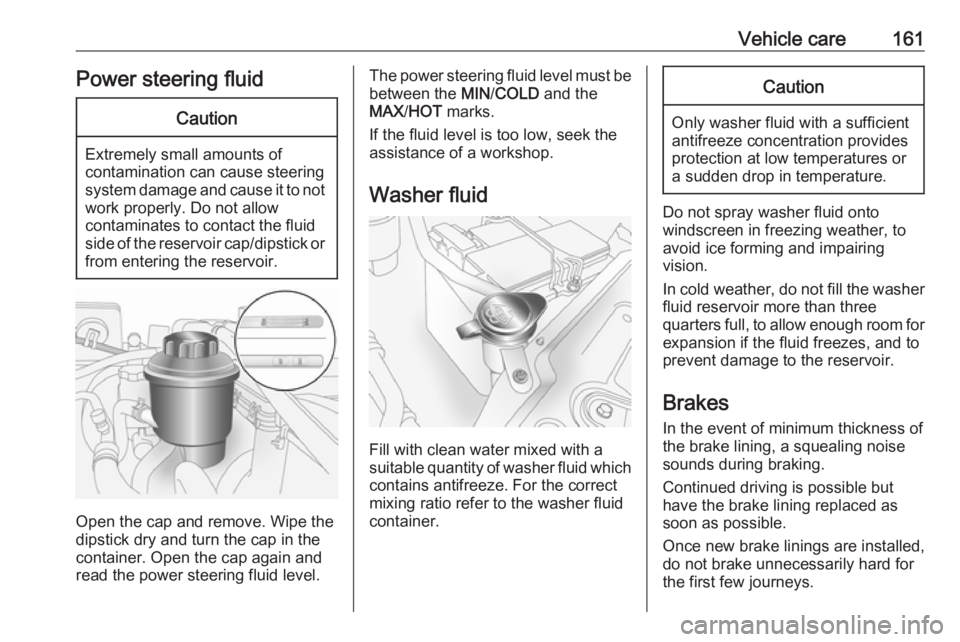
Open the cap and remove. Wipe the
dipstick dry and turn the cap in the
container. Open the cap again and
read the power steering fluid level.
The power steering fluid level must be between the MIN/COLD and the
MAX /HOT marks.
If the fluid level is too low, seek the
assistance of a workshop.
Washer fluid
Fill with clean water mixed with a
suitable quantity of washer fluid which
contains antifreeze. For the correct mixing ratio refer to the washer fluid
container.
Caution
Only washer fluid with a sufficient
antifreeze concentration provides
protection at low temperatures or
a sudden drop in temperature.
Do not spray washer fluid onto
windscreen in freezing weather, to avoid ice forming and impairing
vision.
In cold weather, do not fill the washer
fluid reservoir more than three
quarters full, to allow enough room for expansion if the fluid freezes, and to
prevent damage to the reservoir.
Brakes
In the event of minimum thickness of
the brake lining, a squealing noise
sounds during braking.
Continued driving is possible but
have the brake lining replaced as
soon as possible.
Once new brake linings are installed,
do not brake unnecessarily hard for
the first few journeys.
Page 164 of 225
162Vehicle careBrake fluid9Warning
Brake fluid is poisonous and
corrosive. Avoid contact with eyes, skin, fabrics and painted surfaces.
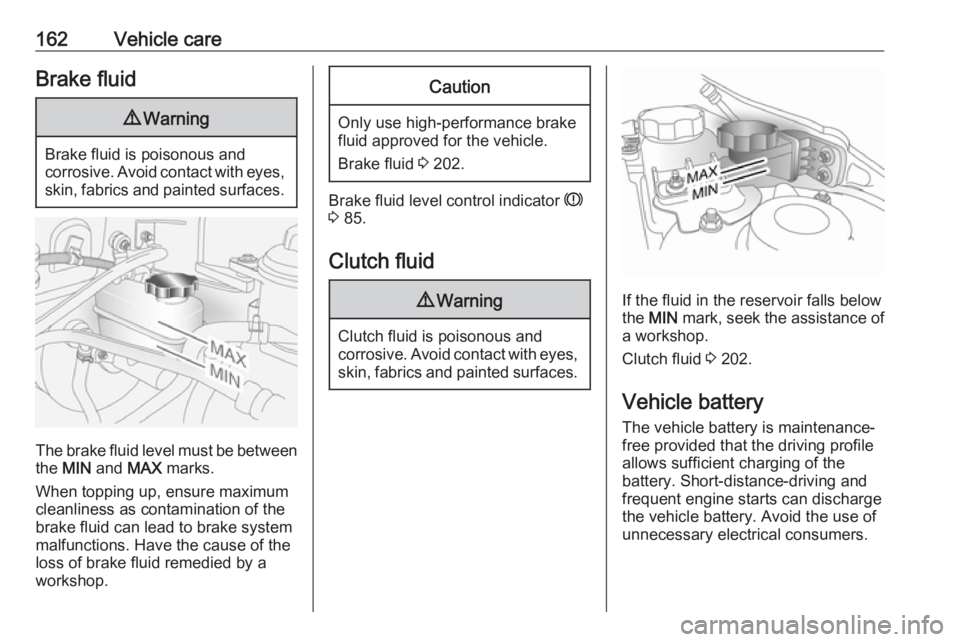
The brake fluid level must be between
the MIN and MAX marks.
When topping up, ensure maximum cleanliness as contamination of the
brake fluid can lead to brake system
malfunctions. Have the cause of the
loss of brake fluid remedied by a
workshop.
Caution
Only use high-performance brake
fluid approved for the vehicle.
Brake fluid 3 202.
Brake fluid level control indicator R
3 85.
Clutch fluid
9 Warning
Clutch fluid is poisonous and
corrosive. Avoid contact with eyes, skin, fabrics and painted surfaces.
If the fluid in the reservoir falls below
the MIN mark, seek the assistance of
a workshop.
Clutch fluid 3 202.
Vehicle battery The vehicle battery is maintenance-
free provided that the driving profile
allows sufficient charging of the
battery. Short-distance-driving and
frequent engine starts can discharge
the vehicle battery. Avoid the use of
unnecessary electrical consumers.