automatic transmission OPEL ASTRA J 2014 Manual user
[x] Cancel search | Manufacturer: OPEL, Model Year: 2014, Model line: ASTRA J, Model: OPEL ASTRA J 2014Pages: 331, PDF Size: 10.13 MB
Page 183 of 331
Driving and operating181Interactive driving system
Flex Ride Flex Ride driving system allows the
driver to select between three driving
modes:
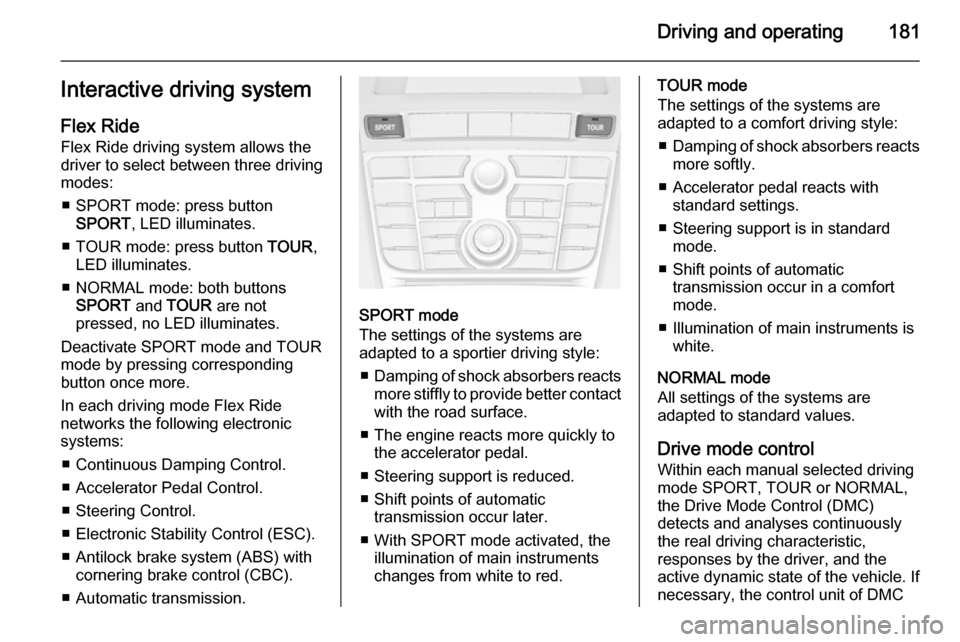
■ SPORT mode: press button SPORT , LED illuminates.
■ TOUR mode: press button TOUR,
LED illuminates.
■ NORMAL mode: both buttons SPORT and TOUR are not
pressed, no LED illuminates.
Deactivate SPORT mode and TOUR
mode by pressing corresponding
button once more.
In each driving mode Flex Ride
networks the following electronic systems:
■ Continuous Damping Control.
■ Accelerator Pedal Control.
■ Steering Control.
■ Electronic Stability Control (ESC).
■ Antilock brake system (ABS) with cornering brake control (CBC).
■ Automatic transmission.
SPORT mode
The settings of the systems are
adapted to a sportier driving style:
■ Damping of shock absorbers reacts
more stiffly to provide better contact
with the road surface.
■ The engine reacts more quickly to the accelerator pedal.
■ Steering support is reduced.
■ Shift points of automatic transmission occur later.
■ With SPORT mode activated, the illumination of main instruments
changes from white to red.
TOUR mode
The settings of the systems are
adapted to a comfort driving style:
■ Damping of shock absorbers reacts
more softly.
■ Accelerator pedal reacts with standard settings.
■ Steering support is in standard mode.
■ Shift points of automatic transmission occur in a comfort
mode.
■ Illumination of main instruments is white.
NORMAL mode
All settings of the systems are
adapted to standard values.
Drive mode control
Within each manual selected driving
mode SPORT, TOUR or NORMAL,
the Drive Mode Control (DMC)
detects and analyses continuously
the real driving characteristic,
responses by the driver, and the
active dynamic state of the vehicle. If
necessary, the control unit of DMC
Page 185 of 331
Driving and operating183
NORMAL mode
In NORMAL mode, when neither
SPORT nor OPC button is pressed,
all settings of the systems are
adapted to standard values.
SPORT mode
The settings of the systems are
adapted to a sportier driving style.
OPC mode
The drive dynamic characteristics are adapted to high performance
settings.
In this mode the illumination of main instruments is switched to red.
Personalised settings in the OPC
mode
The driver can select the functions of
the OPC mode when OPC button is
pressed. These settings can be
changed in the menu Settings in the
Info-Display. Vehicle personalisation 3 134.Driver assistance
systems9 Warning
Driver assistance systems are
developed to support the driver
and not to replace his attention.
The driver accepts full
responsibility when driving the
vehicle.
When using driver assistance
systems, always take care
regarding the current traffic
situation.
Cruise control
The Cruise control can store and
maintain speeds of approx. 30 to
200 km/h. Deviations from the stored
speeds may occur when driving uphill or downhill.
For safety reasons the cruise control cannot be activated until the foot
brake has been operated once.
Activating in first gear is not possible.
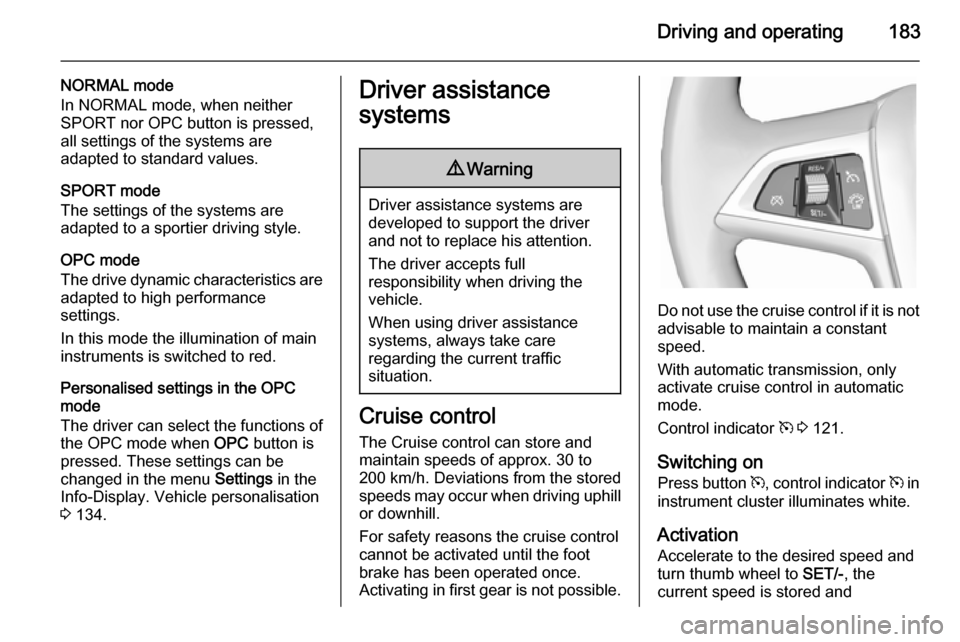
Do not use the cruise control if it is not advisable to maintain a constant
speed.
With automatic transmission, only
activate cruise control in automatic
mode.
Control indicator m 3 121.
Switching on Press button m, control indicator m in
instrument cluster illuminates white.
Activation
Accelerate to the desired speed and
turn thumb wheel to SET/-, the
current speed is stored and
Page 191 of 331

Driving and operating189
The selected following distance is
indicated by filled distance bars in the
adaptive cruise control page.
Note that the following distance
setting is shared with the sensitivity
setting of forward collision alert.
Example: If setting 3 (far) is selected,
then the driver is warned sooner
before a possible collision, also if
adaptive cruise control is inactive or
switched off.
9 Warning
The driver accepts full
responsibility for the appropriate
following distance based on traffic, weather and visibility conditions.
Following distance must be
adjusted or the system switched
off when required by the prevailing
conditions.
Detecting the vehicle ahead
The green illuminated vehicle ahead
control indicator A is displayed in the
speedometer when the system
detects a vehicle in the driving path.
If this symbol does not display, or
displays briefly, adaptive cruise
control will not respond to vehicles
ahead.
Deactivation Adaptive cruise control is deactivated
by the driver when:
■ button y is pressed,
■ brake pedal is applied,
■ clutch pedal is depressed for more than four seconds,
■ gear selector lever of automatic transmission is moved to N.
The system is also automatically
deactivated when:
■ vehicle speed slows down below 45 km/h or accelerates above
190 km/h,
■ Traction Control system is operating for more than
20 seconds,
Page 279 of 331
Vehicle care277
■Never expose the vehicle battery to
naked flames or sparks.
■ A discharged vehicle battery can already freeze at a temperature of
0 °C. Defrost the frozen vehicle
battery before connecting jump
leads.
■ Wear eye protection and protective
clothing when handling a vehicle
battery.
■ Use a booster vehicle battery with the same voltage (12 Volts). Its
capacity (Ah) must not be much less than that of the discharged
vehicle battery.
■ Use jump leads with insulated terminals and a cross section of at
least 16 mm 2
(25 mm 2
for diesel
engines).
■ Do not disconnect the discharged vehicle battery from the vehicle.
■ Switch off all unnecessary electrical
consumers.
■ Do not lean over the vehicle battery
during jump starting.■ Do not allow the terminals of one lead to touch those of the other
lead.
■ The vehicles must not come into contact with each other during the
jump starting process.
■ Apply the parking brake, transmission in neutral, automatic
transmission in P.
■ Open the positive terminal protection caps of both vehicle
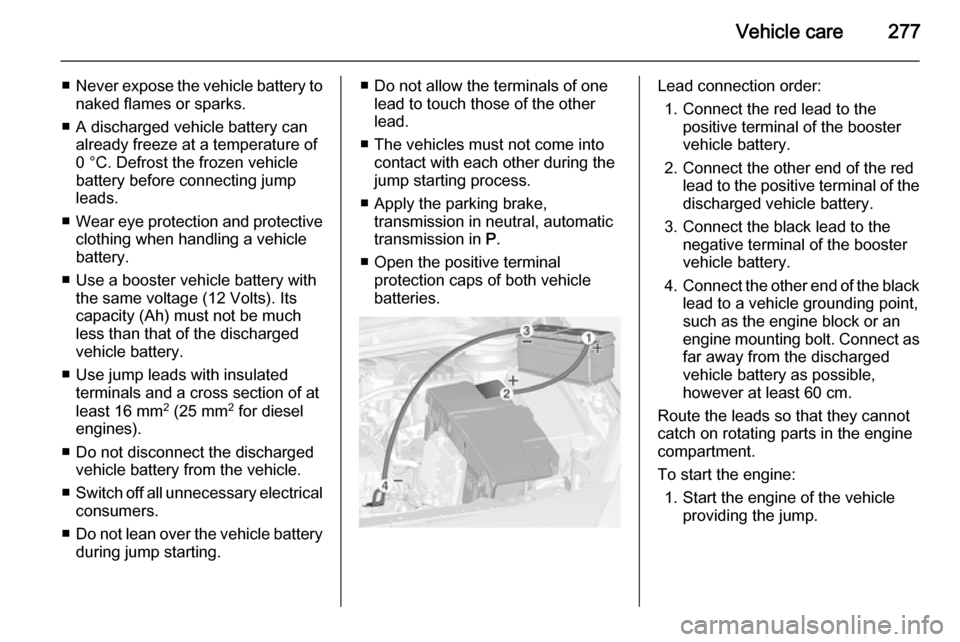
batteries.Lead connection order:
1. Connect the red lead to the positive terminal of the booster
vehicle battery.
2. Connect the other end of the red lead to the positive terminal of the
discharged vehicle battery.
3. Connect the black lead to the negative terminal of the booster
vehicle battery.
4. Connect the other end of the black
lead to a vehicle grounding point,
such as the engine block or an
engine mounting bolt. Connect as far away from the discharged
vehicle battery as possible,
however at least 60 cm.
Route the leads so that they cannot
catch on rotating parts in the engine
compartment.
To start the engine: 1. Start the engine of the vehicle providing the jump.
Page 281 of 331

Vehicle care279Caution
Drive slowly. Do not drive jerkily.
Excessive tractive force can
damage the vehicle.
When the engine is not running,
considerably more force is needed to
brake and steer.
To prevent the entry of exhaust gases from the towing vehicle, switch on the
air recirculation and close the
windows.
Vehicles with automatic transmission: The vehicle must be towed facing
forwards, not faster than 80 km/h nor further than 100 km. In all other cases
and when the transmission is
defective, the front axle must be
raised off the ground.
Seek the assistance of a workshop.
After towing, unscrew the towing eye.
Insert cap at the top and engage
downwards.
Towing another vehicle
Insert a screwdriver in the slot at the
lower bend of the cap. Release the
cap by carefully moving the
screwdriver downwards.
The towing eye is stowed with the
vehicle tools 3 258.
Screw in the towing eye as far as it will
go until it stops in a horizontal
position.
The lashing eye at the rear
underneath the vehicle must never be used as a towing eye.
Attach a tow rope – or even better a
tow bar – to the towing eye.
The towing eye must only be used for
towing and not for recovering a
vehicle.
Page 297 of 331
![OPEL ASTRA J 2014 Manual user Technical data295Performance3-door hatchbackEngineA14XERA14NELA14NETA16LETA16XHTMaximum speed 2)
[km/h]Manual transmission178 3)192201220219Automatic transmission––200–210EngineA18XERA20NFTA17D](/img/37/18768/w960_18768-296.png "OPEL ASTRA J 2014 Manual user Technical data295Performance3-door hatchbackEngineA14XERA14NELA14NETA16LETA16XHTMaximum speed 2)
[km/h]Manual transmission178 3)192201220219Automatic transmission––200–210EngineA18XERA20NFTA17D")
Technical data295Performance3-door hatchbackEngineA14XERA14NELA14NETA16LETA16XHTMaximum speed 2)
[km/h]Manual transmission178 3)192201220219Automatic transmission––200–210EngineA18XERA20NFTA17DTEA17DTCA17DTFMaximum speed 2)
[km/h]Manual transmission200250183182197Automatic transmission–––––EngineA17DTSA20DTHA20DTRMaximum speed 2)
[km/h]Manual transmission196210225Automatic transmission–207–2) The maximum speed indicated is achievable at kerb weight (without driver) plus 200 kg payload. Optional equipment
could reduce the specified maximum speed of the vehicle.
3) 4th gear.
Page 298 of 331
![OPEL ASTRA J 2014 Manual user 296Technical data
5-door hatchbackEngineA14XELA14XERA14NELA14NETA16LETA16XERMaximum speed2)
[km/h]Manual transmission168178192202221188Automatic transmission–––200211182EngineA16XHTA13DTEA17DTE](/img/37/18768/w960_18768-297.png "OPEL ASTRA J 2014 Manual user 296Technical data
5-door hatchbackEngineA14XELA14XERA14NELA14NETA16LETA16XERMaximum speed2)
[km/h]Manual transmission168178192202221188Automatic transmission–––200211182EngineA16XHTA13DTEA17DTE")
296Technical data
5-door hatchbackEngineA14XELA14XERA14NELA14NETA16LETA16XERMaximum speed2)
[km/h]Manual transmission168178192202221188Automatic transmission–––200211182EngineA16XHTA13DTEA17DTEA17DTCA17DTFMaximum speed 2)
[km/h]Manual transmission220175188186201Automatic transmission212––––EngineA17DTSA20DTHA20DTRMaximum speed 2)
[km/h]Manual transmission198215226Automatic transmission–209–2) The maximum speed indicated is achievable at kerb weight (without driver) plus 200 kg payload. Optional equipment
could reduce the specified maximum speed of the vehicle.
Page 299 of 331
![OPEL ASTRA J 2014 Manual user Technical data297
4-door notchbackEngineA14XERA14NETA16LETA16XERA16XHTMaximum speed2)
[km/h]Manual transmission178 3)2022211884)Automatic transmission–200211182–EngineA13DTEA17DTEA17DTCA17DTFMaxi](/img/37/18768/w960_18768-298.png "OPEL ASTRA J 2014 Manual user Technical data297
4-door notchbackEngineA14XERA14NETA16LETA16XERA16XHTMaximum speed2)
[km/h]Manual transmission178 3)2022211884)Automatic transmission–200211182–EngineA13DTEA17DTEA17DTCA17DTFMaxi")
Technical data297
4-door notchbackEngineA14XERA14NETA16LETA16XERA16XHTMaximum speed2)
[km/h]Manual transmission178 3)2022211884)Automatic transmission–200211182–EngineA13DTEA17DTEA17DTCA17DTFMaximum speed 2)
[km/h]Manual transmission175191188206Automatic transmission––––EngineA17DTSA20DTHMaximum speed 2)
[km/h]Manual transmission203215Automatic transmission–2092) The maximum speed indicated is achievable at kerb weight (without driver) plus 200 kg payload. Optional equipment
could reduce the specified maximum speed of the vehicle.
3) 4th gear.
4) Value was not available at time of printing.
Page 300 of 331
![OPEL ASTRA J 2014 Manual user 298Technical data
Sports tourerEngineA14XERA14NELA14NETA16LETA16XERA16XHTMaximum speed [km/h]2)Manual transmission175190200220185220Automatic transmission––198210180211EngineA13DTEA17DTEA17DTFA17D](/img/37/18768/w960_18768-299.png "OPEL ASTRA J 2014 Manual user 298Technical data
Sports tourerEngineA14XERA14NELA14NETA16LETA16XERA16XHTMaximum speed [km/h]2)Manual transmission175190200220185220Automatic transmission––198210180211EngineA13DTEA17DTEA17DTFA17D")
298Technical data
Sports tourerEngineA14XERA14NELA14NETA16LETA16XERA16XHTMaximum speed [km/h]2)Manual transmission175190200220185220Automatic transmission––198210180211EngineA13DTEA17DTEA17DTFA17DTCA17DTSMaximum speed 2)
[km/h]Manual transmission174186198184195Automatic transmission–––––EngineA17DTLA20DTHMaximum speed 2)
[km/h]Manual transmission176212Automatic transmission–2072) The maximum speed indicated is achievable at kerb weight (without driver) plus 200 kg payload. Optional equipment
could reduce the specified maximum speed of the vehicle.
Page 301 of 331
![OPEL ASTRA J 2014 Manual user Technical data299Vehicle weight
Kerb weight, basic model without any optional equipment3-door hatchbackEngineManual transmissionAutomatic transmissionwith air conditioning
[kg]A14XER1393–A14NEL1437â](/img/37/18768/w960_18768-300.png "OPEL ASTRA J 2014 Manual user Technical data299Vehicle weight
Kerb weight, basic model without any optional equipment3-door hatchbackEngineManual transmissionAutomatic transmissionwith air conditioning
[kg]A14XER1393–A14NEL1437â")
Technical data299Vehicle weight
Kerb weight, basic model without any optional equipment3-door hatchbackEngineManual transmissionAutomatic transmissionwith air conditioning
[kg]A14XER1393–A14NEL1437–A14NET14371471A16LET1471–A16XHT15031503A18XER1437–A20NFT1550–A17DTE1503–A17DTS1503–with air conditioning
[kg]A17DTC1503–A17DTF1503–A20DTH15501571A20DTR1571–