LIM OPEL ASTRA J 2014 Manual user
[x] Cancel search | Manufacturer: OPEL, Model Year: 2014, Model line: ASTRA J, Model: OPEL ASTRA J 2014Pages: 331, PDF Size: 10.13 MB
Page 210 of 331

208Driving and operating
Display settings
Brightness can be set with the up/
down buttons of the multifunction
knob.
Contrast can be set with left/right
buttons of the multifunction knob.
Deactivation
The camera is deactivated when a
certain forward speed is exceeded or if reverse gear is not engaged for
approx. 10 seconds.
Activation or deactivation of the rear
view camera can be changed in the menu Settings in the Info-Display.
Vehicle personalisation 3 134.
Fault
Fault messages are displayed with a 9 on the top line of the Info-Display.
The rear view camera may not
operate properly when:
■ the surrounding is dark,
■ the sun or the beam of headlights is
shining directly into the camera
lens,
■ ice, snow, mud, or anything else covers the camera lens. Clean the
lens, rinse it with water, and wipe it
with a soft cloth,
■ the tailgate is not closed correctly,
■ the vehicle had a rear end accident,
■ there are extreme temperature changes.Traffic sign assistant
Functionality The traffic sign assistant systemdetects designated traffic signs via a
front camera and displays them in the
Driver Information Centre.
Traffic signs, which will be detected,
are:
Limit and no passing signs ■ speed limit
■ no passing
■ end of speed limit
■ end of no passing
Page 211 of 331

Driving and operating209
Road signs
Beginning and end of:
■ motorways
■ A-roads
■ play streetsAdd on signs ■ additional hints to traffic signs
■ restriction of trailer towing
■ wet warning
■ ice warning
■ direction arrows
Speed limit signs are displayed in the
Driver Information Centre until the
next speed limit sign or end of speed
limit is detected or up to a defined sign timeout.
Combinations of more signs in the
display are possible.
An exclamation mark in a frame
indicates that there is an add on sign
detected which cannot be recognised
by the system.
The system is active up to a speed of 200 km/h depending on the lighting
conditions. At night the system is
active up to a speed of 160 km/h.
As soon as the speed becomes
slower than 55 km/h the display will
be reset and the content of the traffic
sign page will be cleared. The next
recognized speed indication will be
displayed.
Display indication
Page 212 of 331

210Driving and operating
Traffic signs are displayed on the
page Traffic sign detection on the
Driver Information Centre, chosen via the adjuster wheel on the turn signal
lever 3 121.
When another function on the Driver
Information Centre menu was
selected and then Traffic sign
detection page is chosen again, the
last recognised traffic sign will be displayed.
After the traffic sign page is cleared
by the system, the following symbol is
indicated:The content of the traffic sign page is also cleared during driving by pushing
the SET/CLR button on the turn signal
lever for a longer time.
Pop-up function
Speed limits and no passing signs are
displayed as pop-ups on each page
of the Driver Information Centre.
The pop-up function can be
deactivated on the traffic sign page by
pressing the SET/CLR button on the
turn signal lever.
Page 213 of 331

Driving and operating211
Once setting page is displayed, selectOff to deactivate pop-up function.
Reactivated by selecting On. When
switching on the ignition, pop-up function is deactivated.
Pop-up indication is displayed for approx. 8 seconds in the Driver
Information Centre.
Fault The traffic sign assistant system may
not operate correctly when:
■ the area of the windscreen, where the front camera is located, is notclean
■ traffic signs are completely or partially covered or difficult to
discern
■ there are adverse environmental conditions, e.g. heavy rain, snow,direct sunlight or shadows. In this
case No Traffic Sign Detection due
to Weather is indicated on the
display■ traffic signs are incorrectly mounted
or damaged
■ traffic signs do not comply with the Vienna Convention on traffic signs
(Wiener Übereinkommen über
Straßenverkehrszeichen)Caution
The system is intended to help the driver within a defined speed
range to discern certain traffic
signs. Do not ignore traffic signs
which are not displayed by the
system.
The system does not discern any other than the conventional traffic
signs that might give or end a
speed limit.
Do not let this special feature
tempt you into taking risks when
driving.
Always adapt speed to the road
conditions.
The driver assistance systems do not relieve the driver from full
responsibility for vehicle
operation.
Lane departure warning
The lane departure warning systemobserves the lane markings between
which the vehicle is driving via a front camera. The system detects lane
changes and warns the driver in the
event of an unintended lane change
via visual and acoustic signals.
Criteria for the detection of an
unintended lane change are:
■ no operation of turn signals
■ no brake pedal operation
■ no active accelerator operation or speeding-up
■ no active steering
If the driver is active, no warning will
be issued.
Page 220 of 331

218Driving and operating9Warning
Due to the system design, an
escape of liquid gas after
releasing the locking lever is
unavoidable. Avoid inhaling.
9 Warning
The liquid gas tank may only be
filled to 80% for safety reasons.
The multivalve on the liquid gas tank
automatically limits the fill quantity. If
a larger quantity is added, we
recommend not exposing the vehicle
to the sun until the excess amount
has been used up.
Filling adapter
As filling systems are not
standardised, different adapters are
required which are available from
Opel Distributors and from Opel
Authorised Repairers.ACME adapter: Belgium, Germany,
Ireland, Luxembourg, Switzerland
Bayonet adapter: Netherlands,
Norway, Spain, United Kingdom
EURO adapter: Spain
DISH (Italy) adapter: Bosnia-
Herzegovina, Bulgaria, Denmark,
Estonia, France, Greece, Italy,
Page 222 of 331

220Driving and operatingDriving characteristics and
towing tips Before attaching a trailer, lubricatethe coupling ball. However, do not do
so if a stabiliser, which acts on the
coupling ball, is being used to reduce
snaking movements.
For trailers with low driving stability
and caravan trailers with a permitted
gross vehicle weight of more than
1300 kg the use of a stabiliser is
strongly recommended when driving
above 80 km/h.
If the trailer starts snaking, drive more slowly, do not attempt to correct the
steering and brake sharply if
necessary.
When driving downhill, drive in the
same gear as if driving uphill and
drive at a similar speed.
Adjust tyre pressure to the value
specified for full load 3 309.Trailer towing
Trailer loads The permissible trailer loads are
vehicle and engine-dependent
maximum values which must not be
exceeded. The actual trailer load is
the difference between the actual
gross weight of the trailer and the
actual coupling socket load with the
trailer coupled.
The permissible trailer loads are
specified in the vehicle documents. In
general, they are valid for gradients
up to max. 12 %.
The permitted trailer load applies up
to the specified incline and up to an
altitude of 1000 metres above sea
level. Since engine power decreases
as altitude increases due to the air becoming thinner, therefore reducing
climbing ability, the permissible gross train weight also decreases by 10 %
for every 1000 metres of additional
altitude. The gross train weight does
not have to be reduced when driving
on roads with slight inclines (less than
8 %, e.g. motorways).The permissible gross train weight
must not be exceeded. This weight is
specified on the identification plate
3 287.
Vertical coupling load
The vertical coupling load is the load
exerted by the trailer on the coupling
ball. It can be varied by changing the
weight distribution when loading the
trailer.
The maximum permissible vertical
coupling load (75 kg) is specified on
the towing equipment identification
plate and in the vehicle documents.
Always aim for the maximum load,
especially in the case of heavy
trailers. The vertical coupling load
should never fall below 25 kg.
Page 256 of 331

254Vehicle care
No.Circuit15Engine control module16Starter17Transmission control module18Heated rear window19Front power windows20Rear power windows21Rear electrical centre22Left high beam (Halogen)23Headlamp washer system24Right low beam (Xenon)25Left low beam (Xenon)26Front fog lights27Diesel fuel heating28Start stop system29Electric parking brake30ABS31Adaptive cruise controlNo.Circuit32Airbag33Adaptive forward lighting, auto‐
matic light control34Exhaust gas recirculation35Exterior mirror, rain sensor36Climate control37Canister vent solenoid38Vacuum pump39Central control module40Windscreen washer, rear
window washer system41Right high beam (Halogen)42Radiator fan43Windscreen wiper44Windscreen wiper45Radiator fan46–No.Circuit47Horn48Radiator fan49Fuel pump50Headlamp levelling, adaptive
forward lighting51Air shutter52Auxiliary heater, diesel engine53Transmission control module,
engine control module54Vacuum pump, instrument
panel cluster, heating ventila‐
tion, air conditioning system
After having changed defective fuses,
close the fuse box cover and press
until it engages.
If the fuse box cover is not closed
correctly, malfunction may occur.
Page 263 of 331
Vehicle care261
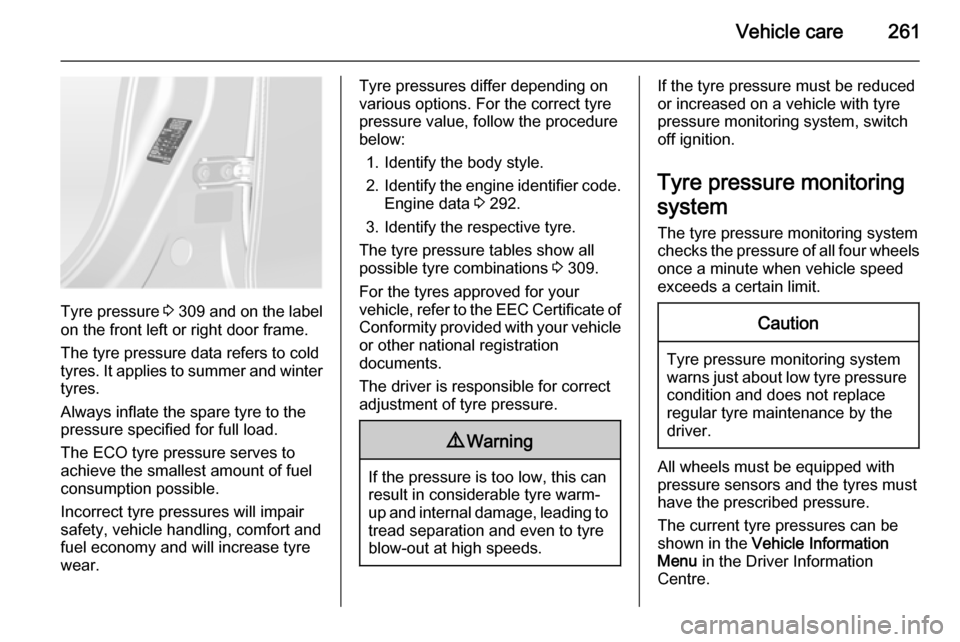
Tyre pressure 3 309 and on the label
on the front left or right door frame.
The tyre pressure data refers to cold
tyres. It applies to summer and winter tyres.
Always inflate the spare tyre to the
pressure specified for full load.
The ECO tyre pressure serves to
achieve the smallest amount of fuel
consumption possible.
Incorrect tyre pressures will impair
safety, vehicle handling, comfort and
fuel economy and will increase tyre
wear.
Tyre pressures differ depending on
various options. For the correct tyre
pressure value, follow the procedure
below:
1. Identify the body style.
2. Identify the engine identifier code.
Engine data 3 292.
3. Identify the respective tyre.
The tyre pressure tables show all
possible tyre combinations 3 309.
For the tyres approved for your
vehicle, refer to the EEC Certificate of Conformity provided with your vehicle
or other national registration
documents.
The driver is responsible for correct
adjustment of tyre pressure.9 Warning
If the pressure is too low, this can
result in considerable tyre warm-
up and internal damage, leading to tread separation and even to tyre
blow-out at high speeds.
If the tyre pressure must be reduced
or increased on a vehicle with tyre
pressure monitoring system, switch
off ignition.
Tyre pressure monitoring system The tyre pressure monitoring system
checks the pressure of all four wheels
once a minute when vehicle speed
exceeds a certain limit.Caution
Tyre pressure monitoring system
warns just about low tyre pressure
condition and does not replace
regular tyre maintenance by the
driver.
All wheels must be equipped with
pressure sensors and the tyres must
have the prescribed pressure.
The current tyre pressures can be
shown in the Vehicle Information
Menu in the Driver Information
Centre.
Page 327 of 331

325
Child restraints.............................. 56
Child restraint systems ................56
Cigarette lighter .........................109
Climate control ............................. 19
Climate control systems .............155
Clock........................................... 107
Code ........................................... 128
Control indicators........................ 113
Control of the vehicle .................164
Controls ...................................... 102
Convex shape .............................. 33
Coolant and antifreeze ...............285
Cruise control ....................121, 183
Cupholders .................................. 62
Curtain airbag system .................. 54
Curve lighting.............................. 145
D Danger, Warnings and Cautions ...4
Daytime running lights ...............145
Declaration of conformity ............321
Diesel fuel system bleeding .......231
Diesel particle filter .............119, 170
Door open .................................. 121
Doors ............................................ 28
Driver assistance systems ..........183
Driver Information Centre ...........121
Driving characteristics and towing tips .............................. 220
Driving hints ................................ 164E
Electric adjustment ......................33
Electrical system......................... 252
Electric parking brake .................117
Electric parking brake fault .........117
Electronic climate control system 158
Electronic driving programmes ..173
Electronic Stability Control.......... 179
Electronic Stability Control and Traction Control system ..........118
Electronic Stability Control off..... 118
End-of-life vehicle recovery .......225
Engine compartment fuse box ...253
Engine coolant ........................... 227
Engine coolant temperature gauge ..................................... 111
Engine data ............................... 292
Engine exhaust .......................... 170
Engine identification ...................288
Engine oil ................... 226, 285, 289
Engine oil pressure ....................119
Entry lighting .............................. 152
Event data recorders ..................321
Exit lighting ................................ 153
Exterior care .............................. 280
Exterior light ............................... 120
Exterior lighting ....................16, 142
Exterior mirrors ............................. 33F
Fault ........................................... 173
First aid ......................................... 97
First aid kit ................................... 97
Fixed air vents ........................... 163
Flex-Fix system ............................ 66
Fog light ..................................... 120
Fog lights ................................... 237
Folding mirrors ............................. 33
Following distance indication ......196
Forward collision alert................. 193
Front airbag system .....................53
Front fog lights ........................... 149
Front seats.................................... 42
Front storage ................................ 63
Front turn signal lights ...............239
Fuel............................................. 213
Fuel consumption - CO 2-
Emissions ............................... 219
Fuel for diesel engines ..............213
Fuel for liquid gas operation .......213
Fuel for petrol engines ...............213
Fuel gauge ................................. 111 Fuel selector .............................. 111
Fuses ......................................... 252
G
Gauges ....................................... 110
General information ...................219
Page 329 of 331

327
PParking ................................ 21, 169
Parking assist ............................ 198
Parking brake ............................ 176
Parking lights ............................. 150
Particulate filter ........................... 170
Performance .............................. 295
Performing work ........................225
Pollen filter ................................. 163
Power outlets ............................. 108
Power seat adjustment ................46
Power steering............................ 118
Power windows ............................ 35
Preheating ................................. 119
Puncture ..................................... 268
Q
Quickheat ................................... 162
R Radio Frequency Identification (RFID) ..................................... 322
Radio remote control ...................23
Reading lights ............................ 152
Rear carrier system ......................66
Rear floor storage cover ..............90
Rear fog light ............................. 121
Rear fog lights ........................... 150
Rear seats .................................... 49
Rear storage ................................. 88Rear view camera ...................... 206
Rear window wiper/washer ........ 106
Recommended fluids and lubricants ........................ 285, 289
Reduced engine power ..............120
Refuelling ................................... 215 Retained power off .....................165
Reversing lights .........................150
Ride control systems ..................178
Roof .............................................. 38
Roof load .................................... 100
Roof rack ..................................... 99
S Safety belts ................................... 49
Safety net .................................... 95
Seat adjustment ....................... 7, 42
Seat belt ...................................... 10
Seat belt reminder .....................115
Seat belts ..................................... 49
Seat folding .................................. 45
Seat position ................................ 42
Selector lever ............................. 172
Service ............................... 163, 284
Service display .......................... 112
Service information ....................284
Service vehicle soon .................. 116
Side airbag system ......................54
Side blind spot alert ....................205
Sidelights .................................... 142Side turn signal lights ................249
Smartphone controller ................128
Spare wheel ............................... 272
Speed limiter............................... 185
Speedometer ............................. 110
Starting and operating ................165
Starting off ................................... 20
Starting the engine ....................165
Steering ...................................... 164
Steering wheel adjustment ..11, 102
Steering wheel controls .............102
Stop-start system........................ 167
Storage ......................................... 62
Storage compartments .................62
Sunroof ........................................ 38
Sunvisor lights ........................... 152
Sun visors .................................... 37
Symbols ......................................... 4
T
Tachometer ............................... 110
Tail lights ................................... 241
Three-point seat belt .................... 50
Tools .......................................... 258
Top-tether fastening eyes ............61
Tow bar....................................... 219
Towing ................................ 219, 278
Towing another vehicle .............279
Towing equipment .....................221
Towing the vehicle .....................278