fuel OPEL ASTRA J 2014 Manual user
[x] Cancel search | Manufacturer: OPEL, Model Year: 2014, Model line: ASTRA J, Model: OPEL ASTRA J 2014Pages: 331, PDF Size: 10.13 MB
Page 256 of 331

254Vehicle care
No.Circuit15Engine control module16Starter17Transmission control module18Heated rear window19Front power windows20Rear power windows21Rear electrical centre22Left high beam (Halogen)23Headlamp washer system24Right low beam (Xenon)25Left low beam (Xenon)26Front fog lights27Diesel fuel heating28Start stop system29Electric parking brake30ABS31Adaptive cruise controlNo.Circuit32Airbag33Adaptive forward lighting, auto‐
matic light control34Exhaust gas recirculation35Exterior mirror, rain sensor36Climate control37Canister vent solenoid38Vacuum pump39Central control module40Windscreen washer, rear
window washer system41Right high beam (Halogen)42Radiator fan43Windscreen wiper44Windscreen wiper45Radiator fan46–No.Circuit47Horn48Radiator fan49Fuel pump50Headlamp levelling, adaptive
forward lighting51Air shutter52Auxiliary heater, diesel engine53Transmission control module,
engine control module54Vacuum pump, instrument
panel cluster, heating ventila‐
tion, air conditioning system
After having changed defective fuses,
close the fuse box cover and press
until it engages.
If the fuse box cover is not closed
correctly, malfunction may occur.
Page 263 of 331
Vehicle care261
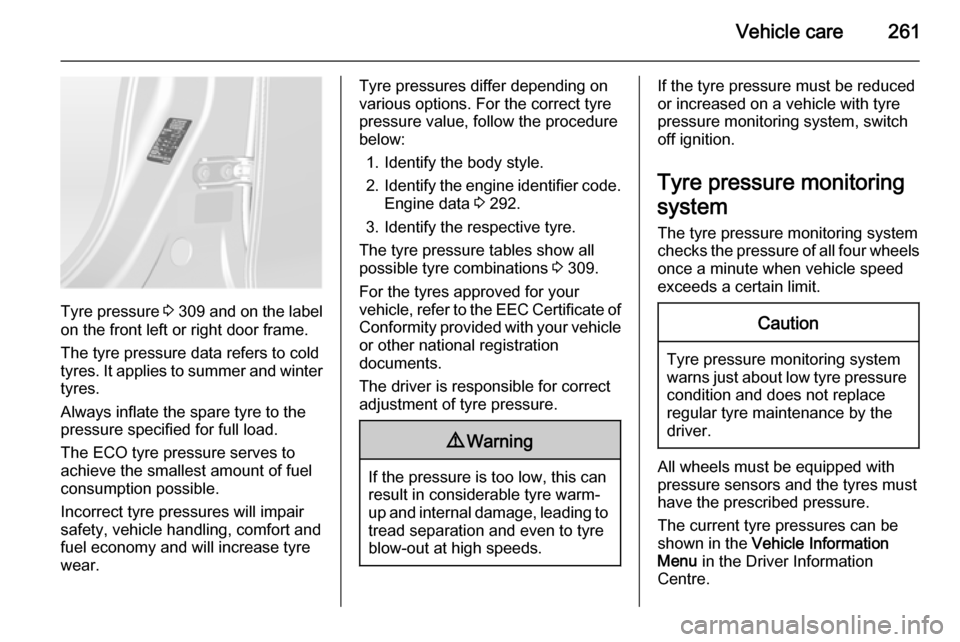
Tyre pressure 3 309 and on the label
on the front left or right door frame.
The tyre pressure data refers to cold
tyres. It applies to summer and winter tyres.
Always inflate the spare tyre to the
pressure specified for full load.
The ECO tyre pressure serves to
achieve the smallest amount of fuel
consumption possible.
Incorrect tyre pressures will impair
safety, vehicle handling, comfort and
fuel economy and will increase tyre
wear.
Tyre pressures differ depending on
various options. For the correct tyre
pressure value, follow the procedure
below:
1. Identify the body style.
2. Identify the engine identifier code.
Engine data 3 292.
3. Identify the respective tyre.
The tyre pressure tables show all
possible tyre combinations 3 309.
For the tyres approved for your
vehicle, refer to the EEC Certificate of Conformity provided with your vehicle
or other national registration
documents.
The driver is responsible for correct
adjustment of tyre pressure.9 Warning
If the pressure is too low, this can
result in considerable tyre warm-
up and internal damage, leading to tread separation and even to tyre
blow-out at high speeds.
If the tyre pressure must be reduced
or increased on a vehicle with tyre
pressure monitoring system, switch
off ignition.
Tyre pressure monitoring system The tyre pressure monitoring system
checks the pressure of all four wheels
once a minute when vehicle speed
exceeds a certain limit.Caution
Tyre pressure monitoring system
warns just about low tyre pressure
condition and does not replace
regular tyre maintenance by the
driver.
All wheels must be equipped with
pressure sensors and the tyres must
have the prescribed pressure.
The current tyre pressures can be
shown in the Vehicle Information
Menu in the Driver Information
Centre.
Page 283 of 331

Vehicle care281
On vehicles with emblem touchpad:
when cleaning with a high-pressure
jet cleaner ensure a minimum
distance of 30 cm when working
around the tailgate to prevent
unintended unlocking.
Thoroughly rinse and leather-off the
vehicle. Rinse leather frequently. Use
separate leathers for painted and
glass surfaces: remnants of wax on
the windows will impair vision.
Do not use hard objects to remove
spots of tar. Use tar removal spray on
painted surfaces.
Exterior lights Headlight and other light covers are
made of plastic. Do not use any
abrasive or caustic agents, do not use
an ice scraper, and do not clean them dry.
Polishing and waxing
Wax the vehicle regularly (at the
latest when water no longer beads).
Otherwise, the paintwork will dry out.Polishing is necessary only if the paint
has become dull or if solid deposits
have become attached to it.
Paintwork polish with silicone forms a
protective film, making waxing
unnecessary.
Plastic body parts must not be treated with wax or polishing agents.
Windows and windscreen wiper blades
Use a soft lint-free cloth or chamois
leather together with window cleaner and insect remover.
When cleaning the rear window from
inside, always wipe in parallel to the
heating element to prevent damage.
For mechanical removal of ice, use a
sharp-edged ice scraper. Press the
scraper firmly against the glass so
that no dirt can get under it and
scratch the glass.
Clean smearing wiper blades with a
soft cloth and window cleaner.Sunroof
Never clean with solvents or abrasive
agents, fuels, aggressive media
(e.g. paint cleaner, acetone-
containing solutions etc.), acidic or
highly alkaline media or abrasive
pads. Do not apply wax or polishing
agents to the sunroof.
Glass panel
Never clean with solvents or abrasive
agents, fuels, aggressive media
(e.g. paint cleaner, acetone-
containing solutions etc.), acidic or
highly alkaline media or abrasive
pads. Do not apply wax or polishing
agents to the glass panel.
Wheels and tyres Do not use high-pressure jet
cleaners.
Clean rims with a pH-neutral wheel
cleaner.
Rims are painted and can be treated
with the same agents as the body.
Page 287 of 331

Service and maintenance285
Make sure that the Service and
Warranty Booklet is completed
correctly as continuous proof of
service is essential if any warranty or goodwill claims are to be met, and is
also a benefit when selling the
vehicle.
Service interval with remaining
engine oil life duration The service interval is based on
several parameters depending on
usage.
The service display lets you know
when to change the engine oil.
Service display 3 112.Recommended fluids,
lubricants and parts
Recommended fluids andlubricants Only use products that meet the
recommended specifications.
Damage resulting from the use of
products not in line with these
specifications will not be covered by
the warranty.9 Warning
Operating materials are
hazardous and could be
poisonous. Handle with care. Pay
attention to information given on
the containers.
Engine oil
Engine oil is identified by its quality
and its viscosity. Quality is more
important than viscosity when
selecting which engine oil to use. The oil quality ensures e.g. engine
cleanliness, wear protection and oil
aging control, whereas viscosity
grade gives information on the oil's
thickness over a temperature range.
Dexos is the newest engine oil quality
that provides optimum protection for
gasoline and diesel engines. If it is unavailable, engine oils of other listed qualities have to be used.
Recommendations for gasoline
engines are also valid for
Compressed Natural Gas (CNG),
Liquified Petroleum Gas (LPG) and
Ethanol (E85) fuelled engines.
Select the appropriate engine oil
based on its quality and on the
minimum ambient temperature
3 289.
Topping up engine oil
Engine oils of different manufacturers
and brands can be mixed as long as
they comply with the required engine
oil quality and viscosity.
Use of engine oil with only
ACEA A1/B1 or only A5/B5 quality is
prohibited, since it can cause long-
term engine damage under certain
operating conditions.
Page 294 of 331
![OPEL ASTRA J 2014 Manual user 292Technical dataEngine dataSales designation1.41.41.41.41.61.61.6Engine identifier codeA14XELA14XERA14NELA14NET LPGA16XERA16LETA16XHTNumber of cylinders4444444Piston displacement [cm3
]13981398136413](/img/37/18768/w960_18768-293.png "OPEL ASTRA J 2014 Manual user 292Technical dataEngine dataSales designation1.41.41.41.41.61.61.6Engine identifier codeA14XELA14XERA14NELA14NET LPGA16XERA16LETA16XHTNumber of cylinders4444444Piston displacement [cm3
]13981398136413")
292Technical dataEngine dataSales designation1.41.41.41.41.61.61.6Engine identifier codeA14XELA14XERA14NELA14NET LPGA16XERA16LETA16XHTNumber of cylinders4444444Piston displacement [cm3
]1398139813641364159815981598Engine power [kW]64748810385132125at rpm600060004200-60004900-6000600055006000Torque [Nm]130130200200155230260at rpm400040001850-42001850-4900400022001650-3200Fuel typePetrolPetrolPetrolPetrol/LPGPetrolPetrolPetrolOctane rating RONrecommended95959595959598possible98989898989895possible91919191919191Gas–––LPG–––Oil consumption [l/1000 km]0.60.60.60.60.60.60.6
Page 295 of 331
![OPEL ASTRA J 2014 Manual user Technical data293
Sales designation1.82.0 OPC1.31.71.71.7Engine identifier codeA18XERA20NFTA13DTEA17DTEA17DTCA17DTFNumber of cylinders444444Piston displacement [cm3
]179619981248168616861686Engine pow](/img/37/18768/w960_18768-294.png "OPEL ASTRA J 2014 Manual user Technical data293
Sales designation1.82.0 OPC1.31.71.71.7Engine identifier codeA18XERA20NFTA13DTEA17DTEA17DTCA17DTFNumber of cylinders444444Piston displacement [cm3
]179619981248168616861686Engine pow")
Technical data293
Sales designation1.82.0 OPC1.31.71.71.7Engine identifier codeA18XERA20NFTA13DTEA17DTEA17DTCA17DTFNumber of cylinders444444Piston displacement [cm3
]179619981248168616861686Engine power [kW]10320670818196at rpm630053004000400040004000Torque [Nm]175400190280280300at rpm38002400-48001750-32501750-25001750-25002000-2500Fuel typePetrolPetrolDieselDieselDieselDieselOctane rating RONrecommended9598possible9895possible9191Oil consumption [l/1000 km]0.60.60.60.60.60.6
Page 296 of 331
![OPEL ASTRA J 2014 Manual user 294Technical data
Sales designation1.72.0 Turbo2.0 TurboEngine identifier codeA17DTSA20DTHA20DTRNumber of cylinders444Piston displacement [cm3
]168619561956Engine power [kW]96121143at rpm400040004000T](/img/37/18768/w960_18768-295.png "OPEL ASTRA J 2014 Manual user 294Technical data
Sales designation1.72.0 Turbo2.0 TurboEngine identifier codeA17DTSA20DTHA20DTRNumber of cylinders444Piston displacement [cm3
]168619561956Engine power [kW]96121143at rpm400040004000T")
294Technical data
Sales designation1.72.0 Turbo2.0 TurboEngine identifier codeA17DTSA20DTHA20DTRNumber of cylinders444Piston displacement [cm3
]168619561956Engine power [kW]96121143at rpm400040004000Torque [Nm]300350400at rpm2000-25001750-25001750-2500Fuel typeDieselDieselDieselOil consumption [l/1000 km]0.60.60.6
Page 310 of 331
![OPEL ASTRA J 2014 Manual user 308Technical dataCapacitiesEngine oilEngineA14XEL,
A14XERA14NEL,
A14NETA16LET,
A16XERA16XHTA18XERA20NFTincluding Filter [l]4.04.04.55.54.56.0between MIN and MAX [l]1.01.01.01.01.01.0EngineA13DTE
ecoFl](/img/37/18768/w960_18768-309.png "OPEL ASTRA J 2014 Manual user 308Technical dataCapacitiesEngine oilEngineA14XEL,
A14XERA14NEL,
A14NETA16LET,
A16XERA16XHTA18XERA20NFTincluding Filter [l]4.04.04.55.54.56.0between MIN and MAX [l]1.01.01.01.01.01.0EngineA13DTE
ecoFl")
308Technical dataCapacitiesEngine oilEngineA14XEL,
A14XERA14NEL,
A14NETA16LET,
A16XERA16XHTA18XERA20NFTincluding Filter [l]4.04.04.55.54.56.0between MIN and MAX [l]1.01.01.01.01.01.0EngineA13DTE
ecoFlexA17DTE,
A17DTCA17DTF,
A17DTSA20DTH,
A20DTRincluding Filter [l]3.55.45.44.5between MIN and MAX [l]1.01.01.01.0
Fuel tank
Petrol/diesel, refilling quantity [l]56 6)LPG, refilling quantity [l]387)6)
A13 DTE diesel engine with stop-start system reduced refilling quantity: 46 litres.
7) Sports tourer: 36.
Page 327 of 331

325
Child restraints.............................. 56
Child restraint systems ................56
Cigarette lighter .........................109
Climate control ............................. 19
Climate control systems .............155
Clock........................................... 107
Code ........................................... 128
Control indicators........................ 113
Control of the vehicle .................164
Controls ...................................... 102
Convex shape .............................. 33
Coolant and antifreeze ...............285
Cruise control ....................121, 183
Cupholders .................................. 62
Curtain airbag system .................. 54
Curve lighting.............................. 145
D Danger, Warnings and Cautions ...4
Daytime running lights ...............145
Declaration of conformity ............321
Diesel fuel system bleeding .......231
Diesel particle filter .............119, 170
Door open .................................. 121
Doors ............................................ 28
Driver assistance systems ..........183
Driver Information Centre ...........121
Driving characteristics and towing tips .............................. 220
Driving hints ................................ 164E
Electric adjustment ......................33
Electrical system......................... 252
Electric parking brake .................117
Electric parking brake fault .........117
Electronic climate control system 158
Electronic driving programmes ..173
Electronic Stability Control.......... 179
Electronic Stability Control and Traction Control system ..........118
Electronic Stability Control off..... 118
End-of-life vehicle recovery .......225
Engine compartment fuse box ...253
Engine coolant ........................... 227
Engine coolant temperature gauge ..................................... 111
Engine data ............................... 292
Engine exhaust .......................... 170
Engine identification ...................288
Engine oil ................... 226, 285, 289
Engine oil pressure ....................119
Entry lighting .............................. 152
Event data recorders ..................321
Exit lighting ................................ 153
Exterior care .............................. 280
Exterior light ............................... 120
Exterior lighting ....................16, 142
Exterior mirrors ............................. 33F
Fault ........................................... 173
First aid ......................................... 97
First aid kit ................................... 97
Fixed air vents ........................... 163
Flex-Fix system ............................ 66
Fog light ..................................... 120
Fog lights ................................... 237
Folding mirrors ............................. 33
Following distance indication ......196
Forward collision alert................. 193
Front airbag system .....................53
Front fog lights ........................... 149
Front seats.................................... 42
Front storage ................................ 63
Front turn signal lights ...............239
Fuel............................................. 213
Fuel consumption - CO 2-
Emissions ............................... 219
Fuel for diesel engines ..............213
Fuel for liquid gas operation .......213
Fuel for petrol engines ...............213
Fuel gauge ................................. 111 Fuel selector .............................. 111
Fuses ......................................... 252
G
Gauges ....................................... 110
General information ...................219
Page 328 of 331

326
Glass panel .................................. 39
Glovebox ..................................... 62
Graphic-Info-Display, Colour- Info-Display ............................ 126
H Halogen headlights ....................232
Hand brake ......................... 175, 176
Hazard warning flashers ............149
Headlight flash ........................... 144
Headlight range adjustment ......144
Headlights................................... 142
Headlights when driving abroad 145
Head restraint adjustment .............9
Head restraints ............................ 40
Heated mirrors ............................. 34
Heated rear window ..................... 37
Heated steering wheel ...............103
Heating ........................................ 49
Heating and ventilation system . 155
Height adjustable rear floor cover 90
High beam ......................... 120, 143
High beam assist ................120, 143
Hill start assist ........................... 178
Horn ..................................... 17, 103
I
Identification plate .....................287
Ignition switch positions .............165
Immobiliser .......................... 32, 120Indicators.................................... 110
Information displays.................... 121
Instrument cluster ......................110
Instrument panel fuse box .........255
Instrument panel illumination .....251
Instrument panel illumination control .................................... 151
Instrument panel overview ........... 12
Interactive driving system ...........181
Interior care ............................... 282
Interior lighting ............................ 151
Interior lights ...................... 151, 251
Interior mirrors .............................. 34
Interruption of power supply ......174
Introduction .................................... 3
ISOFIX child restraint systems ....61
J
Jump starting ............................. 276
K Key, memorised settings ..............25
Keys ............................................. 23
Keys, locks ................................... 23
L
Lane departure warning .....118, 211
Lashing eyes ............................... 93
Lighting features .........................152
Light switch ................................ 142Load compartment ................28, 84
Load compartment cover .............88
Load compartment fuse box ......256
Loading information ...................100
Low fuel ..................................... 120
Low washer fluid ........................121
M
Malfunction indicator light ..........116
Manual anti-dazzle ......................34
Manual mode ............................. 173
Manual transmission .................. 175
Manual windows ..........................35
Memorised settings ......................25
Mirror adjustment ......................... 10
Misted light covers .....................150
N New vehicle running-in ..............165
Number plate light .....................251
O
Object detection systems ...........198
Odometer ................................... 110
Oil, engine .......................... 285, 289
Outside temperature ..................106
Overrun cut-off ........................... 166