parking brake OPEL ASTRA J 2015 Manual user
[x] Cancel search | Manufacturer: OPEL, Model Year: 2015, Model line: ASTRA J, Model: OPEL ASTRA J 2015Pages: 343, PDF Size: 10.27 MB
Page 175 of 343

Driving and operating173To reduce the operating forces of
the parking brake, depress the
foot brake at the same time.
Control indicator R 3 114.
Electric parking brake
Applying when vehicle is stationary
9 Warning
Pull switch m for approx.
one second, the electric parking
brake operates automatically with
adequate force. For maximum
force, e.g. parking with trailer or on
inclines, pull switch m twice.
The electric parking brake is
applied when control indicator m
illuminates 3 115.
The electric parking brake can always
be activated, even if the ignition is off.
Do not operate electric parking brake
system too often without engine
running, as this will discharge the
vehicle battery.
Before leaving the vehicle, check the electric parking brake status. Control
indicator m 3 115.
Releasing
Switch on ignition. Keep brake pedal
depressed and then push switch m.
Drive away function
Depressing clutch pedal (manual
transmission) or engaging drive gear
(automatic transmission) and then
depressing the accelerator pedal
releases the electric parking brake
automatically. This is not possible
when the switch is pulled at the same
time.
This function also helps driving away
on inclines.
Aggressive drive away may reduce
life time of wear parts.
Dynamic braking when vehicle is
moving
When the vehicle is moving and the
switch m is kept pulled, the electric
parking brake system will decelerate the vehicle, but will not apply
statically.
As soon as the switch m is released,
dynamic braking will be stopped.
Fault
Failure mode of electric parking brake
is indicated by control indicator j and
by a code number or a vehicle
message which is displayed in the
Driver Information Centre. Vehicle
messages 3 126.
Page 176 of 343

174Driving and operating
Apply electric parking brake: pull and
hold the switch m for more than
5 seconds. If control indicator m
illuminates, electric parking brake is
applied.
Release electric parking brake: push
and hold the switch m for more than
2 seconds. If control indicator m
extinguishes, electric parking brake is
released.
Control indicator m flashes: electric
parking brake is not fully applied or
released. When continuously
flashing, release electric parking
brake and retry applying.
Brake assist
If the brake pedal is depressed
quickly and forcefully, maximum
brake force is automatically applied
(full braking).
Maintain steady pressure on the
brake pedal for as long as full braking
is required. Maximum brake force is
automatically reduced when the
brake pedal is released.Hill start assist
The system helps prevent unintendedmovement when driving away on
inclines.
When releasing the foot brake after
stopping on an incline, the brakes
remain on for a further two seconds.
The brakes release automatically as
soon as the vehicle begins to
accelerate.
The hill start assist is not active during
an Autostop.Ride control systems
Traction Control system
The Traction Control system (TC) is a
component of the Electronic Stability
Control (ESC) 3 175.
TC improves driving stability when
necessary, regardless of the type of
road surface or tyre grip, by
preventing the drive wheels from
spinning.
As soon as the drive wheels starts to spin, engine output is reduced and
the wheel spinning the most is braked
individually. This considerably
improves the driving stability of the
vehicle on slippery road surfaces.
TC is operational after each engine
start as soon as the control indicator
b extinguishes.
When TC operates b flashes.
Page 224 of 343

222Vehicle careVehicle careGeneral Information...................222
Vehicle checks ........................... 223
Bulb replacement .......................230
Electrical system ........................250
Vehicle tools .............................. 256
Wheels and tyres .......................258
Jump starting ............................. 276
Towing ....................................... 278
Appearance care .......................280General Information
Accessories and vehicle
modifications
We recommend the use of genuine parts and accessories and factory
approved parts specific for your
vehicle type. We cannot assess or
guarantee reliability of other products
- even if they have a regulatory or
otherwise granted approval.
Do not make any modifications to the electrical system, e.g. changes of
electronic control units (chip tuning).Caution
When transporting the vehicle on
a train or on a recovery vehicle, the
mud flaps might be damaged.
Vehicle storage
Storage for a long period of time
If the vehicle is to be stored for several months:
■ Wash and wax the vehicle.
■ Have the wax in the engine compartment and underbody
checked.
■ Clean and preserve the rubber seals.
■ Fill up fuel tank completely.
■ Change the engine oil.
■ Drain the washer fluid reservoir.
■ Check the coolant antifreeze and corrosion protection.
■ Adjust tyre pressure to the value specified for full load.
■ Park the vehicle in a dry, well ventilated place. Engage first orreverse gear or set selector lever to P . Prevent the vehicle from rolling.
■ Do not apply the parking brake.
Page 254 of 343

252Vehicle care
No.Circuit15Engine control module16Starter17Transmission control module18Heated rear window19Front power windows20Rear power windows21Rear electrical centre22Left high beam (Halogen)23Headlamp washer system24Right low beam (Xenon)25Left low beam (Xenon)26Front fog lights27Diesel fuel heating28Start stop system29Electric parking brake30ABS31Adaptive cruise controlNo.Circuit32Airbag33Adaptive forward lighting, auto‐
matic light control34Exhaust gas recirculation35Exterior mirror, rain sensor36Climate control37Canister vent solenoid38Vacuum pump39Central control module40Windscreen washer, rear
window washer system41Right high beam (Halogen)42Radiator fan43Windscreen wiper44Windscreen wiper45Radiator fan46–No.Circuit47Horn48Radiator fan49Fuel pump50Headlamp levelling, adaptive
forward lighting51Air shutter52Auxiliary heater, diesel engine53Transmission control module,
engine control module54Vacuum pump, instrument
panel cluster, heating ventila‐
tion, air conditioning system
After having changed defective fuses,
close the fuse box cover and press
until it engages.
If the fuse box cover is not closed
correctly, malfunction may occur.
Page 264 of 343

262Vehicle care
matching process should also be
performed after replacing a spare tyre with a road tyre containing the TPMS
sensor.
The malfunction light and the warning
message or code should go off at the
next ignition cycle. The sensors are
matched to the tyre/wheel positions,
using a TPMS relearn tool, in the
following order: left side front tyre,
right side front tyre, right side rear tyre and left side rear tyre. The turn signal
light at the current active position is
illuminated until sensor is matched.
Consult your workshop for service or
to purchase a relearn tool. There are
two minutes to match the first tyre/
wheel position, and five minutes
overall to match all four tyre/wheel
positions. If it takes longer, the
matching process stops and must be
restarted.The TPMS sensor matching process
is:
1. Apply the parking brake; on vehicles with automatic
transmission set the selector lever
to P.
2. Turn the ignition on.
3. Use the MENU button on the turn
signal lever to select the Vehicle
Information Menu in the Driver
Information Centre (DIC).
4. Turn the adjuster wheel to scroll to
the tyre pressure menu.
5. Press the SET/CLR button to
begin the sensor matching
process. A message requesting
acceptance of the process should
display.
6. Press the SET/CLR button again
to confirm the selection. The horn sounds twice to signal the
receiver is in relearn mode.
7. Start with the left side front tyre.
8. Place the relearn tool against the tyre sidewall, near the valve stem.Then press the button to activate
the TPMS sensor. A horn chirpconfirms that the sensor
identification code has been
matched to this tyre and wheel
position.
9. Proceed to the right side front tyre,
and repeat the procedure in Step 8.
10. Proceed to the right side rear tyre,
and repeat the procedure in
Step 8.
11. Proceed to the left side rear tyre, and repeat the procedure in
Step 8. The horn sounds twice to
indicate the sensor identification
code has been matched to the left side rear tyre, and the TPMS
sensor matching process is no
longer active.
12. Turn off the ignition.
13. Set all four tyres to the recommended air pressure level
as indicated on the tyre pressure
label.
14. Ensure the tyre loading status is set according selected pressure
3 119.
Page 267 of 343
Vehicle care265
3-door hatchback
Tyre chains are permitted on tyres of
size 225/55 R 17. Always use fine
mesh chains that add no more than
10 mm to the tyre tread and the
inboard sides (including chain lock).
Tyre chains are also permitted on
tyres of size 245/45 R 18. Always use fine mesh chains that add no more
than 7 mm to the tyre tread and the
inboard sides (including chain lock).OPC Version
Tyre chains are permitted on tyres of
size 235/45 R 18. Always use fine
mesh chains that add no more than
10 mm to the tyre tread and the
inboard sides (including chain lock).General
The use of tyre chains is not permitted on the temporary spare wheel.
Tyre repair kit
Minor damage to the tyre tread can be
repaired with the tyre repair kit.
Do not remove foreign bodies from
the tyres.
Tyre damage exceeding 4 mm or that
is at tyre's sidewall cannot be repaired with the tyre repair kit.9 Warning
Do not drive faster than 80 km/h.
Do not use for a lengthy period.
Steering and handling may be
affected.
If you have a flat tyre:
Apply the parking brake and engage
first gear, reverse gear or P.
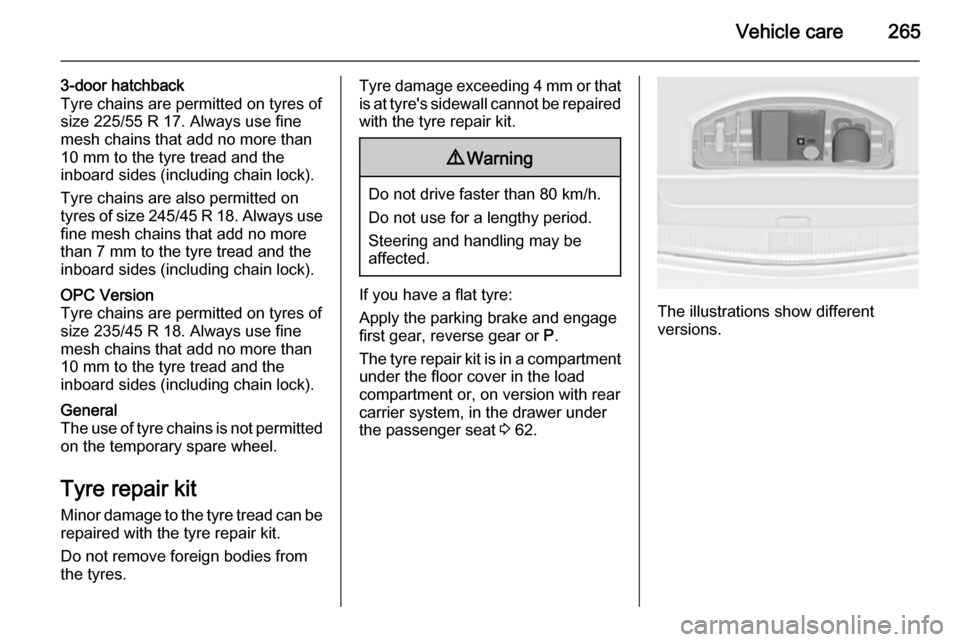
The tyre repair kit is in a compartment under the floor cover in the load
compartment or, on version with rear
carrier system, in the drawer under
the passenger seat 3 62.The illustrations show different
versions.
Page 270 of 343

268Vehicle care
If tyre pressure is more than
1.3 bar , set it to the correct value.
Repeat the procedure until there
is no more loss of pressure.
If the tyre pressure has fallen
below 1.3 bar, the vehicle must
not be used. Seek the assistance
of a workshop.
18. Stow away tyre repair kit in load compartment.
Note
The driving characteristics of the
repaired tyre are severely affected,
therefore have this tyre replaced.
If unusual noise is heard or the
compressor becomes hot, turn
compressor off for at least
30 minutes.
The built-in safety valve opens at a
pressure of 7 bar.
Note the expiry date of the kit. After
this date its sealing capability is no
longer guaranteed. Pay attention to
storage information on sealant
bottle.
Replace the used sealant bottle. Dispose of the bottle as prescribed
by applicable laws.
The compressor and sealant can be used from approx. -30 °C.
The adapters supplied can be used
to pump up other items e.g.
footballs, air mattresses, inflatable
dinghies etc. They are located on the
underside of the compressor. To
remove, screw on compressor air hose and withdraw adapter.
Wheel changing
Some vehicles are equipped with a
tyre repair kit instead of a spare wheel 3 265.Make the following preparations and
observe the following information:
■ Park the vehicle on a level, firm and
non-skid surface. The front wheels
must be in the straight-ahead
position.
■ Apply the parking brake and engage first gear, reverse gear or
P .
■ Remove the spare wheel 3 272.
■ Never change more than one wheel
at once.
■ Use the jack only to change wheels
in case of puncture, not for
seasonal winter or summer tyre
change.
■ The jack is maintenance-free.
■ If the ground on which the vehicle is standing is soft, a solid board
(max. 1 cm thick) should be placed
under the jack.
■ Take heavy objects out of the vehicle before jacking up.
■ No people or animals may be in the
vehicle when it is jacked-up.
Page 279 of 343
Vehicle care277
■Never expose the vehicle battery to
naked flames or sparks.
■ A discharged vehicle battery can already freeze at a temperature of
0 °C. Defrost the frozen vehicle
battery before connecting jump
leads.
■ Wear eye protection and protective
clothing when handling a vehicle
battery.
■ Use a booster vehicle battery with the same voltage (12 Volts). Its
capacity (Ah) must not be much less than that of the discharged
vehicle battery.
■ Use jump leads with insulated terminals and a cross section of at
least 16 mm 2
(25 mm 2
for diesel
engines).
■ Do not disconnect the discharged vehicle battery from the vehicle.
■ Switch off all unnecessary electrical
consumers.
■ Do not lean over the vehicle battery
during jump starting.■ Do not allow the terminals of one lead to touch those of the other
lead.
■ The vehicles must not come into contact with each other during the
jump starting process.
■ Apply the parking brake, transmission in neutral, automatic
transmission in P.
■ Open the positive terminal protection caps of both vehicle
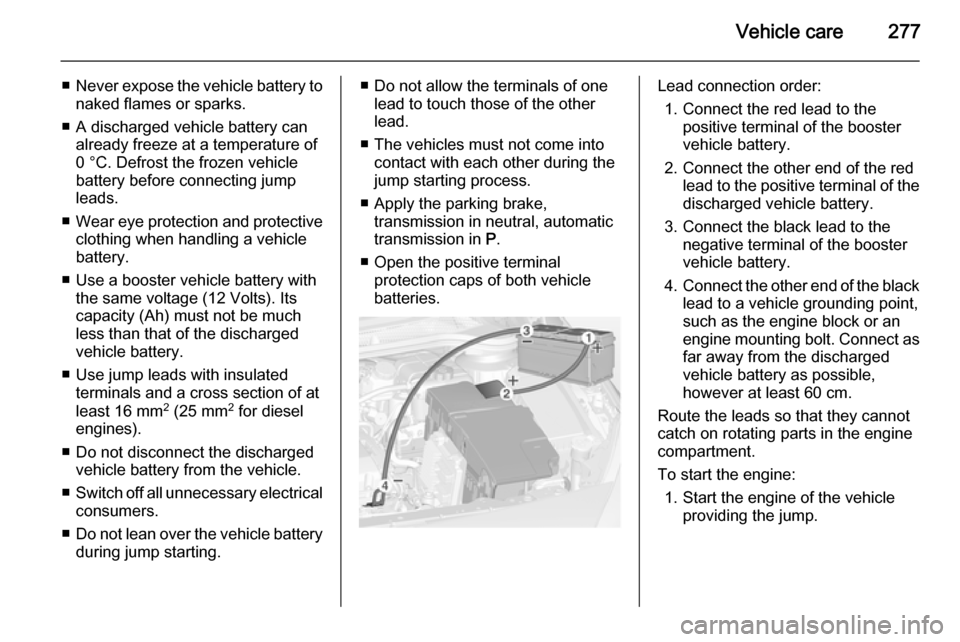
batteries.Lead connection order:
1. Connect the red lead to the positive terminal of the booster
vehicle battery.
2. Connect the other end of the red lead to the positive terminal of the
discharged vehicle battery.
3. Connect the black lead to the negative terminal of the booster
vehicle battery.
4. Connect the other end of the black
lead to a vehicle grounding point,
such as the engine block or an
engine mounting bolt. Connect as far away from the discharged
vehicle battery as possible,
however at least 60 cm.
Route the leads so that they cannot
catch on rotating parts in the engine
compartment.
To start the engine: 1. Start the engine of the vehicle providing the jump.
Page 339 of 343

337
Child restraints.............................. 54
Child restraint systems ................54
Cigarette lighter .........................107
Climate control ............................. 17
Climate control systems .............150
Clock........................................... 105
Code ........................................... 126
Control indicators........................ 111
Control of the vehicle .................160
Controls ...................................... 100
Convex shape .............................. 31
Coolant and antifreeze ...............285
Cruise control ....................119, 179
Cupholders .................................. 60
Curtain airbag system .................. 52
Curve lighting.............................. 140
D Danger, Warnings and Cautions ...3
Daytime running lights ...............140
Declaration of conformity ............331
Diesel fuel system bleeding .......229
Diesel particle filter .............117, 166
Door open .................................. 119
Doors ............................................ 26
Driver assistance systems ..........179
Driver Information Centre ...........119
Driving characteristics and towing tips .............................. 217
Driving hints ................................ 160E
Electric adjustment ......................31
Electrical system......................... 250
Electric parking brake .........115, 172
Electric parking brake fault .........115
Electronic climate control system 153
Electronic driving programmes ..169
Electronic Stability Control.......... 175
Electronic Stability Control and Traction Control system ..........116
Electronic Stability Control off..... 116
End-of-life vehicle recovery .......223
Engine compartment fuse box ...251
Engine coolant ........................... 225
Engine coolant temperature gauge ..................................... 109
Engine data ............................... 292
Engine exhaust .......................... 166
Engine identification ...................288
Engine oil ................... 224, 285, 289
Engine oil pressure ....................117
Entry lighting .............................. 147
Event data recorders ..................334
Exit lighting ................................ 148
Exterior care .............................. 280
Exterior light ............................... 118
Exterior lighting ....................14, 137
Exterior mirrors ............................. 31F
Fault ........................................... 169
First aid ......................................... 95
First aid kit ................................... 95
Fixed air vents ........................... 158
Flex-Fix system ............................ 64
Fog light ..................................... 119
Fog lights ................................... 235
Folding mirrors ............................. 31
Following distance indication ......192
Forward collision alert................. 189
Front airbag system .....................50
Front fog lights ........................... 144
Front seats.................................... 40
Front storage ................................ 61
Front turn signal lights ...............237
Fuel............................................. 210
Fuel consumption - CO 2-
Emissions ............................... 216
Fuel for diesel engines ..............210
Fuel for liquid gas operation .......211
Fuel for petrol engines ...............210
Fuel gauge ................................. 109 Fuel selector .............................. 109
Fuses ......................................... 250
G
Gauges ....................................... 108
General information ...................217
Page 341 of 343

339
PParking ................................ 19, 165
Parking assist ............................ 195
Parking brake ............................ 172
Parking lights ............................. 145
Particulate filter ........................... 166
Performance .............................. 295
Performing work ........................223
Pollen filter ................................. 159
Power outlets ............................. 106
Power seat adjustment ................44
Power steering............................ 116
Power steering fluid ....................226
Power windows ............................ 33
Preheating ................................. 117
Puncture ..................................... 268
Q
Quickheat ................................... 158
R Radio Frequency Identification (RFID) ..................................... 335
Radio remote control ...................22
Reading lights ............................ 147
Rear carrier system ......................64
Rear floor storage cover ..............88
Rear fog light ............................. 119
Rear fog lights ........................... 145
Rear seats .................................... 47Rear storage................................. 86
Rear view camera ...................... 204
Rear window wiper/washer ........ 104
Recommended fluids and lubricants ........................ 285, 289
Reduced engine power ..............118
Refuelling ................................... 213
Retained power off .....................161
Reversing lights .........................145
Ride control systems ..................174
Roof .............................................. 36
Roof load ...................................... 98
Roof rack ..................................... 97
S Safety belts ................................... 47
Safety net .................................... 93
Seat adjustment ....................... 7, 40 Seat belt ........................................ 9
Seat belt reminder .....................113
Seat belts ..................................... 47
Seat folding .................................. 43
Seat position ................................ 40
Selector lever ............................. 168
Service ............................... 159, 284
Service display .......................... 110
Service information ....................284
Service vehicle soon .................. 114
Side airbag system ......................51
Side blind spot alert ....................203Sidelights.................................... 137
Side turn signal lights ................247
Smartphone controller ................125
Spare wheel ............................... 272
Speed limiter............................... 181
Speedometer ............................. 108
Starting and operating ................161
Starting off ................................... 18
Starting the engine ....................161
Steering ...................................... 160
Steering wheel adjustment ..10, 100
Steering wheel controls .............100
Stop-start system........................ 163
Storage ......................................... 60
Storage compartments .................60
Sunroof ........................................ 36
Sunvisor lights ........................... 147
Sun visors .................................... 35
Symbols ......................................... 4
T Tachometer ............................... 108
Tail lights ................................... 240
Three-point seat belt .................... 48
Tools .......................................... 256
Top-tether fastening eyes ............59
Tow bar....................................... 217
Towing ................................ 217, 278
Towing another vehicle .............279
Towing equipment .....................218