Tyres OPEL ASTRA J 2015 User Guide
[x] Cancel search | Manufacturer: OPEL, Model Year: 2015, Model line: ASTRA J, Model: OPEL ASTRA J 2015Pages: 343, PDF Size: 10.27 MB
Page 265 of 343

Vehicle care263
Temperature dependencyTyre pressure depends on the
temperature of the tyre. During
driving, tyre temperature and
pressure increase.
The tyre pressure value displayed in
the DIC shows the actual tyre
pressure. Therefore it is important to
check tyre pressure with cold tyres.
Tread depth Check tread depth at regular
intervals.
Tyres should be replaced for safety
reasons at a tread depth of 2-3 mm
(4 mm for winter tyres).
For safety reasons it is recommended
that the tread depth of the tyres on
one axle should not vary by more than 2 mm.
The legally permissible minimum
tread depth (1.6 mm) has been
reached when the tread has worn
down as far as one of the tread wear
indicators (TWI). Their position is
indicated by markings on the
sidewall.
If there is more wear at the front than
the rear, swap round front wheels and
rear wheels periodically. Ensure that
the direction of rotation of the wheels
is the same as before.
Tyres age, even if they are not used.
We recommend tyre replacement
every 6 years.
Changing tyre and wheel
size
If tyres of a different size than those
fitted at the factory are used, it may be necessary to reprogramme the
speedometer as well as the nominal
tyre pressure and make other vehicle modifications.
After converting to a different tyre
size, have the label with tyre
pressures replaced.9 Warning
Use of unsuitable tyres or wheels
may lead to accidents and will
invalidate the vehicle type
approval.
Wheel covers
Wheel covers and tyres that are
factory approved for the respective
vehicle and comply with all of the
relevant wheel and tyre combination requirements must be used.
Page 266 of 343

264Vehicle care
If the wheel covers and tyres used are
not factory approved, the tyres must
not have a rim protection ridge.
Wheel covers must not impair brake
cooling.9 Warning
Use of unsuitable tyres or wheel
covers could lead to sudden
pressure loss and thereby
accidents.
Vehicles with steel wheels: When
using locking wheel nuts, the wheel
covers might not be attached to the
steel wheels.
Tyre chains
Use tyre chains only on front wheels.
9 Warning
Damage may lead to tyre blowout.
5-door hatchback, 4-door notchback
Always use fine mesh chains that add no more than 10 mm to the tyre tread
and the inboard sides (including chain
lock).
Tyre chains are only permitted on
tyres of size 205/60 R 16,
215/50 R 17 and 215/60 R 16.For the following restrictions apply to
the engines below:
■ Engine A16XHT and A20DTH: tyre
chains only permitted on tyres of
size 205/60 R 16.
■ Engine B16DTH and B16DTL: tyre chains only permitted on tyres of
size 215/60 R 16.Sports tourer
Always use fine mesh chains that add no more than 10 mm to the tyre tread
and the inboard sides (including chain
lock).
Tyre chains are only permitted on
tyres of size 205/60 R 16,
215/50 R 17 and 215/60 R 16.
For the following restrictions apply to
the engines below:
■ Engine A16XHT and A20DTH: tyre
chains only permitted on tyres of
size 205/60 R 16 and 215/50 R 17.
■ Engine B16DTH and B16DTL: tyre chains only permitted on tyres of
size 215/50 R 17 and 215/60 R 16.
Page 267 of 343
Vehicle care265
3-door hatchback
Tyre chains are permitted on tyres of
size 225/55 R 17. Always use fine
mesh chains that add no more than
10 mm to the tyre tread and the
inboard sides (including chain lock).
Tyre chains are also permitted on
tyres of size 245/45 R 18. Always use fine mesh chains that add no more
than 7 mm to the tyre tread and the
inboard sides (including chain lock).OPC Version
Tyre chains are permitted on tyres of
size 235/45 R 18. Always use fine
mesh chains that add no more than
10 mm to the tyre tread and the
inboard sides (including chain lock).General
The use of tyre chains is not permitted on the temporary spare wheel.
Tyre repair kit
Minor damage to the tyre tread can be
repaired with the tyre repair kit.
Do not remove foreign bodies from
the tyres.
Tyre damage exceeding 4 mm or that
is at tyre's sidewall cannot be repaired with the tyre repair kit.9 Warning
Do not drive faster than 80 km/h.
Do not use for a lengthy period.
Steering and handling may be
affected.
If you have a flat tyre:
Apply the parking brake and engage
first gear, reverse gear or P.
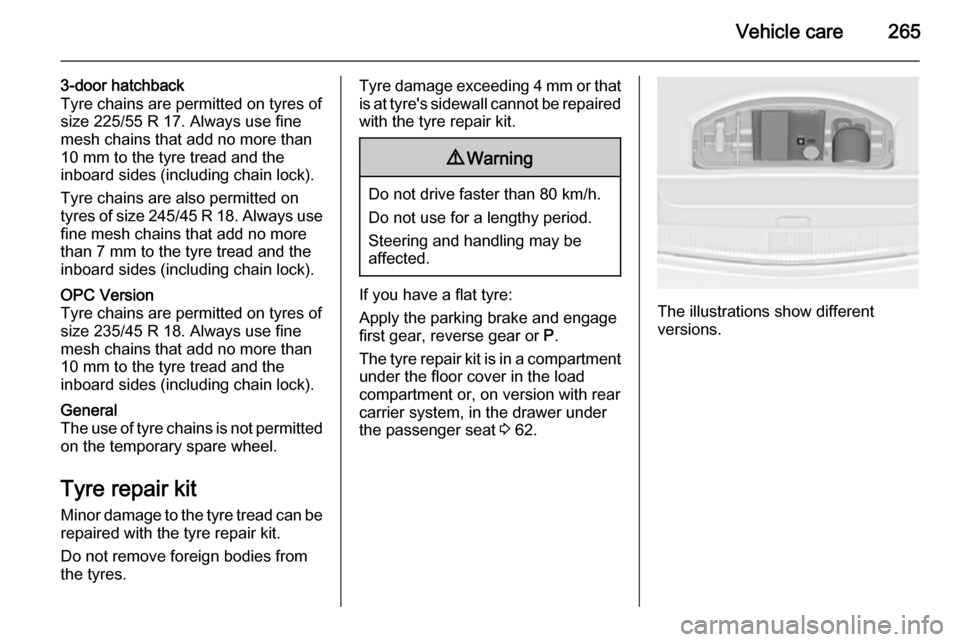
The tyre repair kit is in a compartment under the floor cover in the load
compartment or, on version with rear
carrier system, in the drawer under
the passenger seat 3 62.The illustrations show different
versions.
Page 274 of 343

272Vehicle care
Jacking position for liftingplatform
Rear arm position of the lifting
platform centrically under the recess
of the sill.
Front arm position of the lifting
platform at the underbody.
Spare wheel Some vehicles are equipped with a
tyre repair kit instead of a spare
wheel.
If mounting a spare wheel, which is
different from the other wheels, this
wheel might be classified as a
temporary spare wheel and the
corresponding speed limits apply,
even though no label indicates this.
Seek the assistance of a workshop to
check the applicable speed limit.
The spare wheel has always a steel
rim.Caution
The use of a spare wheel that is smaller than the other wheels or in combination with winter tyres
could affect driveability. Have the defective tyre replaced as soon as
possible.
The spare wheel is located in the load
compartment beneath the floor
covering. It is secured with a wing nut.
Page 278 of 343
276Vehicle carethey are not fixed properly. During
a sudden stop or a collision, loose equipment could strike someone.
Store jack and tools always in the
respective storage compartments
and secure them by fixing.
Damaged wheel placed in the load compartment must always be
secured by the strap.
Temporary spare wheel
Caution
The use of a spare wheel that is smaller than the other wheels or in combination with winter tyres
could affect driveability. Have the defective tyre replaced as soon as
possible.
Only mount one temporary spare
wheel. Do not drive faster than
80 km/h. Take curves slowly. Do not use for a long period of time.
If your vehicle gets a flat tyre on the
rear while towing another vehicle,
mount the temporary spare wheel in the front and the full tyre in the rear.
Tyre chains 3 264.
Spare wheel with directional tyre Fit directional tyres such that they rollin the direction of travel. The rolling
direction is indicated by a symbol
(e.g. an arrow) on the sidewall.
The following applies to tyres fitted
opposing the rolling direction:
■ Driveability may be affected. Have the defective tyre renewed or
repaired as soon as possible.
■ Drive particularly carefully on wet and snow-covered road surfaces.Jump starting
Do not start with quick charger.
A vehicle with a discharged vehicle
battery can be started using jump
leads and the vehicle battery of
another vehicle.9 Warning
Be extremely careful when starting
with jump leads. Any deviation
from the following instructions can
lead to injuries or damage caused
by battery explosion or damage to the electrical systems of both
vehicles.
9 Warning
Avoid contact of the battery with
eyes, skin, fabrics and painted
surfaces. The fluid contains
sulphuric acid which can cause
injuries and damage in the event
of direct contact.
Page 283 of 343

Vehicle care281
On vehicles with emblem touchpad:
when cleaning with a high-pressure
jet cleaner ensure a minimum
distance of 30 cm when working
around the tailgate to prevent
unintended unlocking.
Thoroughly rinse and leather-off the
vehicle. Rinse leather frequently. Use
separate leathers for painted and
glass surfaces: remnants of wax on
the windows will impair vision.
Do not use hard objects to remove
spots of tar. Use tar removal spray on
painted surfaces.
Exterior lights Headlight and other light covers are
made of plastic. Do not use any
abrasive or caustic agents, do not use
an ice scraper, and do not clean them dry.
Polishing and waxing
Wax the vehicle regularly (at the
latest when water no longer beads).
Otherwise, the paintwork will dry out.Polishing is necessary only if the paint
has become dull or if solid deposits
have become attached to it.
Paintwork polish with silicone forms a
protective film, making waxing
unnecessary.
Plastic body parts must not be treated with wax or polishing agents.
Windows and windscreen wiper blades
Use a soft lint-free cloth or chamois
leather together with window cleaner and insect remover.
When cleaning the rear window from
inside, always wipe in parallel to the
heating element to prevent damage.
For mechanical removal of ice, use a
sharp-edged ice scraper. Press the
scraper firmly against the glass so
that no dirt can get under it and
scratch the glass.
Remove dirt residues from smearing wiper blades by using a soft cloth and window cleaner. Also make sure to
remove any residues such as wax,
insect residues and similar from the
window.Ice residues, pollution and continuous wiping on dry windows will damage or
even destroy the wiper blades.
Sunroof Never clean with solvents or abrasive
agents, fuels, aggressive media
(e.g. paint cleaner, acetone-
containing solutions etc.), acidic or
highly alkaline media or abrasive
pads. Do not apply wax or polishing
agents to the sunroof.
Glass panel
Never clean with solvents or abrasive
agents, fuels, aggressive media
(e.g. paint cleaner, acetone-
containing solutions etc.), acidic or
highly alkaline media or abrasive
pads. Do not apply wax or polishing
agents to the glass panel.
Wheels and tyres Do not use high-pressure jet
cleaners.
Clean rims with a pH-neutral wheel
cleaner.
Rims are painted and can be treated
with the same agents as the body.
Page 311 of 343

Technical data309Tyre pressuresTyre pressures differ depending on the model variant. The order of the listed car models is as follows: ■ 3-door hatchback
■ 5-door hatchback, 4-door notchback, Sports tourer
Refer to the table header to find the correct tyre pressure for your model.3-door hatchbackComfort with up to 3 peopleECO with up to 3 peopleWith full loadEngineTyresfrontrearfrontrearfrontrear[kPa/bar]
([psi])[kPa/bar]
([psi])[kPa/bar]
([psi])[kPa/bar]
([psi])[kPa/bar]
([psi])[kPa/bar]
([psi])A14XER225/55 R17,210/2.1 (30)210/2.1 (30)250/2.5 (36)250/2.5 (36)220/2.2 (32)260/2.6 (38)235/45 R19,235/50 R18,235/55 R17,245/45 R18A18XER225/55 R17,210/2.1 (30)210/2.1 (30)250/2.5 (36)250/2.5 (36)220/2.2 (32)260/2.6 (38)235/50 R18,235/55 R17,245/45 R18
Page 312 of 343
![OPEL ASTRA J 2015 User Guide 310Technical data
3-door hatchbackComfort with up to 3 peopleECO with up to 3 peopleWith full loadEngineTyresfrontrearfrontrearfrontrear[kPa/bar]
([psi])[kPa/bar]
([psi])[kPa/bar]
([psi])[kPa/bar]
([p](/img/37/18769/w960_18769-311.png "OPEL ASTRA J 2015 User Guide 310Technical data
3-door hatchbackComfort with up to 3 peopleECO with up to 3 peopleWith full loadEngineTyresfrontrearfrontrearfrontrear[kPa/bar]
([psi])[kPa/bar]
([psi])[kPa/bar]
([psi])[kPa/bar]
([p")
310Technical data
3-door hatchbackComfort with up to 3 peopleECO with up to 3 peopleWith full loadEngineTyresfrontrearfrontrearfrontrear[kPa/bar]
([psi])[kPa/bar]
([psi])[kPa/bar]
([psi])[kPa/bar]
([psi])[kPa/bar]
([psi])[kPa/bar]
([psi])A14NEL,
A14NET225/55 R17,210/2.1 (30)210/2.1 (30)270/2.7 (39)270/2.7 (39)220/2.2 (32)270/2.7 (39)235/45 R19,235/50 R18,235/55 R17,245/40 R20,245/45 R18A17DTE225/55 R17,210/2.1 (30)210/2.1 (30)250/2.5 (36)250/2.5 (36)220/2.2 (32)260/2.6 (38)245/45 R18A17DTF225/55 R17,210/2.1 (30)210/2.1 (30)260/2.6 (38)260/2.6 (38)220/2.2 (32)260/2.6 (38)245/45 R18
Page 313 of 343
![OPEL ASTRA J 2015 User Guide Technical data311
3-door hatchbackComfort with up to 3 peopleECO with up to 3 peopleWith full loadEngineTyresfrontrearfrontrearfrontrear[kPa/bar]
([psi])[kPa/bar]
([psi])[kPa/bar]
([psi])[kPa/bar]
([p](/img/37/18769/w960_18769-312.png "OPEL ASTRA J 2015 User Guide Technical data311
3-door hatchbackComfort with up to 3 peopleECO with up to 3 peopleWith full loadEngineTyresfrontrearfrontrearfrontrear[kPa/bar]
([psi])[kPa/bar]
([psi])[kPa/bar]
([psi])[kPa/bar]
([p")
Technical data311
3-door hatchbackComfort with up to 3 peopleECO with up to 3 peopleWith full loadEngineTyresfrontrearfrontrearfrontrear[kPa/bar]
([psi])[kPa/bar]
([psi])[kPa/bar]
([psi])[kPa/bar]
([psi])[kPa/bar]
([psi])[kPa/bar]
([psi])A17DTS,
A17DTC225/55 R17,210/2.1 (30)210/2.1 (30)260/2.6 (38)260/2.6 (38)220/2.2 (32)260/2.6 (38)235/45 R19,235/50 R18,235/55 R17,245/40 R20,245/45 R18A16XHT,
A16SHT,
A20DTH,
A20DTR,
B16DTH,
B16DTL225/55 R17,230/2.3 (33)230/2.3 (33)270/2.7 (39)270/2.7 (39)240/2.4 (35)280/2.8 (41)235/45 R19,235/50 R18,235/55 R17,245/40 R20,245/45 R18A20NFT235/45 R18,240/2.4 (35)240/2.4 (35)270/2.7 (39)280/2.8 (41)260/2.6 (38)300/3.0 (43)245/40 R19
Page 314 of 343
![OPEL ASTRA J 2015 User Guide 312Technical data
3-door hatchbackComfort with up to 3 peopleECO with up to 3 peopleWith full loadEngineTyresfrontrearfrontrearfrontrear[kPa/bar]
([psi])[kPa/bar]
([psi])[kPa/bar]
([psi])[kPa/bar]
([p](/img/37/18769/w960_18769-313.png "OPEL ASTRA J 2015 User Guide 312Technical data
3-door hatchbackComfort with up to 3 peopleECO with up to 3 peopleWith full loadEngineTyresfrontrearfrontrearfrontrear[kPa/bar]
([psi])[kPa/bar]
([psi])[kPa/bar]
([psi])[kPa/bar]
([p")
312Technical data
3-door hatchbackComfort with up to 3 peopleECO with up to 3 peopleWith full loadEngineTyresfrontrearfrontrearfrontrear[kPa/bar]
([psi])[kPa/bar]
([psi])[kPa/bar]
([psi])[kPa/bar]
([psi])[kPa/bar]
([psi])[kPa/bar]
([psi])245/35 R20270/2.7 (39)250/2.5 (36)280/2.8 (41)290/2.9 (42)280/2.8 (41)310/3.1 (44)AllTemporary spare wheel420/4.2 (61)420/4.2 (61)––420/4.2 (61)420/4.2 (61)5-door hatchbackComfort with up to
3 peopleECO with up to 3 peopleWith full loadEngineTyresfrontrearfrontrearfrontrear[kPa/bar]
([psi])[kPa/bar]
([psi])[kPa/bar]
([psi])[kPa/bar]
([psi])[kPa/bar]
([psi])[kPa/bar]
([psi])A14XER,
A14XEL205/55 R16,220/2.2 (32)220/2.2 (32)270/2.7 (39)270/2.7 (39)230/2.3 (33)270/2.7 (39)205/60 R16,215/50 R17,215/60 R16,225/45 R17