seats OPEL ASTRA J 2015 Owner's Guide
[x] Cancel search | Manufacturer: OPEL, Model Year: 2015, Model line: ASTRA J, Model: OPEL ASTRA J 2015Pages: 343, PDF Size: 10.27 MB
Page 56 of 343
54Seats, restraints
Change status only when the vehicle
is stopped with the ignition off.
Status remains until the next change. Control indicator for airbag
deactivation 3 113.Child restraints
Child restraint systems
We recommend the Opel child
restraint system which is tailored
specifically to the vehicle.
When a child restraint system is being used, pay attention to the following
usage and installation instructions
and also those supplied with the child
restraint system.
Always comply with local or national
regulations. In some countries, the
use of child restraint systems is
forbidden on certain seats.9 Danger
Extreme Hazard!
Do not use a rearward facing child restraint on a seat protected by an airbag in front of it.
9 Warning
When using a child restraint
system on the front passenger
seat, the airbag systems for the
front passenger seat must be
deactivated; if not, the triggering of the airbags poses a risk of fatal
injury to the child.
This is especially the case if rear-
facing child restraint systems are
used on the front passenger seat.
Airbag deactivation 3 52.
Airbag label 3 50.
Selecting the right system The rear seats are the most
convenient location to fasten a child
restraint system.
Children should travel facing
rearwards in the vehicle as long as
possible. This makes sure that the child's backbone, which is still very
weak, is under less strain in the event
of an accident.
Page 57 of 343

Seats, restraints55
Suitable are restraint systems that
comply with valid UN ECE
regulations. Check local laws and
regulations for mandatory use of child restraint systems.
Ensure that the child restraint system to be installed is compatible with the
vehicle type.
Ensure that the mounting location of
the child restraint system within the
vehicle is correct, see following
tables.
Allow children to enter and exit the
vehicle only on the side facing away
from the traffic.
When the child restraint system is not
in use, secure the seat with a seat belt or remove it from the vehicle.
Note
Do not affix anything on the child restraint systems and do not cover
them with any other materials.
A child restraint system which has
been subjected to stress in an
accident must be replaced.
Page 58 of 343

56Seats, restraintsChild restraint installation locationsPermissible options for fitting an ISOFIX child restraint system
This table relates to all ISOFIX child restraint systems.Weight classSize classFixtureOn front passenger seatOn rear outboard
seatsOn rear centre seatGroup 0: up to 10 kg
or approx. 10 monthsEISO/R1XILXGroup 0+: up to 13 kg
or approx. 2 yearsEISO/R1XILXDISO/R2XILXCISO/R3XILXGroup I: 9 to 18 kg
or approx. 8 months to 4 yearsDISO/R2XILXCISO/R3XILXBISO/F2XIL, IUFXB1ISO/F2XXIL, IUFXAISO/F3XIL, IUFX
Page 59 of 343

Seats, restraints57Weight classSize classFixtureOn front passenger seatOn rear outboard
seatsOn rear centre seatGroup II: 15 to 25 kg
or approx. 3 to 7 yearsXILXGroup III: 22 to 36 kg
or approx. 6 to 12 yearsXILXIL=Suitable for particular ISOFIX restraint systems of the 'specific-vehicle', 'restricted' or 'semi-universal' categories. The
ISOFIX restraint system must be approved for the specific vehicle type.IUF=Suitable for ISOFIX forward-facing child restraint systems of universal category approved for use in this weight class.X=No ISOFIX child restraint system approved in this weight class.
ISOFIX size class and seat device
A – ISO/F3=Forward-facing child restraint system for children of maximum size in the weight class 9 to 18 kg.B – ISO/F2=Forward-facing child restraint system for smaller children in the weight class 9 to 18 kg.B1 – ISO/F2X=Forward-facing child restraint system for smaller children in the weight class 9 to 18 kg.C – ISO/R3=Rear-facing child restraint system for children of maximum size in the weight class up to 18 kg.D – ISO/R2=Rear-facing child restraint system for smaller children in the weight class up to 18 kg.E – ISO/R1=Rear-facing child restraint system for young children in the weight class up to 13 kg.
Page 60 of 343

58Seats, restraints
Permissible options for fitting a child restraint system
This table relates to all top-tether child restraint systems.Weight and age classOn front passenger seatOn rear outboard seatsOn rear centre seatGroup 0: up to 10 kg
or approx. 10 monthsXUUGroup 0+: up to 13 kg
or approx. 2 yearsXUUGroup I: 9 to 18 kg
or approx. 8 months to 4 yearsXUUGroup II: 15 to 25 kg
or approx. 3 to 7 yearsXUUGroup III: 22 to 36 kg
or approx. 6 to 12 yearsXUUU=Universal suitability in conjunction with three-point seat belt.X=No child restraint system permitted in this weight class.
Page 61 of 343
Seats, restraints59ISOFIX child restraint
systems
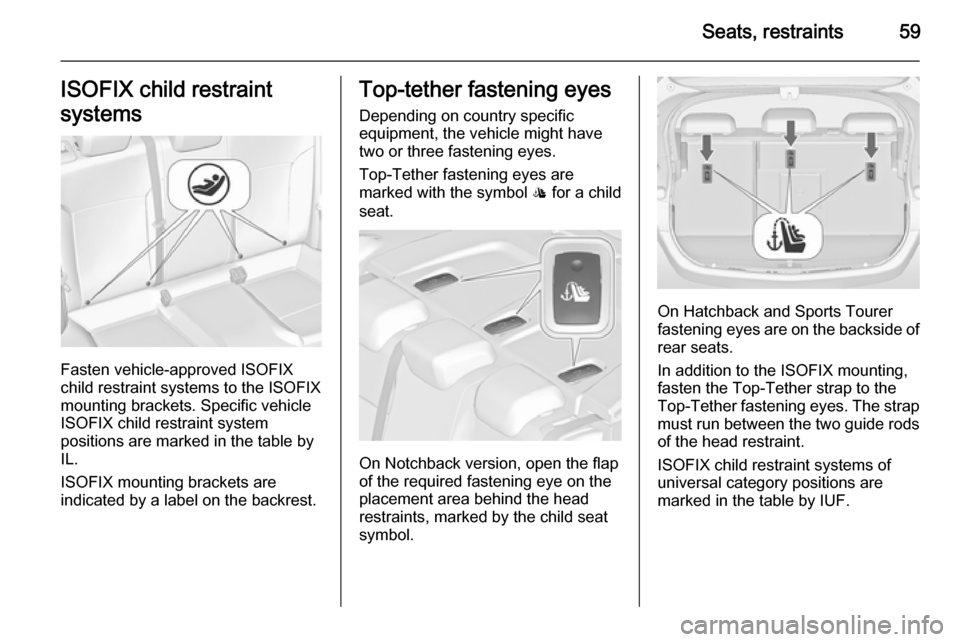
Fasten vehicle-approved ISOFIX
child restraint systems to the ISOFIX
mounting brackets. Specific vehicle
ISOFIX child restraint system
positions are marked in the table by
IL.
ISOFIX mounting brackets are
indicated by a label on the backrest.
Top-tether fastening eyes
Depending on country specific
equipment, the vehicle might have
two or three fastening eyes.
Top-Tether fastening eyes are
marked with the symbol : for a child
seat.
On Notchback version, open the flap
of the required fastening eye on the
placement area behind the head
restraints, marked by the child seat
symbol.
On Hatchback and Sports Tourer
fastening eyes are on the backside of
rear seats.
In addition to the ISOFIX mounting,
fasten the Top-Tether strap to the
Top-Tether fastening eyes. The strap
must run between the two guide rods of the head restraint.
ISOFIX child restraint systems of
universal category positions are
marked in the table by IUF.
Page 84 of 343
82StorageLoad compartmentThe rear seat backrest is divided into
two parts. Both parts can be folded
down.
Load compartment extension,
3-door and 5-door hatchback,
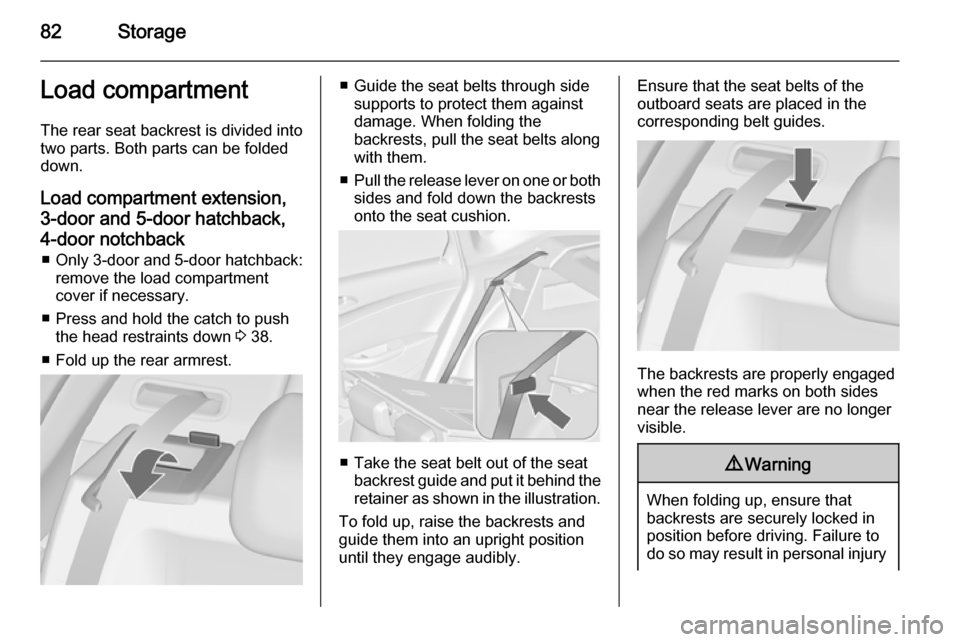
4-door notchback ■ Only 3-door and 5-door hatchback: remove the load compartment
cover if necessary.
■ Press and hold the catch to push the head restraints down 3 38.
■ Fold up the rear armrest.■ Guide the seat belts through side supports to protect them against
damage. When folding the
backrests, pull the seat belts along
with them.
■ Pull the release lever on one or both
sides and fold down the backrests
onto the seat cushion.
■ Take the seat belt out of the seat backrest guide and put it behind theretainer as shown in the illustration.
To fold up, raise the backrests and
guide them into an upright position
until they engage audibly.
Ensure that the seat belts of the
outboard seats are placed in the
corresponding belt guides.
The backrests are properly engaged
when the red marks on both sides near the release lever are no longer
visible.
9 Warning
When folding up, ensure that
backrests are securely locked in
position before driving. Failure to
do so may result in personal injury
Page 85 of 343
Storage83or damage to the load or vehicle inthe event of hard braking or a
collision.
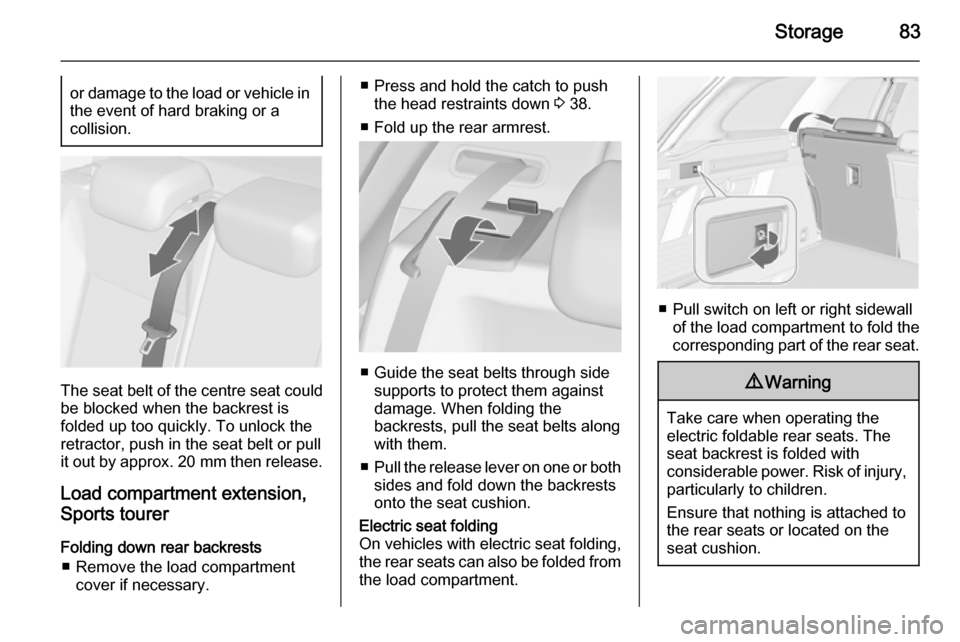
The seat belt of the centre seat could
be blocked when the backrest is
folded up too quickly. To unlock the
retractor, push in the seat belt or pull
it out by approx. 20 mm then release.
Load compartment extension,
Sports tourer
Folding down rear backrests ■ Remove the load compartment cover if necessary.
■ Press and hold the catch to pushthe head restraints down 3 38.
■ Fold up the rear armrest.
■ Guide the seat belts through side supports to protect them against
damage. When folding the
backrests, pull the seat belts along
with them.
■ Pull the release lever on one or both
sides and fold down the backrests
onto the seat cushion.
Electric seat folding
On vehicles with electric seat folding,
the rear seats can also be folded from the load compartment.
■ Pull switch on left or right sidewall of the load compartment to fold the
corresponding part of the rear seat.
9 Warning
Take care when operating the
electric foldable rear seats. The seat backrest is folded with
considerable power. Risk of injury, particularly to children.
Ensure that nothing is attached to
the rear seats or located on the
seat cushion.
Page 86 of 343
84Storage
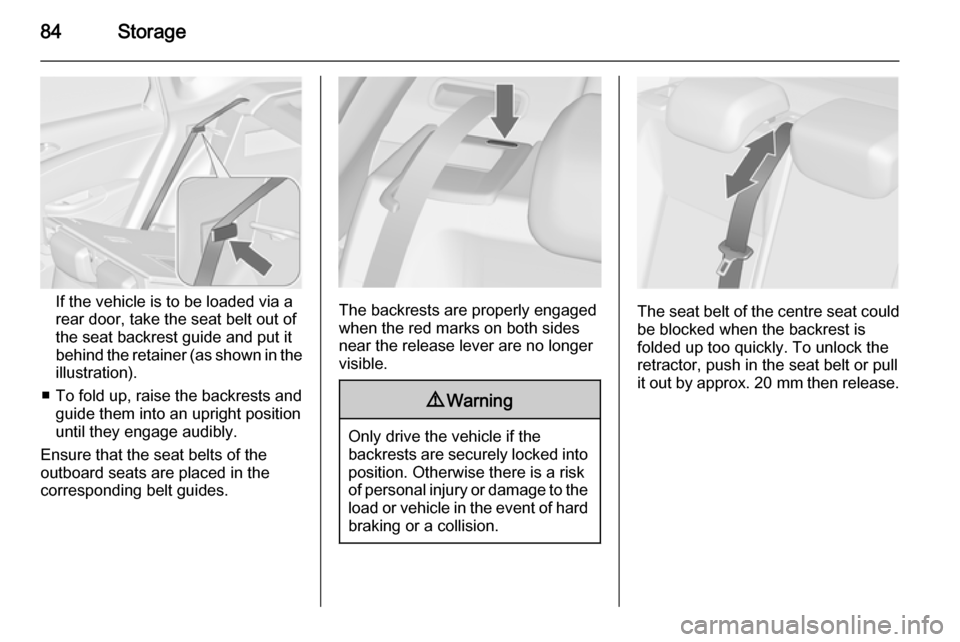
If the vehicle is to be loaded via arear door, take the seat belt out of
the seat backrest guide and put it
behind the retainer (as shown in the illustration).
■ To fold up, raise the backrests and guide them into an upright position
until they engage audibly.
Ensure that the seat belts of the
outboard seats are placed in the corresponding belt guides.The backrests are properly engaged
when the red marks on both sides
near the release lever are no longer
visible.
9 Warning
Only drive the vehicle if the
backrests are securely locked into position. Otherwise there is a risk
of personal injury or damage to the
load or vehicle in the event of hard braking or a collision.
The seat belt of the centre seat could
be blocked when the backrest is
folded up too quickly. To unlock the
retractor, push in the seat belt or pull
it out by approx. 20 mm then release.
Page 92 of 343
90Storage
Note■ If mounted in position 2 or 3, the
space between the rear floor
cover and the height adjustable
cover can be used as a stowage
compartment.
■ The height adjustable cover can be lifted and hooked in with the
strap when it is mounted in
position 1 or 2.
■ If mounted in position 2, an almost
completely flat load bay is created
if the rear seat backrests are
folded forwards.
■ Opening the side covers (e.g. when exchanging the rear light
bulbs) is only possible with the
height adjustable cover mounted
in position 1 or 2.Caution
The height adjustable cover is
able to withstand a load of no more
than 100 kg.
Rear floor cover, Sports tourer
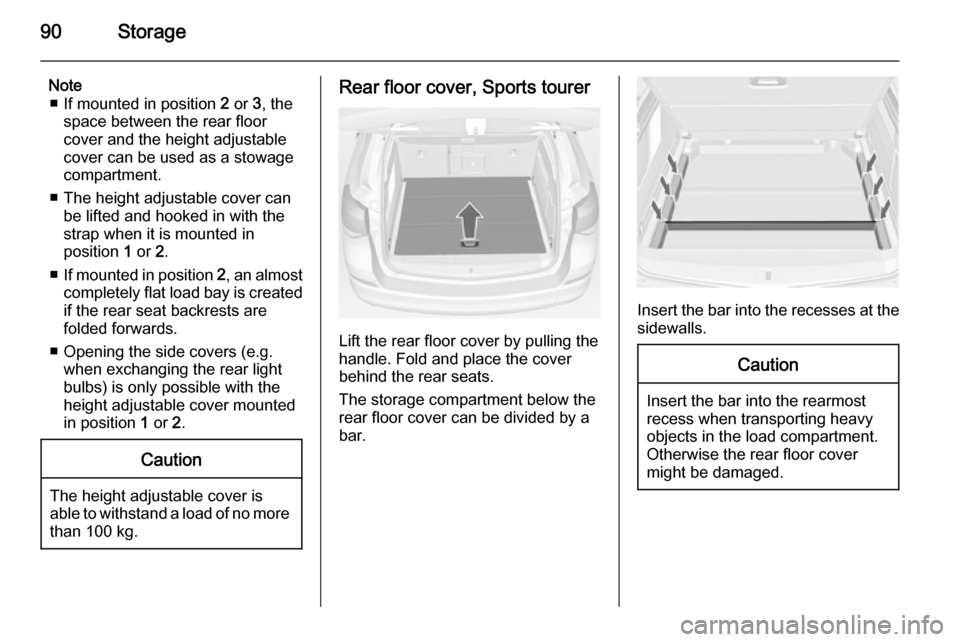
Lift the rear floor cover by pulling the
handle. Fold and place the cover
behind the rear seats.
The storage compartment below the rear floor cover can be divided by a
bar.
Insert the bar into the recesses at the
sidewalls.
Caution
Insert the bar into the rearmost
recess when transporting heavy objects in the load compartment.Otherwise the rear floor cover
might be damaged.