manual transmission OPEL ASTRA J 2018.5 Manual user
[x] Cancel search | Manufacturer: OPEL, Model Year: 2018.5, Model line: ASTRA J, Model: OPEL ASTRA J 2018.5Pages: 295, PDF Size: 8.4 MB
Page 154 of 295
152Driving and operating3. Insert a screwdriver into theopening as far as it will go and
move the selector lever out of P or
N . If P or N is engaged again, the
selector lever will be locked in
position again. Have the cause of
the power supply interruption
remedied by a workshop.
4. Mount the selector lever trim onto
the centre console and refit.Manual transmission
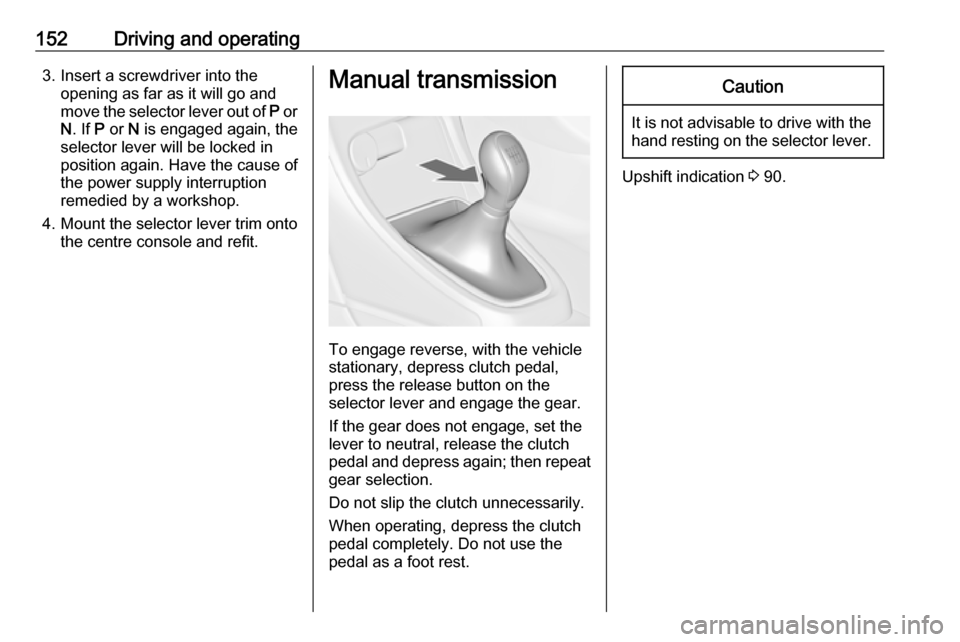
To engage reverse, with the vehicle
stationary, depress clutch pedal,
press the release button on the
selector lever and engage the gear.
If the gear does not engage, set the
lever to neutral, release the clutch
pedal and depress again; then repeat
gear selection.
Do not slip the clutch unnecessarily.
When operating, depress the clutch
pedal completely. Do not use the
pedal as a foot rest.
Caution
It is not advisable to drive with the hand resting on the selector lever.
Upshift indication 3 90.
Page 156 of 295
154Driving and operatingParking brake
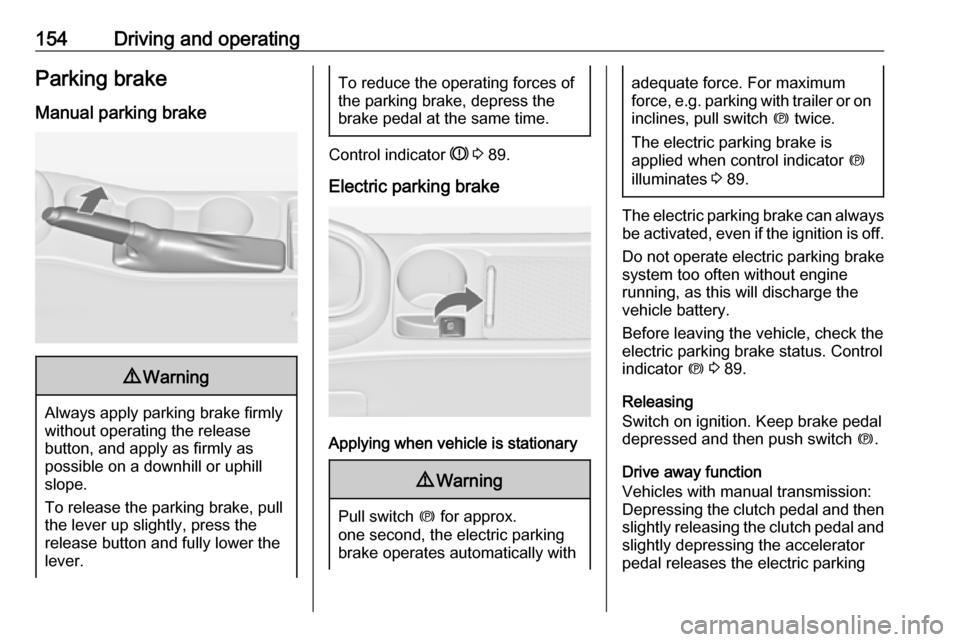
Manual parking brake9 Warning
Always apply parking brake firmly
without operating the release
button, and apply as firmly as
possible on a downhill or uphill
slope.
To release the parking brake, pull
the lever up slightly, press the
release button and fully lower the
lever.
To reduce the operating forces of
the parking brake, depress the
brake pedal at the same time.
Control indicator R 3 89.
Electric parking brake
Applying when vehicle is stationary
9 Warning
Pull switch m for approx.
one second, the electric parking
brake operates automatically with
adequate force. For maximum
force, e.g. parking with trailer or on
inclines, pull switch m twice.
The electric parking brake is
applied when control indicator m
illuminates 3 89.
The electric parking brake can always
be activated, even if the ignition is off.
Do not operate electric parking brake
system too often without engine
running, as this will discharge the
vehicle battery.
Before leaving the vehicle, check the electric parking brake status. Control
indicator m 3 89.
Releasing
Switch on ignition. Keep brake pedal
depressed and then push switch m.
Drive away function
Vehicles with manual transmission:
Depressing the clutch pedal and then
slightly releasing the clutch pedal and
slightly depressing the accelerator
pedal releases the electric parking
Page 160 of 295
158Driving and operatingAdditionally, the selected mode is
displayed as status message in the
Driver Information Centre.
On OPC version TC and ESC remain deactivated even if the vehicle comes into threshold with unstable
driveability.
ESC is reactivated by pressing b
again. If the TC system was
previously disabled, both TC and
ESC are reactivated.
ESC is also reactivated the next time
the ignition is switched on.
Interactive driving system
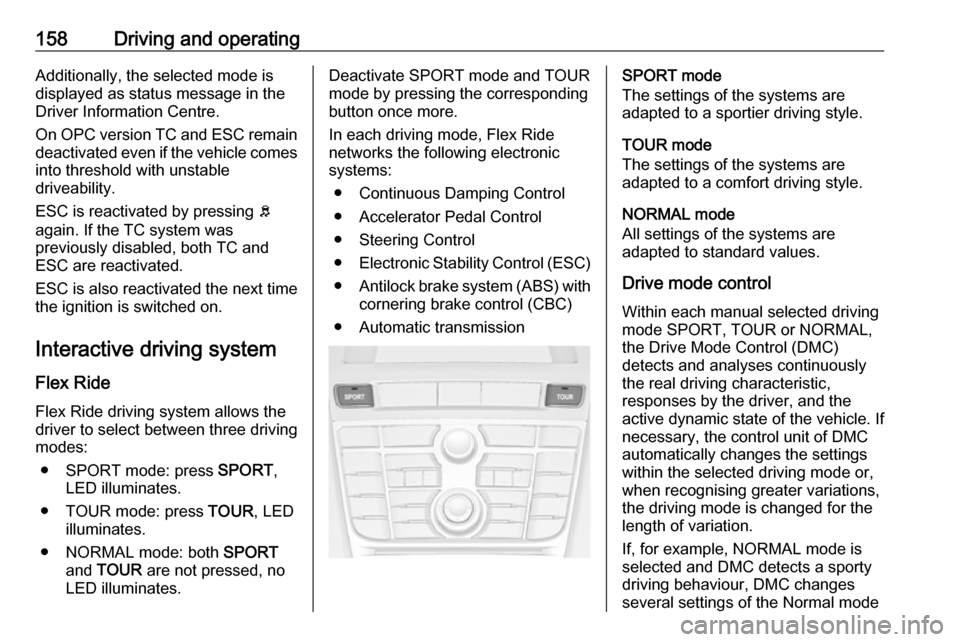
Flex Ride Flex Ride driving system allows the
driver to select between three driving
modes:
● SPORT mode: press SPORT,
LED illuminates.
● TOUR mode: press TOUR, LED
illuminates.
● NORMAL mode: both SPORT
and TOUR are not pressed, no
LED illuminates.Deactivate SPORT mode and TOUR
mode by pressing the corresponding
button once more.
In each driving mode, Flex Ride networks the following electronic
systems:
● Continuous Damping Control
● Accelerator Pedal Control
● Steering Control
● Electronic Stability Control (ESC)
● Antilock brake system (ABS) with
cornering brake control (CBC)
● Automatic transmissionSPORT mode
The settings of the systems are
adapted to a sportier driving style.
TOUR mode
The settings of the systems are
adapted to a comfort driving style.
NORMAL mode
All settings of the systems are
adapted to standard values.
Drive mode control Within each manual selected driving
mode SPORT, TOUR or NORMAL,
the Drive Mode Control (DMC)
detects and analyses continuously
the real driving characteristic,
responses by the driver, and the active dynamic state of the vehicle. If
necessary, the control unit of DMC
automatically changes the settings
within the selected driving mode or,
when recognising greater variations,
the driving mode is changed for the
length of variation.
If, for example, NORMAL mode is selected and DMC detects a sporty
driving behaviour, DMC changes
several settings of the Normal mode
Page 236 of 295
234Vehicle care
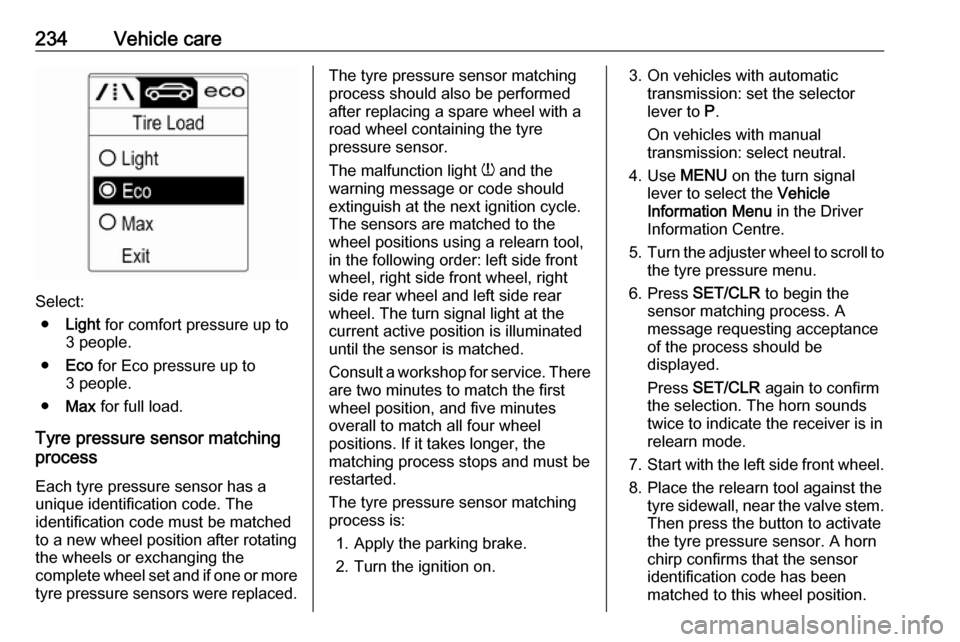
Select:● Light for comfort pressure up to
3 people.
● Eco for Eco pressure up to
3 people.
● Max for full load.
Tyre pressure sensor matching
process
Each tyre pressure sensor has a
unique identification code. The
identification code must be matched
to a new wheel position after rotating the wheels or exchanging the
complete wheel set and if one or more
tyre pressure sensors were replaced.
The tyre pressure sensor matching
process should also be performed
after replacing a spare wheel with a
road wheel containing the tyre
pressure sensor.
The malfunction light w and the
warning message or code should
extinguish at the next ignition cycle.
The sensors are matched to the
wheel positions using a relearn tool,
in the following order: left side front
wheel, right side front wheel, right
side rear wheel and left side rear
wheel. The turn signal light at the
current active position is illuminated
until the sensor is matched.
Consult a workshop for service. There
are two minutes to match the first
wheel position, and five minutes
overall to match all four wheel
positions. If it takes longer, the
matching process stops and must be
restarted.
The tyre pressure sensor matching
process is:
1. Apply the parking brake.
2. Turn the ignition on.3. On vehicles with automatic transmission: set the selector
lever to P.
On vehicles with manual
transmission: select neutral.
4. Use MENU on the turn signal
lever to select the Vehicle
Information Menu in the Driver
Information Centre.
5. Turn the adjuster wheel to scroll to
the tyre pressure menu.
6. Press SET/CLR to begin the
sensor matching process. A
message requesting acceptance
of the process should be
displayed.
Press SET/CLR again to confirm
the selection. The horn sounds
twice to indicate the receiver is in
relearn mode.
7. Start with the left side front wheel.
8. Place the relearn tool against the tyre sidewall, near the valve stem.Then press the button to activate
the tyre pressure sensor. A horn
chirp confirms that the sensor
identification code has been
matched to this wheel position.
Page 267 of 295
![OPEL ASTRA J 2018.5 Manual user Technical data265Performance
3-door hatchbackEngineB14NELB14NETB16SHTB16SHLB20NFTB16DTHB16DTLMaximum speed [km/h]Manual transmission192201230–250198182Automatic transmission–200–210–––
4-d](/img/37/18775/w960_18775-266.png "OPEL ASTRA J 2018.5 Manual user Technical data265Performance
3-door hatchbackEngineB14NELB14NETB16SHTB16SHLB20NFTB16DTHB16DTLMaximum speed [km/h]Manual transmission192201230–250198182Automatic transmission–200–210–––
4-d")
Technical data265Performance
3-door hatchbackEngineB14NELB14NETB16SHTB16SHLB20NFTB16DTHB16DTLMaximum speed [km/h]Manual transmission192201230–250198182Automatic transmission–200–210–––
4-door notchback
EngineB14XERB14NET
B14NET
LPG
B16XERB16DTHB16DTLB16SHL
Maximum speed [km/h]Manual transmission183207202193205189–Automatic transmission–205–185200–215
Page 268 of 295
![OPEL ASTRA J 2018.5 Manual user 266Technical dataVehicle weight
Kerb weight, basic model without any optional equipment3-door hatchbackEngineManual transmissionAutomatic transmissionwithout/with air conditioning
[kg]B14NEL– / 1437](/img/37/18775/w960_18775-267.png "OPEL ASTRA J 2018.5 Manual user 266Technical dataVehicle weight
Kerb weight, basic model without any optional equipment3-door hatchbackEngineManual transmissionAutomatic transmissionwithout/with air conditioning
[kg]B14NEL– / 1437")
266Technical dataVehicle weight
Kerb weight, basic model without any optional equipment3-door hatchbackEngineManual transmissionAutomatic transmissionwithout/with air conditioning
[kg]B14NEL– / 1437–B14NET– / 1437– / 1471B16SHT– / 1503–B16SHL–– / 1503B20NFT– / 1550–B16DTH1503 / 1518–B16DTL1503 / 1518–
Optional equipment and accessories increase the kerb weight.
Loading information 3 71.
Page 269 of 295
![OPEL ASTRA J 2018.5 Manual user Technical data267Kerb weight, basic model without any optional equipment4-door notchbackEngineManual transmissionAutomatic transmissionwithout/with air conditioning
[kg]B14XER1393 / 1405–B14NET1437](/img/37/18775/w960_18775-268.png "OPEL ASTRA J 2018.5 Manual user Technical data267Kerb weight, basic model without any optional equipment4-door notchbackEngineManual transmissionAutomatic transmissionwithout/with air conditioning
[kg]B14XER1393 / 1405–B14NET1437")
Technical data267Kerb weight, basic model without any optional equipment4-door notchbackEngineManual transmissionAutomatic transmissionwithout/with air conditioning
[kg]B14XER1393 / 1405–B14NET1437 / 1449– / 1483B14NET
LPG1503 / 1515–B16XER1393 / 1405– / 1449B16SHL–– / 1503B16DTH1491 / 1503– / 1550B16DTL1491 / 1503–
Optional equipment and accessories increase the kerb weight.
Loading information 3 71.
Page 292 of 295

290Headlight range adjustment ......120
Headlights................................... 117
Headlights when driving abroad 120
Head restraint adjustment .............8
Head restraints ............................ 39
Heated mirrors ............................. 32
Heated rear window ..................... 36
Heated steering wheel .................74
Heating ........................................ 47
Heating and ventilation system . 130
Height adjustable rear floor cover 68
High beam ........................... 93, 119
High beam assist ..................93, 119
Hill start assist ........................... 155
Horn ....................................... 16, 75
I
Identification plate .....................258
Ignition switch positions .............142
Immobiliser ............................ 31, 93
Indicators ...................................... 81
Info Display ................................... 98
Information displays...................... 94
Instrument cluster ........................81
Instrument panel fuse box .........226
Instrument panel illumination .....222
Instrument panel illumination control .................................... 126
Instrument panel overview ........... 11
Interactive driving system ...........158Interior care ............................... 253
Interior lighting ............................ 126
Interior lights ...................... 126, 222
Interior mirrors .............................. 33
Interruption of power supply ......151
Introduction .................................... 3
J
Jump starting ............................. 247
K Key, memorised settings ..............24
Keys ............................................. 22
Keys, locks ................................... 22
L Lane departure warning .......90, 188
Lashing eyes ............................... 69
Lighting features .........................128
Light switch ................................ 117
Load compartment ................27, 65
Load compartment cover .............67
Load compartment fuse box ......227
Loading information .....................71
Low fuel ....................................... 92
Low washer fluid ..........................93
LPG .............................. 82, 191, 260
M Malfunction indicator light ............89
Manual anti-dazzle ......................33Manual mode ............................. 150
Manual seat adjustment ...............42
Manual transmission .................. 152
Manual windows ..........................34
Memorised settings ......................24
Midlevel-Display ........................... 94
Mirror adjustment ........................... 9
Misted light covers .....................126
N New vehicle running-in ..............141
Number plate light .....................222
O
Object detection systems ...........176
Odometer ..................................... 81
Oil, engine .......................... 255, 260
OnStar ........................................ 111
Operate pedal ............................... 89
Outside temperature ....................77
Overrun cut-off ........................... 143
P Parking ................................ 20, 145
Parking assist ............................ 176
Parking brake ............................ 154
Parking lights ............................. 125
Particulate filter ........................... 146
Performance .............................. 265
Performing work ........................202
Pollen filter ................................. 138