towing OPEL ASTRA J 2018 Manual user
[x] Cancel search | Manufacturer: OPEL, Model Year: 2018, Model line: ASTRA J, Model: OPEL ASTRA J 2018Pages: 295, PDF Size: 8.41 MB
Page 201 of 295

Vehicle care199Vehicle careGeneral Information...................200
Accessories and vehicle modifications .......................... 200
Vehicle storage ........................200
End-of-life vehicle recovery .....201
Vehicle checks ........................... 201
Performing work ......................201
Bonnet ..................................... 201
Engine oil ................................. 202
Engine coolant ......................... 203
Power steering fluid .................204
Washer fluid ............................ 204
Brakes ..................................... 205
Brake fluid ............................... 205
Vehicle battery ......................... 205
Diesel fuel system bleeding .....207
Wiper blade replacement ........207
Bulb replacement .......................208
Halogen headlights ..................208
Adaptive forward lighting .........211
Fog lights ................................. 212
Front turn signal lights .............214
Tail lights ................................. 216
Side turn signal lights ..............219
Number plate light ...................221Interior lights ............................ 221
Instrument panel illumination ...221
Electrical system ........................222
Fuses ....................................... 222
Engine compartment fuse box . 223
Instrument panel fuse box .......225
Load compartment fuse box ....226
Vehicle tools .............................. 227
Tools ........................................ 227
Wheels and tyres .......................229
Winter tyres ............................. 229
Tyre designations ....................229
Tyre pressure .......................... 229
Tyre pressure monitoring system .................................... 231
Tread depth ............................. 234
Changing tyre and wheel size . 234
Wheel covers ........................... 235
Tyre chains .............................. 235
Tyre repair kit .......................... 235
Wheel changing .......................238
Spare wheel ............................ 242
Jump starting ............................. 246
Towing ....................................... 247
Towing the vehicle ...................247
Towing another vehicle ...........248Appearance care .......................249
Exterior care ............................ 249
Interior care ............................. 252
Page 229 of 295

Vehicle care227No.Circuit1–2Trailer outlet3Parking assist4–5–6–7Power seat8–9–10–11Trailer module/Trailer socket12Trailer module13Trailer outlet14Rear seat/Electrical folding15–16Interior mirror17Power outletNo.Circuit18–19Steering wheel heating20Sunroof21Heated front seats22–23–24–25–26Deactivated logistic mode27–28–29–30–31Amplifier/Subwoofer32Active damping system/Lane
departure warningVehicle tools
Tools
Vehicles without spare wheel Some tools and the towing eye are
located in a tool box in the load
compartment below the floor cover.
Page 230 of 295

228Vehicle careVehicles with spare wheelVariant 1a: 3-door hatchback with
rigid wheel wrench
The jack, the tools and a strap for
securing a damaged wheel are in the
tool box below the spare wheel in the load compartment. The wheel wrenchand the towing eye are in the tool bag
located in the spare wheel well near
the tool box. Spare wheel 3 242.
Variant 1b: 3-door hatchback with
foldable wheel wrench
Same content as variant 1a, but with
a foldable wheel wrench instead of
the rigid wheel wrench located in the
tool bag.
Variant 2: 4-door notchback
The jack and the tools are in the tool
box below the spare wheel in the load
compartment. The wheel wrench, the towing eye and an extension bolt for
securing a damaged wheel (only
vehicles with temporary spare wheel)
are in the tool bag located in the spare wheel well near the tool box. Spare
wheel 3 242.
Page 245 of 295
Vehicle care243Stowing a damaged full size
wheel in the load compartment,
3-door hatchback
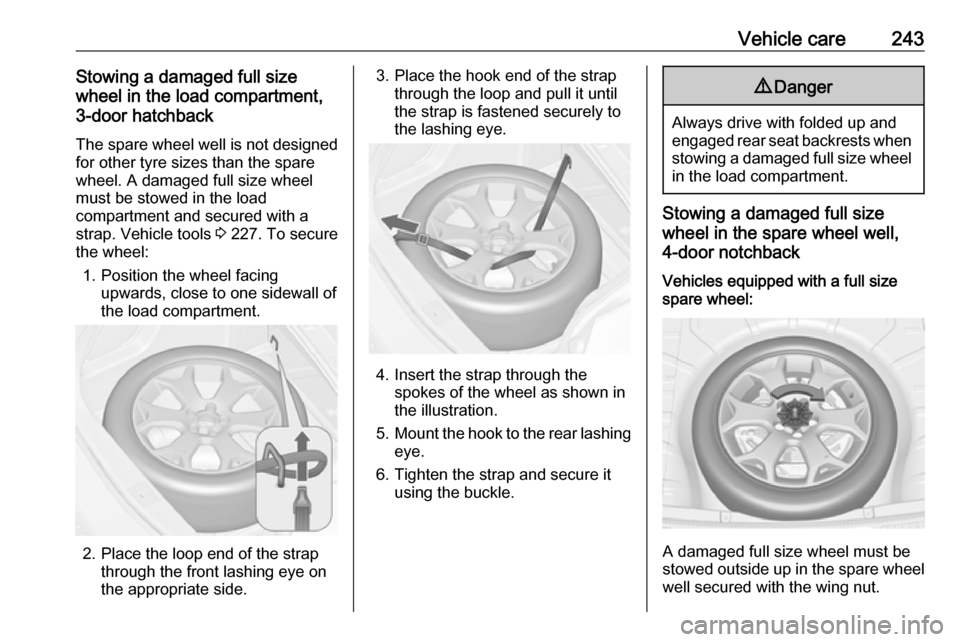
The spare wheel well is not designed
for other tyre sizes than the spare
wheel. A damaged full size wheel
must be stowed in the load
compartment and secured with a
strap. Vehicle tools 3 227. To secure
the wheel:
1. Position the wheel facing upwards, close to one sidewall of
the load compartment.
2. Place the loop end of the strap through the front lashing eye on
the appropriate side.
3. Place the hook end of the strap through the loop and pull it until
the strap is fastened securely to
the lashing eye.
4. Insert the strap through the spokes of the wheel as shown in
the illustration.
5. Mount the hook to the rear lashing
eye.
6. Tighten the strap and secure it using the buckle.
9 Danger
Always drive with folded up and
engaged rear seat backrests when stowing a damaged full size wheel
in the load compartment.
Stowing a damaged full size
wheel in the spare wheel well,
4-door notchback
Vehicles equipped with a full size
spare wheel:
A damaged full size wheel must be
stowed outside up in the spare wheel
well secured with the wing nut.
Page 246 of 295

244Vehicle careThe floor cover can be placed on the
projecting wheel.Vehicles equipped with a temporary
spare wheel:
Secure a damaged full size wheel
facing upwards with the wing nut in
the spare wheel well after exchanging the thread bolt by an extension bolt,
placed in the tool bag 3 227. To
replace the bolt:
1. Install the hexagon key of the wheel wrench ensuring that it
locates securely on the bolt.
2. Turn the wheel wrench anticlockwise to loosen the bolt.
Remove the bolt.
3. Take the extension bolt from the tool bag 3 227 and screw it in
hand-tight using the hexagon key
of the wheel wrench.
4. Store the tool box and the damaged wheel with the side
facing upwards, in the spare
wheel well and secure it by turning
the wing nut clockwise on the bolt.
The floor cover can be placed on the
projecting wheel.
Replace the extension bolt with the short bolt before placing the
temporary spare wheel in the well
after renewing or repairing the
defective wheel.
Stowing the spare wheel back in
the well after replacing the
damaged wheel
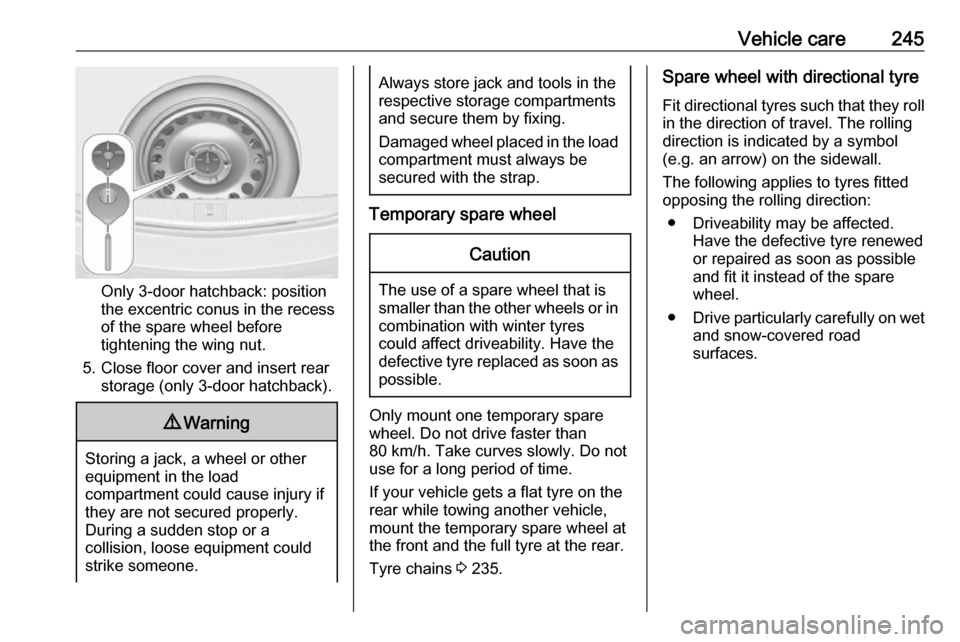
1. Open the floor cover, loosen and remove wing nut.
Only 3-door hatchback: open floor
cover, remove rear storage,
loosen and remove wing nut and
conus.
2. Only 4-door notchback with temporary spare wheel: replace
the extension bolt with the short
bolt by using the hexagon key of
the wheel wrench.
3. Place the tools in the tool box or the tool bag 3 227.
4. Place spare wheel facing upwards, in the wheel well and
secure by tightening the wing nut.
Page 247 of 295
Vehicle care245
Only 3-door hatchback: position
the excentric conus in the recess
of the spare wheel before
tightening the wing nut.
5. Close floor cover and insert rear storage (only 3-door hatchback).
9 Warning
Storing a jack, a wheel or other
equipment in the load
compartment could cause injury if they are not secured properly.
During a sudden stop or a
collision, loose equipment could strike someone.
Always store jack and tools in the
respective storage compartments
and secure them by fixing.
Damaged wheel placed in the load compartment must always be
secured with the strap.
Temporary spare wheel
Caution
The use of a spare wheel that is smaller than the other wheels or in combination with winter tyres
could affect driveability. Have the defective tyre replaced as soon as
possible.
Only mount one temporary spare
wheel. Do not drive faster than
80 km/h. Take curves slowly. Do not use for a long period of time.
If your vehicle gets a flat tyre on the
rear while towing another vehicle,
mount the temporary spare wheel at
the front and the full tyre at the rear.
Tyre chains 3 235.
Spare wheel with directional tyre
Fit directional tyres such that they roll in the direction of travel. The rolling
direction is indicated by a symbol
(e.g. an arrow) on the sidewall.
The following applies to tyres fitted
opposing the rolling direction:
● Driveability may be affected. Have the defective tyre renewed
or repaired as soon as possible
and fit it instead of the spare
wheel.
● Drive particularly carefully on wet
and snow-covered road
surfaces.
Page 249 of 295

Vehicle care2473. Connect the black lead to thenegative terminal of the booster
vehicle battery.
4. Connect the other end of the black
lead to a vehicle grounding point,
such as the engine block or an
engine mounting bolt. Connect as far away from the discharged
vehicle battery as possible,
however at least 60 cm.
Route the leads so that they cannot
catch on rotating parts in the engine
compartment.
To start the engine: 1. Start the engine of the vehicle providing the jump.
2. After five minutes, start the other engine. Start attempts should be
made for no longer than
15 seconds at an interval of one
minute.
3. Allow both engines to idle for approx. three minutes with the
leads connected.4. Switch on electrical consumers (e.g. headlights, heated rear
window) of the vehicle receiving
the jump start.
5. Reverse above sequence exactly when removing leads.Towing
Towing the vehicle
Insert a screwdriver in the slot at the
lower part of the cap. Release the cap
by carefully moving the screwdriver
downwards.
The towing eye is stowed with the
vehicle tools 3 227.
Page 250 of 295
248Vehicle care
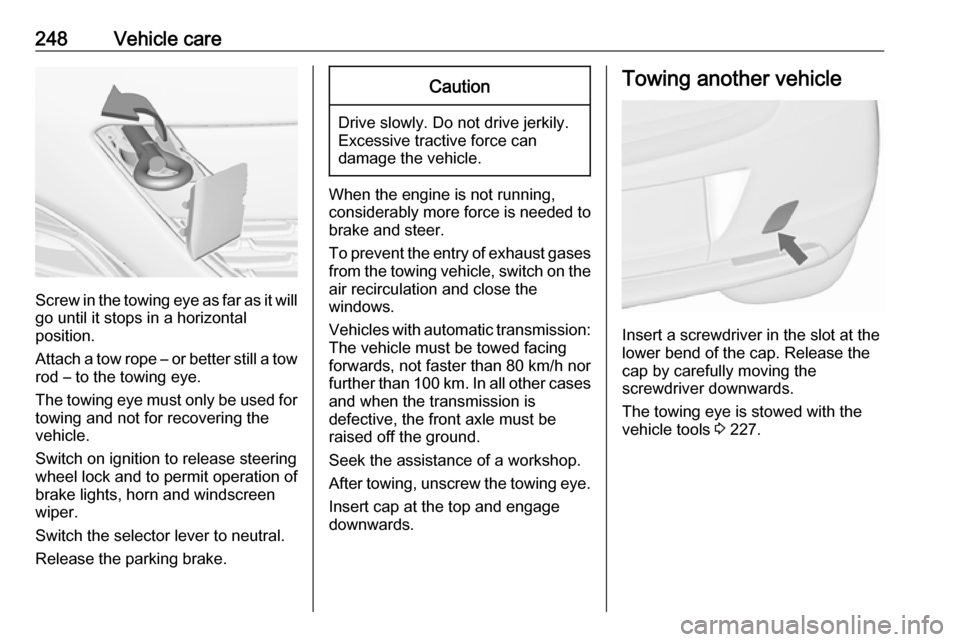
Screw in the towing eye as far as it will
go until it stops in a horizontal
position.
Attach a tow rope – or better still a tow
rod – to the towing eye.
The towing eye must only be used for towing and not for recovering the
vehicle.
Switch on ignition to release steering
wheel lock and to permit operation of
brake lights, horn and windscreen
wiper.
Switch the selector lever to neutral.
Release the parking brake.
Caution
Drive slowly. Do not drive jerkily.
Excessive tractive force can
damage the vehicle.
When the engine is not running,
considerably more force is needed to
brake and steer.
To prevent the entry of exhaust gases from the towing vehicle, switch on the
air recirculation and close the
windows.
Vehicles with automatic transmission: The vehicle must be towed facing
forwards, not faster than 80 km/h nor further than 100 km. In all other cases
and when the transmission is
defective, the front axle must be
raised off the ground.
Seek the assistance of a workshop.
After towing, unscrew the towing eye.
Insert cap at the top and engage
downwards.
Towing another vehicle
Insert a screwdriver in the slot at the
lower bend of the cap. Release the
cap by carefully moving the
screwdriver downwards.
The towing eye is stowed with the
vehicle tools 3 227.
Page 251 of 295

Vehicle care249
Screw in the towing eye as far as it will
go until it stops in a horizontal
position.
The lashing eye at the rear
underneath the vehicle must never be used as a towing eye.
Attach a tow rope – or even better a
tow bar – to the towing eye.
The towing eye must only be used for
towing and not for recovering a
vehicle.
Caution
Drive slowly. Do not drive jerkily.
Excessive tractive force can
damage the vehicle.
After towing, unscrew the towing eye.
Insert cap at the top and engage
downwards.
Appearance care
Exterior care Locks
The locks are lubricated at the factory using a high quality lock cylinder
grease. Use de-icing agent only when absolutely necessary, as this has a
degreasing effect and impairs lock function. After using a de-icing agent,
have the locks regreased by a
workshop.
WashingThe paintwork of your vehicle is
exposed to environmental influences.
Wash and wax your vehicle regularly.
When using automatic vehicle
washes, select a programme that
includes waxing.
Bird droppings, dead insects, resin,
pollen and the like should be cleaned
off immediately, as they contain
aggressive constituents which can
cause paint damage.
Page 253 of 295

Vehicle care251Remove dirt residues from smearing
wiper blades by using a soft cloth and
window cleaner. Also make sure to
remove any residues such as wax,
insect residues and similar from the
window.
Ice residues, pollution and continuous wiping on dry windows will damage or
even destroy the wiper blades.
Sunroof Never clean with solvents or abrasive
agents, fuels, aggressive media
(e.g. paint cleaner, acetone-
containing solutions etc.), acidic or
highly alkaline media or abrasive
pads. Do not apply wax or polishing
agents to the sunroof.
Glass panel Never clean with solvents or abrasive
agents, fuels, aggressive media
(e.g. paint cleaner, acetone-
containing solutions etc.), acidic or
highly alkaline media or abrasive
pads. Do not apply wax or polishing
agents to the glass panel.Wheels and tyres
Do not use high-pressure jet
cleaners.
Clean rims with a pH-neutral wheel
cleaner.
Rims are painted and can be treated
with the same agents as the body.
Paintwork damageRectify minor paintwork damage witha touch-up pen before rust forms.
Have more extensive damage or rust
areas repaired by a workshop.
Underbody Some areas of the vehicle underbody
have a PVC undercoating while other
critical areas have a durable
protective wax coating.
After the underbody is washed, check
the underbody and have it waxed if
necessary.
Bitumen/rubber materials could
damage the PVC coating. Have
underbody work carried out by a
workshop.Before and after winter, wash the
underbody and have the protective
wax coating checked.
Liquid gas system9 Danger
Liquid gas is heavier than air and
can collect in sink points.
Take care when performing work
at the underbody in a pit.
For painting work and when using a
drying booth at a temperature above
60 °C, the liquid gas tank must be
removed.
Do not make any modifications to the
liquid gas system.
Towing equipment
Do not clean the coupling ball bar with a steam-jet or high-pressure jet
cleaner.
Air shutter Clean the shutter system in the front
bumper to maintain correct
functionality.