parking brake OPEL ASTRA J 2018 Manual user
[x] Cancel search | Manufacturer: OPEL, Model Year: 2018, Model line: ASTRA J, Model: OPEL ASTRA J 2018Pages: 295, PDF Size: 8.41 MB
Page 234 of 295
232Vehicle care
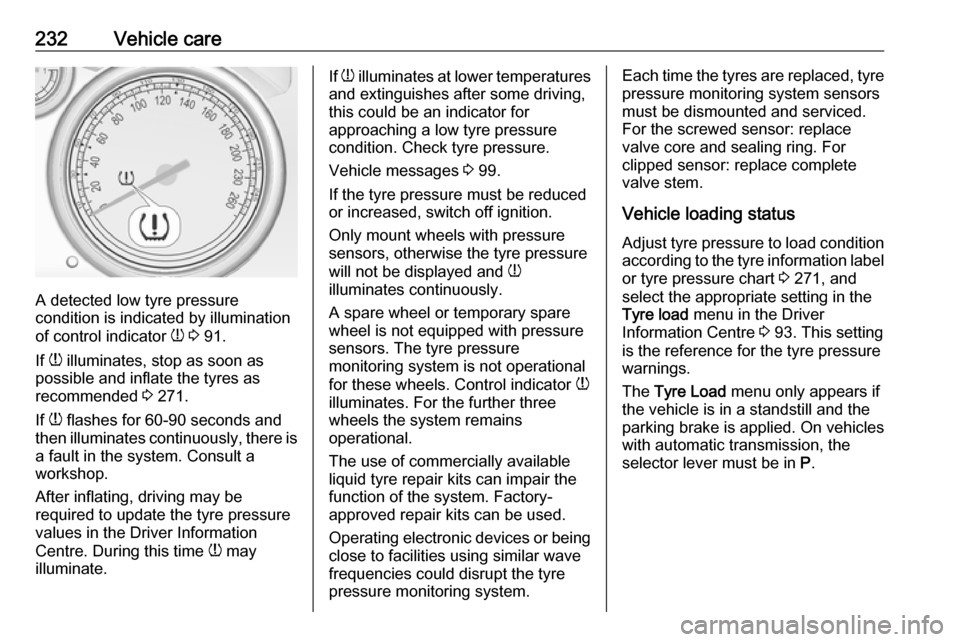
A detected low tyre pressure
condition is indicated by illumination
of control indicator w 3 91.
If w illuminates, stop as soon as
possible and inflate the tyres as
recommended 3 271.
If w flashes for 60-90 seconds and
then illuminates continuously, there is
a fault in the system. Consult a
workshop.
After inflating, driving may be
required to update the tyre pressure
values in the Driver Information
Centre. During this time w may
illuminate.
If w illuminates at lower temperatures
and extinguishes after some driving,
this could be an indicator for
approaching a low tyre pressure
condition. Check tyre pressure.
Vehicle messages 3 99.
If the tyre pressure must be reduced
or increased, switch off ignition.
Only mount wheels with pressure
sensors, otherwise the tyre pressure
will not be displayed and w
illuminates continuously.
A spare wheel or temporary spare
wheel is not equipped with pressure
sensors. The tyre pressure
monitoring system is not operational
for these wheels. Control indicator w
illuminates. For the further three
wheels the system remains
operational.
The use of commercially available
liquid tyre repair kits can impair the
function of the system. Factory-
approved repair kits can be used.
Operating electronic devices or being close to facilities using similar wave
frequencies could disrupt the tyre
pressure monitoring system.Each time the tyres are replaced, tyre pressure monitoring system sensors
must be dismounted and serviced. For the screwed sensor: replace
valve core and sealing ring. For
clipped sensor: replace complete
valve stem.
Vehicle loading status Adjust tyre pressure to load condition
according to the tyre information label or tyre pressure chart 3 271, and
select the appropriate setting in the Tyre load menu in the Driver
Information Centre 3 93. This setting
is the reference for the tyre pressure
warnings.
The Tyre Load menu only appears if
the vehicle is in a standstill and the
parking brake is applied. On vehicles
with automatic transmission, the
selector lever must be in P.
Page 235 of 295
Vehicle care233
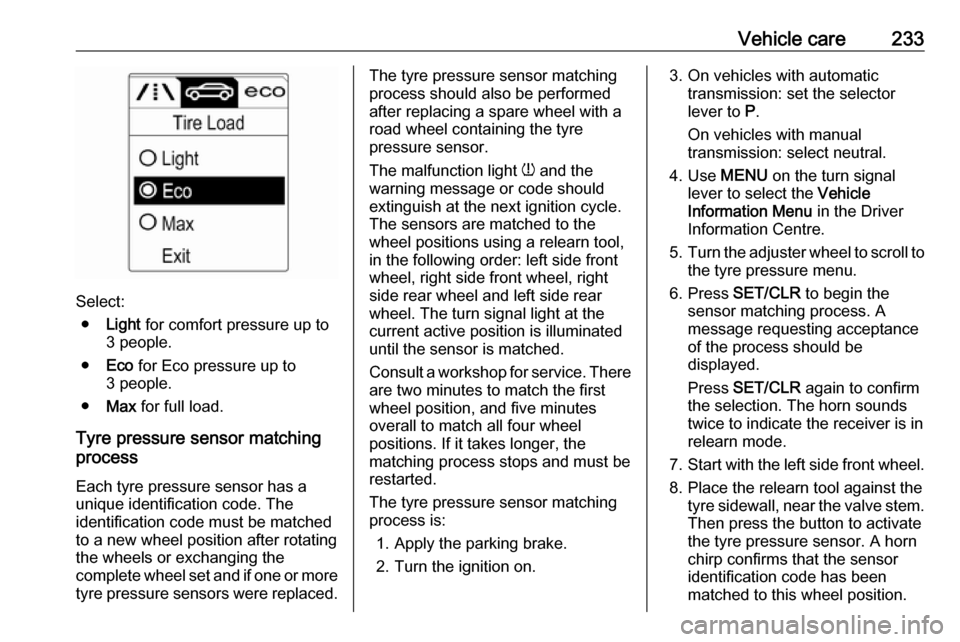
Select:● Light for comfort pressure up to
3 people.
● Eco for Eco pressure up to
3 people.
● Max for full load.
Tyre pressure sensor matching
process
Each tyre pressure sensor has a
unique identification code. The
identification code must be matched
to a new wheel position after rotating the wheels or exchanging the
complete wheel set and if one or more
tyre pressure sensors were replaced.
The tyre pressure sensor matching
process should also be performed
after replacing a spare wheel with a
road wheel containing the tyre
pressure sensor.
The malfunction light w and the
warning message or code should
extinguish at the next ignition cycle.
The sensors are matched to the
wheel positions using a relearn tool,
in the following order: left side front
wheel, right side front wheel, right
side rear wheel and left side rear
wheel. The turn signal light at the
current active position is illuminated
until the sensor is matched.
Consult a workshop for service. There
are two minutes to match the first
wheel position, and five minutes
overall to match all four wheel
positions. If it takes longer, the
matching process stops and must be
restarted.
The tyre pressure sensor matching
process is:
1. Apply the parking brake.
2. Turn the ignition on.3. On vehicles with automatic transmission: set the selector
lever to P.
On vehicles with manual
transmission: select neutral.
4. Use MENU on the turn signal
lever to select the Vehicle
Information Menu in the Driver
Information Centre.
5. Turn the adjuster wheel to scroll to
the tyre pressure menu.
6. Press SET/CLR to begin the
sensor matching process. A
message requesting acceptance
of the process should be
displayed.
Press SET/CLR again to confirm
the selection. The horn sounds
twice to indicate the receiver is in
relearn mode.
7. Start with the left side front wheel.
8. Place the relearn tool against the tyre sidewall, near the valve stem.Then press the button to activate
the tyre pressure sensor. A horn
chirp confirms that the sensor
identification code has been
matched to this wheel position.
Page 238 of 295
236Vehicle careTyre damage exceeding 4 mm or thatis at the tyre's sidewall cannot be
repaired with the tyre repair kit.9 Warning
Do not drive faster than 80 km/h.
Do not use for a lengthy period.
Steering and handling may be
affected.
If you have a flat tyre:
Apply the parking brake and engage
first gear, reverse gear or P.
The tyre repair kit is in a compartment under the floor cover in the load
compartment.
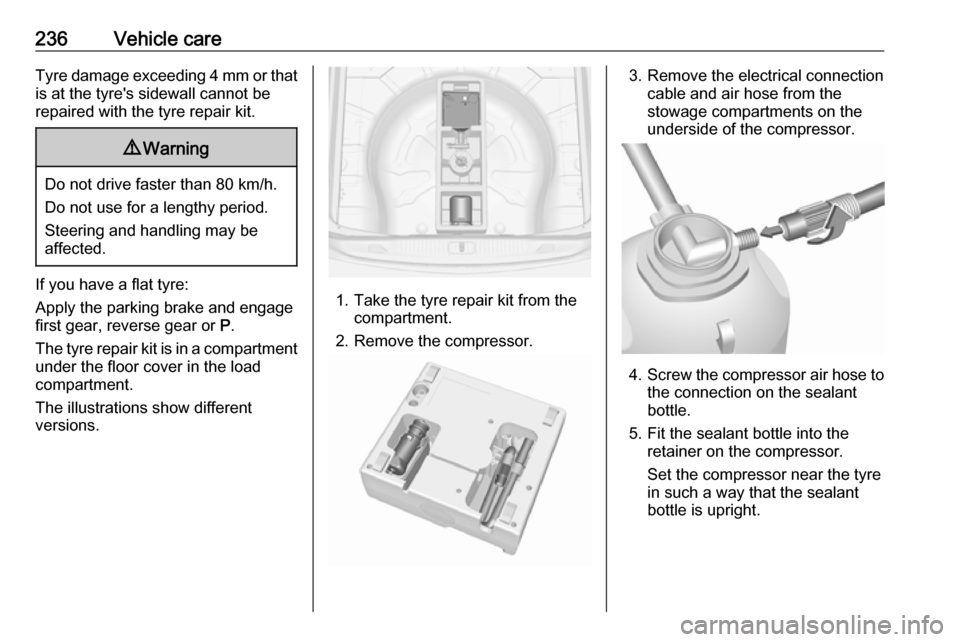
The illustrations show different
versions.1. Take the tyre repair kit from the compartment.
2. Remove the compressor.
3. Remove the electrical connection cable and air hose from the
stowage compartments on the
underside of the compressor.
4. Screw the compressor air hose to
the connection on the sealant
bottle.
5. Fit the sealant bottle into the retainer on the compressor.
Set the compressor near the tyre
in such a way that the sealant
bottle is upright.
Page 241 of 295

Vehicle care239Make the following preparations and
observe the following information:
● Park the vehicle on a level, firm and non-skid surface. The front
wheels must be in the straight- ahead position.
● Apply the parking brake and engage first gear, reverse gear or
P .
● Remove the spare wheel 3 242.
● Never change more than one wheel at once.
● Use the jack only to change wheels in case of puncture, not
for seasonal winter or summer
tyre change.
● The jack is maintenance-free. ● If the ground on which the vehicle
is standing is soft, a solid board
(max. 1 cm thick) should be
placed under the jack.
● Take heavy objects out of the vehicle before jacking up.
● No people or animals may be in the vehicle when it is jacked-up.
● Never crawl under a jacked-up vehicle.●Do not start the vehicle when it is
raised on the jack.
● Clean wheel nuts and thread with
a clean cloth before mounting the wheel.9 Warning
Do not grease wheel bolt, wheel
nut and wheel nut cone.
1. Disengage wheel nut caps with a
screwdriver and remove. Pull off
the wheel cover. Vehicle tools
3 227.
Alloy wheels: Disengage wheel
nut caps with a screwdriver and
remove. To protect the wheel,
place a soft cloth between the
screwdriver and the alloy wheel.Alloy wheels with centre wheel
bolt cap: Disengage centre cap by
inserting and pulling the extractor
in the recess of the brand
emblem. Vehicle tools 3 227.
2. Two types of jacks and wheel nut wrenches are possible dependingon the version. Vehicle tools
3 227.
Variant 1a with rigid wheel
wrench:
Page 248 of 295

246Vehicle careJump startingDo not start with quick charger.
A vehicle with a discharged vehicle
battery can be started using jump
leads and the vehicle battery of
another vehicle.9 Warning
Be extremely careful when starting
with jump leads. Any deviation
from the following instructions can
lead to injuries or damage caused
by battery explosion or damage to the electrical systems of both
vehicles.
9 Warning
Avoid contact of the battery with
eyes, skin, fabrics and painted
surfaces. The fluid contains
sulphuric acid which can cause
injuries and damage in the event
of direct contact.
● Never expose the vehicle battery
to naked flames or sparks.
● A discharged vehicle battery can already freeze at a temperature
of 0 °C. Defrost the frozen vehicle
battery before connecting jump leads.
● Wear eye protection and protective clothing when
handling a vehicle battery.
● Use a booster vehicle battery with the same voltage ( 12 Volts).
Its capacity (Ah) must not be
much less than that of the
discharged vehicle battery.
● Use jump leads with insulated terminals and a cross section of
at least 16 mm 2
(25 mm 2
for
diesel engines).
● Do not disconnect the discharged
vehicle battery from the vehicle.
● Switch off all unnecessary electrical consumers.
● Do not lean over the vehicle battery during jump starting.
● Do not allow the terminals of one
lead to touch those of the other
lead.● The vehicles must not come into contact with each other during
the jump starting process.
● Apply the parking brake, transmission in neutral,
automatic transmission in P.
● Open the positive terminal protection caps of both vehicle
batteries.
Lead connection order:
1. Connect the red lead to the positive terminal of the booster
vehicle battery.
2. Connect the other end of the red lead to the positive terminal of the
discharged vehicle battery.
Page 250 of 295
248Vehicle care
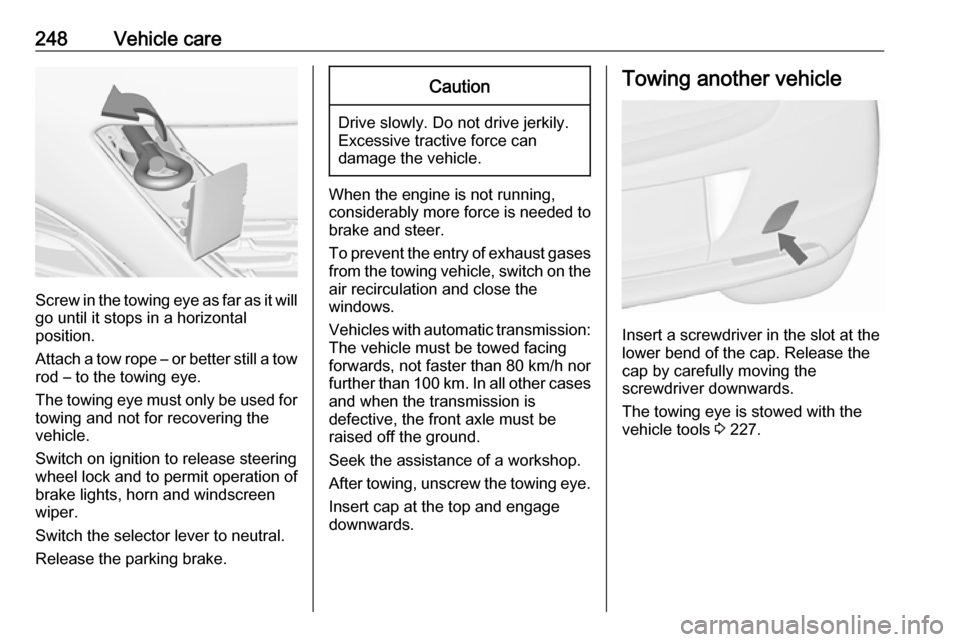
Screw in the towing eye as far as it will
go until it stops in a horizontal
position.
Attach a tow rope – or better still a tow
rod – to the towing eye.
The towing eye must only be used for towing and not for recovering the
vehicle.
Switch on ignition to release steering
wheel lock and to permit operation of
brake lights, horn and windscreen
wiper.
Switch the selector lever to neutral.
Release the parking brake.
Caution
Drive slowly. Do not drive jerkily.
Excessive tractive force can
damage the vehicle.
When the engine is not running,
considerably more force is needed to
brake and steer.
To prevent the entry of exhaust gases from the towing vehicle, switch on the
air recirculation and close the
windows.
Vehicles with automatic transmission: The vehicle must be towed facing
forwards, not faster than 80 km/h nor further than 100 km. In all other cases
and when the transmission is
defective, the front axle must be
raised off the ground.
Seek the assistance of a workshop.
After towing, unscrew the towing eye.
Insert cap at the top and engage
downwards.
Towing another vehicle
Insert a screwdriver in the slot at the
lower bend of the cap. Release the
cap by carefully moving the
screwdriver downwards.
The towing eye is stowed with the
vehicle tools 3 227.
Page 291 of 295

289Climate control ............................. 17
Climate control systems .............129
Clock............................................. 77
Code ............................................. 99
Collision damage repair ..............284
Control indicators.......................... 84
Control of the vehicle .................140
Controls ........................................ 73
Convex shape .............................. 31
Coolant and antifreeze ...............254
Cruise control ...................... 92, 159
Cupholders .................................. 60
Curtain airbag system .................. 53
Curve lighting.............................. 120
D Danger, Warnings and Cautions ...4
Daytime running lights ...............120
Declaration of conformity ............280
Diesel fuel system bleeding .......207
Diesel particle filter ...............90, 146
Door open .................................... 93
Doors ............................................ 27
Driver assistance systems ..........159
Driver Information Centre .............93
Driving characteristics and towing tips .............................. 194
Driving hints ................................ 140E
Electric adjustment ......................31
Electrical system......................... 222
Electric parking brake ...........88, 153
Electric parking brake fault ...........89
Electronic climate control system 132
Electronic driving programmes ..149
Electronic Stability Control.......... 155
Electronic Stability Control and Traction Control system ............90
Electronic Stability Control off....... 90
End-of-life vehicle recovery .......201
Engine compartment fuse box ...223
Engine coolant ........................... 203
Engine coolant temperature gauge ....................................... 83
Engine data ............................... 262
Engine exhaust .......................... 145
Engine identification ...................258
Engine oil ................... 202, 254, 259
Engine oil pressure ......................91
Entry lighting .............................. 127
ERA GLONASS .......................... 113
Event data recorders ..................287
Exit lighting ................................ 127
Exterior care .............................. 249
Exterior light ................................. 92
Exterior lighting ....................15, 116
Exterior mirrors ............................. 31F
Fault ........................................... 150
First aid ......................................... 69
First aid kit ................................... 69
Fixed air vents ........................... 137
Fog light ....................................... 92
Fog lights ................................... 212
Folding mirrors ............................. 32
Following distance indication ......172
Forward collision alert................. 169
Front airbag system .....................52
Front fog lights ........................... 124
Front seats.................................... 41
Front storage ................................ 61
Front turn signal lights ...............214
Fuel............................................. 188
Fuel consumption - CO 2-
Emissions ............................... 193
Fuel for diesel engines ..............189
Fuel for liquid gas operation .......190
Fuel for petrol engines ...............188
Fuel gauge ................................... 81
Fuel selector ................................ 81
Fuses ......................................... 222
G Gauges ......................................... 80
General information ...................194
Glass panel .................................. 38
Page 293 of 295

291PParking ................................ 20, 144
Parking assist ............................ 175
Parking brake ............................ 153
Parking lights ............................. 124
Particulate filter ........................... 146
Performance .............................. 265
Performing work ........................201
Pollen filter ................................. 137
Power outlets ............................... 78
Power seat adjustment ................45
Power steering.............................. 89
Power steering fluid ....................204
Power windows ............................ 34
Preheating ................................... 90
Puncture ..................................... 238
Q
Quickheat ................................... 136
R Radio Frequency Identification (RFID) ..................................... 287
Radio remote control ...................23
REACH ....................................... 284
Reading lights ............................ 126
Rear floor storage cover ..............67
Rear fog light ............................... 92
Rear fog lights ........................... 124
Rear seats .................................... 48
Rear storage ................................. 66Rear window wiper/washer .......... 76
Recommended fluids and lubricants ........................ 254, 259
Reduced engine power ................92
Refuelling ................................... 190 Registered trademarks ...............286
Retained power off .....................141
Reversing lights .........................125
Ride control systems ..................155
Roof .............................................. 36
Roof load ...................................... 70
Roof rack ..................................... 70
S Safety belts ................................... 48
Seat adjustment ............................. 7
Seat belt ........................................ 9
Seat belt reminder .......................87
Seat belts ..................................... 48
Seat folding .................................. 44
Seat heating ................................. 47
Seat position ................................ 41
Selector lever ............................. 148
Service ............................... 138, 253
Service display ............................ 83
Service information ....................253
Service vehicle soon .................... 88
Side airbag system ......................52
Side blind spot alert ....................182
Sidelights .................................... 116Side turn signal lights ................219
Smartphone controller ..................99
Software acknowledgement .......284
Spare wheel ............................... 242
Speed limiter............................... 161
Speedometer ............................... 80
Starting and operating ................140
Starting off ................................... 19
Starting the engine ....................141
Steering ...................................... 140
Steering wheel adjustment ....10, 73
Steering wheel controls ...............73
Stop-start system........................ 142
Storage ......................................... 60
Storage compartments .................60
Sunroof ........................................ 36
Sunvisor lights ........................... 126
Sun visors .................................... 36
Symbols ......................................... 4
T
Tachometer ................................. 80
Tail lights ................................... 216
Three-point seat belt .................... 49
Tools .......................................... 227
Tow bar....................................... 194 Towing ................................ 194, 247
Towing another vehicle .............248
Towing equipment .....................195
Towing the vehicle .....................247