parking brake OPEL ASTRA J 2019 Manual user
[x] Cancel search | Manufacturer: OPEL, Model Year: 2019, Model line: ASTRA J, Model: OPEL ASTRA J 2019Pages: 205, PDF Size: 6.25 MB
Page 166 of 205

164Vehicle carepositions. If it takes longer, the
matching process stops and must be
restarted.
The tyre pressure sensor matching
process is:
1. Apply the parking brake.
2. Turn the ignition on.
3. On vehicles with automatic transmission: set the selector
lever to P.
On vehicles with manual
transmission: select neutral.
4. Use MENU on the turn signal
lever to select the Vehicle
Information Menu in the Driver
Information Centre.
5. Turn the adjuster wheel to scroll to
the tyre pressure menu.
6. Press SET/CLR to begin the
sensor matching process. A
message requesting acceptance
of the process should be
displayed.
Press SET/CLR again to confirm
the selection. The horn sounds
twice to indicate the receiver is in
relearn mode.7. Start with the left side front wheel.
8. Place the relearn tool against the tyre sidewall, near the valve stem.Then press the button to activate
the tyre pressure sensor. A horn
chirp confirms that the sensor
identification code has been
matched to this wheel position.
9. Proceed to the right side front wheel, and repeat the procedure
in Step 8.
10. Proceed to the right side rear wheel, and repeat the procedure
in Step 8.
11. Proceed to the left side rear wheel, and repeat the procedure
in Step 8. The horn sounds twice
to indicate the sensor
identification code has been
matched to the left side rear tyre,
and the tyre pressure sensor
matching process is no longer
active.
12. Turn off the ignition.13. Set all four tyres to the recommended air pressure level
as indicated on the tyre pressure
label.
14. Ensure the tyre loading status is set according to the selected
pressure 3 73.
Tread depth
Check tread depth at regular
intervals.
Tyres should be replaced for safety
reasons at a tread depth of 2-3 mm
(4 mm for winter tyres).
For safety reasons it is recommended
that the tread depth of the tyres on
one axle should not vary by more than 2 mm.
Page 168 of 205
166Vehicle care9Warning
Damage may lead to tyre blowout.
Always use fine mesh chains that add
no more than 10 mm to the tyre tread
and the inboard sides (including chain
lock).
Tyre chains are only permitted on
tyres of size 205/60 R16 and
215/50 R17.
The use of tyre chains is not permitted on the temporary spare wheel.
Wheel changing
Make the following preparations and
observe the following information:
● Park the vehicle on a level, firm and non-skid surface. The front
wheels must be in the straight-
ahead position.
● Apply the parking brake and engage first gear, reverse gear or
P .
● If the ground on which the vehicle
is standing is soft, a solid board
(max. 1 cm thick) should be
placed under the jack.
● Take heavy objects out of the vehicle before jacking up.
● No people or animals may be in the vehicle when it is jacked-up.
● Never crawl under a jacked-up vehicle.
● Do not start the vehicle when it is
raised on the jack.
● Clean wheel nuts and thread with
a clean cloth before mounting the wheel.9 Warning
Do not grease wheel bolt, wheel
nut and wheel nut cone.
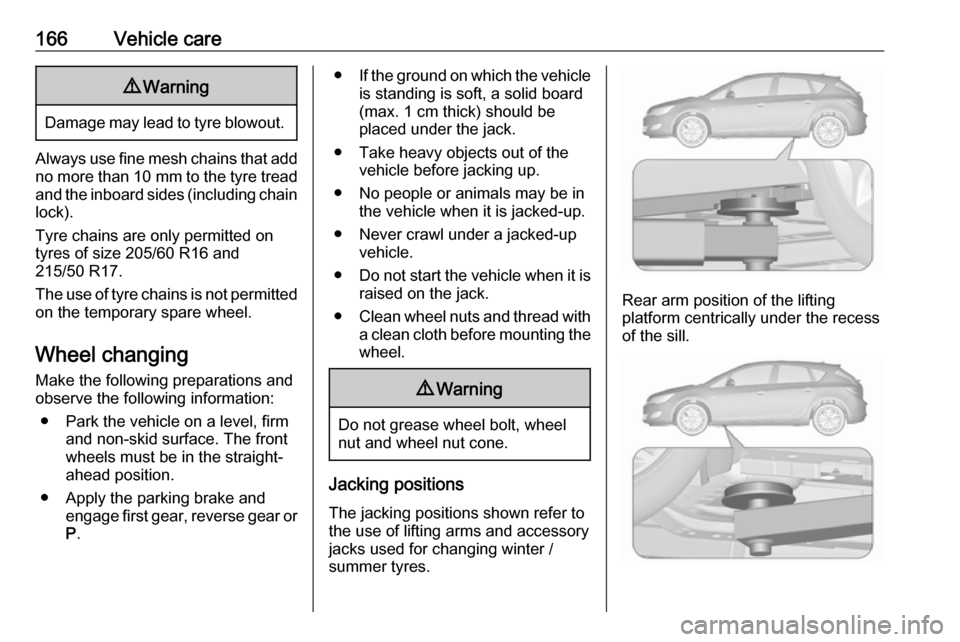
Jacking positions
The jacking positions shown refer to
the use of lifting arms and accessory
jacks used for changing winter /
summer tyres.
Rear arm position of the lifting
platform centrically under the recess
of the sill.
Page 169 of 205
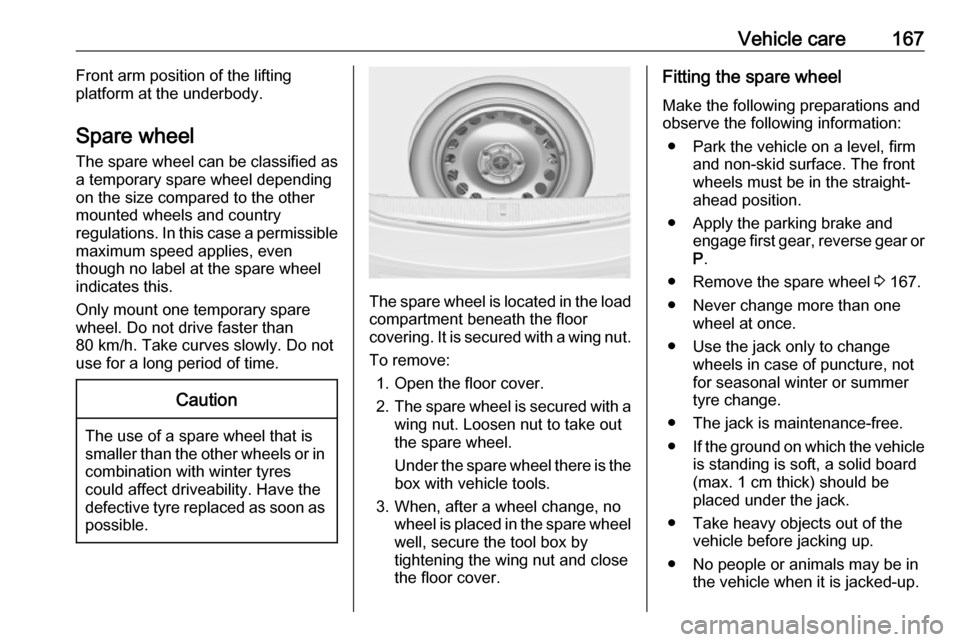
Vehicle care167Front arm position of the lifting
platform at the underbody.
Spare wheel
The spare wheel can be classified as
a temporary spare wheel depending
on the size compared to the other
mounted wheels and country
regulations. In this case a permissible maximum speed applies, even
though no label at the spare wheel
indicates this.
Only mount one temporary spare
wheel. Do not drive faster than
80 km/h. Take curves slowly. Do not
use for a long period of time.Caution
The use of a spare wheel that is smaller than the other wheels or in combination with winter tyres
could affect driveability. Have the defective tyre replaced as soon as
possible.
The spare wheel is located in the load
compartment beneath the floor
covering. It is secured with a wing nut.
To remove: 1. Open the floor cover.
2. The spare wheel is secured with a
wing nut. Loosen nut to take out
the spare wheel.
Under the spare wheel there is the box with vehicle tools.
3. When, after a wheel change, no wheel is placed in the spare wheel
well, secure the tool box by
tightening the wing nut and close
the floor cover.
Fitting the spare wheel
Make the following preparations and
observe the following information:
● Park the vehicle on a level, firm and non-skid surface. The front
wheels must be in the straight-
ahead position.
● Apply the parking brake and engage first gear, reverse gear orP .
● Remove the spare wheel 3 167.
● Never change more than one wheel at once.
● Use the jack only to change wheels in case of puncture, not
for seasonal winter or summer
tyre change.
● The jack is maintenance-free.
● If the ground on which the vehicle
is standing is soft, a solid board
(max. 1 cm thick) should be
placed under the jack.
● Take heavy objects out of the vehicle before jacking up.
● No people or animals may be in the vehicle when it is jacked-up.
Page 173 of 205

Vehicle care171● A discharged vehicle battery canalready freeze at a temperature
of 0 °C. Defrost the frozen vehicle battery before connecting jump
leads.
● Wear eye protection and protective clothing when
handling a vehicle battery.
● Use a booster vehicle battery with the same voltage ( 12 Volts).
Its capacity (Ah) must not be
much less than that of the
discharged vehicle battery.
● Use jump leads with insulated terminals and a cross section of
at least 16 mm 2
.
● Do not disconnect the discharged
vehicle battery from the vehicle.
● Switch off all unnecessary electrical consumers.
● Do not lean over the vehicle battery during jump starting.
● Do not allow the terminals of one
lead to touch those of the other
lead.
● The vehicles must not come into contact with each other during
the jump starting process.● Apply the parking brake, transmission in neutral,
automatic transmission in P.
● Open the positive terminal protection caps of both vehicle
batteries.
Lead connection order:
1. Connect the red lead to the positive terminal of the booster
vehicle battery.
2. Connect the other end of the red lead to the positive terminal of the
discharged vehicle battery.
3. Connect the black lead to the negative terminal of the booster
vehicle battery.
4. Connect the other end of the black
lead to a vehicle grounding point,
such as the engine block or an
engine mounting bolt. Connect as far away from the discharged
vehicle battery as possible,
however at least 60 cm.
Route the leads so that they cannot
catch on rotating parts in the engine
compartment.
To start the engine: 1. Start the engine of the vehicle providing the jump.
2. After five minutes, start the other engine. Start attempts should be
made for no longer than
15 seconds at an interval of one
minute.
3. Allow both engines to idle for approx. three minutes with the
leads connected.
Page 174 of 205

172Vehicle care4. Switch on electrical consumers(e.g. headlights, heated rear
window) of the vehicle receiving
the jump start.
5. Reverse above sequence exactly when removing leads.Towing
Towing the vehicle
Wrap a cloth around the tip of a flat
screwdriver to prevent paint damage.
Insert the screwdriver in the slot at the
lower part of the cap. Release the cap by carefully moving the screwdriver
downwards.
The towing eye is stowed with the
vehicle tools 3 159.
Screw in the towing eye as far as it will
go until it stops in a horizontal
position.
Attach a tow rope – or better still a tow
rod – to the towing eye.
The towing eye must only be used for
towing and not for recovering the
vehicle.
Switch on ignition to release steering wheel lock and to permit operation of
brake lights, horn and windscreen
wiper.
Switch the selector lever to neutral.
Release the parking brake.
Page 201 of 205

199Cupholders .................................. 48
Curve lighting................................ 97
D
Danger, Warnings and Cautions ...4
Daytime running lights .................97
Declaration of conformity ............188
Door open .................................... 73
Doors ............................................ 23
Driver assistance systems ..........130
Driver Information Centre .............73
Driving hints ................................ 115
E Electric adjustment ......................25
Electrical system......................... 154
Electric parking brake ...........69, 126
Electric parking brake fault ...........70
Electronic climate control system 109
Electronic driving programmes ..123
Electronic Stability Control.......... 129
Electronic Stability Control and Traction Control system ............71
Electronic Stability Control off....... 71
End-of-life vehicle recovery .......139
Engine compartment fuse box ...155
Engine coolant ........................... 142
Engine coolant temperature gauge ....................................... 64
Engine data ............................... 184
Engine exhaust .......................... 119Engine identification ...................181
Engine oil ................... 141, 178, 182
Engine oil pressure ......................72
Entry lighting .............................. 104
Event data recorders ..................193
Exhaust filter ......................... 71, 119
Exit lighting ................................ 104
Exterior care .............................. 174
Exterior light ................................. 72
Exterior lighting ......................12, 93
Exterior mirrors ............................. 25
F Fault ........................................... 123
First aid ......................................... 53
First aid kit ................................... 53
Fixed air vents ........................... 113
Folding mirrors ............................. 25
Front airbag system .....................40
Front fog lights .............73, 101, 149
Front seats.................................... 32
Front storage ................................ 49
Front turn lights .......................... 150
Fuel............................................. 135
Fuel for petrol engines ...............135
Fuel gauge ................................... 63
Fuses ......................................... 154
G Gauges ......................................... 62
Glovebox ..................................... 48H
Halogen headlights ....................146
Hand brake ......................... 125, 126
Hazard warning flashers ............100
Headlight flash ............................. 95
Headlight range adjustment ........96
Headlights..................................... 93
Headlights when driving abroad ..96
Head restraint adjustment .............8
Head restraints ............................ 31
Heated mirrors ............................. 26
Heated rear window ..................... 30
Heated steering wheel .................57
Heating ........................................ 35
Heating and ventilation system . 106
High beam ............................. 72, 95
High beam assist ....................72, 95
Hill start assist ........................... 128
Horn ....................................... 13, 58
I
Identification plate .....................180
Ignition switch positions .............116
Immobiliser ............................ 24, 72
Indicators ...................................... 62
Info Display ................................... 77
Information displays...................... 73
Instrument cluster ........................62
Instrument panel fuse box .........157
Instrument panel illumination .....153
Page 202 of 205

200Instrument panel illuminationcontrol .................................... 102
Instrument panel overview ........... 10
Interior care ............................... 176
Interior lighting ............................ 102
Interior lights ...................... 102, 153
Interior mirrors .............................. 26
Interruption of power supply ......123
Introduction .................................... 3
J
Jump starting ............................. 170
K
Key, memorised settings ..............20
Keys ............................................. 18
Keys, locks ................................... 18
L
Lashing eyes ............................... 52
Lighting features .........................104
Light switch .................................. 93
Load compartment ................23, 51
Load compartment fuse box ......158
Loading information .....................54
Low fuel ....................................... 72
Low washer fluid ..........................73
M Malfunction indicator light ............69
Manual anti-dazzle ......................26Manual mode ............................. 122
Manual seat adjustment ...............33
Manual transmission .................. 124
Manual windows ..........................27
Memorised settings ......................20
Midlevel-Display ........................... 73
Mirror adjustment ........................... 9
Misted light covers .....................102
N New vehicle running-in ..............116
Number plate light .....................153
O Object detection systems ...........133
Odometer ..................................... 63
Oil, engine .......................... 178, 182
OnStar .......................................... 88
Operate pedal ............................... 69
Outside temperature ....................60
Overrun cut-off ........................... 117
P Parking ................................ 16, 118
Parking assist ......................70, 133
Parking brake ............................ 126
Parking lights ............................. 101
Particulate filter ........................... 119
Performing work ........................140
Power outlets ............................... 62
Power steering.............................. 70Power steering fluid ....................142
Power windows ............................ 28
Puncture ..................................... 167
R Radio Frequency Identification (RFID) ..................................... 196
Radio remote control ...................19
REACH ....................................... 191
Reading lights ............................ 103
Rear fog light ...............73, 101, 151
Rear seats .................................... 36
Recommended fluids and lubricants ........................ 178, 182
Reduced engine power ................72
Refuelling ................................... 136
Registered trademarks ...............193
Retained power off .....................116
Reversing lights .........................102
Ride control systems ..................128
Roof load ...................................... 54
Roof rack ..................................... 53
S Safety belts ................................... 36
Seat adjustment ............................. 7
Seat belt ........................................ 8
Seat belt reminder .......................68
Seat belts ..................................... 36
Seat heating ................................. 35
Seat position ................................ 32