battery OPEL ASTRA K 2018.75 Manual user
[x] Cancel search | Manufacturer: OPEL, Model Year: 2018.75, Model line: ASTRA K, Model: OPEL ASTRA K 2018.75Pages: 319, PDF Size: 9.63 MB
Page 234 of 319

232Vehicle careCaution
When transporting the vehicle on
a train or on a recovery vehicle, the
mud flaps might be damaged.
Vehicle storage
Storage for a long period of time
If the vehicle is to be stored for several months:
● Wash and wax the vehicle.
● Have the wax in the engine compartment and underbody
checked.
● Clean and preserve the rubber seals.
● Fill up fuel tank completely.
● Change the engine oil.
● Drain the washer fluid reservoir.
● Check the coolant antifreeze and
corrosion protection.
● Adjust tyre pressure to the value specified for full load.
● Park the vehicle in a dry, wellventilated place. Engage first or
reverse gear or set selector lever
to P. Prevent the vehicle from
rolling.
● Do not apply the parking brake.
● Open the bonnet, close all doors and lock the vehicle.
● Disconnect the clamp from the negative terminal of the vehicle
battery. Beware that all systems
are not functional, e.g. anti-theft
alarm system.
Putting back into operation
When the vehicle is to be put back into
operation:
● Connect the clamp to the negative terminal of the vehicle
battery. Activate the electronics
of the power windows.
● Check tyre pressure.
● Fill up the washer fluid reservoir.
● Check the engine oil level.
● Check the coolant level.
● Fit the number plate if necessary.End-of-life vehicle recovery
Information on end-of-life vehicle
recovery centres and the recycling of
end-of-life vehicles is available on our website, where legally required. Only
entrust this work to an authorised
recycling centre.
Page 239 of 319
Vehicle care237Vehicle battery
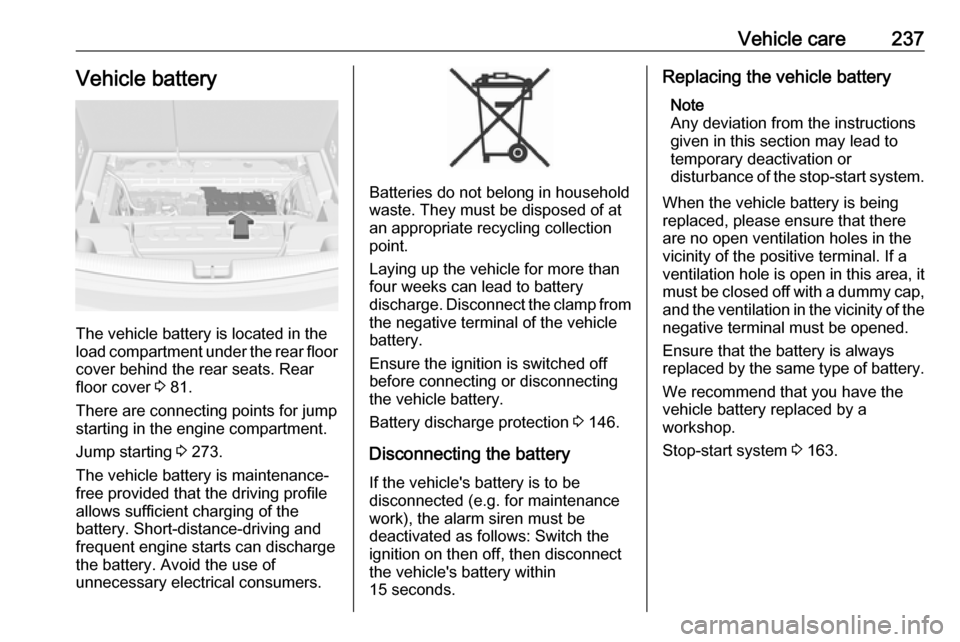
The vehicle battery is located in the
load compartment under the rear floor cover behind the rear seats. Rear
floor cover 3 81.
There are connecting points for jump starting in the engine compartment.
Jump starting 3 273.
The vehicle battery is maintenance-
free provided that the driving profile
allows sufficient charging of the
battery. Short-distance-driving and
frequent engine starts can discharge
the battery. Avoid the use of
unnecessary electrical consumers.
Batteries do not belong in household
waste. They must be disposed of at
an appropriate recycling collection
point.
Laying up the vehicle for more than
four weeks can lead to battery
discharge. Disconnect the clamp from
the negative terminal of the vehicle
battery.
Ensure the ignition is switched off
before connecting or disconnecting
the vehicle battery.
Battery discharge protection 3 146.
Disconnecting the battery
If the vehicle's battery is to be
disconnected (e.g. for maintenance
work), the alarm siren must be
deactivated as follows: Switch the ignition on then off, then disconnect
the vehicle's battery within
15 seconds.
Replacing the vehicle battery
Note
Any deviation from the instructions
given in this section may lead to
temporary deactivation or
disturbance of the stop-start system.
When the vehicle battery is being
replaced, please ensure that there
are no open ventilation holes in the
vicinity of the positive terminal. If a
ventilation hole is open in this area, it
must be closed off with a dummy cap,
and the ventilation in the vicinity of the negative terminal must be opened.
Ensure that the battery is always
replaced by the same type of battery.
We recommend that you have the
vehicle battery replaced by a
workshop.
Stop-start system 3 163.
Page 240 of 319
238Vehicle careCharging the vehicle battery9Warning
On vehicles with stop-start
system, ensure that the charging potential does not exceed
14.6 volts when using a battery
charger. Otherwise the vehicle
battery might be damaged.
Jump starting 3 273.
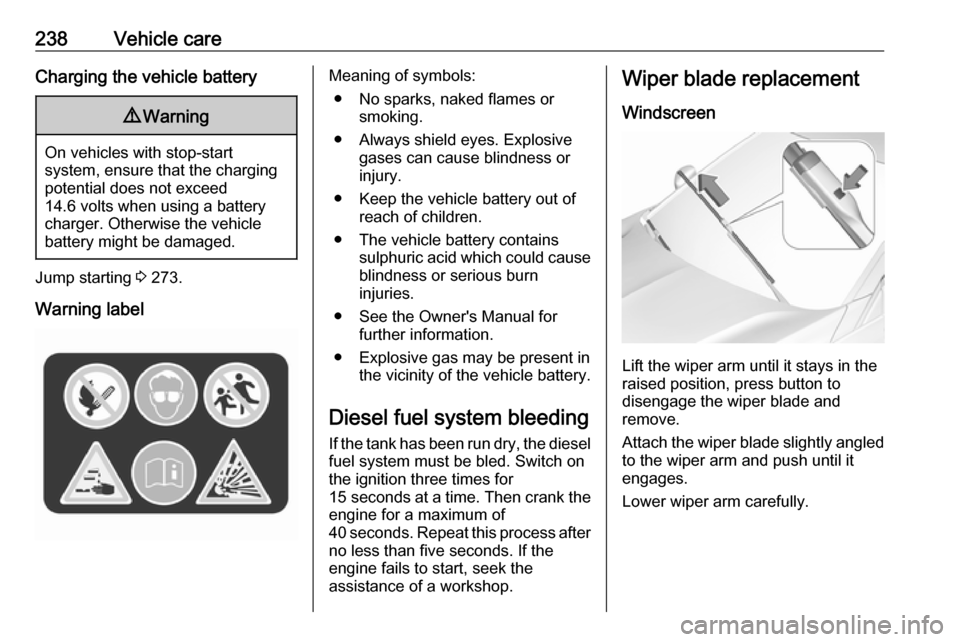
Warning label
Meaning of symbols: ● No sparks, naked flames or smoking.
● Always shield eyes. Explosive gases can cause blindness or
injury.
● Keep the vehicle battery out of reach of children.
● The vehicle battery contains sulphuric acid which could cause
blindness or serious burn
injuries.
● See the Owner's Manual for further information.
● Explosive gas may be present in the vicinity of the vehicle battery.
Diesel fuel system bleeding If the tank has been run dry, the diesel
fuel system must be bled. Switch on
the ignition three times for
15 seconds at a time. Then crank the
engine for a maximum of 40 seconds. Repeat this process after
no less than five seconds. If the
engine fails to start, seek the
assistance of a workshop.Wiper blade replacement
Windscreen
Lift the wiper arm until it stays in the
raised position, press button to
disengage the wiper blade and
remove.
Attach the wiper blade slightly angled
to the wiper arm and push until it
engages.
Lower wiper arm carefully.
Page 258 of 319
256Vehicle careNo.Circuit16Trailer outlet17Trailer outlet18–19–20–21Electrical rear seat folding (only
Caravan)22–
After having changed defective fuses,
close the fuse box cover and press
until it engages.
Additional fuses are located near the
vehicle battery.
No.Circuit1Fuel pump2Engine control module3Power supplyVehicle tools
Tools
5-door hatchback with spare
wheel
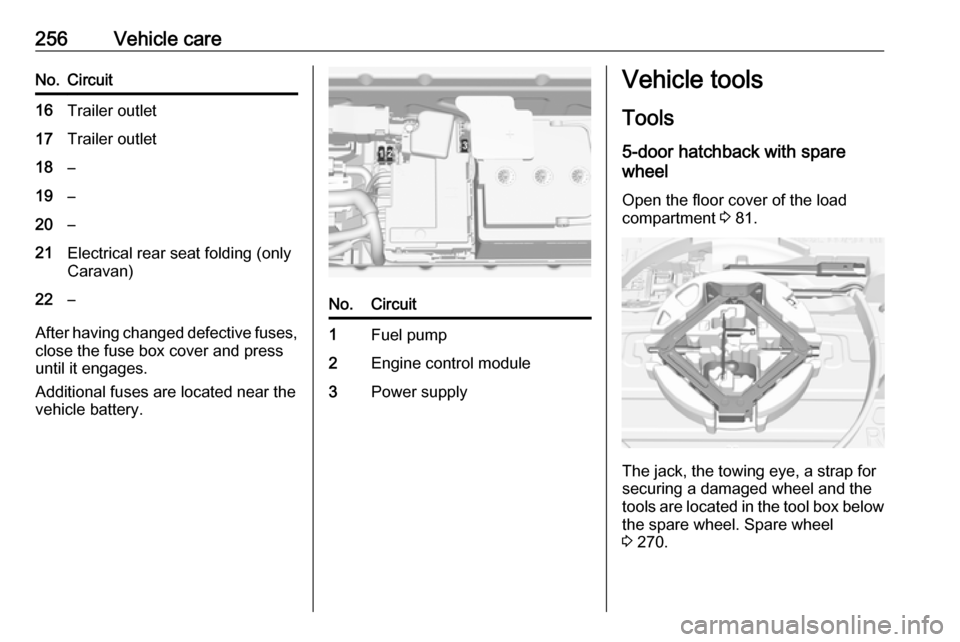
Open the floor cover of the load
compartment 3 81.
The jack, the towing eye, a strap for
securing a damaged wheel and the
tools are located in the tool box below the spare wheel. Spare wheel
3 270.
Page 268 of 319
266Vehicle care
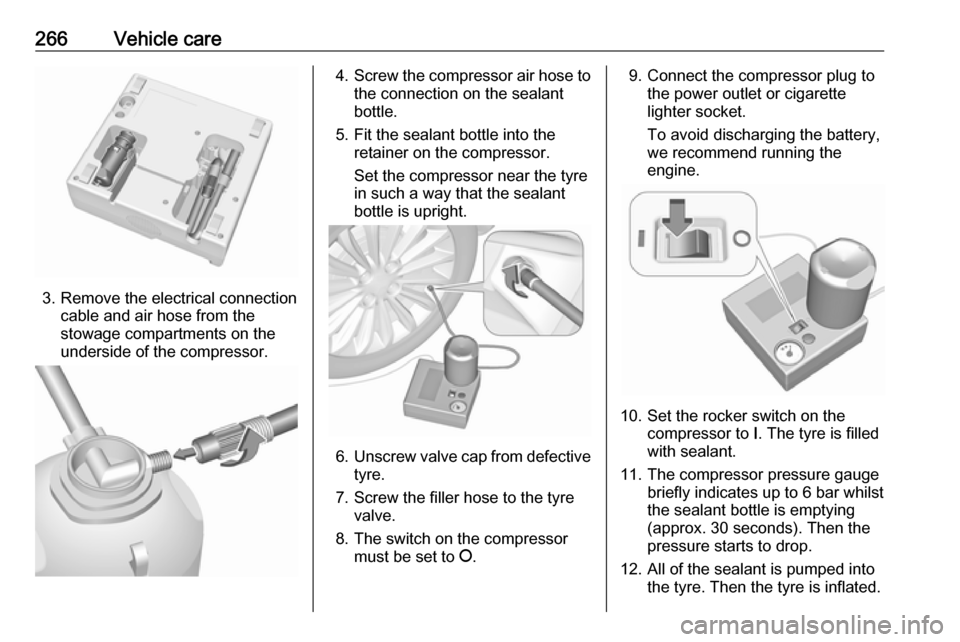
3. Remove the electrical connectioncable and air hose from the
stowage compartments on the
underside of the compressor.
4. Screw the compressor air hose to
the connection on the sealant
bottle.
5. Fit the sealant bottle into the retainer on the compressor.
Set the compressor near the tyre
in such a way that the sealant
bottle is upright.
6. Unscrew valve cap from defective
tyre.
7. Screw the filler hose to the tyre valve.
8. The switch on the compressor must be set to J.
9. Connect the compressor plug to
the power outlet or cigarette
lighter socket.
To avoid discharging the battery,
we recommend running the
engine.
10. Set the rocker switch on the compressor to I. The tyre is filled
with sealant.
11. The compressor pressure gauge briefly indicates up to 6 bar whilstthe sealant bottle is emptying
(approx. 30 seconds). Then the
pressure starts to drop.
12. All of the sealant is pumped into the tyre. Then the tyre is inflated.
Page 275 of 319
Vehicle care273Spare wheel with directional tyreIf possible, fit directional tyres such
that they roll in the direction of travel.
The rolling direction is indicated by a
symbol (e.g. an arrow) on the
sidewall.
The following applies to tyres fitted
opposing the rolling direction:
● Driveability may be affected. Have the defective tyre renewed
or repaired as soon as possible
and fit it instead of the spare
wheel.
● Drive particularly carefully on wet
and snow-covered road
surfaces.Jump starting
The vehicle battery is located in the
load compartment under a cover. There are connecting points for jump
starting in the engine compartment.
A vehicle with a discharged vehicle
battery can be started using jump
leads and the vehicle battery of
another vehicle.
Do not start with quick charger.9 Warning
Be extremely careful when starting
with jump leads. Any deviation
from the following instructions can
lead to injuries or damage caused
by battery explosion or damage to the electrical systems of both
vehicles.
9 Warning
Avoid contact of the battery with
eyes, skin, fabrics and painted
surfaces. The fluid contains
sulphuric acid which can cause
injuries and damage in the event
of direct contact.
● Never expose the vehicle battery
to naked flames or sparks.
● A discharged vehicle battery can already freeze at a temperature
of 0 °C. Defrost the frozen vehicle
battery before connecting jump leads.
● Wear eye protection and protective clothing when
handling a vehicle battery.
● Use a booster vehicle battery with the same voltage (12 Volt).
Its capacity (Ah) must not be
much less than that of the
discharged vehicle battery.
● Use jump leads with insulated terminals and a cross section of
at least 16 mm 2
(25 mm 2
for
diesel engines).
● Do not disconnect the discharged
vehicle battery from the vehicle.
● Switch off all unnecessary electrical consumers.
Page 276 of 319
274Vehicle care● Do not lean over the vehiclebattery during jump starting.
● Do not allow the terminals of one
lead to touch those of the other
lead.
● The vehicles must not come into contact with each other during
the jump starting process.
● Apply the parking brake, transmission in neutral,
automatic transmission in P.
● Open the positive terminal protection cap of your vehicle in
the engine compartment and of
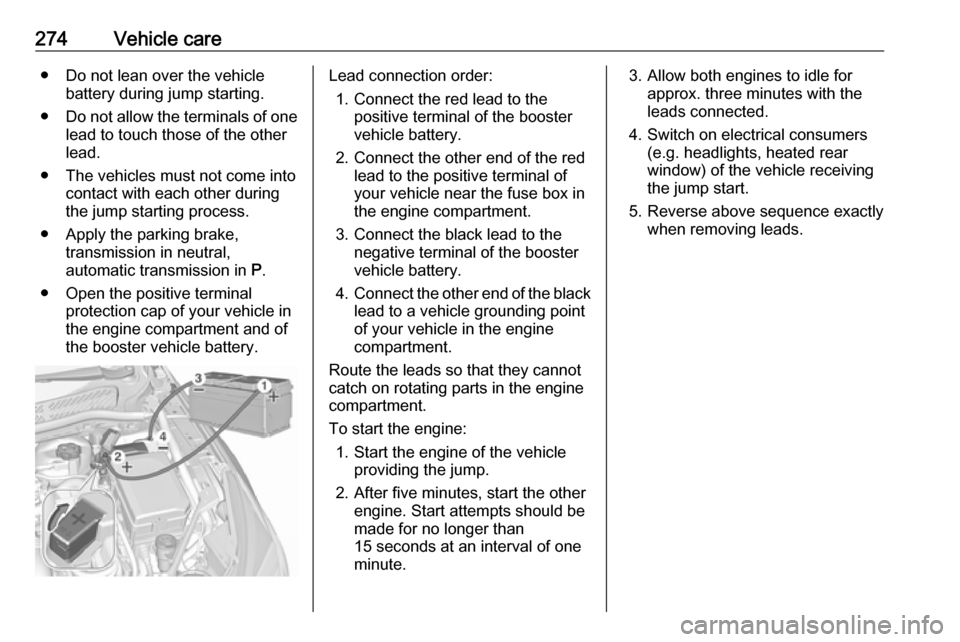
the booster vehicle battery.Lead connection order:
1. Connect the red lead to the positive terminal of the booster
vehicle battery.
2. Connect the other end of the red lead to the positive terminal of
your vehicle near the fuse box in
the engine compartment.
3. Connect the black lead to the negative terminal of the booster
vehicle battery.
4. Connect the other end of the black
lead to a vehicle grounding point
of your vehicle in the engine
compartment.
Route the leads so that they cannot
catch on rotating parts in the engine
compartment.
To start the engine: 1. Start the engine of the vehicle providing the jump.
2. After five minutes, start the other engine. Start attempts should be
made for no longer than
15 seconds at an interval of one
minute.3. Allow both engines to idle for approx. three minutes with the
leads connected.
4. Switch on electrical consumers (e.g. headlights, heated rear
window) of the vehicle receiving
the jump start.
5. Reverse above sequence exactly when removing leads.
Page 310 of 319

308Customer informationEnGIS Technologies, Inc.
BringGo ®
is a registered trademark of
EnGIS Technologies, Inc.Google Inc.
Android™ and Google Play™ Store
are trademarks of Google Inc.Stitcher Inc.
Stitcher™ is a trademark of Stitcher,
Inc.Verband der Automobilindustrie e.V.
AdBlue ®
is a registered trademark of
the VDA.Vehicle data recording
and privacy
Event data recorders
Electronic control units are installed in
your vehicle. Control units process
data which is received by vehicle
sensors, for example, or which they
generate themselves or exchange
amongst themselves. Some control
units are necessary for the safe
functioning of your vehicle, others
assist you while you drive (driver
assistance systems), while others
provide comfort or infotainment
functions.
Operating data in the vehicle Control units process data for
operation of the vehicle.This data includes, for example:
● Vehicle status information (e.g. wheel rotation rate, speed,
movement delay, lateral
acceleration, "seatbelts
fastened" display),
● Ambient conditions (e.g. temperature, rain sensor,
distance sensor).
Most of this data is volatile and is
processed only in the vehicle itself,
and not beyond the operating time.
Moreover, many control units include
data storage device (amongst others the vehicle key). This is used to allow
information to be documented
temporarily or permanently on vehicle
condition, component stress,
maintenance requirements and
technical events and errors.
The following information, for
example, is stored:
● System component operating states (e.g. fill level, tyre
pressure, battery status),
● State of charge of the high voltage battery, estimated range(in the case of electric vehicles),
Page 314 of 319

312IndexAAccessories and vehicle modifications .......................... 231
Active emergency braking ..........200
Adaptive cruise control .......115, 189
AdBlue ................................ 113, 169
Adjustable air vents ...................155
Airbag and belt tensioners .........110
Airbag deactivation ..............63, 110
Airbag label................................... 58
Airbag system .............................. 58
Air conditioning regular operation ................................ 156
Air conditioning system .............. 148
Air intake .................................... 156
Air vents...................................... 155
Antilock brake system ................ 179
Antilock brake system (ABS) .....112
Anti-theft alarm system ................36
Anti-theft locking system .............. 36
Appearance care ........................277
Armrest ................................... 53, 55
Armrest storage ........................... 72
Ashtrays ..................................... 100
Automatic anti-dazzle ..................41
Automatic light control ...............137
Automatic locking ........................29
Automatic transmission .............172
Autostop ..................................... 163
Auxiliary heater ........................... 155B
Battery discharge protection ......146
Battery voltage ........................... 125 Belts.............................................. 56
BlueInjection ............................... 169
Bonnet ....................................... 233
Brake and clutch fluid .................281
Brake and clutch system ...........111
Brake assist ............................... 182
Brake fluid .................................. 236
Brakes ............................... 179, 236
Breakdown.................................. 275
Bulb replacement ....................... 239
C Capacities .................................. 297
Cargo management system ........82
Catalytic converter .....................169
Central locking system ................24
Centre console lighting ..............145
Changing tyre and wheel size ...264
Charging system ........................ 111 Child locks ................................... 30
Child restraint installation locations ................................... 67
Child restraints.............................. 65
Child restraint systems ................65
Climate control ............................. 16
Climate control systems .............147
Clock............................................. 95
Page 318 of 319

316Transmission display .........172, 177
Tread depth ............................... 263
Trip odometer ............................ 105
Turn lights .......................... 109, 142
Tyre chains ................................ 264
Tyre designations ......................258
Tyre pressure ............................ 258
Tyre pressure monitoring system ............................. 113, 259
Tyre pressures ........................... 298
Tyre repair kit ............................. 265
U Ultrasonic parking assist............. 203
Upholstery .................................. 278
Uplevel display ........................... 116
Using this manual ..........................3
V Valet mode ................................. 121
Vehicle battery ........................... 237
Vehicle checks............................ 233
Vehicle data ................................ 286
Vehicle data recording and privacy ..................................... 308
Vehicle detected ahead ..............115
Vehicle dimensions .................... 296 Vehicle Identification Number ....284
Vehicle jack ................................ 256
Vehicle messages .....................124
Vehicle personalisation .............125Vehicle security ............................ 36
Vehicle specific data ......................3
Vehicle storage ........................... 232
Vehicle tools ............................... 256
Vehicle unlocking ........................... 6 Vehicle weight ........................... 293
Ventilating ..................................... 54
Ventilation ................................... 147
W
Warning chimes .........................124
Warning lights ............................. 104
Warning triangle .......................... 86
Washer and wiper systems .........14
Washer fluid ............................... 236
Wheel changing .........................268
Wheel covers ............................. 264
Wheels and tyres .......................258
Windows ....................................... 41
Windscreen................................... 41
Windscreen wiper and washer ....92
Winter tyres ............................... 258
Wiper blade replacement ..........238