cruise control OPEL ASTRA K 2018.75 Manual user
[x] Cancel search | Manufacturer: OPEL, Model Year: 2018.75, Model line: ASTRA K, Model: OPEL ASTRA K 2018.75Pages: 319, PDF Size: 9.63 MB
Page 196 of 319
194Driving and operating9Warning
When adaptive cruise control is
deactivated, the driver must take
over full brake and engine control
immediately.
Switching off the system
Press C to switch off adaptive cruise
control. The control indicator C
extinguishes in the Driver Information Centre. The stored speed is deleted.
Switching off the ignition also
switches off adaptive cruise control
and deletes the stored speed.
Driver's attention ● Use adaptive cruise control carefully on bends or mountain
roads, as it can lose the vehicle
ahead and needs time to detect it again.
● Do not use the system on slippery roads as it can create
rapid changes in tyre traction
(wheel spinning), so that you
could lose control of the vehicle.
● Do not use adaptive cruise control during rain, snow or
heavy dirt, as the radar sensor
can be covered by a water film,
dust, ice or snow. This reduces or suppresses completely the
visibility. In case of sensor
blockage, clean the sensor
cover.
System limits9 Warning
The system's automatic brake
force does not permit hard braking and the braking level may not be
sufficient to avoid a collision.
● After a sudden lane change, the system needs a certain time to
detect the next preceding
vehicle. So if a new vehicle is
detected, the system may
accelerate instead of braking.
● Adaptive cruise control does ignore the oncoming traffic.
● Adaptive cruise control does not consider pedestrians and
animals for braking and driving
off.
● Adaptive cruise control considers
stopped vehicles only at low
speed.
● Do not use adaptive cruise control when towing a trailer.
● Do not use adaptive cruise control on roads with an incline ofmore than 10%.
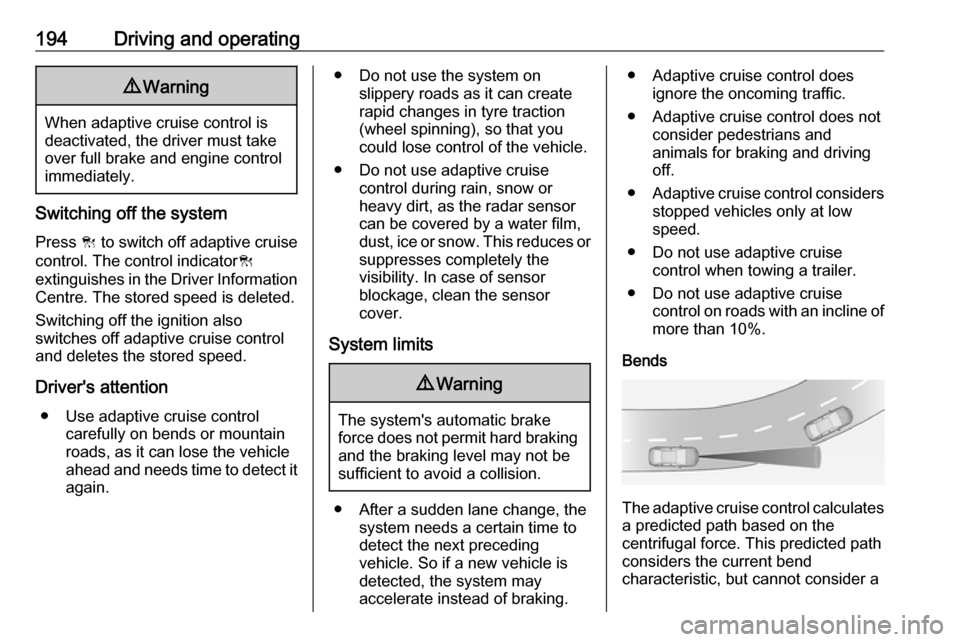
Bends
The adaptive cruise control calculates
a predicted path based on the
centrifugal force. This predicted path
considers the current bend
characteristic, but cannot consider a
Page 197 of 319
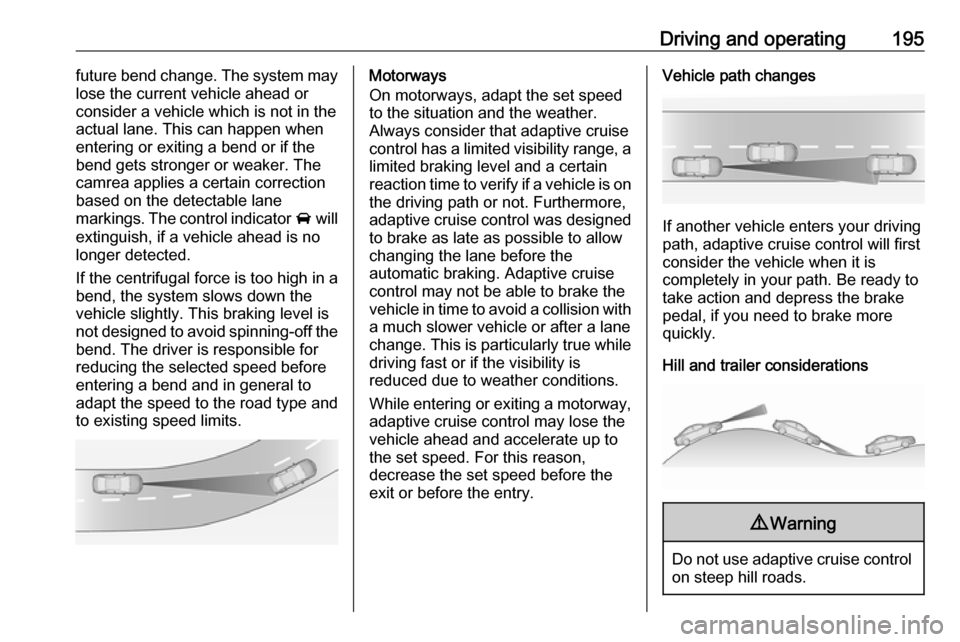
Driving and operating195future bend change. The system may
lose the current vehicle ahead or consider a vehicle which is not in the
actual lane. This can happen when
entering or exiting a bend or if the
bend gets stronger or weaker. The
camrea applies a certain correction
based on the detectable lane
markings. The control indicator A will
extinguish, if a vehicle ahead is no longer detected.
If the centrifugal force is too high in a
bend, the system slows down the
vehicle slightly. This braking level is
not designed to avoid spinning-off the
bend. The driver is responsible for
reducing the selected speed before
entering a bend and in general to
adapt the speed to the road type and
to existing speed limits.Motorways
On motorways, adapt the set speed
to the situation and the weather.
Always consider that adaptive cruise
control has a limited visibility range, a
limited braking level and a certain
reaction time to verify if a vehicle is on
the driving path or not. Furthermore,
adaptive cruise control was designed to brake as late as possible to allow
changing the lane before the
automatic braking. Adaptive cruise
control may not be able to brake the
vehicle in time to avoid a collision with
a much slower vehicle or after a lane
change. This is particularly true while
driving fast or if the visibility is
reduced due to weather conditions.
While entering or exiting a motorway, adaptive cruise control may lose thevehicle ahead and accelerate up to
the set speed. For this reason,
decrease the set speed before the
exit or before the entry.Vehicle path changes
If another vehicle enters your driving
path, adaptive cruise control will first
consider the vehicle when it is
completely in your path. Be ready to
take action and depress the brake
pedal, if you need to brake more
quickly.
Hill and trailer considerations
9 Warning
Do not use adaptive cruise control
on steep hill roads.
Page 198 of 319
196Driving and operatingSystem performance on hills depends
on vehicle speed, vehicle load, traffic
conditions and the road gradient. It
may not detect a vehicle in your path
while driving on hills. Full speed range
adaptive control is deactivated
automatically, as the vehicle is
stopping uphill on an incline greater than 10%. In this condition, be
prepared to take control of the
vehicle.
Note that applying the brake
deactivates the system.
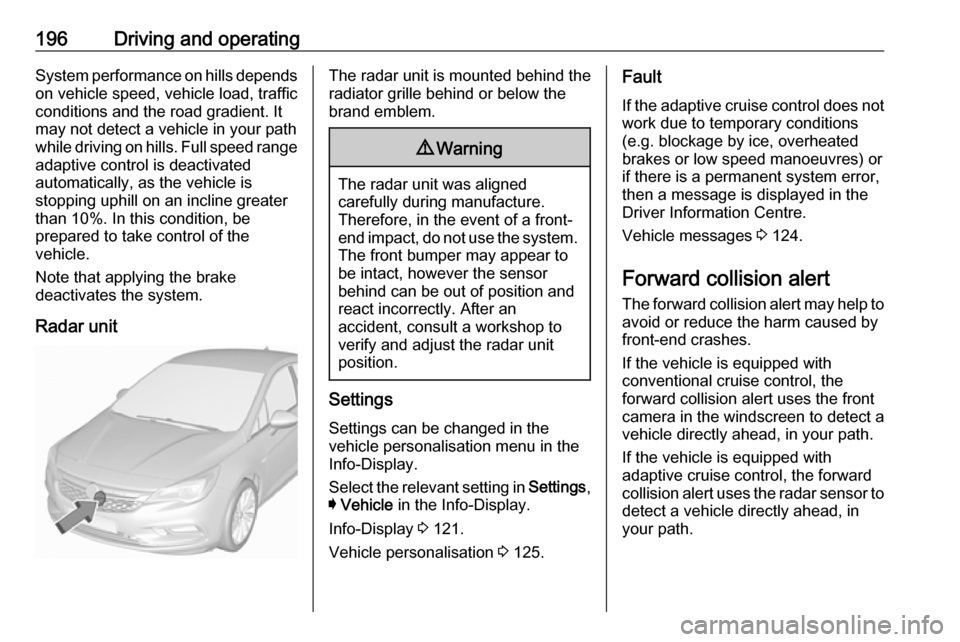
Radar unitThe radar unit is mounted behind the
radiator grille behind or below the
brand emblem.9 Warning
The radar unit was aligned
carefully during manufacture.
Therefore, in the event of a front-
end impact, do not use the system. The front bumper may appear to
be intact, however the sensor
behind can be out of position and
react incorrectly. After an
accident, consult a workshop to
verify and adjust the radar unit
position.
Settings
Settings can be changed in the
vehicle personalisation menu in the
Info-Display.
Select the relevant setting in Settings,
I Vehicle in the Info-Display.
Info-Display 3 121.
Vehicle personalisation 3 125.
Fault
If the adaptive cruise control does not
work due to temporary conditions
(e.g. blockage by ice, overheated
brakes or low speed manoeuvres) or
if there is a permanent system error,
then a message is displayed in the
Driver Information Centre.
Vehicle messages 3 124.
Forward collision alert The forward collision alert may help toavoid or reduce the harm caused by
front-end crashes.
If the vehicle is equipped with
conventional cruise control, the
forward collision alert uses the front
camera in the windscreen to detect a
vehicle directly ahead, in your path.
If the vehicle is equipped with
adaptive cruise control, the forward
collision alert uses the radar sensor to
detect a vehicle directly ahead, in
your path.
Page 200 of 319
198Driving and operating
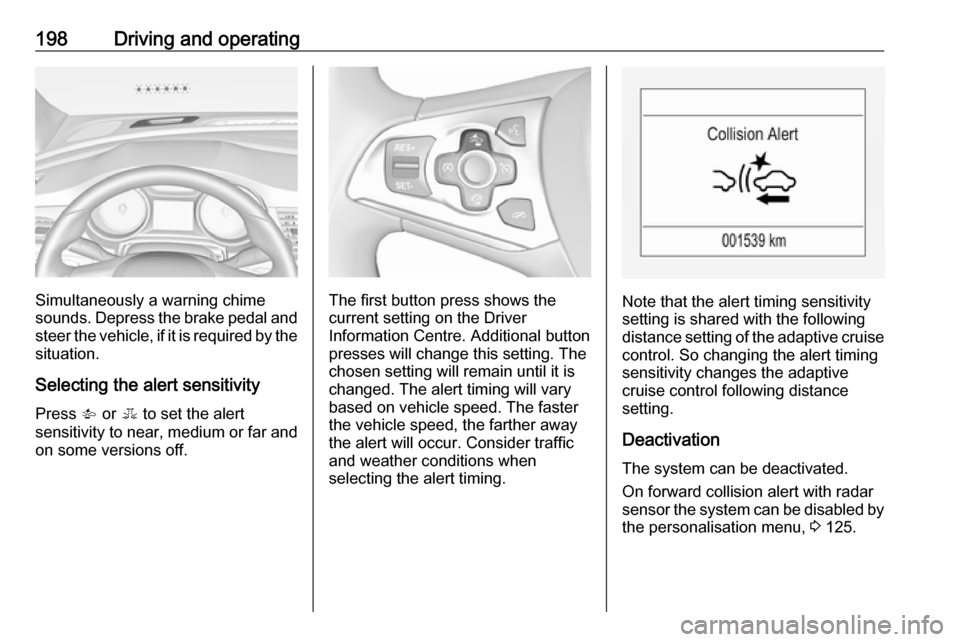
Simultaneously a warning chime
sounds. Depress the brake pedal and
steer the vehicle, if it is required by the
situation.
Selecting the alert sensitivity Press V or E to set the alert
sensitivity to near, medium or far and
on some versions off.The first button press shows the
current setting on the Driver
Information Centre. Additional button
presses will change this setting. The
chosen setting will remain until it is
changed. The alert timing will vary
based on vehicle speed. The faster
the vehicle speed, the farther away
the alert will occur. Consider traffic
and weather conditions when
selecting the alert timing.Note that the alert timing sensitivity
setting is shared with the following
distance setting of the adaptive cruise
control. So changing the alert timing
sensitivity changes the adaptive
cruise control following distance
setting.
Deactivation
The system can be deactivated.
On forward collision alert with radar
sensor the system can be disabled by the personalisation menu, 3 125.
Page 202 of 319
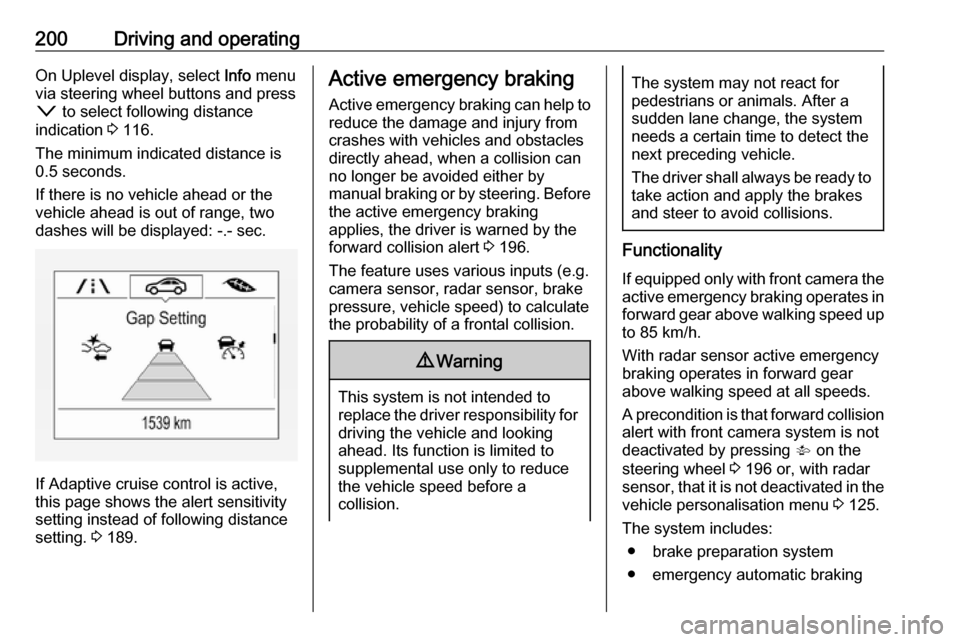
200Driving and operatingOn Uplevel display, select Info menu
via steering wheel buttons and press o to select following distance
indication 3 116.
The minimum indicated distance is 0.5 seconds.
If there is no vehicle ahead or the
vehicle ahead is out of range, two
dashes will be displayed: -.- sec.
If Adaptive cruise control is active,
this page shows the alert sensitivity
setting instead of following distance
setting. 3 189.
Active emergency braking
Active emergency braking can help to reduce the damage and injury from
crashes with vehicles and obstacles
directly ahead, when a collision can no longer be avoided either by
manual braking or by steering. Before the active emergency braking
applies, the driver is warned by the forward collision alert 3 196.
The feature uses various inputs (e.g.
camera sensor, radar sensor, brake
pressure, vehicle speed) to calculate
the probability of a frontal collision.9 Warning
This system is not intended to
replace the driver responsibility for driving the vehicle and looking
ahead. Its function is limited to
supplemental use only to reduce
the vehicle speed before a
collision.
The system may not react for
pedestrians or animals. After a
sudden lane change, the system
needs a certain time to detect the
next preceding vehicle.
The driver shall always be ready to take action and apply the brakes
and steer to avoid collisions.
Functionality
If equipped only with front camera the active emergency braking operates in
forward gear above walking speed up to 85 km/h.
With radar sensor active emergency
braking operates in forward gear
above walking speed at all speeds.
A precondition is that forward collision
alert with front camera system is not
deactivated by pressing V on the
steering wheel 3 196 or, with radar
sensor, that it is not deactivated in the
vehicle personalisation menu 3 125.
The system includes: ● brake preparation system
● emergency automatic braking
Page 314 of 319

312IndexAAccessories and vehicle modifications .......................... 231
Active emergency braking ..........200
Adaptive cruise control .......115, 189
AdBlue ................................ 113, 169
Adjustable air vents ...................155
Airbag and belt tensioners .........110
Airbag deactivation ..............63, 110
Airbag label................................... 58
Airbag system .............................. 58
Air conditioning regular operation ................................ 156
Air conditioning system .............. 148
Air intake .................................... 156
Air vents...................................... 155
Antilock brake system ................ 179
Antilock brake system (ABS) .....112
Anti-theft alarm system ................36
Anti-theft locking system .............. 36
Appearance care ........................277
Armrest ................................... 53, 55
Armrest storage ........................... 72
Ashtrays ..................................... 100
Automatic anti-dazzle ..................41
Automatic light control ...............137
Automatic locking ........................29
Automatic transmission .............172
Autostop ..................................... 163
Auxiliary heater ........................... 155B
Battery discharge protection ......146
Battery voltage ........................... 125 Belts.............................................. 56
BlueInjection ............................... 169
Bonnet ....................................... 233
Brake and clutch fluid .................281
Brake and clutch system ...........111
Brake assist ............................... 182
Brake fluid .................................. 236
Brakes ............................... 179, 236
Breakdown.................................. 275
Bulb replacement ....................... 239
C Capacities .................................. 297
Cargo management system ........82
Catalytic converter .....................169
Central locking system ................24
Centre console lighting ..............145
Changing tyre and wheel size ...264
Charging system ........................ 111 Child locks ................................... 30
Child restraint installation locations ................................... 67
Child restraints.............................. 65
Child restraint systems ................65
Climate control ............................. 16
Climate control systems .............147
Clock............................................. 95
Page 315 of 319

313CNG.................................... 106, 223
Control indicators........................ 109
Control of the vehicle .................158
Controls ........................................ 91
Convex shape .............................. 39
Coolant and antifreeze ...............281
Cruise control ....................115, 185
Cupholders .................................. 71
Curtain airbag system .................. 63
Curve lighting.............................. 138
D
Danger, Warnings and Cautions ...4
Daytime running lights ...............138
Declaration of conformity ............301
DEF ............................................ 169
Diesel exhaust fluid ....................169
Diesel fuel system bleeding .......238
Door open .................................. 115
Doors ............................................ 30
Driver assistance systems ..........185
Driver Information Centre ...........116
Driving characteristics and towing tips .............................. 226
Driving hints ................................ 158
E Electric adjustment ......................39
Electrical system......................... 249
Electric parking brake .........111, 180
Electric parking brake fault .........111Electronic climate control system 150
Electronic driving programmes . ........................................ 174, 179
Electronic key system ...................22
Electronic Stability Control.......... 183
Electronic Stability Control and Traction Control system ..........112
Electronic Stability Control off..... 112
End-of-life vehicle recovery .......232
Engine compartment fuse box ...250
Engine coolant ........................... 235
Engine coolant temperature gauge ..................................... 107
Engine data ............................... 289
Engine exhaust .......................... 168
Engine identification ...................285
Engine oil ................... 234, 281, 286
Engine oil pressure ....................113
Entry lighting .............................. 145
Event data recorders ..................308
Exhaust filter ....................... 113, 168
Exit lighting ................................ 145
Exterior care .............................. 277
Exterior light ............................... 114
Exterior lighting ....................13, 136
Exterior mirrors ............................. 39
F
Fault ................................... 174, 179
First aid kit ................................... 87Fixed air vents ........................... 155
Fog light ..................................... 115
Fog lights ................................... 241
Folding mirrors ............................. 39
Following distance ......................112
Following distance indication ......199
Forward collision alert................. 196
Fragrance diffuser ........................99
Front airbag system .....................62
Front fog lights ........................... 142
Front seats.................................... 47
Front storage ................................ 72
Fuel............................................. 221
Fuel for diesel engines ..............222
Fuel for natural gas operation ...223
Fuel for petrol engines ...............221
Fuel gauge ................................. 106
Fuel selector .............................. 106
Fuses ......................................... 249
G
Gauges ....................................... 104
Gear shifting ............................... 112
General information ...................226
Glovebox ..................................... 71
H Halogen headlights ....................239
Hand brake ......................... 179, 180
Hazard warning flashers ............141
Headlight flash ........................... 137