Seat OPEL ASTRA K 2018 Repair Manual
[x] Cancel search | Manufacturer: OPEL, Model Year: 2018, Model line: ASTRA K, Model: OPEL ASTRA K 2018Pages: 313, PDF Size: 9.35 MB
Page 153 of 313
Climate control151Heated exterior mirrors Ü 3 40.
Heated seats ß 3 54.
Ventilated seats A 3 54.
Heated steering wheel A 3 92.
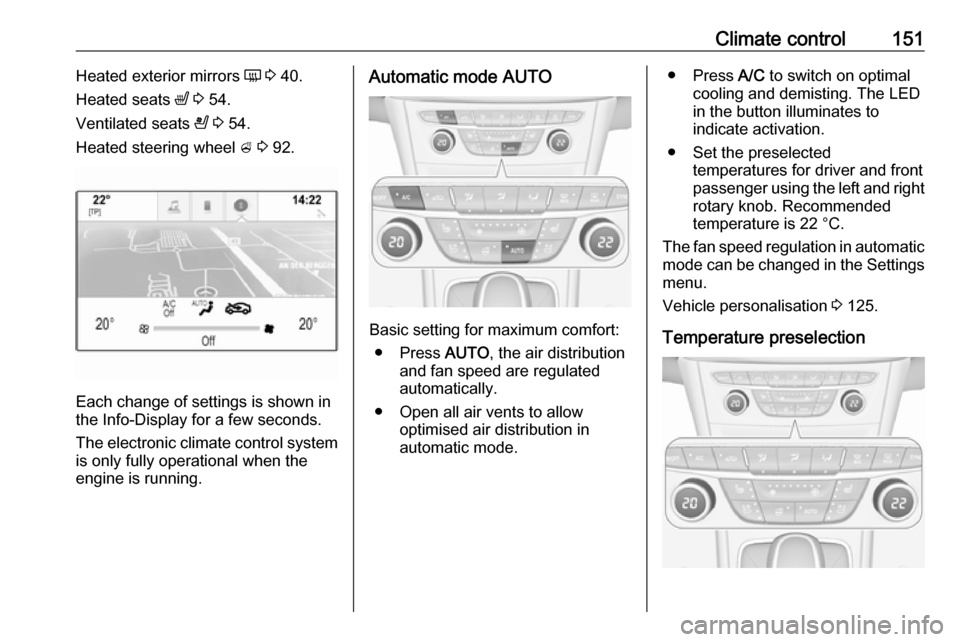
Each change of settings is shown in
the Info-Display for a few seconds.
The electronic climate control system
is only fully operational when the
engine is running.
Automatic mode AUTO
Basic setting for maximum comfort:
● Press AUTO, the air distribution
and fan speed are regulated
automatically.
● Open all air vents to allow optimised air distribution in
automatic mode.
● Press A/C to switch on optimal
cooling and demisting. The LED in the button illuminates to
indicate activation.
● Set the preselected temperatures for driver and front
passenger using the left and right
rotary knob. Recommended
temperature is 22 °C.
The fan speed regulation in automatic mode can be changed in the Settings menu.
Vehicle personalisation 3 125.
Temperature preselection
Page 166 of 313

164Driving and operatingVehicles with automatic transmission
or manual transmission automated
If the vehicle is at a standstill with
depressed brake pedal, Autostop is
activated automatically.
Indication
An Autostop is indicated by the
needle at the AUTOSTOP position in
the tachometer.
After restart, the idle speed is
indicated.
During an Autostop the performance
of the vehicle will be maintained.
Conditions for an Autostop
The stop-start system checks if each
of the following conditions is fulfilled.
● The stop-start system is not manually deactivated.
● The bonnet is fully closed.
● The driver's door is closed or the driver's seat belt is fastened.
● The vehicle battery is sufficiently charged and in good condition.
● The engine is warmed up.
● The engine coolant temperature is not too high.
● The engine exhaust temperature is not too high, e.g. after driving
with high engine load.
● The ambient temperature is above -5 °C.
● The brake vacuum is sufficient.
● Between the last Restart and a new Autostop must be about
10 s.
● The self-cleaning function of the diesel particle filter is not active.●The vehicle was driven at least at
walking speed since the last
Autostop.
● The stop-start system will be deactivated on inclines of 15% or
more.
Otherwise an Autostop will be
inhibited.
Certain settings of the climate control
system may inhibit an Autostop. See
Climate control chapter for more
details 3 148.
Immediately after motorway driving
an Autostop may be inhibited.
New vehicle running-in 3 158.
Vehicle battery discharge protection
To ensure reliable engine restarts,
several vehicle battery discharge
protection features are implemented
as part of the stop-start system.
Power saving measures
During an Autostop, several electrical
features such as auxiliary electric
heater or rear window heating are
disabled or switched to a power
Page 167 of 313

Driving and operating165saving mode. The fan speed of the
climate control system is reduced to
save power.
Restart of the engine by the driverVehicles with manual transmission
Depending on the engine, two
versions of a restart are available.
See engine data to identify the engine
identifier code for your vehicle
3 285.
Conventional restart
Depress the clutch pedal to restart the
engine. For engines with late restart,
this is only possible without
depressing the brake pedal.
Late restart
All petrol engines and the diesel
engines B16DTU and B16DTR have
late restart in addition to conventional
restart. Late restart is only active on
inclines up to 5%.
● Depress the brake pedal.
● Depress the clutch pedal.
● Select first gear.
● Release the brake pedal to restart the engine.Vehicles with automatic transmission
or manual transmission automated:
Release the brake pedal or move
selector lever out of D into N or P to
restart the engine.
Restart of the engine by the stop- start system
On vehicles with manual transmission
which are in a conventional Autostop,
the selector lever must be in neutral
to enable an automatic restart.
On vehicles with manual transmission
which are in an early Autostop, an
automatic restart is possible, when
not in neutral if the brake pedal and
the clutch pedal are depressed.
On vehicles with automatic
transmission or manual transmission
automated, the selector lever must be
in D to enable an automatic restart.
The engine will be restarted
automatically by the stop-start
system, if one of the following
conditions occurs during an Autostop:
● The stop-start system is manually deactivated.
● The bonnet is opened.● The driver's seat belt is unfastened and / or the driver'sdoor is opened.
● The engine temperature is too low.
● The charging level of the vehicle battery is below a defined level.
● The brake vacuum is not sufficient.
● The vehicle is driven at least at walking speed.
● The climate control system requests an engine start.
● The desired compartment temperature does not match the
actual temperature.
● The air conditioning is manually switched on.
If the bonnet is not fully closed, a
warning message is displayed in the
Driver Information Centre.
If an electrical accessory, e.g. a
portable CD player, is connected to
the power outlet, a brief power drop
during the restart might be noticeable.
Page 192 of 313

190Driving and operatingIf this symbol does not display, or
displays briefly, adaptive cruise
control will not respond to vehicles
ahead.
Deactivation
Adaptive cruise control is deactivated by the driver when:
● y is pressed.
● Brake pedal is applied.
● Clutch pedal is depressed for more than four seconds.
● Selector lever of automatic transmission is moved to N.
The system is also automatically
deactivated when:
● Vehicle speed accelerates above
190 km/h or slows down below
55 km/h (on vehicles with
automatic transmission it slows
down to a stop without
deactivating within five minutes).
● The Traction Control system is deactivated or operating.
● The Electronic Stability Control is
deactivated or operating.● There is no traffic and nothing detected on the road sides for
approx. one minute. In this case there are no radar echoes and
the sensor may report that it is
blocked.
● The active emergency braking system is applying the brakes.
● Driving on steep inclines.
● The radar sensor is blocked by an ice or water film.
● A fault is detected in the radar, camera, engine or brake system.
● The brakes are too hot.
Additionally, the system is
automatically deactivated on vehicles with automatic transmission (full
speed range adaptive cruise control)
when:
● The electric parking brake is applied.
● The vehicle is being held to a stop
by the system for more than
five minutes.
● The vehicle stops, the driver's seat belt is unbuckled and the
driver's door is opened.When adaptive cruise control is
deactivated, the control indicator m
changes from green to white and a
pop-up message is displayed in the
Driver Information Centre.
The stored speed is maintained.
On Midlevel display, the stored speed is indicated in brackets in the Driver
Information Centre when the system
is deactivated but not switched off.
On Uplevel display, the adaptive
cruise control symbol C changes
from green to white when the system
is deactivated but not switched off.
9 Warning
When adaptive cruise control is
deactivated, the driver must take
over full brake and engine control.
Page 200 of 313

198Driving and operatingonly occur if a vehicle ahead is
detected, indicated by the vehicle ahead indicator A 3 193.
If equipped only with front camera the
system operates up to a speed of 60
km/h.
Below a speed of 40 km/h the system can apply full braking.
Emergency automatic braking may
slow the vehicle to a complete stop to
try to avoid a potential crash. If this
happens, emergency automatic
braking may engage the electric
parking brake to hold the vehicle at a
stop. To release press the electric
parking brake button or firmly press
the accelerator pedal.9 Warning
Emergency automatic braking is
an emergency crash preparation
feature and is not designed to
avoid crashes. Do not rely on the
system to brake the vehicle.
Emergency automatic braking will
not brake outside of its operating speed range and only responds to
detected vehicles.
Forward looking brake assist
In addition to the brake preparation
system and emergency automatic
braking, the forward looking brake
assist function makes the brake assist more sensitive. Therefore, pressing
the brake pedal less strongly results
in immediate hard braking. This
function helps the driver brake
quicker and harder before the
imminent collision.
If equipped only with front camera the
system operates up to a speed of 85
km/h.9 Warning
Active emergency braking is not
designed to apply hard
autonomous braking or to
automatically avoid a collision. It is designed to reduce the vehicle
speed before a collision. It may not
react for pedestrians or animals.
After a sudden lane change, the
system needs a certain time to
detect the next preceding vehicle.
The complete attention of the
driver is always required while
driving. The driver shall always be ready to take action and apply the
brakes and steer to avoid
collisions. The system is designed to work with all occupants wearingtheir seat belts.
Intelligent Brake Assist
If the vehicle is equipped with radar
sensor Intelligent brake assist may
activate when the brake pedal is
applied quickly by providing a boost
to braking based on the speed of
approach and distance to a vehicle
ahead.
Minor brake pedal pulsations or pedal movement during this time is normal
and the brake pedal should continue to be applied as needed. Intelligent
brake assist will automatically
disengage only when the brake pedal is released.
Page 235 of 313

Vehicle care233Vehicle battery
The vehicle battery is located in the
load compartment under the rear floor cover behind the rear seats. Rear
floor cover 3 81.
There are connecting points for jump starting in the engine compartment.
Jump starting 3 269.
The vehicle battery is maintenance-
free provided that the driving profile
allows sufficient charging of the
battery. Short-distance-driving and
frequent engine starts can discharge
the battery. Avoid the use of
unnecessary electrical consumers.
Batteries do not belong in household
waste. They must be disposed of at
an appropriate recycling collection
point.
Laying up the vehicle for more than
four weeks can lead to battery
discharge. Disconnect the clamp from
the negative terminal of the vehicle
battery.
Ensure the ignition is switched off
before connecting or disconnecting
the vehicle battery.
Battery discharge protection 3 146.
Disconnecting the battery
If the vehicle's battery is to be
disconnected (e.g. for maintenance
work), the alarm siren must be
deactivated as follows: Switch the ignition on then off, then disconnect
the vehicle's battery within
15 seconds.
Replacing the vehicle battery
Note
Any deviation from the instructions
given in this section may lead to
temporary deactivation or
disturbance of the stop-start system.
When the vehicle battery is being
replaced, please ensure that there
are no open ventilation holes in the
vicinity of the positive terminal. If a
ventilation hole is open in this area, it
must be closed off with a dummy cap,
and the ventilation in the vicinity of the negative terminal must be opened.
Ensure that the battery is always
replaced by the same type of battery.
We recommend that you have the
vehicle battery replaced by a
workshop.
Stop-start system 3 163.
Page 249 of 313
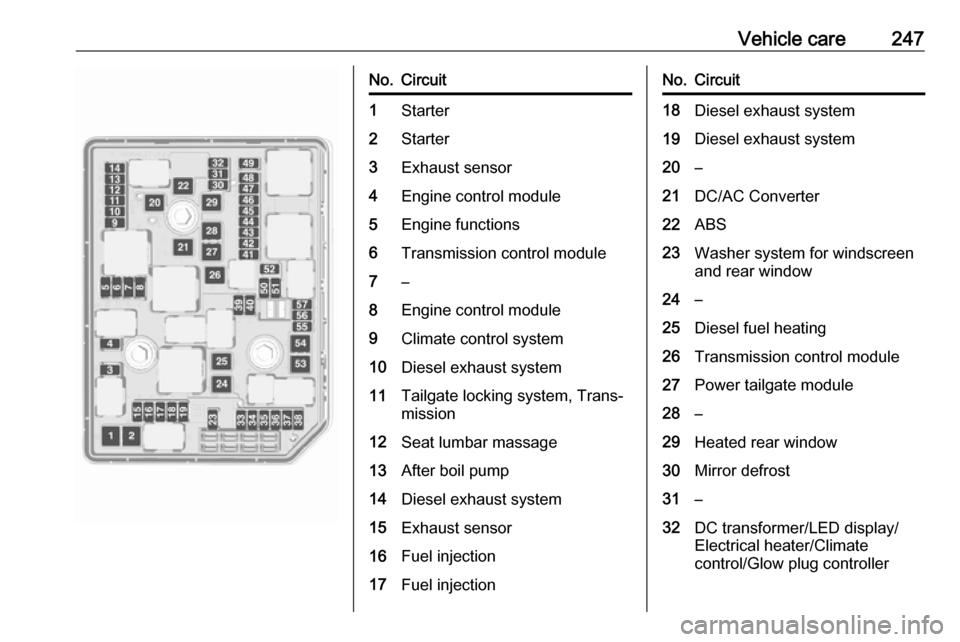
Vehicle care247No.Circuit1Starter2Starter3Exhaust sensor4Engine control module5Engine functions6Transmission control module7–8Engine control module9Climate control system10Diesel exhaust system11Tailgate locking system, Trans‐
mission12Seat lumbar massage13After boil pump14Diesel exhaust system15Exhaust sensor16Fuel injection17Fuel injectionNo.Circuit18Diesel exhaust system19Diesel exhaust system20–21DC/AC Converter22ABS23Washer system for windscreen
and rear window24–25Diesel fuel heating26Transmission control module27Power tailgate module28–29Heated rear window30Mirror defrost31–32DC transformer/LED display/
Electrical heater/Climate
control/Glow plug controller
Page 251 of 313
Vehicle care249
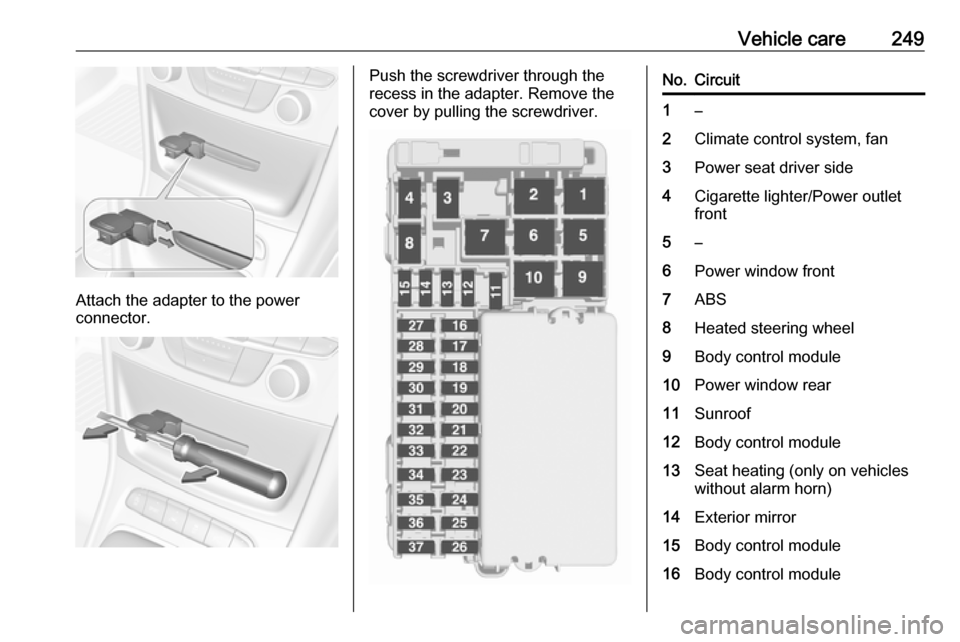
Attach the adapter to the power
connector.
Push the screwdriver through the
recess in the adapter. Remove the
cover by pulling the screwdriver.No.Circuit1–2Climate control system, fan3Power seat driver side4Cigarette lighter/Power outlet
front5–6Power window front7ABS8Heated steering wheel9Body control module10Power window rear11Sunroof12Body control module13Seat heating (only on vehicles
without alarm horn)14Exterior mirror15Body control module16Body control module
Page 252 of 313
250Vehicle careNo.Circuit17Body control module18Body control module19Data link connector20Airbag system21Climate control system22Central locking system, tailgate23Electronic key system24Power seat memory function25Airbag system steering wheel26Ignition switch/Steering column
lock27Body control module28USB socket29–30Selector lever31Rear window wiper32Transmission control moduleNo.Circuit33Anti-theft alarm system/Power
sounder34Parking assist/Side blind spot
alert/Infotainment system/USB
socket35OnStar36Info display/Instrument cluster/ CD player37Infotainment system, radio
After having changed defective fuses,
close the fuse box cover and press
until it engages.
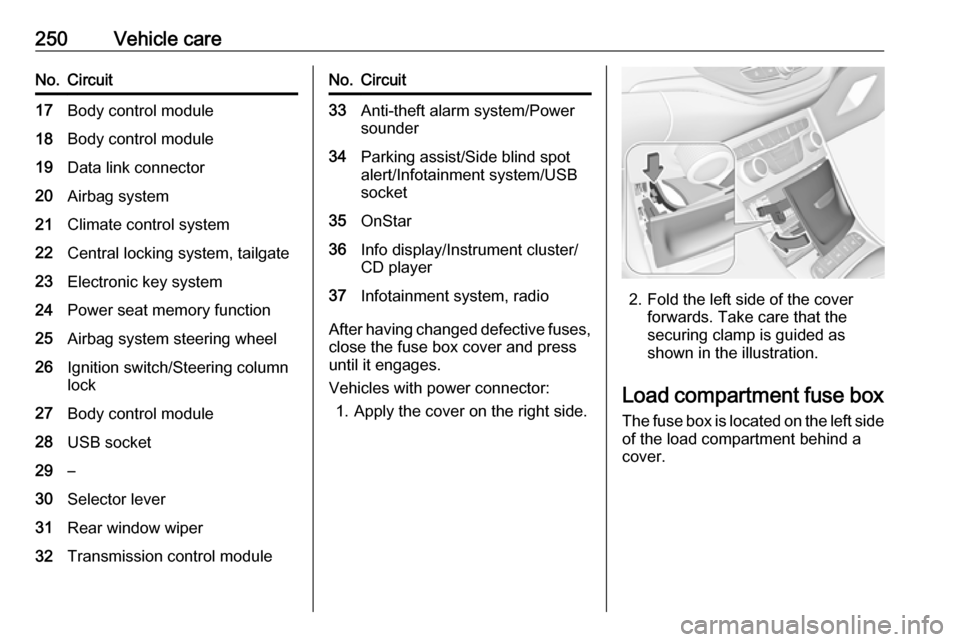
Vehicles with power connector: 1. Apply the cover on the right side.
2. Fold the left side of the cover forwards. Take care that the
securing clamp is guided as
shown in the illustration.
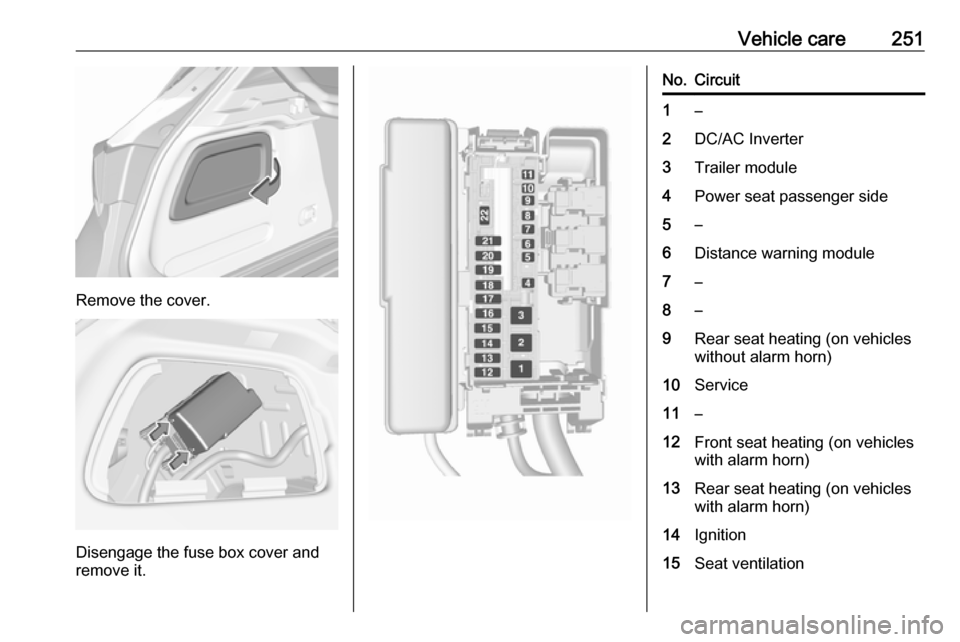
Load compartment fuse box
The fuse box is located on the left side
of the load compartment behind a
cover.
Page 253 of 313
Vehicle care251
Remove the cover.
Disengage the fuse box cover and
remove it.
No.Circuit1–2DC/AC Inverter3Trailer module4Power seat passenger side5–6Distance warning module7–8–9Rear seat heating (on vehicles
without alarm horn)10Service11–12Front seat heating (on vehicles
with alarm horn)13Rear seat heating (on vehicles
with alarm horn)14Ignition15Seat ventilation