trans OPEL ASTRA K 2019.5 Service Manual
[x] Cancel search | Manufacturer: OPEL, Model Year: 2019.5, Model line: ASTRA K, Model: OPEL ASTRA K 2019.5Pages: 311, PDF Size: 9.52 MB
Page 274 of 311
272Vehicle care
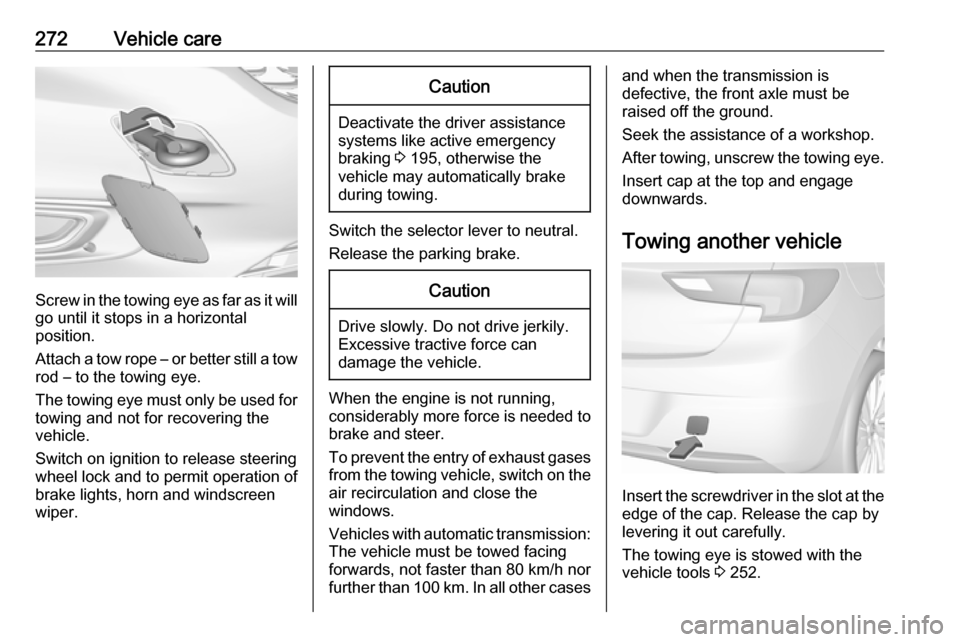
Screw in the towing eye as far as it will
go until it stops in a horizontal
position.
Attach a tow rope – or better still a tow
rod – to the towing eye.
The towing eye must only be used for towing and not for recovering the
vehicle.
Switch on ignition to release steering
wheel lock and to permit operation of
brake lights, horn and windscreen
wiper.
Caution
Deactivate the driver assistance
systems like active emergency
braking 3 195, otherwise the
vehicle may automatically brake during towing.
Switch the selector lever to neutral.
Release the parking brake.
Caution
Drive slowly. Do not drive jerkily.
Excessive tractive force can
damage the vehicle.
When the engine is not running,
considerably more force is needed to
brake and steer.
To prevent the entry of exhaust gases from the towing vehicle, switch on the
air recirculation and close the
windows.
Vehicles with automatic transmission: The vehicle must be towed facing
forwards, not faster than 80 km/h nor further than 100 km. In all other cases
and when the transmission is
defective, the front axle must be
raised off the ground.
Seek the assistance of a workshop.
After towing, unscrew the towing eye.
Insert cap at the top and engage
downwards.
Towing another vehicle
Insert the screwdriver in the slot at the edge of the cap. Release the cap by
levering it out carefully.
The towing eye is stowed with the
vehicle tools 3 252.
Page 288 of 311
![OPEL ASTRA K 2019.5 Service Manual 286Technical dataPerformance
5-door HatchbackEngineD10XFLD14XFLB14XFT / D14XFT
D14XNT
CNG
D16SHT
Maximum speed [km/h]Manual transmission195/188 5)205215195235Automatic transmission––210–2355)
Ec](/img/37/18788/w960_18788-287.png "OPEL ASTRA K 2019.5 Service Manual 286Technical dataPerformance
5-door HatchbackEngineD10XFLD14XFLB14XFT / D14XFT
D14XNT
CNG
D16SHT
Maximum speed [km/h]Manual transmission195/188 5)205215195235Automatic transmission––210–2355)
Ec")
286Technical dataPerformance
5-door HatchbackEngineD10XFLD14XFLB14XFT / D14XFT
D14XNT
CNG
D16SHT
Maximum speed [km/h]Manual transmission195/188 5)205215195235Automatic transmission––210–2355)
Ecotec versionEngineD16DTND16DTID16DTHMaximum speed [km/h]Manual transmission200200213Automatic transmission––208
Page 289 of 311
![OPEL ASTRA K 2019.5 Service Manual Technical data287Sports Tourer
EngineD10XFLD14XFLD14XFT
D14XNT
CNG
D16SHT
Maximum speed [km/h]Manual transmission195/187 5)205215195235Automatic transmission––210–2355)
Ecotec versionEngineD16DT](/img/37/18788/w960_18788-288.png "OPEL ASTRA K 2019.5 Service Manual Technical data287Sports Tourer
EngineD10XFLD14XFLD14XFT
D14XNT
CNG
D16SHT
Maximum speed [km/h]Manual transmission195/187 5)205215195235Automatic transmission––210–2355)
Ecotec versionEngineD16DT")
Technical data287Sports Tourer
EngineD10XFLD14XFLD14XFT
D14XNT
CNG
D16SHT
Maximum speed [km/h]Manual transmission195/187 5)205215195235Automatic transmission––210–2355)
Ecotec versionEngineD16DTID16DTHD16DTNMaximum speed [km/h]Manual transmission200212200Automatic transmission–207–
Page 295 of 311

Customer information293Customer
informationCustomer information ................293
Declaration of conformity .........293
REACH .................................... 297
Software acknowledgement ....297
Software update ......................299
Registered trademarks ............300
Vehicle data recording and pri‐ vacy ........................................... 300
Event data recorders ...............300
Radio Frequency Identification (RFID) ..................................... 303Customer information
Declaration of conformity
Radio transmission systems
This vehicle has systems that
transmit and / or receive radio waves
subject to Directive 2014/53/EU. The
manufacturers of the systems listed
below declare conformity with
Directive 2014/53/EU. The full text of
the EU declaration of conformity for each system is available at the
following internet address:
www.opel.com/conformity.
Importer is
Opel / Vauxhall, Bahnhofsplatz,
65423 Ruesselsheim am Main,
Germany.
Antenna
Laird
8100 Industrial Park Drive, Grand
Blanc, MI, 48439, USA
Operation frequency: N/A
Maximum output: N/AAntenna
Kathrein Automotive North America,
Inc.
3967 W. Hamlin Rd., Rochester Hills, MI 48309, USA
Operation frequency: N/A
Maximum output: N/A
Electronic key
Denso Coperation
Waldeckerstraße 11, 64546
Mörfelden-Walldorf, Germany
Operation frequency: 433,92 MHz
Maximum output: -5,88 dBm
Electronic key module
Denso Coperation
Waldeckerstraße 11, 64546
Mörfelden-Walldorf, Germany
Operation frequency: 125 kHz
Maximum output: -0,14 dBm
Front radar unit
Continental Automotive GmbH
ADC Automotive Distance Control
Systems GmbH, Peter-Dornier-
Straße 10, 88131 Lindau, Germany
Page 297 of 311

Customer information295Parking heater remote conrtol
transmitter
Webasto Thermo & Comfort SE
Friedrichshafener Straße 9, 82205 Gilching, Germany
Operation frequency: 869,0 MHz
Maximum output: 14 dBm
Radio remote control receiver
Robert Bosch GmbH
Robert Bosch Platz 1, 70839
Gerlingen, Germany
Operation frequency: 433.92 MHz
Maximum output: N/A
Radio remote control transmitter
Robert Bosch GmbH
Robert Bosch Platz 1, 70839
Gerlingen, Germany
Operation frequency: 433.92 MHz
Maximum output: -9 dbm
Tyre pressure sensors
Schrader Electronics Ltd.
11 Technology Park, Belfast Road,
Antrim BT41 1QS, Northern Ireland,
United KingdomOperation frequency: 433.92 MHz
Maximum output: 10 dBm
Page 299 of 311

Customer information297Translation of the original declaration
of conformity
Declaration of conformity according
to EC Directive 2006/42/EC
We declare that the product:
Product designation: Jack
Type/GM part number: 13512620
is in compliance with the provisions of
Directive 2006/42/EC.
Applied technical standards:GMN9737:jackingGM 14337:standard equipment
jack – hardware
testsGMN5127:vehicle integrity –
hoisting and service station jackingGMW15005:standard equipment
jack and spare tyre,
vehicle testISO TS 16949:quality
management
systemsThe signatory is authorised to
compile the technical documentation.
Rüsselsheim, 27th November 2015
signed by
André-Alexander Konter
Engineering Group Manager Tyre
and Wheel Systems
Adam Opel AG
D-65423 Rüsselsheim
CRAN type approval numbers
List of all Communications
Regulatory Authority of Namibia
(CRAN) type approval numbers:
TA-2017/3397, TA-2017/3398,
TA-2017/3399, TA-2017/3443REACH
Registration, Evaluation,
Authorisation and Restriction of
Chemicals (REACH) is a European
Union regulation adopted to improve
the protection of human health and
the environment from the risks that
can be posed by chemicals. Visit
www.opel.com/reach for further
information and for access to the
Article 33 communication.
Software acknowledgement Certain OnStar components include
libcurl and unzip software and other
third party software. Below are the
notices and licenses associated with
libcurl and unzip and for other third
party software please see http://
www.lg.com/global/support/
opensource/index.
libcurl Copyright and permission notice
Copyright (c) 1996 - 2010, Daniel
Stenberg,
All rights reserved.
Page 303 of 311

Customer information301Operating data in the vehicleControl units process data for
operation of the vehicle.
This data includes, e.g.: ● vehicle status information (e.g. wheel rotation rate, speed,
movement delay, lateral
acceleration, "seatbelts
fastened" display),
● ambient conditions (e.g. temperature, rain sensor,
distance sensor).
As a rule such data is transient, not
stored for longer than an operational
cycle, and only processed on board
the vehicle itself. Control units often
include data storage (including the
vehicle key). This is used to allow information to be documented
temporarily or permanently on vehicle
condition, component stress,
maintenance requirements and
technical events and errors.Depending on the technical
equipment level, the data stored is as follows:
● system component operating states (e.g. fill level, tyre
pressure, battery status)
● faults and defects in important system components (e.g. lights,
brakes)
● system reactions in special driving situations (e.g. triggering
of an airbag, actuation of the
stability control systems)
● information on events damaging the vehicle
● for electric vehicles the amount of
charge in the high-voltage
battery, estimated range
In special cases (e.g. if the vehicle
has detected a malfunction), it may be
necessary to save data that would
otherwise just be volatile.
When you use services (e.g. repairs,
maintenance), the operating data
saved can be read together with the
vehicle identification number and
used when necessary. Staff working
for the service net-work ( e.g. garages,manufacturers) or third parties (e.g.
breakdown services) can read the
data from the vehicle. The same
applies to warranty work and quality
assurance measures.
Data is generally read via the OBD
(On-Board Diagnostics) port
prescribed by law in the vehicle. The operating data which is read out,
documents the technical condition of
the vehicle or individual components
and assists with fault diagnosis,
compliance with warranty obligations
and quality improvement. This data,
in particular information on
component stress, technical events,
operator errors and other faults, is
transmitted to the manufacturer
where appropriate, together with the
vehicle identification number. The
manufacturer is also subject to
product liability. The manufacturer
potentially also uses operating data
from vehicles for product recalls. This
data can also be used to check
customer warranty and guarantee
claims.
Page 304 of 311

302Customer informationFault memories in the vehicle can be
reset by a service company when
carrying out servicing or repairs or at
your request.
Comfort and infotainment
functions
Comfort settings and custom settings can be stored in the vehicle and
changed or reset at any time.
Depending on the equipment level in
question, these include
● seat and steering wheel position settings
● chassis and air conditioning settings
● custom settings such as interior lighting
You can input your own data in the
infotainment functions for your
vehicle as part of the selected
features.Depending on the equipment level in
question, these include
● multimedia data such as music, videos or photos for playback in
an integrated multimedia system
● address book data for use with an
integrated hands-free system or
an integrated navigation system
● input destinations
● data on the use of online services
This data for comfort and
infotainment functions can be stored
locally in the vehicle or be kept on a
device that you have connected to the
vehicle ( e.g. a smartphone, USB stick
or MP3 player). Data that you have
input yourself can be deleted at any
time.
This data can only be transmitted out
of the vehicle at your request,
particularly when using online
services in accordance with the
settings selected by you.Smartphone integration, e.g.
Android Auto or Apple CarPlay
If your vehicle is equipped
accordingly, you can connect your
smartphone or another mobile device to the vehicle so that you can control
it via the controls integrated in the
vehicle. The smartphone image and
sound can be output via the
multimedia system in this case. At the
same time, specific information is
transmitted to your smartphone.
Depending on the type of integration, this includes data such as position
data, day / night mode and other
general vehicle information. For more
information, please see the operating
instructions for the vehicle /
infotainment system.
Integration allows selected
smartphone apps to be used, such as navigation or music playback. No
further integration is possible
between smartphone and vehicle, in
particular active access to vehicle
data. The nature of further data
processing is determined by the
provider of the app used. Whether
you can define settings, and if so
Page 305 of 311

Customer information303which ones, is dependent on the app
in question and your smartphone's
operating system.
Online services
If your vehicle has a radio network
connection, this allows data to be
exchanged between your vehicle and other systems. The radio network
connection is made possible by
means of a transmitter device in your
vehicle or a mobile device provided
by you (e.g. a smartphone). Online
functions can be used via this radio
network connection. These include
online services and applications /
apps provided to you by the
manufacturer or other providers.
Proprietary services In the case of the manufacturer's
online services, the relevant functions are described by the manufacturer in
an appropriate location (e.g. Owner's
Manual, the manufacturer's website)
and the associated data protection
information is provided. Personal
data may be used to provide online
services. Data exchange for thispurpose takes place via a protected
connection, e.g. using the
manufacturer's IT systems provided
for the purpose. Collection,
processing and use of personal data
for the purposes of preparation of
services take place solely on the
basis of legal permission, e.g. in the case of a legally prescribed
emergency communication system or
a contractual agreement, or by virtue
of consent.
You can activate or deactivate the
services and functions (which are
subject to charges to some extent)
and, in some cases, the vehicle's
entire radio network connection. This
does not include statutory functions
and services such as an emergency
communication system.
Third party servicesIf you make use of online services
from other providers (third parties),
these services are subject to the
liability and data protection and usage
conditions of the provider in question.The manufacturer frequently has no
influence over the content exchanged
in this regard.
Therefore, please note the nature,
scope and purpose of the collection
and use of personal data within the
scope of third party services provided by the service provider in question.
Radio Frequency
Identification (RFID)
RFID technology is used in some
vehicles for functions such as tyre
pressure monitoring and immobiliser. It is also used in connection with
conveniences such as radio remote
controls for door locking / unlocking and starting. RFID technology in Opel
vehicles does not use or record
personal information or link with any
other Opel system containing
personal information.
Page 306 of 311

304IndexAAccessories and vehicle modifications .......................... 227
Active emergency braking ..........195
Adaptive cruise control .......113, 185
AdBlue ................................ 111, 169
Adjustable air vents ...................155
Airbag and belt tensioners .........108
Airbag deactivation ..............63, 108
Airbag label................................... 58
Airbag system .............................. 58
Air conditioning regular operation ................................ 156
Air conditioning system .............. 148
Air intake .................................... 156
Air vents...................................... 155
Antilock brake system ................ 175
Antilock brake system (ABS) .....110
Anti-theft alarm system ................36
Anti-theft locking system .............. 36
Appearance care ........................273
Armrest ................................... 53, 55
Armrest storage ........................... 72
Ashtrays ....................................... 98 Automatic anti-dazzle ..................41
Automatic light control ...............136
Automatic locking ........................29
Automatic transmission .............172
Autostop ..................................... 163
Auxiliary heater ........................... 155B
Battery discharge protection ......145
Battery voltage ........................... 123 Belts.............................................. 56
BlueInjection ............................... 169
Bonnet ....................................... 229
Brake and clutch fluid .................278
Brake and clutch system ...........109
Brake assist ............................... 178
Brake fluid .................................. 232
Brakes ............................... 175, 232
Breakdown.................................. 271
Bulb replacement ....................... 235
C Capacities .................................. 289
Cargo management system ........82
Catalytic converter .....................168
Central locking system ................24
Centre console lighting ..............144
Changing tyre and wheel size ...260
Charging system ........................ 109 Child locks ................................... 30
Child restraint installation locations ................................... 67
Child restraints.............................. 65
Child restraint systems ................65
Climate control ............................. 16
Climate control systems .............147
Clock............................................. 95