brake light OPEL ASTRA K 2019 Manual user
[x] Cancel search | Manufacturer: OPEL, Model Year: 2019, Model line: ASTRA K, Model: OPEL ASTRA K 2019Pages: 317, PDF Size: 9.56 MB
Page 243 of 317
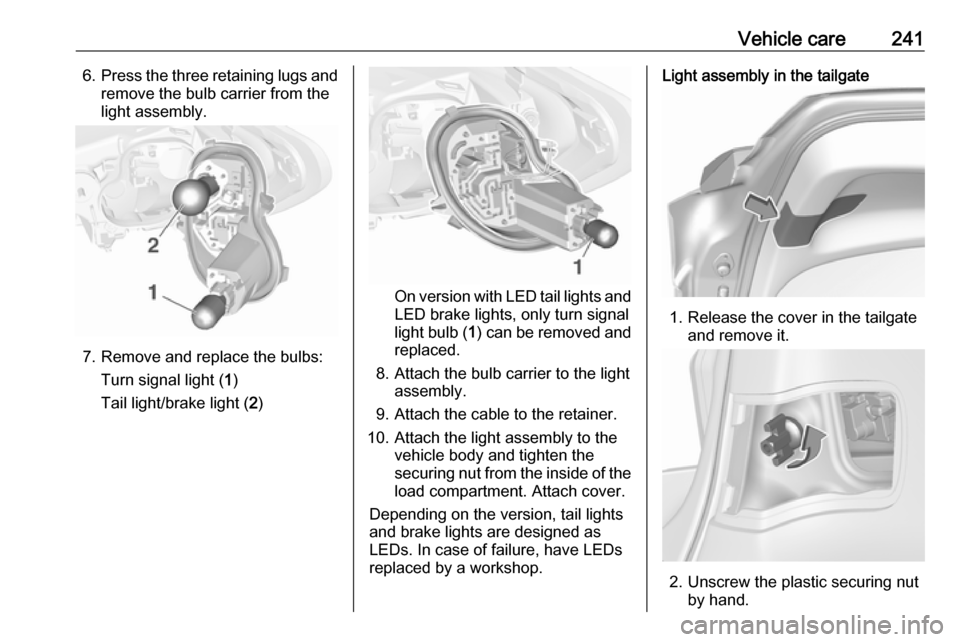
Vehicle care2416.Press the three retaining lugs and
remove the bulb carrier from the
light assembly.
7. Remove and replace the bulbs:
Turn signal light ( 1)
Tail light/brake light ( 2)
On version with LED tail lights and
LED brake lights, only turn signal
light bulb ( 1) can be removed and
replaced.
8. Attach the bulb carrier to the light assembly.
9. Attach the cable to the retainer.
10. Attach the light assembly to the vehicle body and tighten the
securing nut from the inside of the load compartment. Attach cover.
Depending on the version, tail lights
and brake lights are designed as
LEDs. In case of failure, have LEDs replaced by a workshop.
Light assembly in the tailgate
1. Release the cover in the tailgate and remove it.
2. Unscrew the plastic securing nutby hand.
Page 246 of 317
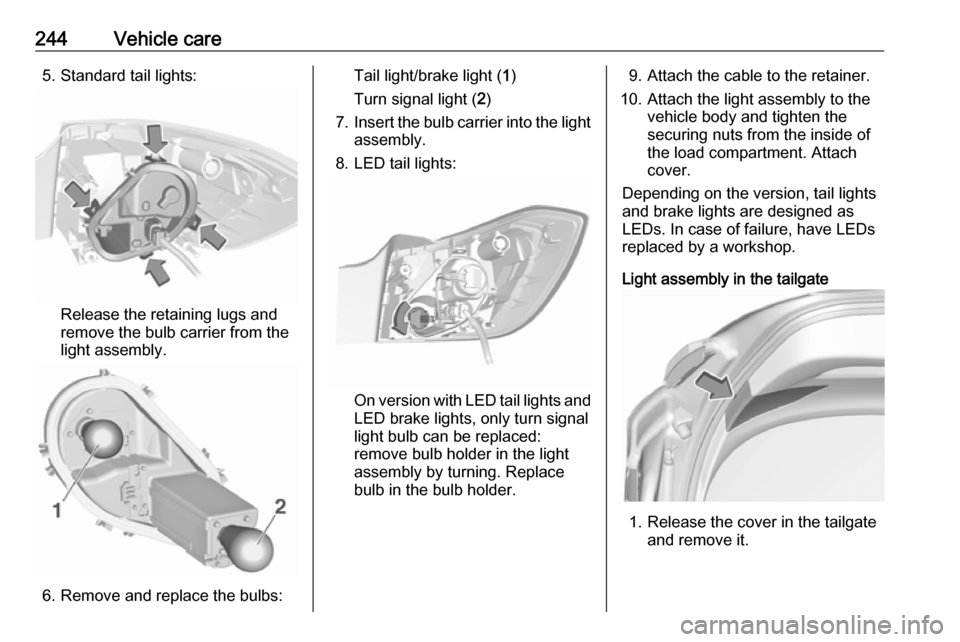
244Vehicle care5. Standard tail lights:
Release the retaining lugs and
remove the bulb carrier from the
light assembly.
6. Remove and replace the bulbs:
Tail light/brake light ( 1)
Turn signal light ( 2)
7. Insert the bulb carrier into the light
assembly.
8. LED tail lights:
On version with LED tail lights and
LED brake lights, only turn signal
light bulb can be replaced:
remove bulb holder in the light
assembly by turning. Replace
bulb in the bulb holder.
9. Attach the cable to the retainer.
10. Attach the light assembly to the vehicle body and tighten the
securing nuts from the inside of
the load compartment. Attach
cover.
Depending on the version, tail lights
and brake lights are designed as
LEDs. In case of failure, have LEDs
replaced by a workshop.
Light assembly in the tailgate
1. Release the cover in the tailgate and remove it.
Page 261 of 317
Vehicle care259Vehicle loading statusAdjust tyre pressure to load condition
according to the tyre information label or tyre pressure chart 3 295, and
select the appropriate setting in the menu Tyre Load in the Driver
Information Centre, Vehicle
Information Menu 3 115. This setting
is the reference for the tyre pressure
warnings.
The Tyre load menu only appears
when the vehicle is at a standstill and the parking brake is applied. On
vehicles with automatic transmission
the selector lever must be in P.
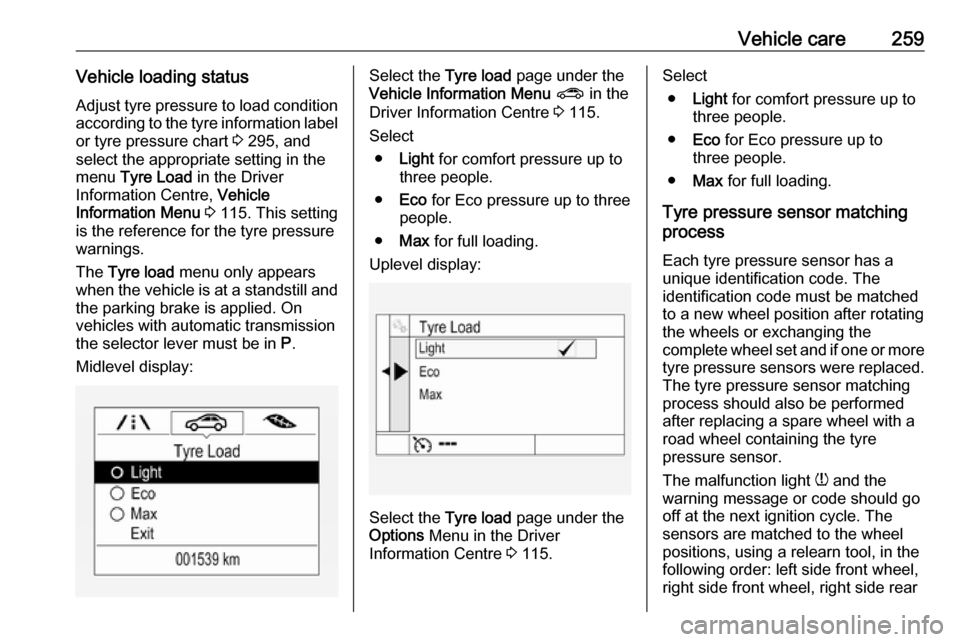
Midlevel display:Select the Tyre load page under the
Vehicle Information Menu ? in the
Driver Information Centre 3 115.
Select ● Light for comfort pressure up to
three people.
● Eco for Eco pressure up to three
people.
● Max for full loading.
Uplevel display:
Select the Tyre load page under the
Options Menu in the Driver
Information Centre 3 115.
Select
● Light for comfort pressure up to
three people.
● Eco for Eco pressure up to
three people.
● Max for full loading.
Tyre pressure sensor matching
process
Each tyre pressure sensor has a
unique identification code. The
identification code must be matched
to a new wheel position after rotating the wheels or exchanging the
complete wheel set and if one or more tyre pressure sensors were replaced.
The tyre pressure sensor matching
process should also be performed
after replacing a spare wheel with a
road wheel containing the tyre
pressure sensor.
The malfunction light w and the
warning message or code should go
off at the next ignition cycle. The
sensors are matched to the wheel
positions, using a relearn tool, in the following order: left side front wheel,
right side front wheel, right side rear
Page 262 of 317
260Vehicle carewheel and left side rear wheel. Theturn signal light at the current active
position is illuminated until sensor is
matched.
Consult a workshop for service. There are two minutes to match the first
wheel position, and five minutes
overall to match all four wheel
positions. If it takes longer, the
matching process stops and must be
restarted.
The tyre pressure sensor matching
process is:
1. Apply the parking brake.
2. Turn the ignition on.
3. On vehicles with automatic transmission: set the selector
lever to P.
On vehicles with manual
transmission: select neutral.
4. Midlevel display: Use MENU on the turn signal
lever to select the Vehicle
Information Menu ? in the
Driver Information Centre.
Uplevel display:Press p on the steering wheel to
open main menu page.
Select the Info page with Q or P.
Confirm with 9.
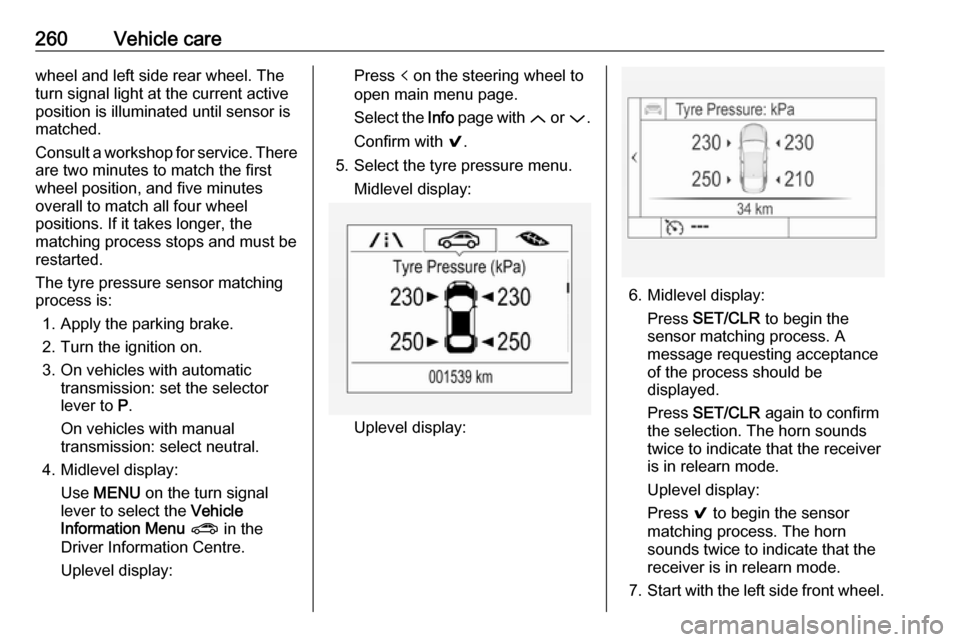
5. Select the tyre pressure menu. Midlevel display:
Uplevel display:
6. Midlevel display:Press SET/CLR to begin the
sensor matching process. A
message requesting acceptance
of the process should be
displayed.
Press SET/CLR again to confirm
the selection. The horn sounds
twice to indicate that the receiver
is in relearn mode.
Uplevel display:
Press 9 to begin the sensor
matching process. The horn
sounds twice to indicate that the receiver is in relearn mode.
7. Start with the left side front wheel.
Page 274 of 317

272Vehicle care● Do not lean over the vehiclebattery during jump starting.
● Do not allow the terminals of one
lead to touch those of the other
lead.
● The vehicles must not come into contact with each other during
the jump starting process.
● Apply the parking brake, transmission in neutral,
automatic transmission in P.
● Open the positive terminal protection cap of your vehicle in
the engine compartment and of
the booster vehicle battery.Lead connection order:
1. Connect the red lead to the positive terminal of the booster
vehicle battery.
2. Connect the other end of the red lead to the positive terminal of
your vehicle near the fuse box in
the engine compartment.
3. Connect the black lead to the negative terminal of the booster
vehicle battery.
4. Connect the other end of the black
lead to a vehicle grounding point
of your vehicle in the engine
compartment.
Route the leads so that they cannot
catch on rotating parts in the engine
compartment.
To start the engine: 1. Start the engine of the vehicle providing the jump.
2. After five minutes, start the other engine. Start attempts should be
made for no longer than
15 seconds at an interval of one
minute.3. Allow both engines to idle for approx. three minutes with the
leads connected.
4. Switch on electrical consumers (e.g. headlights, heated rear
window) of the vehicle receiving
the jump start.
5. Reverse above sequence exactly when removing leads.
Page 275 of 317
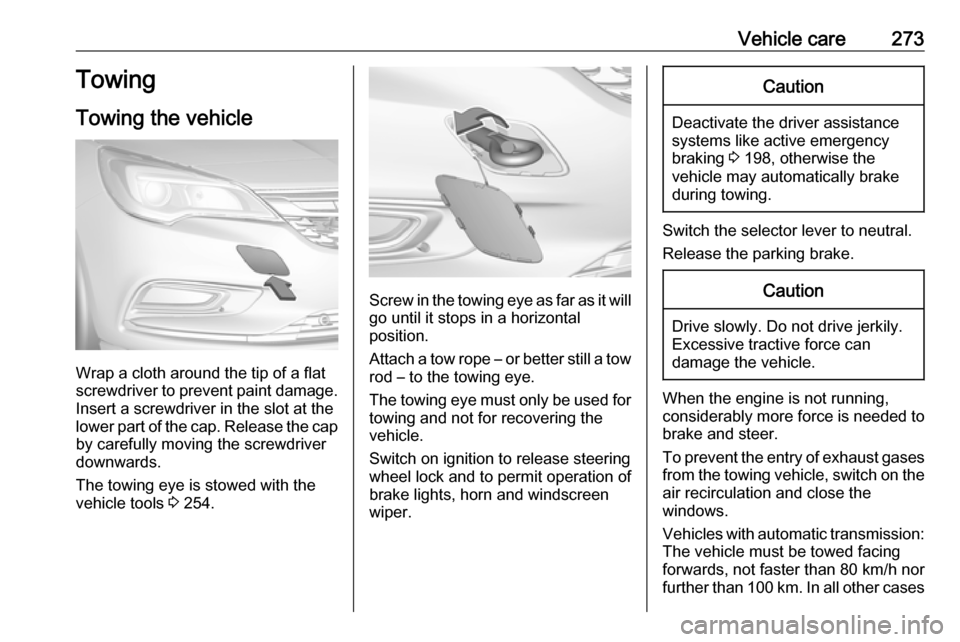
Vehicle care273Towing
Towing the vehicle
Wrap a cloth around the tip of a flat
screwdriver to prevent paint damage.
Insert a screwdriver in the slot at the
lower part of the cap. Release the cap
by carefully moving the screwdriver
downwards.
The towing eye is stowed with the
vehicle tools 3 254.
Screw in the towing eye as far as it will
go until it stops in a horizontal
position.
Attach a tow rope – or better still a tow rod – to the towing eye.
The towing eye must only be used for
towing and not for recovering the
vehicle.
Switch on ignition to release steering wheel lock and to permit operation of
brake lights, horn and windscreen
wiper.
Caution
Deactivate the driver assistance
systems like active emergency
braking 3 198, otherwise the
vehicle may automatically brake during towing.
Switch the selector lever to neutral.
Release the parking brake.
Caution
Drive slowly. Do not drive jerkily.
Excessive tractive force can
damage the vehicle.
When the engine is not running,
considerably more force is needed to
brake and steer.
To prevent the entry of exhaust gases from the towing vehicle, switch on the
air recirculation and close the
windows.
Vehicles with automatic transmission: The vehicle must be towed facing
forwards, not faster than 80 km/h nor further than 100 km. In all other cases
Page 308 of 317

306Customer informationOperating data in the vehicleControl units process data for
operation of the vehicle.
This data includes, e.g.: ● vehicle status information (e.g. wheel rotation rate, speed,
movement delay, lateral
acceleration, "seatbelts
fastened" display),
● ambient conditions (e.g. temperature, rain sensor,
distance sensor).
As a rule such data is transient, not
stored for longer than an operational
cycle, and only processed on board
the vehicle itself. Control units often
include data storage (including the vehicle key). This is used to allowinformation to be documented
temporarily or permanently on vehicle
condition, component stress,
maintenance requirements and
technical events and errors.Depending on the technical
equipment level, the data stored is as follows:
● system component operating states (e.g. fill level, tyre
pressure, battery status)
● faults and defects in important system components (e.g. lights,
brakes)
● system reactions in special driving situations (e.g. triggeringof an airbag, actuation of the
stability control systems)
● information on events damaging the vehicle
● for electric vehicles the amount of
charge in the high-voltage
battery, estimated range
In special cases (e.g. if the vehicle
has detected a malfunction), it may be
necessary to save data that would
otherwise just be volatile.
When you use services (e.g. repairs,
maintenance), the operating data
saved can be read together with the
vehicle identification number and
used when necessary. Staff working
for the service net-work ( e.g. garages,manufacturers) or third parties (e.g.
breakdown services) can read the
data from the vehicle. The same
applies to warranty work and quality
assurance measures.
Data is generally read via the OBD
(On-Board Diagnostics) port
prescribed by law in the vehicle. The operating data which is read out,
documents the technical condition of
the vehicle or individual components
and assists with fault diagnosis,
compliance with warranty obligations
and quality improvement. This data,
in particular information on
component stress, technical events,
operator errors and other faults, is
transmitted to the manufacturer
where appropriate, together with the
vehicle identification number. The
manufacturer is also subject to
product liability. The manufacturer
potentially also uses operating data
from vehicles for product recalls. This
data can also be used to check
customer warranty and guarantee
claims.
Fault memories in the vehicle can be
reset by a service company when
carrying out servicing or repairs.
Page 312 of 317

310IndexAAccessories and vehicle modifications .......................... 229
Active emergency braking ..........198
Adaptive cruise control .......114, 187
AdBlue ................................ 112, 169
Adjustable air vents ...................154
Airbag and belt tensioners .........109
Airbag deactivation ..............64, 109
Airbag label................................... 59
Airbag system .............................. 59
Air conditioning regular operation ................................ 155
Air conditioning system .............. 147
Air intake .................................... 155
Air vents...................................... 154
Antilock brake system ................ 178
Antilock brake system (ABS) .....111
Anti-theft alarm system ................37
Anti-theft locking system .............. 37
Appearance care ........................275
Armrest ................................... 54, 56
Armrest storage ........................... 73
Ashtrays ....................................... 99 Automatic anti-dazzle ..................42
Automatic light control ...............136
Automatic locking ........................30
Automatic transmission .............171
Autostop ..................................... 162
Auxiliary heater ........................... 154B
Battery discharge protection ......145
Battery voltage ........................... 124 Belts.............................................. 57
BlueInjection ............................... 169
Bonnet ....................................... 231
Brake and clutch fluid .................279
Brake and clutch system ...........110
Brake assist ............................... 181
Brake fluid .................................. 234
Brakes ............................... 178, 234
Breakdown.................................. 273
Bulb replacement ....................... 237
C Capacities .................................. 294
Cargo management system ........83
Catalytic converter .....................168
Central locking system ................25
Centre console lighting ..............144
Changing tyre and wheel size ...262
Charging system ........................ 110 Child locks ................................... 31
Child restraint installation locations ................................... 68
Child restraints.............................. 66
Child restraint systems ................66
Climate control ............................. 16
Climate control systems .............146
Clock............................................. 96
Page 313 of 317

311CNG.................................... 105, 221
Control indicators........................ 108
Control of the vehicle .................157
Controls ........................................ 92
Convex shape .............................. 40
Coolant and antifreeze ...............279
Cruise control ....................114, 184
Cupholders .................................. 72
Curtain airbag system .................. 64
Curve lighting.............................. 137
D
Danger, Warnings and Cautions ...4
Daytime running lights ...............137
Declaration of conformity ............298
DEF ............................................ 169
Diesel exhaust fluid ....................169
Diesel fuel system bleeding .......236
Door open .................................. 115
Doors ............................................ 31
Driver assistance systems ..........184
Driver Information Centre ...........115
Driving characteristics and towing tips .............................. 224
Driving hints ................................ 157
E Electric adjustment ......................40
Electrical system......................... 247
Electric parking brake .........110, 179
Electric parking brake fault .........110Electronic climate control system 149
Electronic driving programmes . ........................................ 173, 177
Electronic key system ...................23
Electronic Stability Control.......... 182
Electronic Stability Control and Traction Control system ..........111
Electronic Stability Control off..... 111
End-of-life vehicle recovery .......230
Engine compartment fuse box ...248
Engine coolant ........................... 233
Engine coolant temperature gauge ..................................... 106
Engine data ............................... 287
Engine exhaust .......................... 167
Engine identification ...................283
Engine oil ................... 232, 279, 284
Engine oil pressure ....................112
Entry lighting .............................. 144
Event data recorders ..................305
Exhaust filter ....................... 112, 167
Exit lighting ................................ 144
Exterior care .............................. 275
Exterior light ............................... 113
Exterior lighting ....................13, 135
Exterior mirrors ............................. 40
F
Fault ................................... 173, 177
First aid kit ................................... 88Fixed air vents ........................... 154
Folding mirrors ............................. 40
Following distance ......................111
Following distance indication ......197
Forward collision alert................. 195
Front airbag system .....................63
Front fog lights ...........114, 141, 239
Front seats.................................... 48
Front storage ................................ 73
Fuel............................................. 219
Fuel for diesel engines ..............220
Fuel for natural gas operation ...221
Fuel for petrol engines ...............219
Fuel gauge ................................. 105
Fuel selector .............................. 105
Fuses ......................................... 247
G
Gauges ....................................... 103
Gear shifting ............................... 111
General information ...................224
Glovebox ..................................... 72
H Halogen headlights ....................237
Hand brake ......................... 178, 179
Hazard warning flashers ............140
Headlight flash ........................... 136
Headlight range adjustment ......136
Headlights................................... 135 Headlights when driving abroad 137
Page 314 of 317

312Head restraint adjustment .............8
Head restraints ............................ 47
Heated mirrors ............................. 41
Heated rear window ..................... 44
Heated steering wheel .................93
Heating .................................. 55, 57
Heating and ventilation system . 146
High beam ......................... 113, 136
High beam assist ........................113
Hill start assist ........................... 181
Horn ....................................... 14, 93
I
Identification plate .....................282
Ignition switch positions .............157
Immobiliser .......................... 39, 113
Indicators .................................... 103
Info Display ................................. 121
Information displays.................... 115
Instrument cluster ......................100
Instrument panel fuse box .........250
Instrument panel illumination .....247
Instrument panel illumination control .................................... 143
Instrument panel overview ........... 10
Interior care ............................... 276
Interior lighting ............................ 143
Interior lights ...................... 143, 247
Interior mirrors .............................. 41Interruption of power supply ......174
Introduction .................................... 3
J Jump starting ............................. 271
K Key, memorised settings ..............25
Keys ............................................. 21
Keys, locks ................................... 21
L
Lane keep assist ................111, 216
Lashing eyes ............................... 82
LED headlights ...................113, 137
Lighting features .........................144
Light switch ................................ 135
Load compartment ................31, 74
Load compartment cover .............80
Load compartment fuse box ......252
Loading information .....................89
Low fuel ..................................... 113
M
Malfunction indicator light ..........110
Manual anti-dazzle ......................41
Manual mode .....................173, 177
Manual seat adjustment ...............49
Manual transmission .................. 174
Manual transmission automated 175
Manual windows ..........................42Massage....................................... 56
Maximum speed ......................... 256
Memorised settings ......................25
Midlevel display .......................... 115
Mirror adjustment ........................... 9
Misted light covers .....................142
N Natural gas ......................... 105, 221
New vehicle running-in ..............157
Number plate light .....................246
O
Object detection systems ...........201
Odometer ................................... 104 Oil, engine .......................... 279, 284
OnStar ........................................ 131
Outside temperature ....................96
Overrun cut-off ........................... 162
P Parking ................................ 19, 165
Parking assist ............................ 201
Parking brake ............................ 179
Parking lights ............................. 142
Particulate filter ........................... 167
Performance .............................. 289
Performing work ........................231
Pollen filter ................................. 155
Power button .............................. 158
Power outlets ............................... 98