transmission OPEL ASTRA K 2019 Manual user
[x] Cancel search | Manufacturer: OPEL, Model Year: 2019, Model line: ASTRA K, Model: OPEL ASTRA K 2019Pages: 317, PDF Size: 9.56 MB
Page 251 of 317
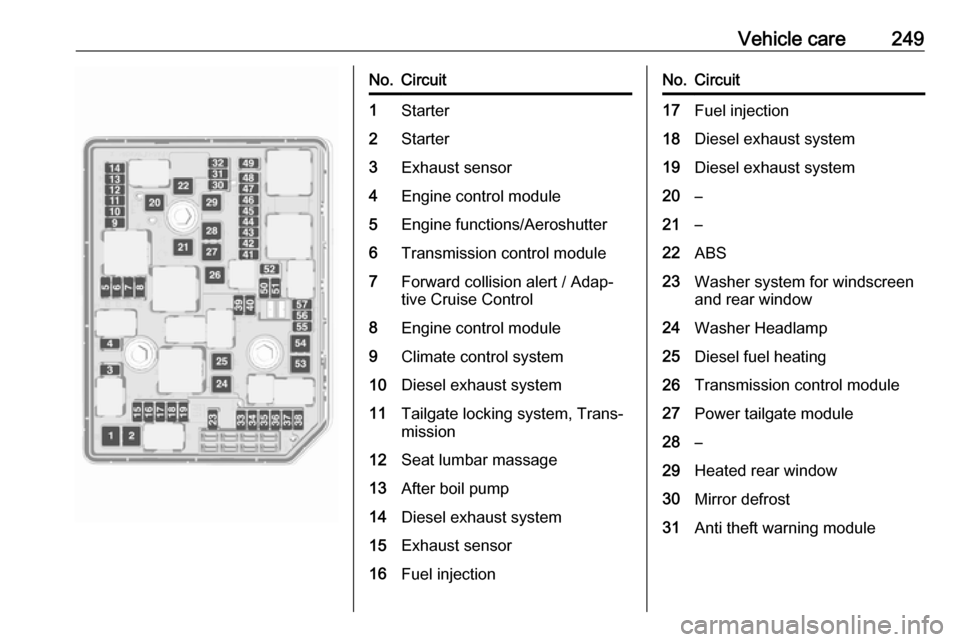
Vehicle care249No.Circuit1Starter2Starter3Exhaust sensor4Engine control module5Engine functions/Aeroshutter6Transmission control module7Forward collision alert / Adap‐
tive Cruise Control8Engine control module9Climate control system10Diesel exhaust system11Tailgate locking system, Trans‐
mission12Seat lumbar massage13After boil pump14Diesel exhaust system15Exhaust sensor16Fuel injectionNo.Circuit17Fuel injection18Diesel exhaust system19Diesel exhaust system20–21–22ABS23Washer system for windscreen
and rear window24Washer Headlamp25Diesel fuel heating26Transmission control module27Power tailgate module28–29Heated rear window30Mirror defrost31Anti theft warning module
Page 253 of 317
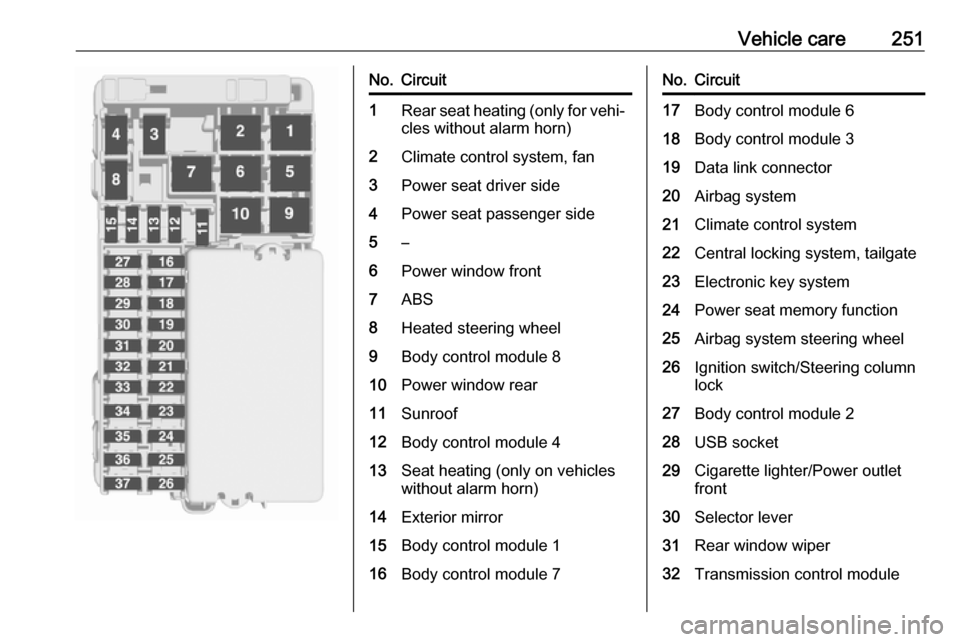
Vehicle care251No.Circuit1Rear seat heating (only for vehi‐cles without alarm horn)2Climate control system, fan3Power seat driver side4Power seat passenger side5–6Power window front7ABS8Heated steering wheel9Body control module 810Power window rear11Sunroof12Body control module 413Seat heating (only on vehicles
without alarm horn)14Exterior mirror15Body control module 116Body control module 7No.Circuit17Body control module 618Body control module 319Data link connector20Airbag system21Climate control system22Central locking system, tailgate23Electronic key system24Power seat memory function25Airbag system steering wheel26Ignition switch/Steering column
lock27Body control module 228USB socket29Cigarette lighter/Power outlet
front30Selector lever31Rear window wiper32Transmission control module
Page 261 of 317
Vehicle care259Vehicle loading statusAdjust tyre pressure to load condition
according to the tyre information label or tyre pressure chart 3 295, and
select the appropriate setting in the menu Tyre Load in the Driver
Information Centre, Vehicle
Information Menu 3 115. This setting
is the reference for the tyre pressure
warnings.
The Tyre load menu only appears
when the vehicle is at a standstill and the parking brake is applied. On
vehicles with automatic transmission
the selector lever must be in P.
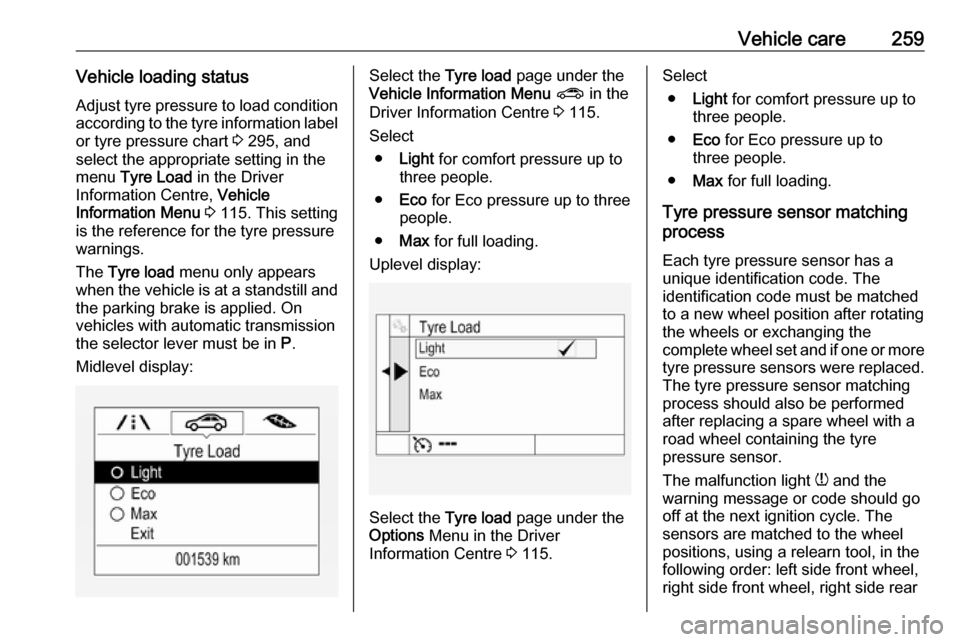
Midlevel display:Select the Tyre load page under the
Vehicle Information Menu ? in the
Driver Information Centre 3 115.
Select ● Light for comfort pressure up to
three people.
● Eco for Eco pressure up to three
people.
● Max for full loading.
Uplevel display:
Select the Tyre load page under the
Options Menu in the Driver
Information Centre 3 115.
Select
● Light for comfort pressure up to
three people.
● Eco for Eco pressure up to
three people.
● Max for full loading.
Tyre pressure sensor matching
process
Each tyre pressure sensor has a
unique identification code. The
identification code must be matched
to a new wheel position after rotating the wheels or exchanging the
complete wheel set and if one or more tyre pressure sensors were replaced.
The tyre pressure sensor matching
process should also be performed
after replacing a spare wheel with a
road wheel containing the tyre
pressure sensor.
The malfunction light w and the
warning message or code should go
off at the next ignition cycle. The
sensors are matched to the wheel
positions, using a relearn tool, in the following order: left side front wheel,
right side front wheel, right side rear
Page 262 of 317
260Vehicle carewheel and left side rear wheel. Theturn signal light at the current active
position is illuminated until sensor is
matched.
Consult a workshop for service. There are two minutes to match the first
wheel position, and five minutes
overall to match all four wheel
positions. If it takes longer, the
matching process stops and must be
restarted.
The tyre pressure sensor matching
process is:
1. Apply the parking brake.
2. Turn the ignition on.
3. On vehicles with automatic transmission: set the selector
lever to P.
On vehicles with manual
transmission: select neutral.
4. Midlevel display: Use MENU on the turn signal
lever to select the Vehicle
Information Menu ? in the
Driver Information Centre.
Uplevel display:Press p on the steering wheel to
open main menu page.
Select the Info page with Q or P.
Confirm with 9.
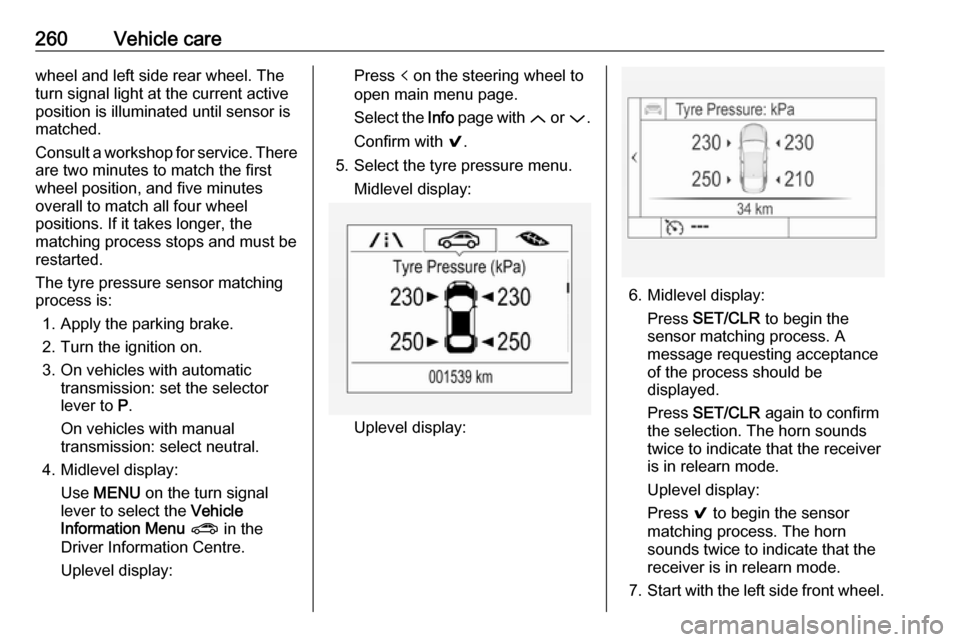
5. Select the tyre pressure menu. Midlevel display:
Uplevel display:
6. Midlevel display:Press SET/CLR to begin the
sensor matching process. A
message requesting acceptance
of the process should be
displayed.
Press SET/CLR again to confirm
the selection. The horn sounds
twice to indicate that the receiver
is in relearn mode.
Uplevel display:
Press 9 to begin the sensor
matching process. The horn
sounds twice to indicate that the receiver is in relearn mode.
7. Start with the left side front wheel.
Page 274 of 317

272Vehicle care● Do not lean over the vehiclebattery during jump starting.
● Do not allow the terminals of one
lead to touch those of the other
lead.
● The vehicles must not come into contact with each other during
the jump starting process.
● Apply the parking brake, transmission in neutral,
automatic transmission in P.
● Open the positive terminal protection cap of your vehicle in
the engine compartment and of
the booster vehicle battery.Lead connection order:
1. Connect the red lead to the positive terminal of the booster
vehicle battery.
2. Connect the other end of the red lead to the positive terminal of
your vehicle near the fuse box in
the engine compartment.
3. Connect the black lead to the negative terminal of the booster
vehicle battery.
4. Connect the other end of the black
lead to a vehicle grounding point
of your vehicle in the engine
compartment.
Route the leads so that they cannot
catch on rotating parts in the engine
compartment.
To start the engine: 1. Start the engine of the vehicle providing the jump.
2. After five minutes, start the other engine. Start attempts should be
made for no longer than
15 seconds at an interval of one
minute.3. Allow both engines to idle for approx. three minutes with the
leads connected.
4. Switch on electrical consumers (e.g. headlights, heated rear
window) of the vehicle receiving
the jump start.
5. Reverse above sequence exactly when removing leads.
Page 275 of 317
Vehicle care273Towing
Towing the vehicle
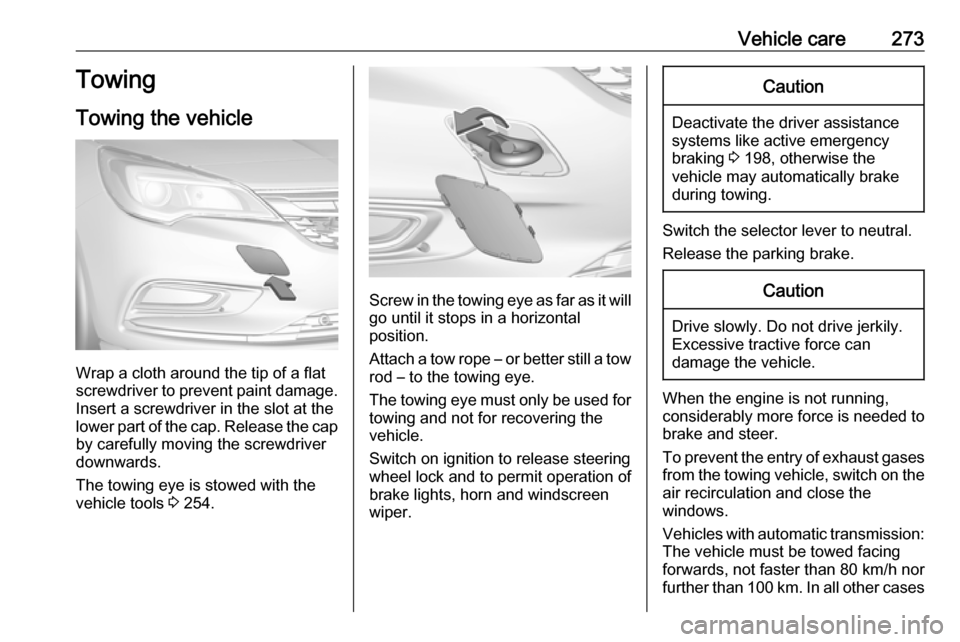
Wrap a cloth around the tip of a flat
screwdriver to prevent paint damage.
Insert a screwdriver in the slot at the
lower part of the cap. Release the cap
by carefully moving the screwdriver
downwards.
The towing eye is stowed with the
vehicle tools 3 254.
Screw in the towing eye as far as it will
go until it stops in a horizontal
position.
Attach a tow rope – or better still a tow rod – to the towing eye.
The towing eye must only be used for
towing and not for recovering the
vehicle.
Switch on ignition to release steering wheel lock and to permit operation of
brake lights, horn and windscreen
wiper.
Caution
Deactivate the driver assistance
systems like active emergency
braking 3 198, otherwise the
vehicle may automatically brake during towing.
Switch the selector lever to neutral.
Release the parking brake.
Caution
Drive slowly. Do not drive jerkily.
Excessive tractive force can
damage the vehicle.
When the engine is not running,
considerably more force is needed to
brake and steer.
To prevent the entry of exhaust gases from the towing vehicle, switch on the
air recirculation and close the
windows.
Vehicles with automatic transmission: The vehicle must be towed facing
forwards, not faster than 80 km/h nor further than 100 km. In all other cases
Page 276 of 317
274Vehicle careand when the transmission is
defective, the front axle must be
raised off the ground.
Vehicles with manual transmission
automated: the vehicle must only be
towed facing forwards with the front
axle raised off the ground.
Seek the assistance of a workshop. After towing, unscrew the towing eye.
Insert cap at the top and engage
downwards.
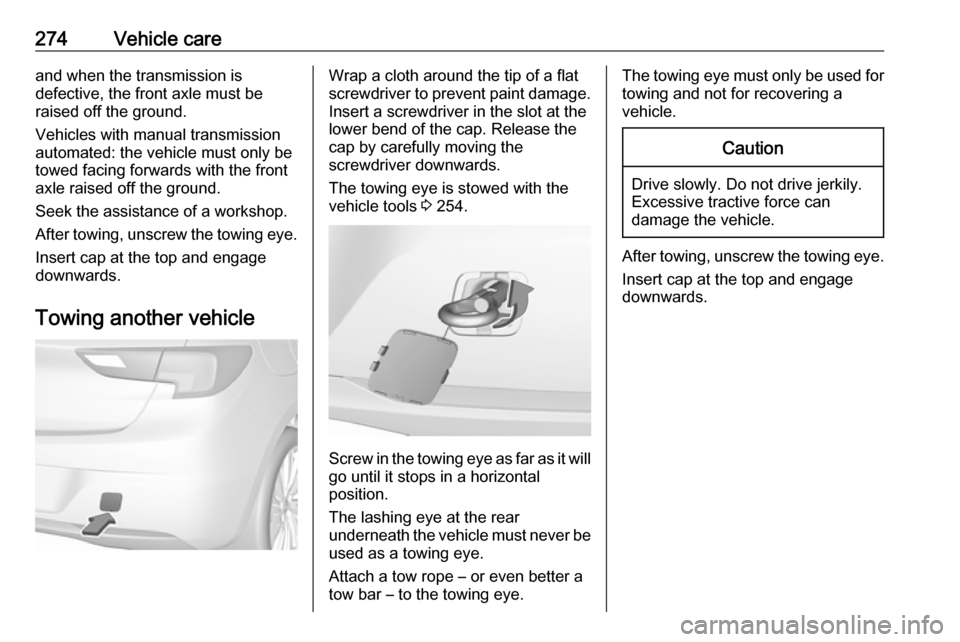
Towing another vehicleWrap a cloth around the tip of a flat
screwdriver to prevent paint damage. Insert a screwdriver in the slot at the
lower bend of the cap. Release the
cap by carefully moving the
screwdriver downwards.
The towing eye is stowed with the
vehicle tools 3 254.
Screw in the towing eye as far as it will
go until it stops in a horizontal
position.
The lashing eye at the rear
underneath the vehicle must never be used as a towing eye.
Attach a tow rope – or even better a
tow bar – to the towing eye.
The towing eye must only be used for
towing and not for recovering a
vehicle.Caution
Drive slowly. Do not drive jerkily.
Excessive tractive force can
damage the vehicle.
After towing, unscrew the towing eye.
Insert cap at the top and engage
downwards.
Page 291 of 317
![OPEL ASTRA K 2019 Manual user Technical data289Performance
5-door HatchbackEngineD10XFLD14XFLB14XFT / D14XFT
D14XNT
CNG
D16SHT
Maximum speed [km/h]Manual transmission195/188 2)205215195235Manual transmission automated200–––â](/img/37/18787/w960_18787-290.png "OPEL ASTRA K 2019 Manual user Technical data289Performance
5-door HatchbackEngineD10XFLD14XFLB14XFT / D14XFT
D14XNT
CNG
D16SHT
Maximum speed [km/h]Manual transmission195/188 2)205215195235Manual transmission automated200–––â")
Technical data289Performance
5-door HatchbackEngineD10XFLD14XFLB14XFT / D14XFT
D14XNT
CNG
D16SHT
Maximum speed [km/h]Manual transmission195/188 2)205215195235Manual transmission automated200––––Automatic transmission––210–2352)
Ecotec versionEngineD16DTND16DTID16DTHD16DTRMaximum speed [km/h]Manual transmission200200213220Manual transmission automated––––Automatic transmission––208–
Page 292 of 317
![OPEL ASTRA K 2019 Manual user 290Technical dataSports Tourer
EngineD10XFLD14XFLB14XFT / D14XFT
D14XNT
CNG
D16SHT
Maximum speed [km/h]Manual transmission195/187 2)205215195235Manual transmission automated–––––Automatic tr](/img/37/18787/w960_18787-291.png "OPEL ASTRA K 2019 Manual user 290Technical dataSports Tourer
EngineD10XFLD14XFLB14XFT / D14XFT
D14XNT
CNG
D16SHT
Maximum speed [km/h]Manual transmission195/187 2)205215195235Manual transmission automated–––––Automatic tr")
290Technical dataSports Tourer
EngineD10XFLD14XFLB14XFT / D14XFT
D14XNT
CNG
D16SHT
Maximum speed [km/h]Manual transmission195/187 2)205215195235Manual transmission automated–––––Automatic transmission––210–2352)
Ecotec versionEngineD16DTID16DTHB16DTRMaximum speed [km/h]Manual transmission200212220Manual transmission automated–––Automatic transmission–207–
Page 293 of 317

Technical data291Vehicle weightKerb weight, basic model without any optional equipment5-door HatchbackEngineManual
transmissionManual transmission
automatedAutomatic
transmissionwithout/with
air conditioning
[kg]D10XFL1263/1273––D14XFL1268/1278––B14XFT / D14XFT1268/1278–1298/1308D14XNT
CNG1364/1383––D16SHT1350/1369–1378/1397D16DTN1364/1383––D16DTI1364/1384––D16DTH1378/1397–1393/1412D16DTR1396/1412––
Optional equipment and accessories increase the kerb weight.
Loading information 3 89.