Electrical OPEL ASTRA K 2020 User Guide
[x] Cancel search | Manufacturer: OPEL, Model Year: 2020, Model line: ASTRA K, Model: OPEL ASTRA K 2020Pages: 305, PDF Size: 27.84 MB
Page 164 of 305
162Driving and operatingAutomatic cleaning process
The exhaust filter system filters soot
particles out of the exhaust gases.
The system includes a self-cleaning
function that runs automatically
during driving without any notification.
The filter is cleaned by periodically
burning off the soot particles at high
temperature. This process takes
place automatically under set driving
conditions and may take up to
25 minutes. Typically it needs
between 7 and 12 minutes. Autostop
is not available and fuel consumption may be higher during this period. The
emission of smells and smoke during
this process is normal.
System requires cleaning
Under certain conditions, e.g. driving
short distances, the system cannot
clean itself automatically.
If cleaning of the filter is required and if previous driving conditions did not
enable automatic cleaning, it will be
indicated by a warning message in
the Driver Information Centre.A warning message appears when
exhaust filter is full. Start cleaning
process as soon as possible.
A warning message also appears
when exhaust filter has reached the
maximum filling level. Start cleaning
process immediately to avoid
damage to the engine.
Activate self-cleaning process
Cleaning process is completed more
quickly at high engine speeds and
loads. Therefore, drive in lower gears
than normal, and use manual gear
selection on vehicles with automatic
transmission. Usage of electrical consumers like air conditioning and
heated windows to increase engine
load supports cleaning process.Caution
If possible, do not interrupt
cleaning process. Drive until
cleaning is completed to avoid the
need for service or repair by a
workshop.
Vehicles with petrol engine
To activate cleaning process,
continue driving, keep engine speed
above 2500 rpm. Shift down if
necessary.
Drive dynamically at different engine
speeds. Use engine brake for
deceleration, if possible.
Keep on driving until self-cleaning
operation is complete and the display
message disappears.Vehicles with diesel engine
To activate cleaning process,
continue driving, keep engine speed
above 2000 rpm, ideally and
continuously around 2500 rpm. Shift
down if necessary.
Keep on driving until self-cleaning
operation is complete and the display message disappears.
Page 173 of 305
Driving and operating171Fault9Warning
If there is a fault in the ABS, the
wheels may be liable to lock due
to braking that is heavier than
normal. The advantages of ABS are no longer available. During
hard braking, the vehicle can no longer be steered and may
swerve.
Have the cause of the fault remedied
by a workshop.
Parking brake
9 Warning
Before leaving the vehicle, check
parking brake status. Control
indicator R (manual parking
brake) or m (electrical parking
brake) illuminate constantly when
parking brake is applied.
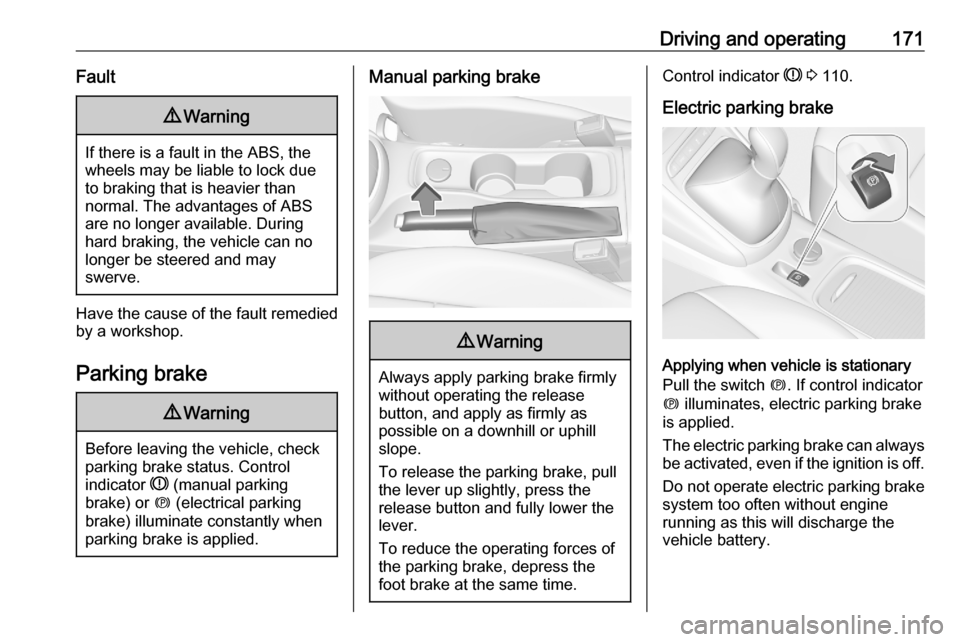
Manual parking brake9 Warning
Always apply parking brake firmly
without operating the release
button, and apply as firmly as
possible on a downhill or uphill
slope.
To release the parking brake, pull
the lever up slightly, press the
release button and fully lower the
lever.
To reduce the operating forces of
the parking brake, depress the
foot brake at the same time.
Control indicator R 3 110.
Electric parking brake
Applying when vehicle is stationary
Pull the switch m. If control indicator
m illuminates, electric parking brake
is applied.
The electric parking brake can always
be activated, even if the ignition is off.
Do not operate electric parking brake
system too often without engine
running as this will discharge the
vehicle battery.
Page 224 of 305

222Vehicle careVehicle careGeneral Information...................222
Accessories and vehicle modifications .......................... 222
Vehicle storage ........................223
End-of-life vehicle recovery .....223
Vehicle checks ........................... 224
Performing work ......................224
Bonnet ..................................... 224
Engine oil ................................. 225
Engine coolant ......................... 226
Washer fluid ............................ 227
Brakes ..................................... 227
Brake fluid ............................... 227
Vehicle battery ......................... 228
Diesel fuel system bleeding .....229
Wiper blade replacement ........230
Bulb replacement .......................230
Halogen headlights ..................230
Front fog lights ......................... 232
Tail lights ................................. 233
Side turn lights ......................... 239
Number plate light ...................240
Interior lights ............................ 240
Electrical system ........................241
Fuses ....................................... 241Engine compartment fuse box . 242
Instrument panel fuse box .......244
Load compartment fuse box ....245
Vehicle tools .............................. 247
Tools ........................................ 247
Wheels and tyres .......................249
Winter tyres ............................. 249
Tyre designations ....................249
Tyre pressure .......................... 249
Tyre pressure monitoring system .................................... 251
Tread depth ............................. 253
Changing tyre and wheel size . 254
Wheel covers ........................... 254
Tyre chains .............................. 255
Tyre repair kit .......................... 255
Wheel changing .......................258
Spare wheel ............................ 259
Jump starting ............................. 263
Towing ....................................... 265
Towing the vehicle ...................265
Towing another vehicle ...........266
Appearance care .......................267
Exterior care ............................ 267
Interior care ............................. 269
Floor mats ............................... 269General Information
Accessories and vehiclemodifications
We recommend the use of genuine
parts and accessories and factory approved parts specific for your
vehicle type. We cannot assess or guarantee reliability of other products - even if they have a regulatory or
otherwise granted approval.
Any modification, conversion or other
changes made to standard vehicle
specifications (including, without
limitation, software modifications,
modifications of the electronic control units) may invalidate the warranty
offered by Opel. Furthermore, such
changes may affect driver assistance
systems, fuel consumption, CO 2
emissions and other emissions of the
vehicle. They may also invalidate the
vehicle operating permit.
Page 230 of 305
228Vehicle careVehicle battery
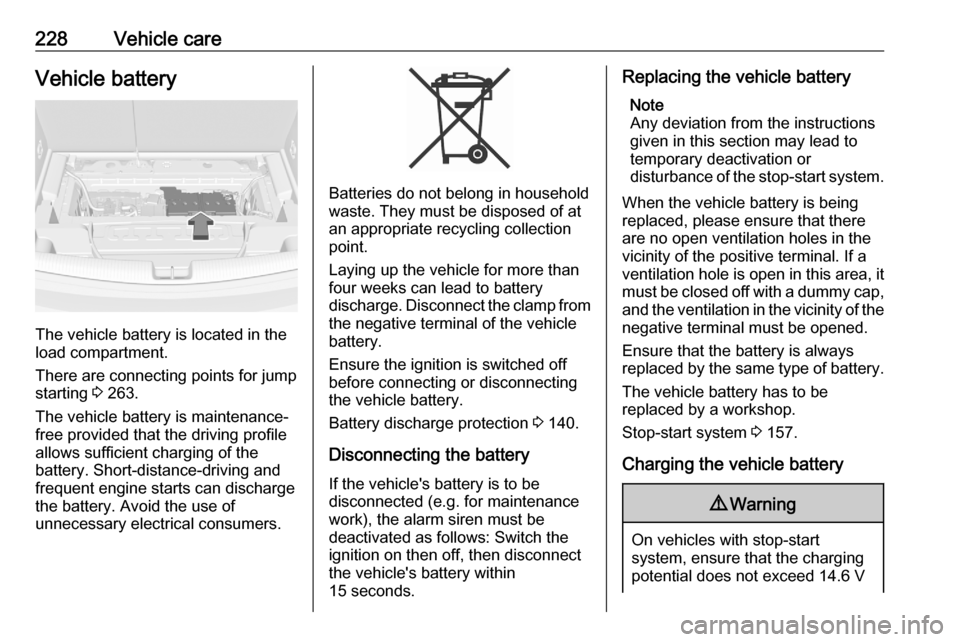
The vehicle battery is located in the
load compartment.
There are connecting points for jump
starting 3 263.
The vehicle battery is maintenance-
free provided that the driving profile
allows sufficient charging of the
battery. Short-distance-driving and
frequent engine starts can discharge
the battery. Avoid the use of
unnecessary electrical consumers.
Batteries do not belong in household
waste. They must be disposed of at
an appropriate recycling collection
point.
Laying up the vehicle for more than
four weeks can lead to battery
discharge. Disconnect the clamp from the negative terminal of the vehicle
battery.
Ensure the ignition is switched off
before connecting or disconnecting
the vehicle battery.
Battery discharge protection 3 140.
Disconnecting the battery
If the vehicle's battery is to be
disconnected (e.g. for maintenance
work), the alarm siren must be
deactivated as follows: Switch the ignition on then off, then disconnect
the vehicle's battery within
15 seconds.
Replacing the vehicle battery
Note
Any deviation from the instructions
given in this section may lead to
temporary deactivation or
disturbance of the stop-start system.
When the vehicle battery is being
replaced, please ensure that there
are no open ventilation holes in the
vicinity of the positive terminal. If a
ventilation hole is open in this area, it
must be closed off with a dummy cap, and the ventilation in the vicinity of the
negative terminal must be opened.
Ensure that the battery is always replaced by the same type of battery.
The vehicle battery has to be
replaced by a workshop.
Stop-start system 3 157.
Charging the vehicle battery9 Warning
On vehicles with stop-start
system, ensure that the charging potential does not exceed 14.6 V
Page 243 of 305
Vehicle care241Electrical system
Fuses Data on the replacement fuse must
match the data on the defective fuse.
There are three fuse boxes in the
vehicle:
● engine compartment
● instrument panel
● load compartment
Before replacing a fuse, turn off the
respective switch and the ignition.
A blown fuse can be recognized by its melted wire.Caution
Do not replace the fuse until the
cause of the fault has been
remedied.
Some functions are protected by
several fuses.
Fuses may also be inserted without
existence of a function.
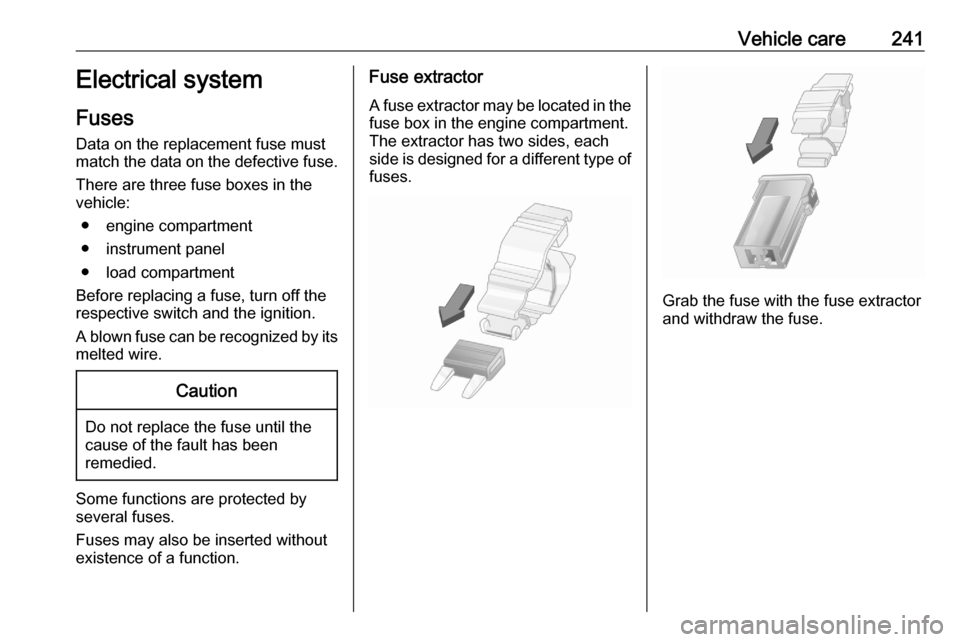
Fuse extractor
A fuse extractor may be located in the
fuse box in the engine compartment.
The extractor has two sides, each
side is designed for a different type of fuses.
Grab the fuse with the fuse extractor
and withdraw the fuse.
Page 245 of 305

Vehicle care243No.Circuit16Fuel injection17Fuel injection18Diesel exhaust system19–20–21–22ABS23Washer system for windscreen
and rear window24–25Diesel fuel heating26Transmission control module27Power tailgate module28–29Heated rear window30Mirror defrost31–No.Circuit32DC transformer / LED display /
Electrical heater / Climate
control / Glow plug controller33–34Horn35Engine control module36Right high beam (Halogen, Eco
LED) / Right low beam (LED)37Left high beam (Halogen, Eco
LED)38LED headlight / Automatic
headlight range adjustment39Front fog light40Central Gateway Module41–42Manual headlight range adjust‐
ment43Fuel pump44Rear view camera / Inside rear
view mirror / Trailer moduleNo.Circuit45LED headlight left / Automatic
headlight range adjustment left46Instrument cluster47Steering column lock48Rear wiper49Outside rearview mirror50LED headlight right / Automatic
headlight range adjustment
right51Left low beam (LED)52Engine control module / Trans‐
mission control module53Windscreen wiper54Windscreen wiper55Diesel Exhaust system56–57–
After having changed defective fuses,
close the fuse box cover and press
until it engages.
Page 249 of 305
Vehicle care247No.Circuit17Trailer outlet18–19–20–21Electrical rear seat folding22–
After having changed defective fuses,
close the fuse box cover and press
until it engages.
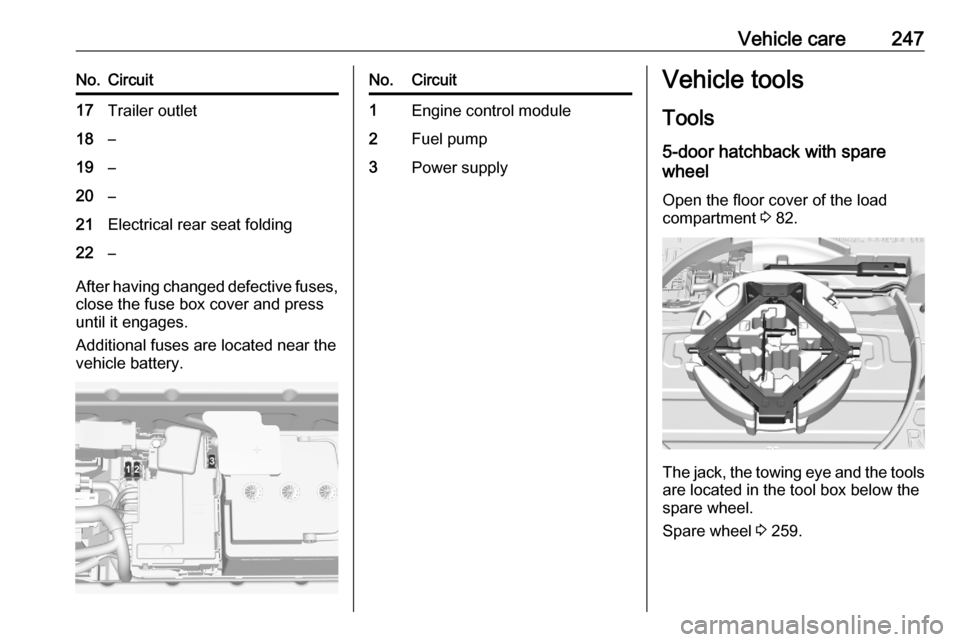
Additional fuses are located near the
vehicle battery.
No.Circuit1Engine control module2Fuel pump3Power supplyVehicle tools
Tools
5-door hatchback with spare
wheel
Open the floor cover of the load
compartment 3 82.
The jack, the towing eye and the tools
are located in the tool box below the
spare wheel.
Spare wheel 3 259.
Page 258 of 305

256Vehicle careOn Sports Tourer the tyre repair kit isin a suitcase on the right side of the
load compartment behind a cover.
The suitcase is secured with a strap.
1. Remove the sealant bottle.
2. Insert thumb into the opening and
pull out the compressor.
3. Remove the electrical connection cable and air hose from the
stowage compartments on the
underside of the compressor.
4. Screw the compressor air hose to
the connection on the sealant
bottle.
5. Fit the sealant bottle into the retainer on the compressor.
Set the compressor near the tyre
in such a way that the sealant
bottle is upright.6. Unscrew valve cap from defective
tyre.
7. Screw the filler hose to the tyre valve.
8. The switch on the compressor must be set to J.
9. Connect the compressor plug to the power outlet or cigarette
lighter socket.
To avoid discharging the battery, we recommend running the
engine.
Page 265 of 305

Vehicle care263
1.Remove centre cap with the brand
emblem by pushing from the
inside.
2. Position the wheel outside down in the wheel well.
3. Secure the defective wheel with the wing nut.
4. Depending on the tyre size, the floor cover can be placed on the
projecting wheel.
Spare wheel with directional tyre
The following applies to tyres fitted
opposing the rolling direction:
● Driveability may be affected. Have the defective tyre renewed
or repaired as soon as possible
and fit it instead of the spare
wheel.
● Drive particularly carefully on wet
and snow-covered road
surfaces.Jump starting
A vehicle with a discharged vehicle
battery can be started using jump
leads and the vehicle battery of
another vehicle.
Do not start with quick charger.
The vehicle battery is located in the
load compartment under a cover.
There are connecting points for jump
starting in the engine compartment.9 Warning
Be extremely careful when starting
with jump leads. Any deviation
from the following instructions can
lead to injuries or damage caused
by battery explosion or damage to the electrical systems of both
vehicles.
9 Warning
Avoid contact of the battery with
eyes, skin, fabrics and painted
surfaces. The fluid contains
Page 266 of 305
264Vehicle caresulphuric acid which can cause
injuries and damage in the event
of direct contact.
● Never expose the vehicle battery
to naked flames or sparks.
● A discharged vehicle battery can already freeze at a temperature
of 0 °C. Defrost the frozen vehicle battery before connecting jump
leads.
● Wear eye protection and protective clothing when
handling a vehicle battery.
● Use a booster vehicle battery with the same voltage (12 V). Its
capacity (Ah) must not be much
less than that of the discharged
vehicle battery.
● Use jump leads with insulated terminals and a cross section of
at least 16 mm 2
(25 mm 2
for
diesel engines).
● Do not disconnect the discharged
vehicle battery from the vehicle.
● Switch off all unnecessary electrical consumers.
● Do not lean over the vehiclebattery during jump starting.
● Do not allow the terminals of one
lead to touch those of the other
lead.
● The vehicles must not come into contact with each other during
the jump starting process.
● Apply the parking brake, transmission in neutral,
automatic transmission in P.
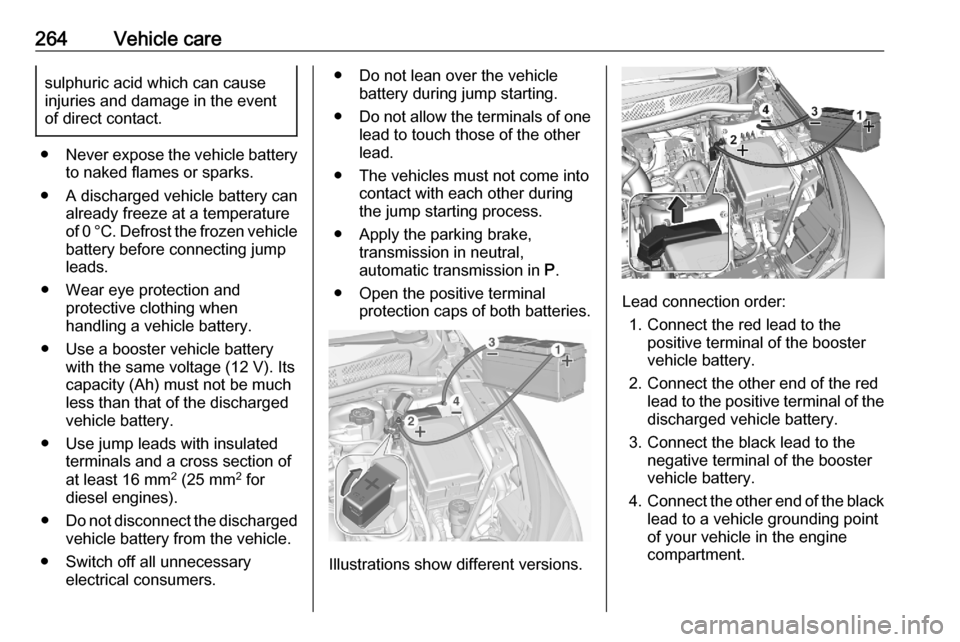
● Open the positive terminal protection caps of both batteries.
Illustrations show different versions.
Lead connection order:
1. Connect the red lead to the positive terminal of the booster
vehicle battery.
2. Connect the other end of the red lead to the positive terminal of the
discharged vehicle battery.
3. Connect the black lead to the negative terminal of the booster
vehicle battery.
4. Connect the other end of the black
lead to a vehicle grounding point
of your vehicle in the engine
compartment.