belt OPEL ASTRA SALOON 2014 User Guide
[x] Cancel search | Manufacturer: OPEL, Model Year: 2014, Model line: ASTRA SALOON, Model: OPEL ASTRA SALOON 2014Pages: 245, PDF Size: 7.12 MB
Page 63 of 245
Seats, restraints61Child restraintsChild restraint systems
We recommend the Opel child
restraint system which is tailored
specifically to the vehicle.
When a child restraint system is being used, pay attention to the following
usage and installation instructions
and also those supplied with the child
restraint system.
Always comply with local or national
regulations. In some countries, the
use of child restraint systems is
forbidden on certain seats.
Selecting the right systemThe rear seats are the most
convenient location to fasten a child
restraint system.
Children should travel facing
rearwards in the vehicle as long as
possible. This ensures that the child's
backbone, which is still very weak, is
under less strain in the event of an
accident.Suitable are restraint systems that
comply with ECE 44-03 or
ECE 44-04. Check local laws and
regulations for mandatory use of child restraint systems.
Never hold a child whilst travelling in
the vehicle. The child will become too
heavy to be held in the event of a
collision.
When transporting children, use the
child restraint systems suitable for the
child's weight.
Ensure that the child restraint system to be installed is compatible with the
vehicle type.
Ensure that the mounting location of
the child restraint system within the
vehicle is correct.
Allow children to enter and exit the
vehicle only on the side facing away
from the traffic.
When the child restraint system is not in use, secure the seat with a seat belt
or remove it from the vehicle.Note
Do not affix anything on the child
restraint systems and do not cover
them with any other materials.
A child restraint system which has
been subjected to stress in an
accident must be replaced.
Page 64 of 245
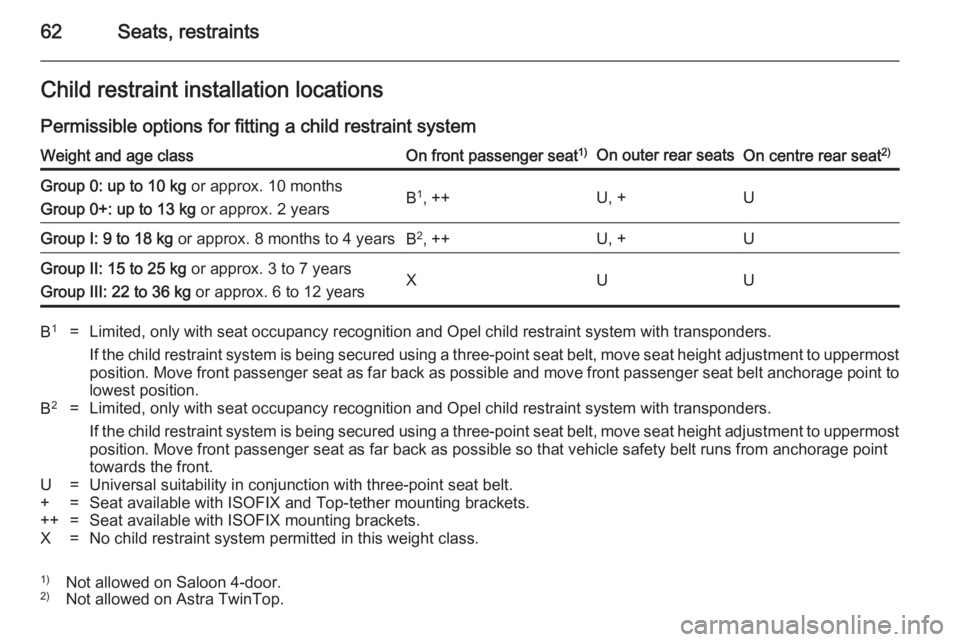
62Seats, restraintsChild restraint installation locationsPermissible options for fitting a child restraint systemWeight and age classOn front passenger seat 1)On outer rear seatsOn centre rear seat2)Group 0: up to 10 kg
or approx. 10 months
Group 0+: up to 13 kg or approx. 2 yearsB1
, ++U, +UGroup I: 9 to 18 kg or approx. 8 months to 4 yearsB2
, ++U, +UGroup II: 15 to 25 kg or approx. 3 to 7 years
Group III: 22 to 36 kg or approx. 6 to 12 yearsXUUB1=Limited, only with seat occupancy recognition and Opel child restraint system with transponders.
If the child restraint system is being secured using a three-point seat belt, move seat height adjustment to uppermost position. Move front passenger seat as far back as possible and move front passenger seat belt anchorage point to lowest position.B 2=Limited, only with seat occupancy recognition and Opel child restraint system with transponders.
If the child restraint system is being secured using a three-point seat belt, move seat height adjustment to uppermost position. Move front passenger seat as far back as possible so that vehicle safety belt runs from anchorage point
towards the front.U=Universal suitability in conjunction with three-point seat belt.+=Seat available with ISOFIX and Top-tether mounting brackets.++=Seat available with ISOFIX mounting brackets.X=No child restraint system permitted in this weight class.1) Not allowed on Saloon 4-door.
2) Not allowed on Astra TwinTop.
Page 71 of 245
Storage69
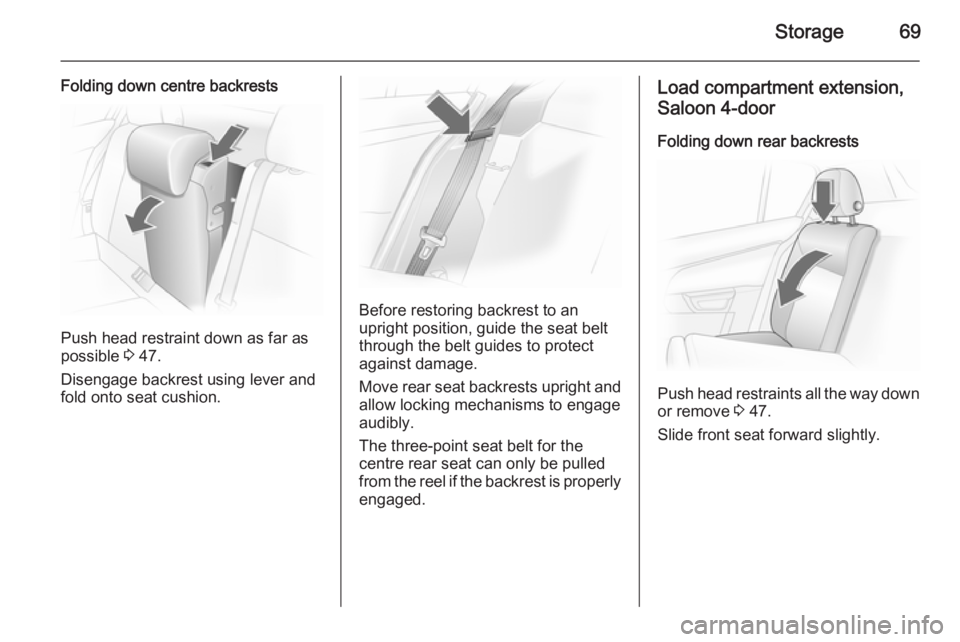
Folding down centre backrests
Push head restraint down as far as
possible 3 47.
Disengage backrest using lever and
fold onto seat cushion.
Before restoring backrest to an
upright position, guide the seat belt
through the belt guides to protect
against damage.
Move rear seat backrests upright and
allow locking mechanisms to engage
audibly.
The three-point seat belt for the
centre rear seat can only be pulled
from the reel if the backrest is properly engaged.
Load compartment extension,
Saloon 4-door
Folding down rear backrests
Push head restraints all the way down or remove 3 47.
Slide front seat forward slightly.
Page 72 of 245
70Storage
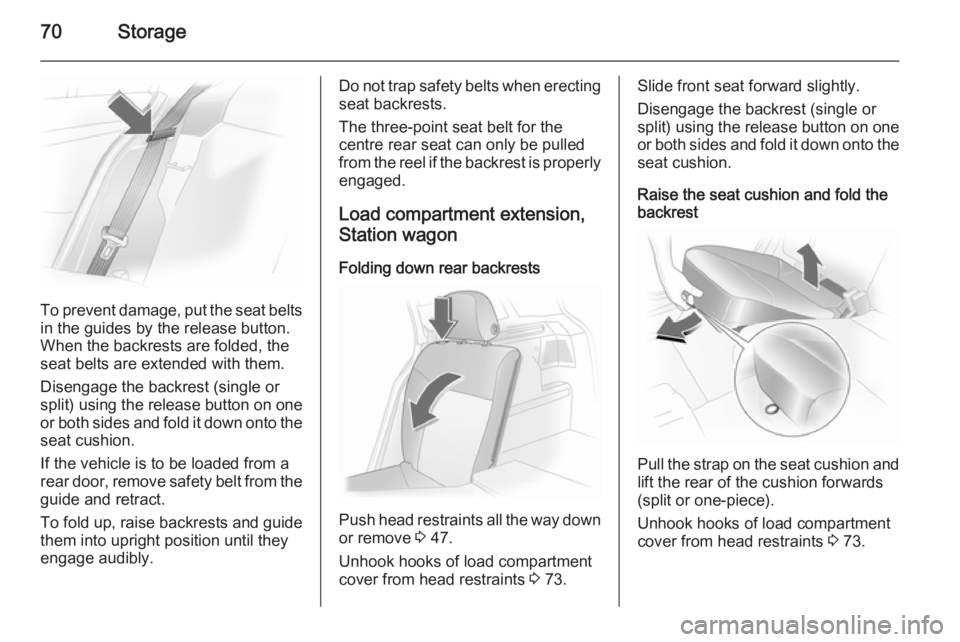
To prevent damage, put the seat beltsin the guides by the release button.
When the backrests are folded, the seat belts are extended with them.
Disengage the backrest (single or
split) using the release button on one or both sides and fold it down onto the
seat cushion.
If the vehicle is to be loaded from a rear door, remove safety belt from the guide and retract.
To fold up, raise backrests and guide
them into upright position until they
engage audibly.
Do not trap safety belts when erecting seat backrests.
The three-point seat belt for the
centre rear seat can only be pulled
from the reel if the backrest is properly
engaged.
Load compartment extension,
Station wagon
Folding down rear backrests
Push head restraints all the way downor remove 3 47.
Unhook hooks of load compartment
cover from head restraints 3 73.
Slide front seat forward slightly.
Disengage the backrest (single or
split) using the release button on one or both sides and fold it down onto the
seat cushion.
Raise the seat cushion and fold the
backrest
Pull the strap on the seat cushion and
lift the rear of the cushion forwards
(split or one-piece).
Unhook hooks of load compartment
cover from head restraints 3 73.
Page 74 of 245
72Storage
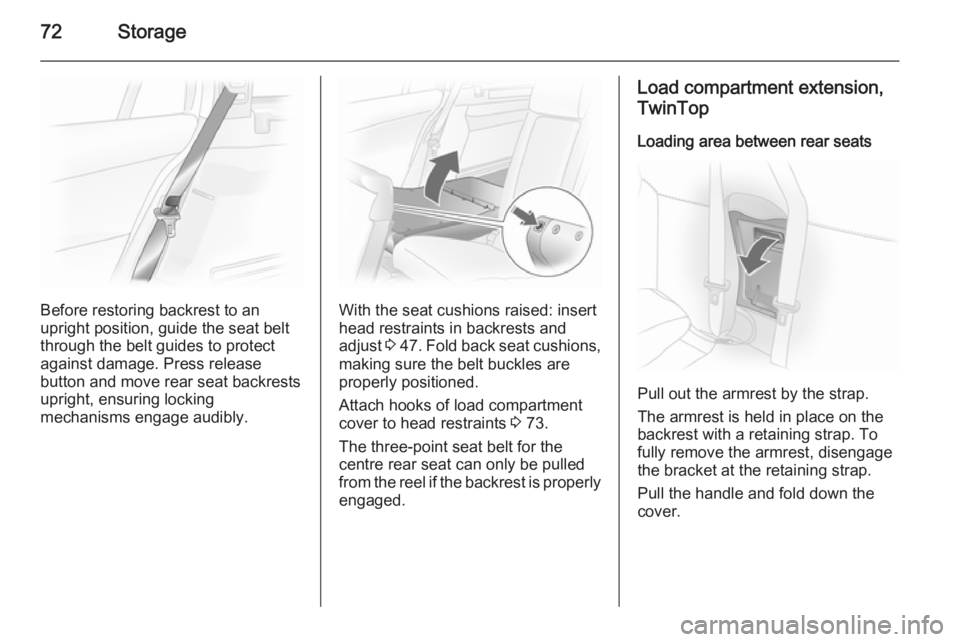
Before restoring backrest to an
upright position, guide the seat belt
through the belt guides to protect
against damage. Press release
button and move rear seat backrests upright, ensuring locking
mechanisms engage audibly.With the seat cushions raised: insert
head restraints in backrests and
adjust 3 47 . Fold back seat cushions,
making sure the belt buckles are
properly positioned.
Attach hooks of load compartment
cover to head restraints 3 73.
The three-point seat belt for the
centre rear seat can only be pulled
from the reel if the backrest is properly engaged.
Load compartment extension,
TwinTop
Loading area between rear seats
Pull out the armrest by the strap.
The armrest is held in place on the
backrest with a retaining strap. To
fully remove the armrest, disengage
the bracket at the retaining strap.
Pull the handle and fold down the
cover.
Page 81 of 245
Storage79
Behind the rear seats
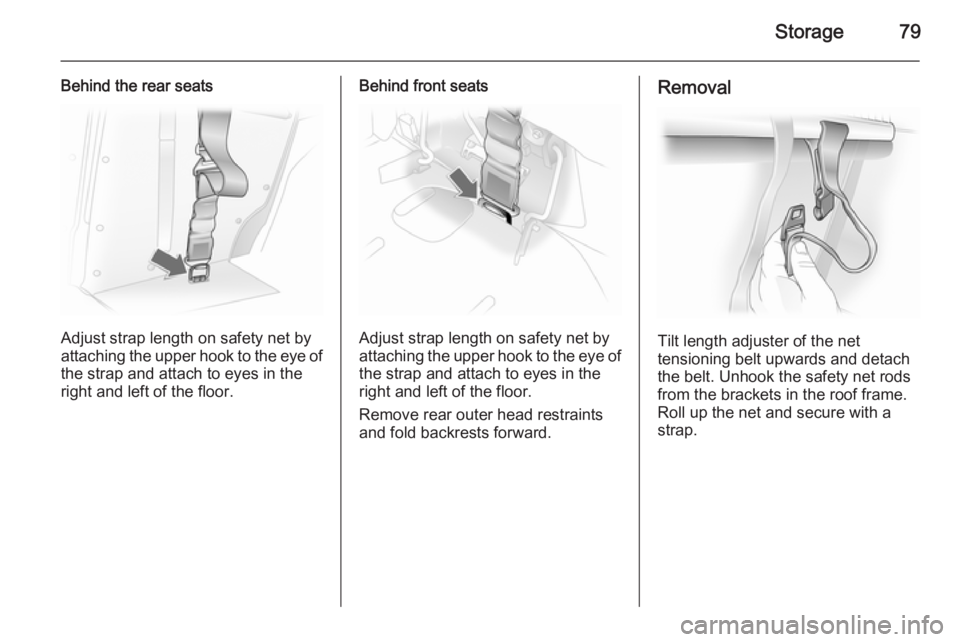
Adjust strap length on safety net by
attaching the upper hook to the eye of
the strap and attach to eyes in the
right and left of the floor.
Behind front seats
Adjust strap length on safety net by
attaching the upper hook to the eye of
the strap and attach to eyes in the
right and left of the floor.
Remove rear outer head restraints
and fold backrests forward.
Removal
Tilt length adjuster of the net
tensioning belt upwards and detach
the belt. Unhook the safety net rods
from the brackets in the roof frame.
Roll up the net and secure with a
strap.
Page 98 of 245
96Instruments and controlsTurn signal
O illuminates or flashes green.
Illuminates The control indicator illuminates
briefly when the parking lights are
switched on.
Flashes
The control indicator flashes if a turn
signal or the hazard warning flashers
are activated.
Rapid flashing: failure of a direction
indicator lamp or associated fuse,
failure of direction indicator lamp on
trailer.
Bulb replacement 3 166. Fuses
3 181.
Turn signals 3 120.
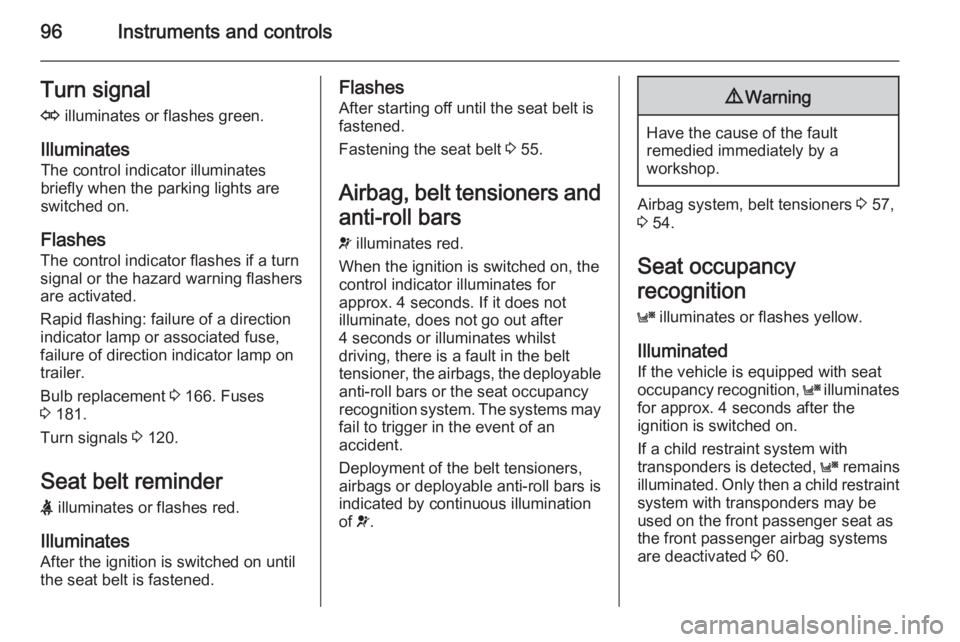
Seat belt reminder X illuminates or flashes red.
Illuminates After the ignition is switched on until
the seat belt is fastened.Flashes
After starting off until the seat belt is
fastened.
Fastening the seat belt 3 55.
Airbag, belt tensioners and
anti-roll bars v illuminates red.
When the ignition is switched on, the
control indicator illuminates for
approx. 4 seconds. If it does not
illuminate, does not go out after
4 seconds or illuminates whilst
driving, there is a fault in the belt
tensioner, the airbags, the deployable
anti-roll bars or the seat occupancy
recognition system. The systems may fail to trigger in the event of an
accident.
Deployment of the belt tensioners,
airbags or deployable anti-roll bars is
indicated by continuous illumination
of v.9 Warning
Have the cause of the fault
remedied immediately by a
workshop.
Airbag system, belt tensioners 3 57,
3 54.
Seat occupancy
recognition y illuminates or flashes yellow.
Illuminated
If the vehicle is equipped with seat occupancy recognition, y illuminates
for approx. 4 seconds after the
ignition is switched on.
If a child restraint system with
transponders is detected, y remains
illuminated. Only then a child restraint system with transponders may be
used on the front passenger seat as
the front passenger airbag systems
are deactivated 3 60.
Page 111 of 245
Instruments and controls109
Always day design black or coloured
text on light background.
Always night design white or coloured
text on dark background.
Selection is indicated by a o in front
of the menu item.
Ignition logic
See Infotainment system manual.Vehicle messages
Messages are given via the
instrument panel display or as
warning and signal buzzers. Check
control messages appear on the
Info-Display. Some appear in an
abbreviated form. Confirm warning
messages with the multifunction knob
3 102, 3 105.
Warning chimes
When starting the engine or
whilst driving ■ If the electronic key is not present or is not recognised.
■ If seat belt is not fastened.
■ If a door or the tailgate is not fully closed when starting off.
■ If a certain speed is exceeded with the parking brake applied.■ If the speed programmed at thefactory is exceeded.
■ If the vehicle has automated manual transmission and the
driver's door is opened when the
engine is running, a gear is
engaged and the foot brake is not
depressed.
When the vehicle is parked and the driver's door is opened ■ When the key is in the ignition switch.
■ With exterior lights on.
■ With Open&Start system and automatic transmission, if the
selector lever is not in P.
■ For automated manual transmission, if the parking brake is
not applied and no gear is engaged when the engine is switched off.
Page 133 of 245
Climate control131Maintenance
Air intake
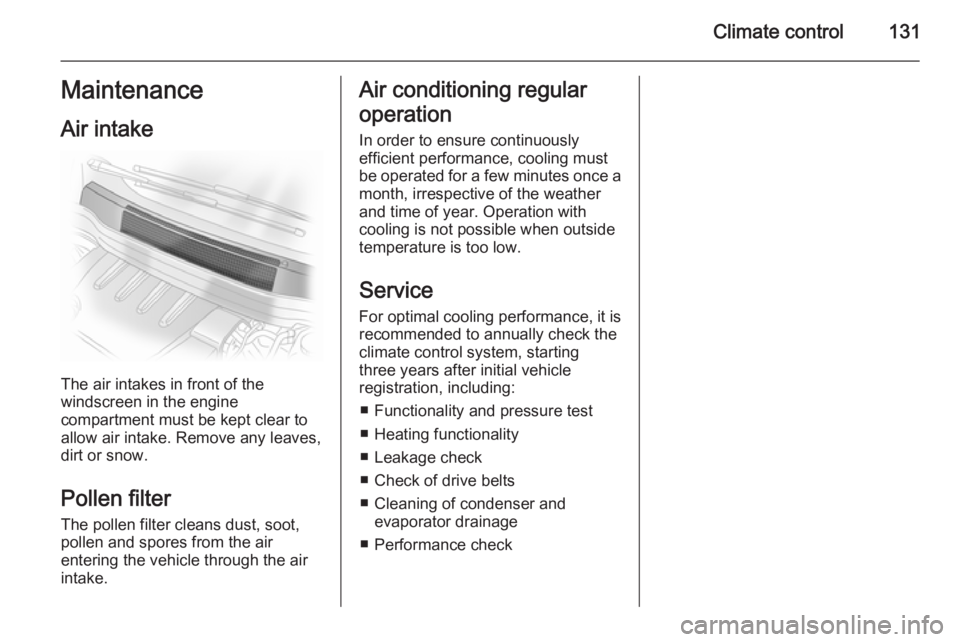
The air intakes in front of the
windscreen in the engine
compartment must be kept clear to
allow air intake. Remove any leaves,
dirt or snow.
Pollen filter
The pollen filter cleans dust, soot,
pollen and spores from the air
entering the vehicle through the air
intake.
Air conditioning regular
operation In order to ensure continuously
efficient performance, cooling must
be operated for a few minutes once a
month, irrespective of the weather
and time of year. Operation with
cooling is not possible when outside
temperature is too low.
Service For optimal cooling performance, it isrecommended to annually check the
climate control system, starting
three years after initial vehicle
registration, including:
■ Functionality and pressure test■ Heating functionality
■ Leakage check
■ Check of drive belts
■ Cleaning of condenser and evaporator drainage
■ Performance check
Page 192 of 245
190Vehicle careTyre designationsE.g. 195/65 R 15 91 H195=Tyre width, mm65=Cross-section ratio (tyre
height to tyre width), %R=Belt type: RadialRF=Type: RunFlat15=Wheel diameter, inches91=Load index e.g. 91 is
equivalent to 618 kgH=Speed code letter
Speed code letter:
Q=up to 160 km/hS=up to 180 km/hT=up to 190 km/hH=up to 210 km/hV=up to 240 km/hW=up to 270 km/h
Tyre pressure
Check the pressure of cold tyres at
least every 14 days and before any
long journey. Do not forget the spare
wheel. This also applies to vehicles
with tyre pressure monitoring.
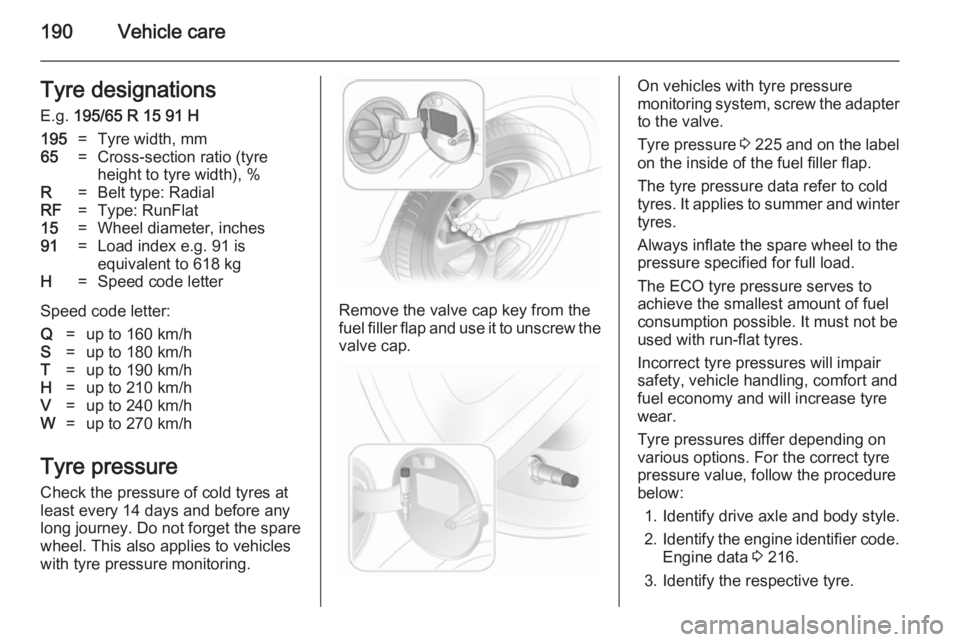
Remove the valve cap key from the
fuel filler flap and use it to unscrew the
valve cap.
On vehicles with tyre pressure
monitoring system, screw the adapter
to the valve.
Tyre pressure 3 225 and on the label
on the inside of the fuel filler flap.
The tyre pressure data refer to cold
tyres. It applies to summer and winter tyres.
Always inflate the spare wheel to the
pressure specified for full load.
The ECO tyre pressure serves to
achieve the smallest amount of fuel
consumption possible. It must not be used with run-flat tyres.
Incorrect tyre pressures will impair
safety, vehicle handling, comfort and
fuel economy and will increase tyre
wear.
Tyre pressures differ depending on
various options. For the correct tyre
pressure value, follow the procedure
below:
1. Identify drive axle and body style.
2. Identify the engine identifier code.
Engine data 3 216.
3. Identify the respective tyre.