radio OPEL ASTRA SALOON 2014 User Guide
[x] Cancel search | Manufacturer: OPEL, Model Year: 2014, Model line: ASTRA SALOON, Model: OPEL ASTRA SALOON 2014Pages: 245, PDF Size: 7.12 MB
Page 34 of 245
32Keys, doors and windows
During the first 10 seconds of anti-
theft alarm system activation:LED
illuminates=Test, ignition delayLED
flashes
quickly=Door, load
compartment or
bonnet open, or
system fault
After the first 10 seconds of anti-theft
alarm system activation:
LED flashes
slowly=System activeLED comes on for
approx. 1 second=Switch off
function
Seek the assistance of a workshop in the event of faults.
Alarm When triggered, the alarm gives off
an acoustic signal (horn) and a visual
signal (hazard warning flashers). The number and duration of which are
stipulated by legislation.
The alarm siren can be silenced by
pressing a button of the radio remote control or by switching on the ignition. The anti-theft alarm system is
deactivated at the same time.
Immobiliser
The system checks whether the
vehicle is allowed to start with the key being used. If the transponder in the
key is recognised, the engine can be
started.
The electronic immobiliser activates
itself automatically after the key has
been removed from the ignition
switch or when the engine is switched
off by pressing the Start/Stop button.
Control indicator A 3 97.
Note
The immobiliser does not lock the
doors. You should always lock the
vehicle after leaving it and switch on the anti-theft alarm system 3 25,
3 30.Exterior mirrors
Convex shape
The convex exterior mirror contains
an aspherical area and reduces blind spots. The shape of the mirror makes objects appear smaller, which will
affect the ability to estimate
distances.
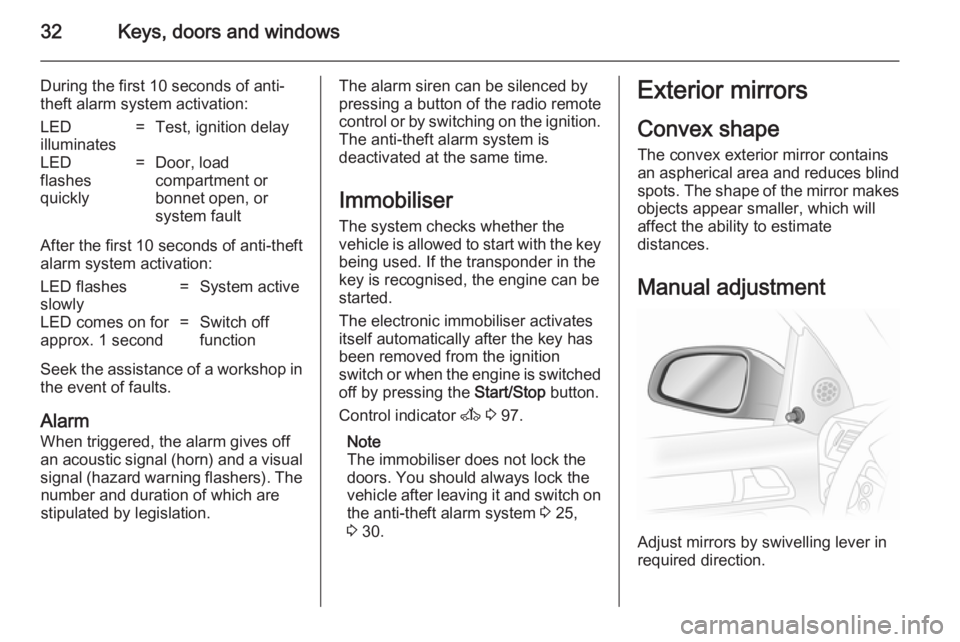
Manual adjustment
Adjust mirrors by swivelling lever in
required direction.
Page 39 of 245
Keys, doors and windows37
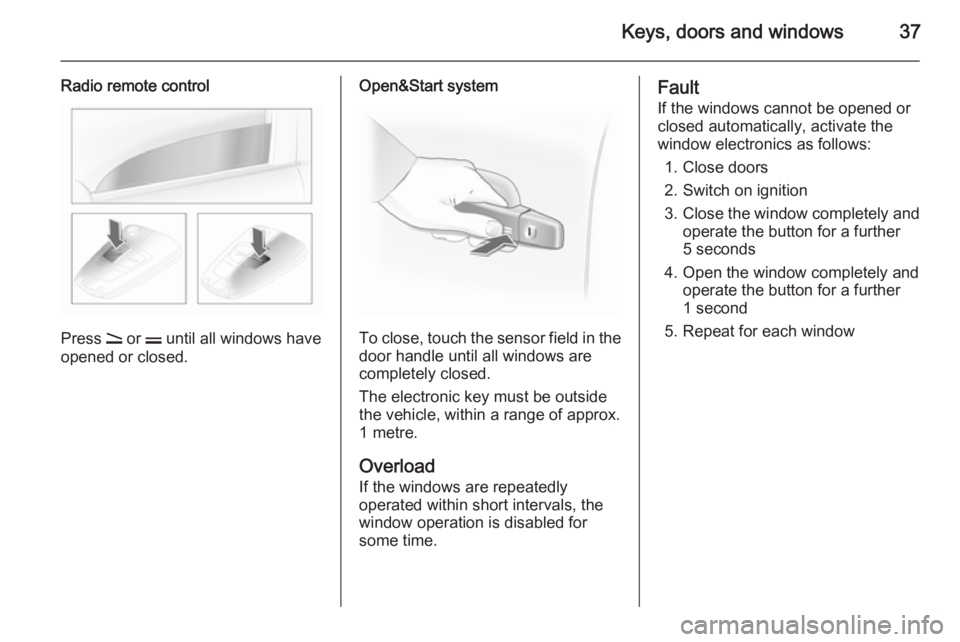
Radio remote control
Press q or p until all windows have
opened or closed.
Open&Start system
To close, touch the sensor field in the
door handle until all windows are
completely closed.
The electronic key must be outside
the vehicle, within a range of approx. 1 metre.
Overload If the windows are repeatedly
operated within short intervals, the
window operation is disabled for
some time.
Fault
If the windows cannot be opened or
closed automatically, activate the window electronics as follows:
1. Close doors
2. Switch on ignition
3. Close the window completely and
operate the button for a further
5 seconds
4. Open the window completely and operate the button for a further
1 second
5. Repeat for each window
Page 62 of 245
60Seats, restraints9Warning
Keep the area in which the airbag
inflates clear of obstructions.
The hooks on the handles in the
roof frame are only suitable for
hanging up light articles of
clothing, without coat hangers. Do not keep any items in these
clothes.
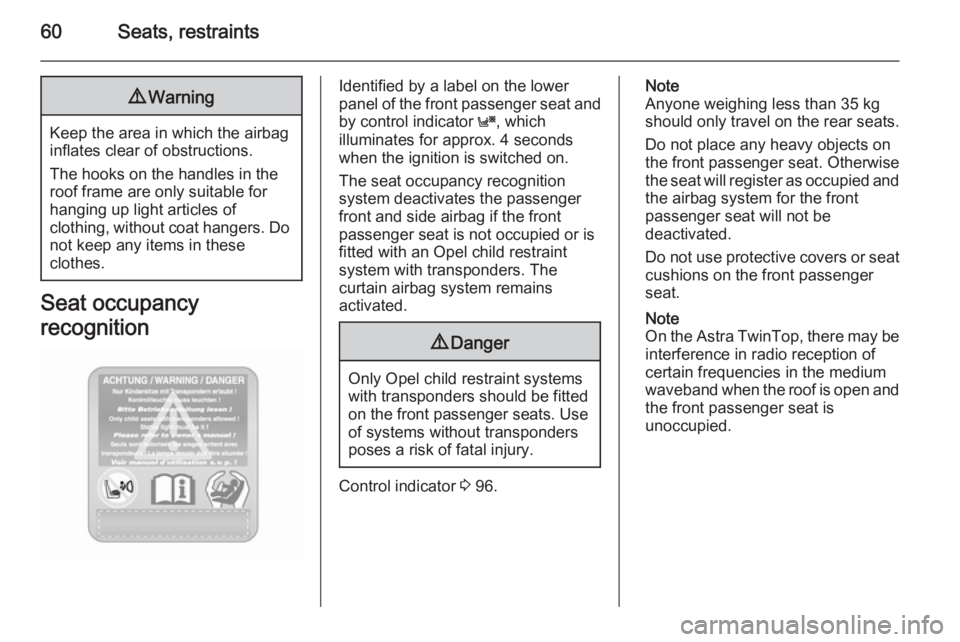
Seat occupancy
recognition
Identified by a label on the lower
panel of the front passenger seat and
by control indicator y, which
illuminates for approx. 4 seconds when the ignition is switched on.
The seat occupancy recognition
system deactivates the passenger
front and side airbag if the front
passenger seat is not occupied or is
fitted with an Opel child restraint
system with transponders. The
curtain airbag system remains
activated.9 Danger
Only Opel child restraint systems
with transponders should be fitted
on the front passenger seats. Use of systems without transponders
poses a risk of fatal injury.
Control indicator 3 96.
Note
Anyone weighing less than 35 kg
should only travel on the rear seats.
Do not place any heavy objects on
the front passenger seat. Otherwise
the seat will register as occupied and
the airbag system for the front
passenger seat will not be
deactivated.
Do not use protective covers or seat cushions on the front passenger
seat.
Note
On the Astra TwinTop, there may be
interference in radio reception of
certain frequencies in the medium
waveband when the roof is open and
the front passenger seat is
unoccupied.
Page 112 of 245
110Instruments and controls
When operating the retractable
hardtop ■ Indicator buzzer upon completed opening or closing of the
convertible hardtop.
■ Indicator buzzer upon completed raising or lowering of the electricload compartment loading aid.
■ Gong tone if the tailgate is not closed during roof operation.
■ Gong tone if the tailgate is not fully open during operation of the load
compartment loading aid.
■ Gong tone during roof operation if vehicle speed exceeds 30 km/h.
■ Gong tone when vehicle speed exceeds 30 km/h if the roof is not
fully open or closed.
■ Three gong tones during roof or loading aid operation if the load
compartment blind is not attached.
■ Three gong tones during roof operation if outside temperature is
below -20 °C, vehicle battery
voltage is too low or the system is
overloaded.■ Continuous warning buzzer during roof operation if the anti-roll bars
have been triggered.
■ Continuous warning buzzer starting
one minute before the end of the
9-minute standby time with the roof
in an intermediate position or the loading aid in a raised position.
■ Persistent warning buzzer when closing the tailgate, if the lowering
process of the electric load aid is
not complete or has been
interrupted.
Battery voltage
Low battery voltage in radio remote
control or electronic key. On vehicles
without check control, the message
InSP3 appears in the instrument
panel display. Replace the battery
3 20, 3 22.
Brake light switch
Brake light does not come on during
braking. Have the cause of the fault
remedied immediately by a
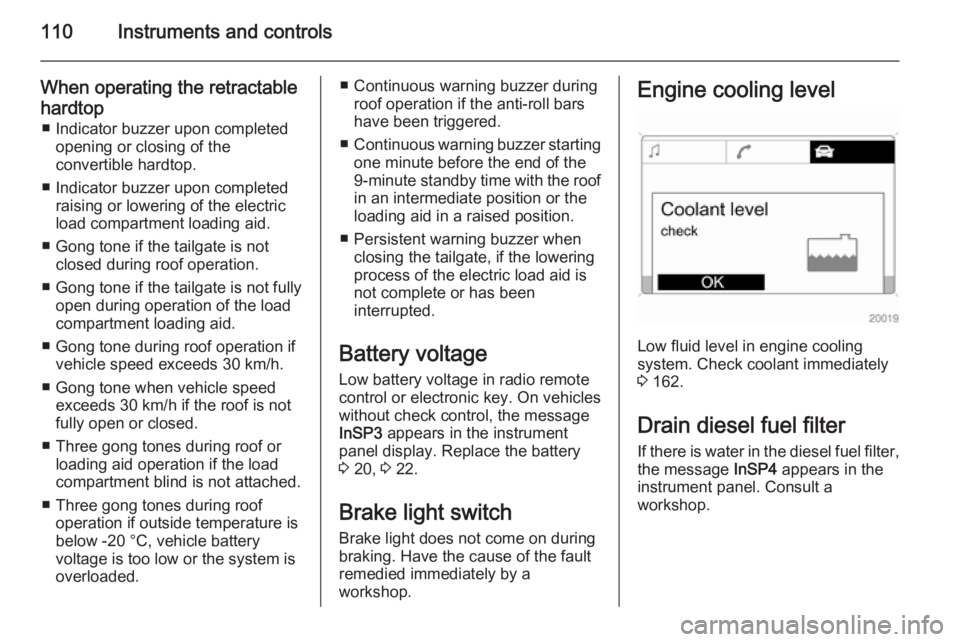
workshop.Engine cooling level
Low fluid level in engine cooling
system. Check coolant immediately
3 162.
Drain diesel fuel filter
If there is water in the diesel fuel filter, the message InSP4 appears in the
instrument panel. Consult a
workshop.
Page 193 of 245
Vehicle care191
The tyre pressure tables show all
possible tyre combinations 3 225.
For the tyres approved for your
vehicle, refer to the EEC Certificate of Conformity provided with your vehicle
or other national registration
documents.
The driver is responsible for correct
adjustment of tyre pressure.9 Warning
If the pressure is too low, this can
result in considerable tyre warm-
up and internal damage, leading to tread separation and even to tyre
blow-out at high speeds.
Tyre pressure monitoring
system
The tyre pressure monitoring system
continually checks the pressure of all
four wheels when vehicle speed
exceeds a certain limit.
All wheels must be equipped with
pressure sensors and the tyres must
have the prescribed pressure.
Otherwise, the tyre pressure will be monitored by the deflation detection
system 3 191.
Note
In countries where the tyre pressure
monitoring system is legally
required, the use of wheels without
pressure sensors will invalidate the
vehicle type approval.
The current tyre pressures can be
shown in the Info-Display 3 116.
Vehicle messages, tyre pressure
3 111.
Control indicator w 3 99.
If a complete set of wheels without
sensors is mounted (e.g. four winter
tyres), no error message will be
displayed. The tyre pressure
monitoring system is not operational.
Retrofitting of sensors is possible.
The use of commercially available
liquid tyre repair kits can impair the
function of the system. Factory-
approved systems can be used.
External high-power radio equipment
could disrupt the tyre pressure
monitoring system.System initialisation
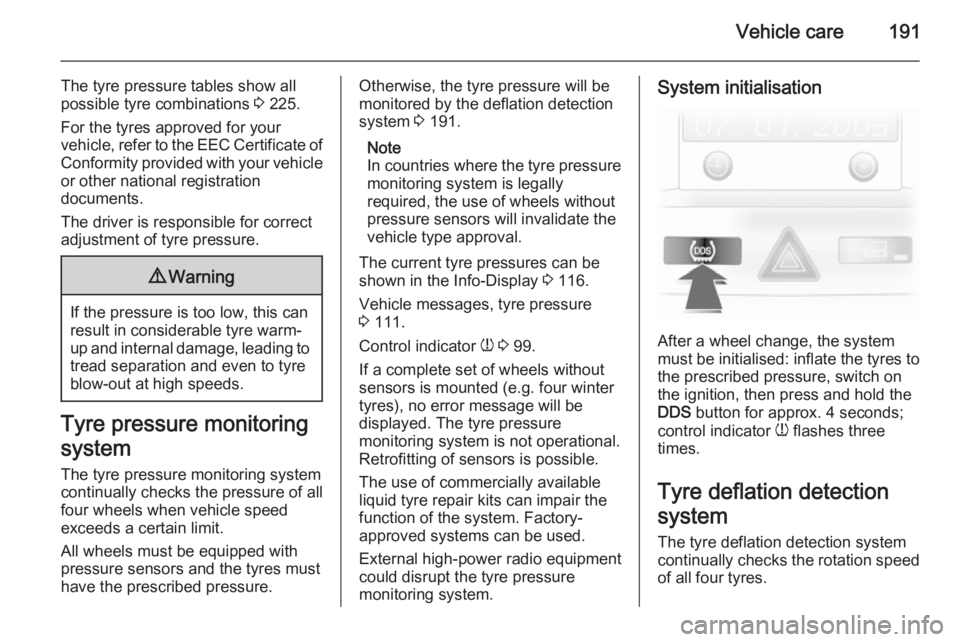
After a wheel change, the system
must be initialised: inflate the tyres to
the prescribed pressure, switch on
the ignition, then press and hold the
DDS button for approx. 4 seconds;
control indicator w flashes three
times.
Tyre deflation detection
system
The tyre deflation detection system
continually checks the rotation speed
of all four tyres.
Page 237 of 245
Customer information235Customer informationCustomer information................235
Vehicle data recording and pri‐
vacy ........................................... 235Customer information
Declaration of conformity
This vehicle has systems that
transmit and/or receive radio waves
subject to Directive 1999/5/EC.
These systems are in compliance with the essential requirements and
other relevant provisions of Directive
1999/5/EC. Copies of the original
Declarations of Conformity can be
obtained on our website.Vehicle data recording
and privacy
Event data recordersData storage modules in thevehicle
A large number of electronic
components of your vehicle contain
data storage modules temporarily or
permanently storing technical data
about the condition of the vehicle,
events and errors. In general, this
technical information documents the
condition of parts, modules, systems
or the environment:
■ Operating conditions of system components (e.g. filling levels)
■ Status messages of the vehicle and
its single components (e.g. number
of wheel revolutions / rotational
speed, deceleration, lateral
acceleration)
■ Dysfunctions and defects in important system components
Page 238 of 245
236Customer information
■ Vehicle reactions in particulardriving situations (e.g. inflation of
an airbag, activation of the stability
regulation system)
■ Environmental conditions (e.g. temperature)
These data are exclusively technical
and help identifying and correcting
errors as well as optimizing vehicle
functions.
Motion profiles indicating travelled
routes cannot be created with these
data.
If services are used (e.g. repair
works, service processes, warranty
cases, quality assurance),
employees of the service network
(manufacturer included) are able to
read out this technical information
from the event and error data storage
modules applying special diagnostic
devices. If required, you will receive
further information at these
workshops. After an error has been
corrected, the data are deleted from
the error storage module or they are
constantly overwritten.When using the vehicle, situations
may occur in which these technical
data related to other information
(accident report, damages on the
vehicle, witness statements etc.) may be associated with a specific person -
possibly, with the assistance of an
expert.
Additional functions contractually
agreed upon with the client (e.g.
vehicle location in emergency cases)
allow the transmission of particular vehicle data from the vehicle.Radio Frequency
Identification (RFID) RFID technology is used in somevehicles for functions such as tyre
pressure monitoring and ignition
system security. It is also used in
connection with conveniences such
as radio remote controls for door
locking/unlocking and starting, and in-
vehicle transmitters for garage door
openers. RFID technology in Opel
vehicles does not use or record
personal information or link with any
other Opel system containing
personal information.
Page 243 of 245
241
Performing work ........................160
Pollen filter ................................. 131
Power outlets ............................... 90
Power windows ............................ 35
Preheating and diesel particle filter .......................................... 99
Puncture ..................................... 196
Q
Quickheat ................................... 130
R Radio Frequency Identification (RFID) ..................................... 236
Radio remote control ...................20
Reading lights ............................ 122
Rear fog light ............................. 102
Rear fog lights ........................... 120
Rear seats .................................... 53
Rear window wiper/washer .......... 88
Recommended fluids and lubricants ........................ 208, 213
Refuelling ................................... 152
Retractable hardtop .....................41
Reversing lights .........................121
Ride control systems ..................147
Roof .............................................. 39
Roof rack ..................................... 83
Run-flat tyres ............................. 189S
Safety net .................................... 78
Seat adjustment ....................... 7, 50
Seat belt ........................................ 8
Seat belt reminder .......................96
Seat belts ..................................... 54
Seat folding .................................. 52
Seat occupancy recognition ..60, 96
Seat position ................................ 49
Selector lever ..................... 137, 142
Service ............................... 131, 207
Service display ............................ 94
Service information ....................207
Service vehicle soon .................... 97
Side airbag system ......................59
Sidelights .................................... 117
Side turn signal lights ................178
Spare wheel ............................... 198
Speedometer ............................... 93
Sport mode .......................... 98, 148
Starting and operating ................132
Starting off ................................... 17
Starting the engine ............133, 142
Steering wheel adjustment ......9, 86
Steering wheel controls ...............86
Stop watch ................................. 116
Storage ......................................... 67
Storage compartments .................67
Sunglasses storage .....................68Sunroof ........................................ 39
Sunvisor lights ........................... 122
Sun visors .................................... 38
Symbols ......................................... 4
T
Tachometer ................................. 93
Tail lights ................................... 171
Three-point seat belt .................... 55
Tools .......................................... 187
Top-tether child restraint systems 65
Tow bar....................................... 154
Towing ................................ 154, 201
Towing another vehicle .............202
Towing equipment .....................155
Towing hitch installation dimensions ............................. 232
Towing the vehicle .....................201
Trailer coupling ........................... 154
Trailer stability assist .................158
Trailer towing ............................. 155
Transmission ............................... 16
Transmission display .........136, 142
Tread depth ............................... 192
Trip computer in Board-Info- Display ................................... 112
Trip computer in Graphic-Info- Display or Colour-Info-Display 113
Triple-Info-Display .....................102
Trip odometer .............................. 93