seats OPEL ASTRA SALOON 2014 Owner's Manual
[x] Cancel search | Manufacturer: OPEL, Model Year: 2014, Model line: ASTRA SALOON, Model: OPEL ASTRA SALOON 2014Pages: 245, PDF Size: 7.12 MB
Page 63 of 245
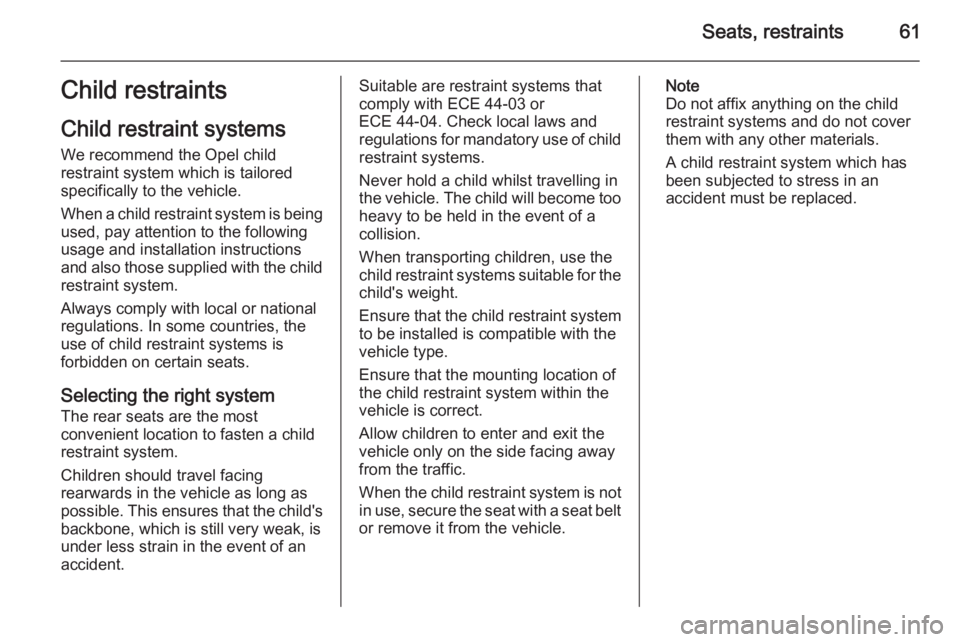
Seats, restraints61Child restraintsChild restraint systems
We recommend the Opel child
restraint system which is tailored
specifically to the vehicle.
When a child restraint system is being used, pay attention to the following
usage and installation instructions
and also those supplied with the child
restraint system.
Always comply with local or national
regulations. In some countries, the
use of child restraint systems is
forbidden on certain seats.
Selecting the right systemThe rear seats are the most
convenient location to fasten a child
restraint system.
Children should travel facing
rearwards in the vehicle as long as
possible. This ensures that the child's
backbone, which is still very weak, is
under less strain in the event of an
accident.Suitable are restraint systems that
comply with ECE 44-03 or
ECE 44-04. Check local laws and
regulations for mandatory use of child restraint systems.
Never hold a child whilst travelling in
the vehicle. The child will become too
heavy to be held in the event of a
collision.
When transporting children, use the
child restraint systems suitable for the
child's weight.
Ensure that the child restraint system to be installed is compatible with the
vehicle type.
Ensure that the mounting location of
the child restraint system within the
vehicle is correct.
Allow children to enter and exit the
vehicle only on the side facing away
from the traffic.
When the child restraint system is not in use, secure the seat with a seat belt
or remove it from the vehicle.Note
Do not affix anything on the child
restraint systems and do not cover
them with any other materials.
A child restraint system which has
been subjected to stress in an
accident must be replaced.
Page 64 of 245
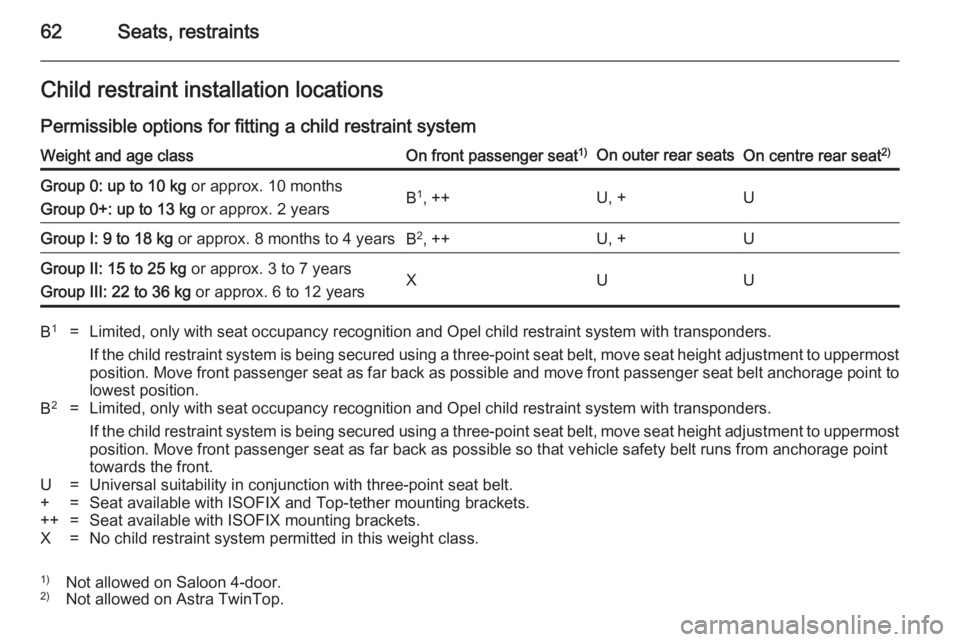
62Seats, restraintsChild restraint installation locationsPermissible options for fitting a child restraint systemWeight and age classOn front passenger seat 1)On outer rear seatsOn centre rear seat2)Group 0: up to 10 kg
or approx. 10 months
Group 0+: up to 13 kg or approx. 2 yearsB1
, ++U, +UGroup I: 9 to 18 kg or approx. 8 months to 4 yearsB2
, ++U, +UGroup II: 15 to 25 kg or approx. 3 to 7 years
Group III: 22 to 36 kg or approx. 6 to 12 yearsXUUB1=Limited, only with seat occupancy recognition and Opel child restraint system with transponders.
If the child restraint system is being secured using a three-point seat belt, move seat height adjustment to uppermost position. Move front passenger seat as far back as possible and move front passenger seat belt anchorage point to lowest position.B 2=Limited, only with seat occupancy recognition and Opel child restraint system with transponders.
If the child restraint system is being secured using a three-point seat belt, move seat height adjustment to uppermost position. Move front passenger seat as far back as possible so that vehicle safety belt runs from anchorage point
towards the front.U=Universal suitability in conjunction with three-point seat belt.+=Seat available with ISOFIX and Top-tether mounting brackets.++=Seat available with ISOFIX mounting brackets.X=No child restraint system permitted in this weight class.1) Not allowed on Saloon 4-door.
2) Not allowed on Astra TwinTop.
Page 65 of 245
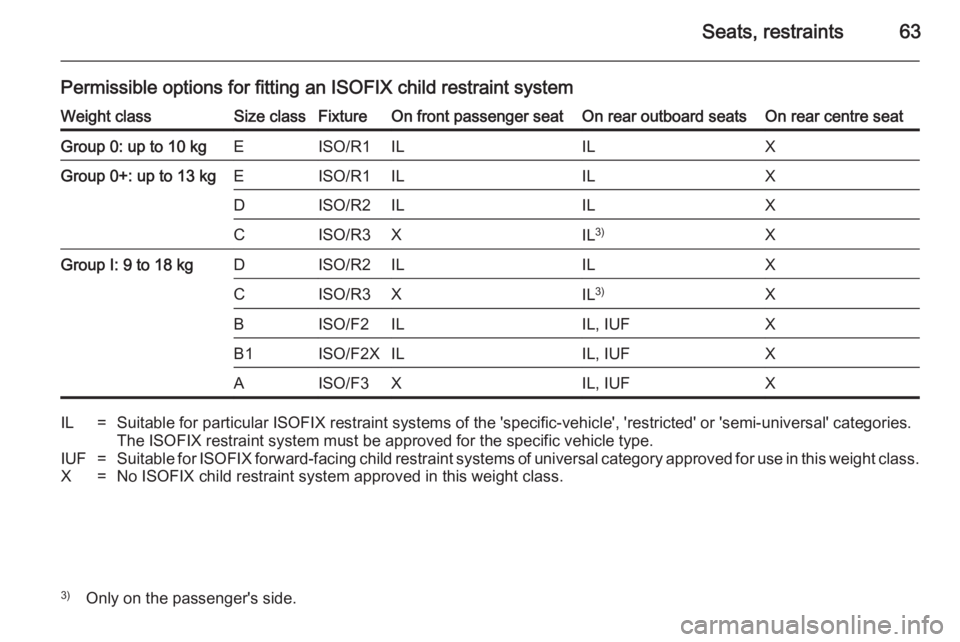
Seats, restraints63
Permissible options for fitting an ISOFIX child restraint systemWeight classSize classFixtureOn front passenger seatOn rear outboard seatsOn rear centre seatGroup 0: up to 10 kgEISO/R1ILILXGroup 0+: up to 13 kgEISO/R1ILILXDISO/R2ILILXCISO/R3XIL3)XGroup I: 9 to 18 kgDISO/R2ILILXCISO/R3XIL3)XBISO/F2ILIL, IUFXB1ISO/F2XILIL, IUFXAISO/F3XIL, IUFXIL=Suitable for particular ISOFIX restraint systems of the 'specific-vehicle', 'restricted' or 'semi-universal' categories.
The ISOFIX restraint system must be approved for the specific vehicle type.IUF=Suitable for ISOFIX forward-facing child restraint systems of universal category approved for use in this weight class.X=No ISOFIX child restraint system approved in this weight class.3)
Only on the passenger's side.
Page 66 of 245
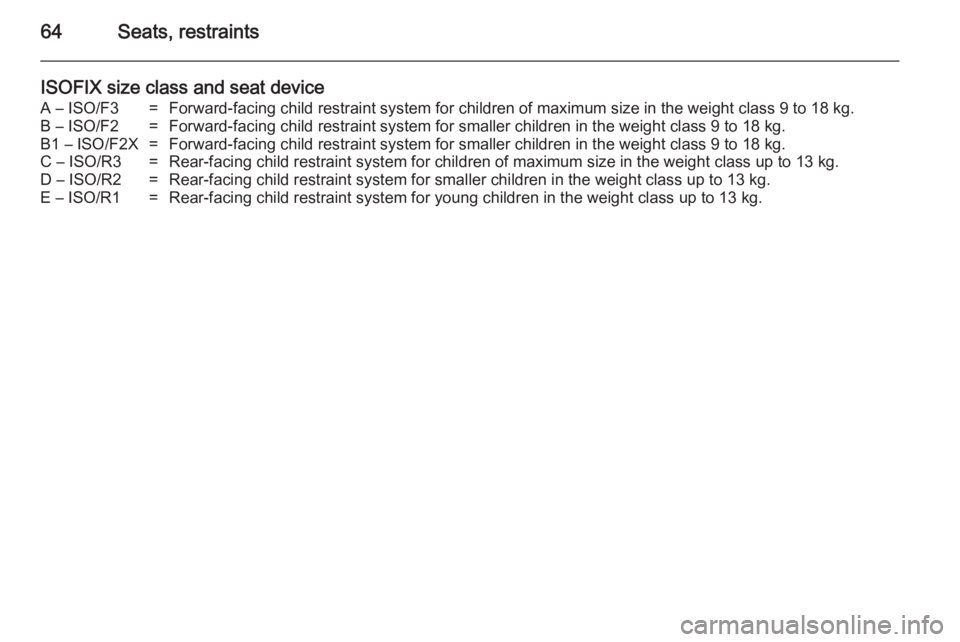
64Seats, restraints
ISOFIX size class and seat deviceA – ISO/F3=Forward-facing child restraint system for children of maximum size in the weight class 9 to 18 kg.B – ISO/F2=Forward-facing child restraint system for smaller children in the weight class 9 to 18 kg.B1 – ISO/F2X=Forward-facing child restraint system for smaller children in the weight class 9 to 18 kg.C – ISO/R3=Rear-facing child restraint system for children of maximum size in the weight class up to 13 kg.D – ISO/R2=Rear-facing child restraint system for smaller children in the weight class up to 13 kg.E – ISO/R1=Rear-facing child restraint system for young children in the weight class up to 13 kg.
Page 67 of 245
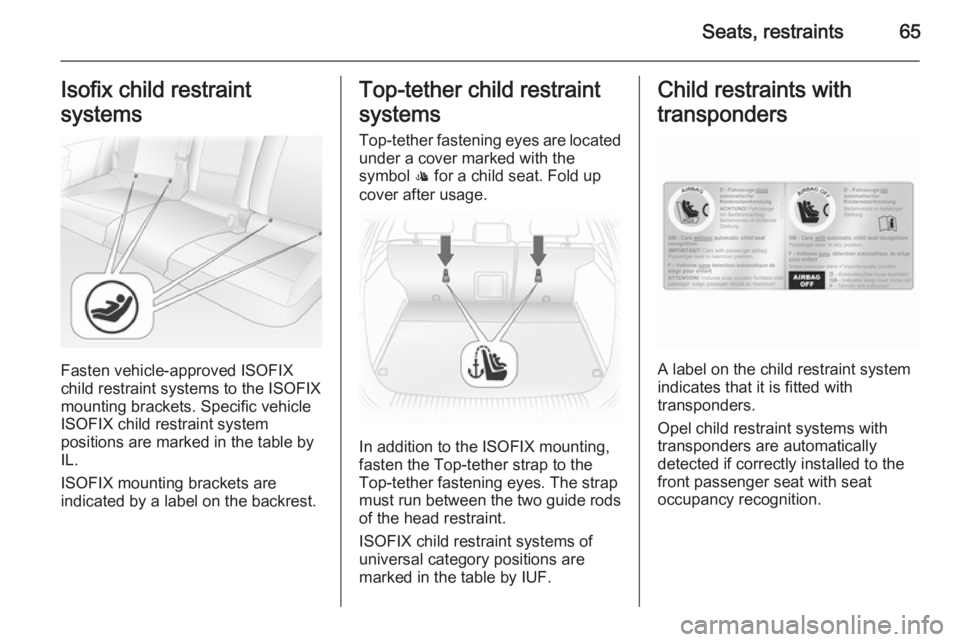
Seats, restraints65Isofix child restraint
systems
Fasten vehicle-approved ISOFIX
child restraint systems to the ISOFIX
mounting brackets. Specific vehicle
ISOFIX child restraint system
positions are marked in the table by
IL.
ISOFIX mounting brackets are
indicated by a label on the backrest.
Top-tether child restraint
systems Top-tether fastening eyes are located
under a cover marked with the
symbol : for a child seat. Fold up
cover after usage.
In addition to the ISOFIX mounting,
fasten the Top-tether strap to the
Top-tether fastening eyes. The strap
must run between the two guide rods of the head restraint.
ISOFIX child restraint systems of
universal category positions are
marked in the table by IUF.
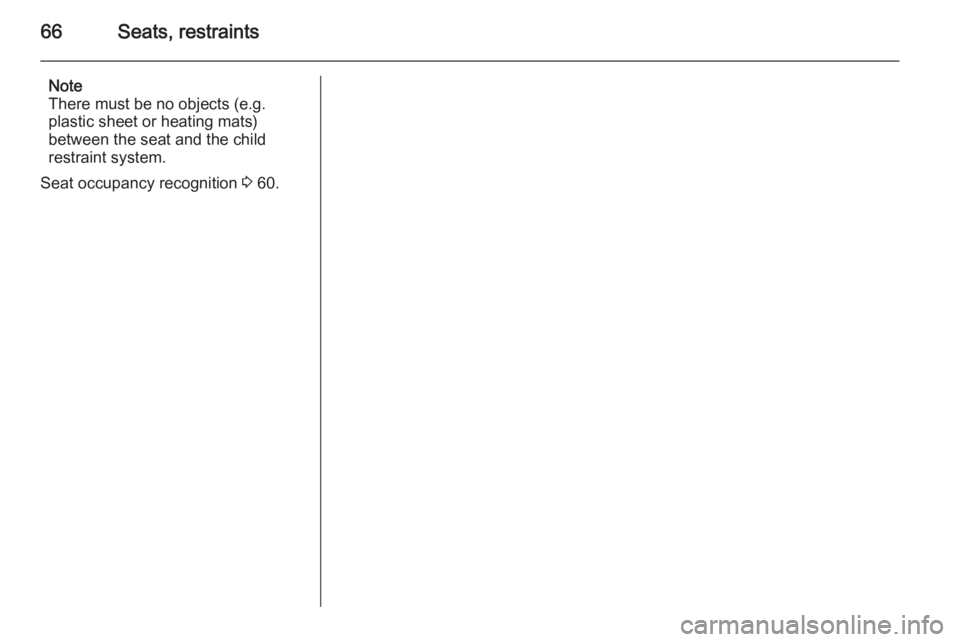
Child restraints with
transponders
A label on the child restraint system
indicates that it is fitted with
transponders.
Opel child restraint systems with
transponders are automatically
detected if correctly installed to the
front passenger seat with seat
occupancy recognition.
Page 68 of 245
66Seats, restraints
Note
There must be no objects (e.g.
plastic sheet or heating mats)
between the seat and the child
restraint system.
Seat occupancy recognition 3 60.
Page 74 of 245
72Storage
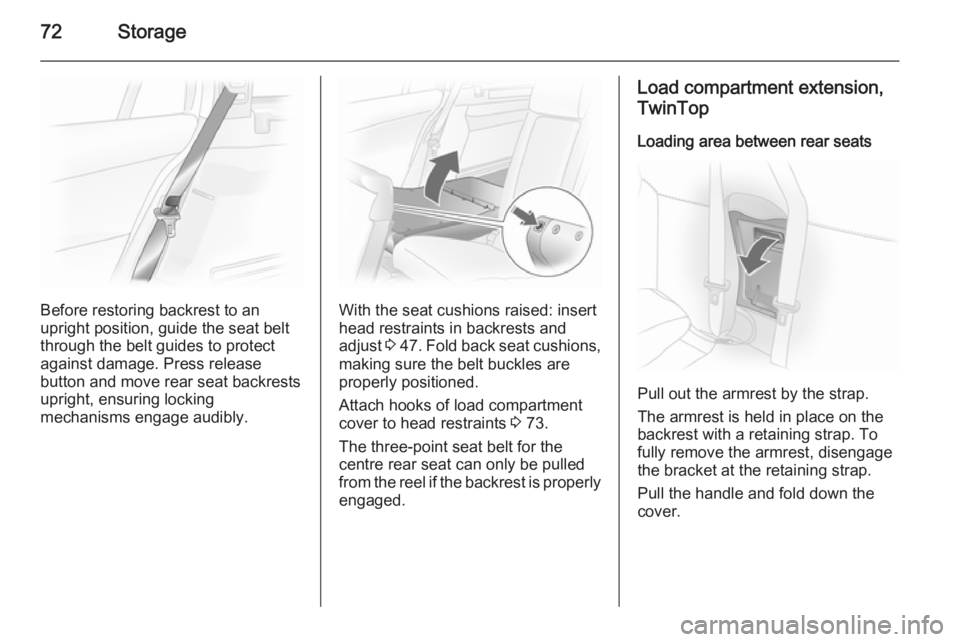
Before restoring backrest to an
upright position, guide the seat belt
through the belt guides to protect
against damage. Press release
button and move rear seat backrests upright, ensuring locking
mechanisms engage audibly.With the seat cushions raised: insert
head restraints in backrests and
adjust 3 47 . Fold back seat cushions,
making sure the belt buckles are
properly positioned.
Attach hooks of load compartment
cover to head restraints 3 73.
The three-point seat belt for the
centre rear seat can only be pulled
from the reel if the backrest is properly engaged.
Load compartment extension,
TwinTop
Loading area between rear seats
Pull out the armrest by the strap.
The armrest is held in place on the
backrest with a retaining strap. To
fully remove the armrest, disengage
the bracket at the retaining strap.
Pull the handle and fold down the
cover.
Page 80 of 245
78Storage
Note■ Do not place objects on or near the
load compartment blind
■ The folded roof can only be lowered
when the blind is closed.
Otherwise, a warning buzzer will
sound three times
■ The movement of the tilted roof can
be stopped by pressing the loading aid button and another longer press
reverses the direction of the
movement
■ A confirmation buzzer is heard in the upper and lower roof end
positions when the roof is tilted
■ Only close the tailgate once the confirmation signal has sounded to
indicate that the loading aid is in its
lower end position
■ If the loading aid is not in its lower end position when the boot lid is
closed, a warning tone sounds or
the tailgate is blocked mechanically 3 41
■ Do not touch moving parts■ One minute before the end of the hold time for the raised loading aid,a warning buzzer will sound to
remind you to lower the roof
■ The loading aid is only operable when the vehicle is unlocked
■ Frequent operation of the loading aid with the engine off discharges
the battery
■ Repeated operation of the loading aid can cause malfunctions
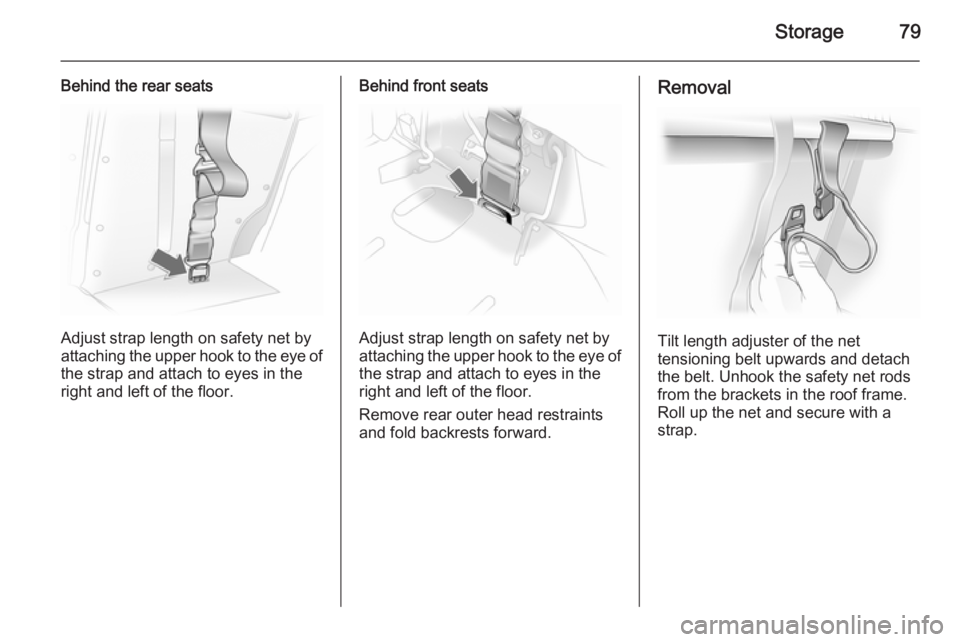
Safety net The safety net is available on the
Station wagon and can be installed
behind the rear seats or, if the rear
seat backrests are folded and the
seat cushions raised, behind the front seats.
Passengers must not be transported
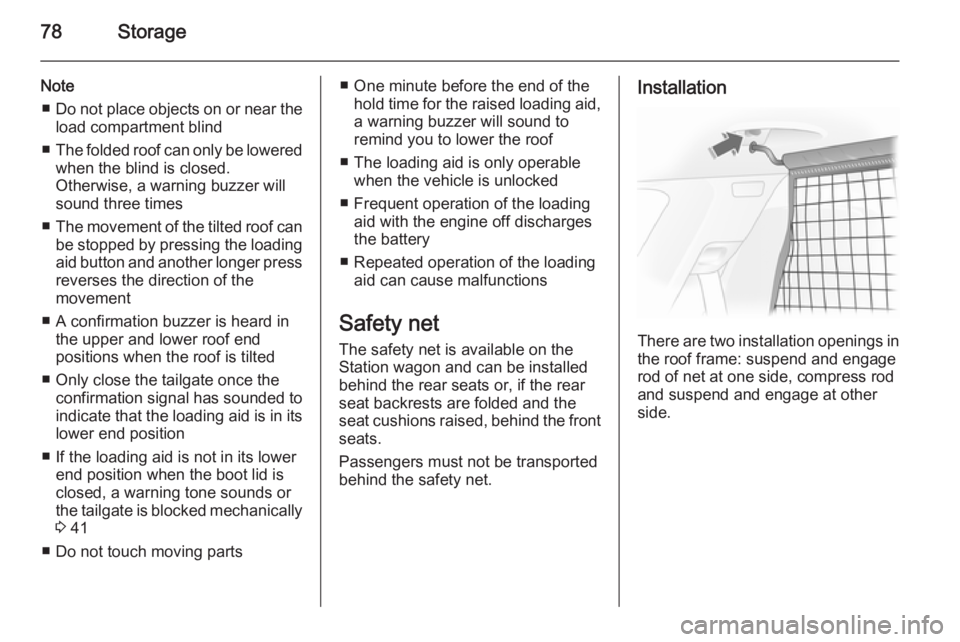
behind the safety net.Installation
There are two installation openings in the roof frame: suspend and engage
rod of net at one side, compress rod and suspend and engage at other
side.
Page 81 of 245
Storage79
Behind the rear seats
Adjust strap length on safety net by
attaching the upper hook to the eye of
the strap and attach to eyes in the
right and left of the floor.
Behind front seats
Adjust strap length on safety net by
attaching the upper hook to the eye of
the strap and attach to eyes in the
right and left of the floor.
Remove rear outer head restraints
and fold backrests forward.
Removal
Tilt length adjuster of the net
tensioning belt upwards and detach
the belt. Unhook the safety net rods
from the brackets in the roof frame.
Roll up the net and secure with a
strap.
Page 86 of 245
84StorageLoading information
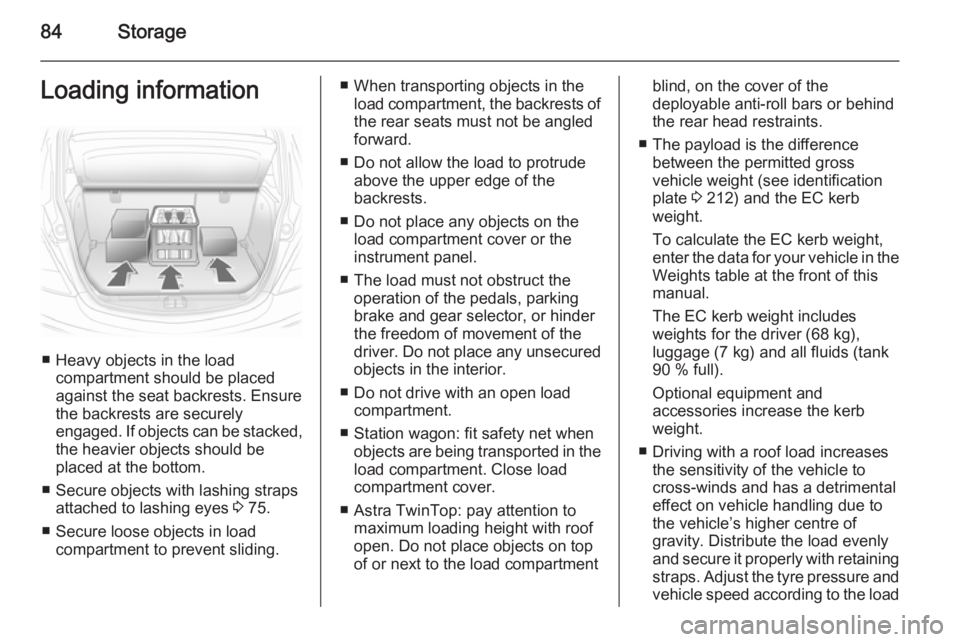
■ Heavy objects in the loadcompartment should be placedagainst the seat backrests. Ensure
the backrests are securely
engaged. If objects can be stacked, the heavier objects should be
placed at the bottom.
■ Secure objects with lashing straps attached to lashing eyes 3 75.
■ Secure loose objects in load compartment to prevent sliding.
■ When transporting objects in theload compartment, the backrests of
the rear seats must not be angled
forward.
■ Do not allow the load to protrude above the upper edge of the
backrests.
■ Do not place any objects on the load compartment cover or theinstrument panel.
■ The load must not obstruct the operation of the pedals, parking
brake and gear selector, or hinder
the freedom of movement of the
driver. Do not place any unsecured objects in the interior.
■ Do not drive with an open load compartment.
■ Station wagon: fit safety net when objects are being transported in theload compartment. Close load
compartment cover.
■ Astra TwinTop: pay attention to maximum loading height with roof
open. Do not place objects on top
of or next to the load compartmentblind, on the cover of the
deployable anti-roll bars or behind
the rear head restraints.
■ The payload is the difference between the permitted gross
vehicle weight (see identification
plate 3 212) and the EC kerb
weight.
To calculate the EC kerb weight,
enter the data for your vehicle in the
Weights table at the front of this
manual.
The EC kerb weight includes
weights for the driver (68 kg),
luggage (7 kg) and all fluids (tank
90 % full).
Optional equipment and
accessories increase the kerb
weight.
■ Driving with a roof load increases the sensitivity of the vehicle to
cross-winds and has a detrimental
effect on vehicle handling due to
the vehicle’s higher centre of
gravity. Distribute the load evenly
and secure it properly with retaining
straps. Adjust the tyre pressure and vehicle speed according to the load