engine OPEL ASTRA SALOON 2014 Repair Manual
[x] Cancel search | Manufacturer: OPEL, Model Year: 2014, Model line: ASTRA SALOON, Model: OPEL ASTRA SALOON 2014Pages: 245, PDF Size: 7.12 MB
Page 183 of 245
Vehicle care181Electrical systemFuses
Data on the replacement fuse must match data on the defective fuse.
The vehicle has two fuse boxes: one
behind a cover on the left side of the
load compartment and one in the front left of the engine compartment.
Store spare fuses in the load
compartment fuse box version B.
Open the cover 3 185.
Before replacing a fuse, turn off the
respective switch and the ignition.
A blown fuse can be recognised by its melted wire. Do not replace the fuse
until the cause of the fault has been
remedied.
Some functions are protected by
several fuses.
Fuses may also be inserted without existence of a function.
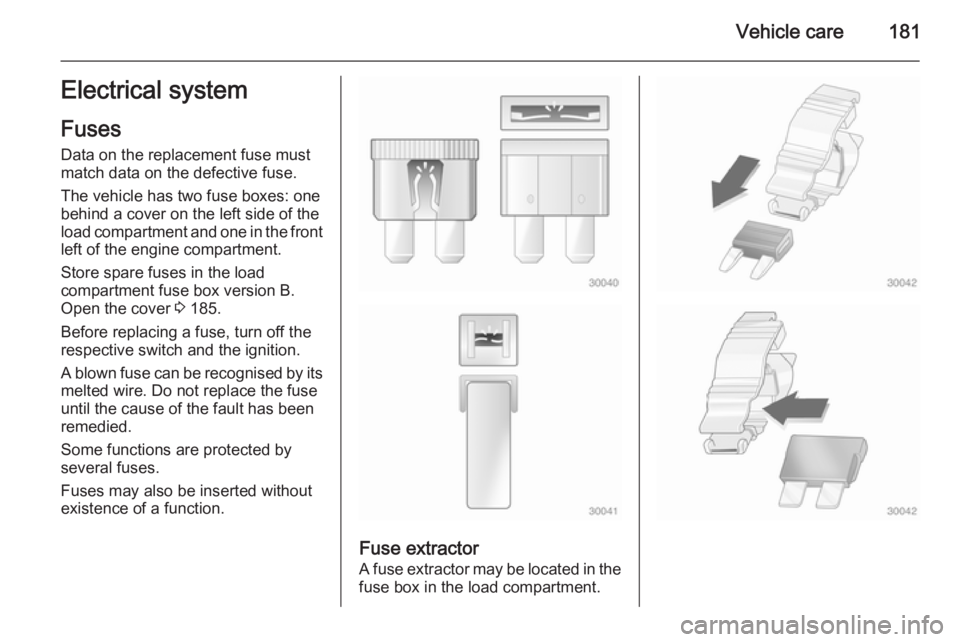
Fuse extractor
A fuse extractor may be located in the
fuse box in the load compartment.
Page 184 of 245
182Vehicle care
Place the fuse extractor on the
various types of fuse from the top or
side, and withdraw fuse.
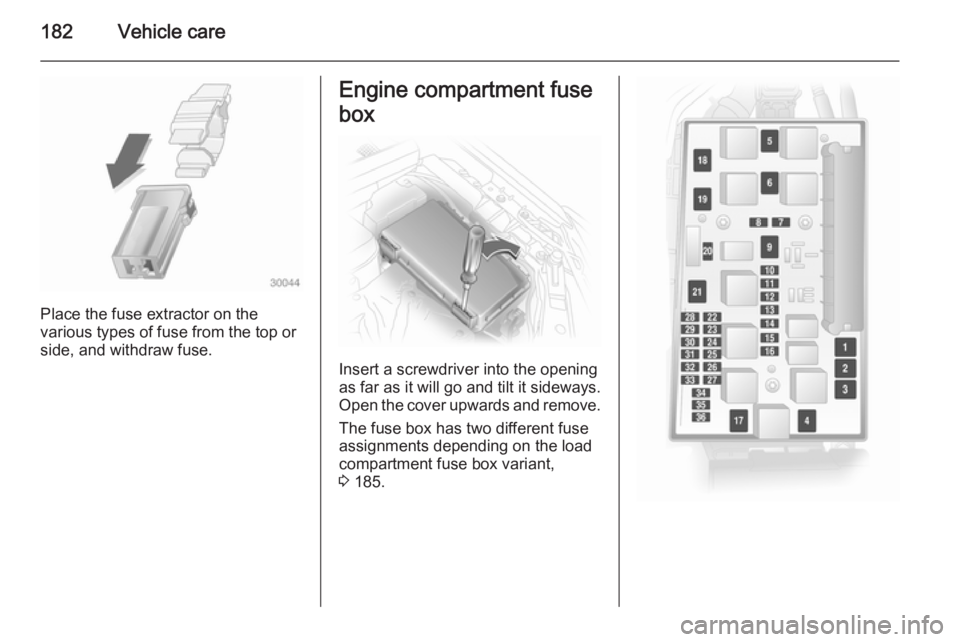
Engine compartment fuse
box
Insert a screwdriver into the opening
as far as it will go and tilt it sideways.
Open the cover upwards and remove.
The fuse box has two different fuse
assignments depending on the load
compartment fuse box variant,
3 185.
Page 185 of 245
Vehicle care183
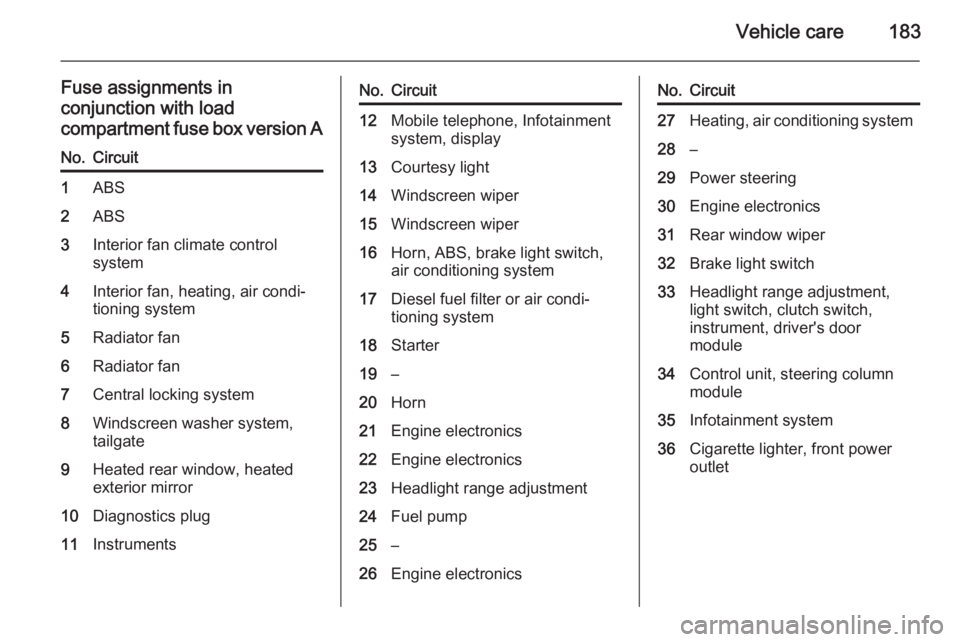
Fuse assignments inconjunction with loadcompartment fuse box version ANo.Circuit1ABS2ABS3Interior fan climate control
system4Interior fan, heating, air condi‐
tioning system5Radiator fan6Radiator fan7Central locking system8Windscreen washer system,
tailgate9Heated rear window, heated
exterior mirror10Diagnostics plug11InstrumentsNo.Circuit12Mobile telephone, Infotainment
system, display13Courtesy light14Windscreen wiper15Windscreen wiper16Horn, ABS, brake light switch,
air conditioning system17Diesel fuel filter or air condi‐
tioning system18Starter19–20Horn21Engine electronics22Engine electronics23Headlight range adjustment24Fuel pump25–26Engine electronicsNo.Circuit27Heating, air conditioning system28–29Power steering30Engine electronics31Rear window wiper32Brake light switch33Headlight range adjustment,
light switch, clutch switch,
instrument, driver's door
module34Control unit, steering column
module35Infotainment system36Cigarette lighter, front power
outlet
Page 186 of 245
184Vehicle care
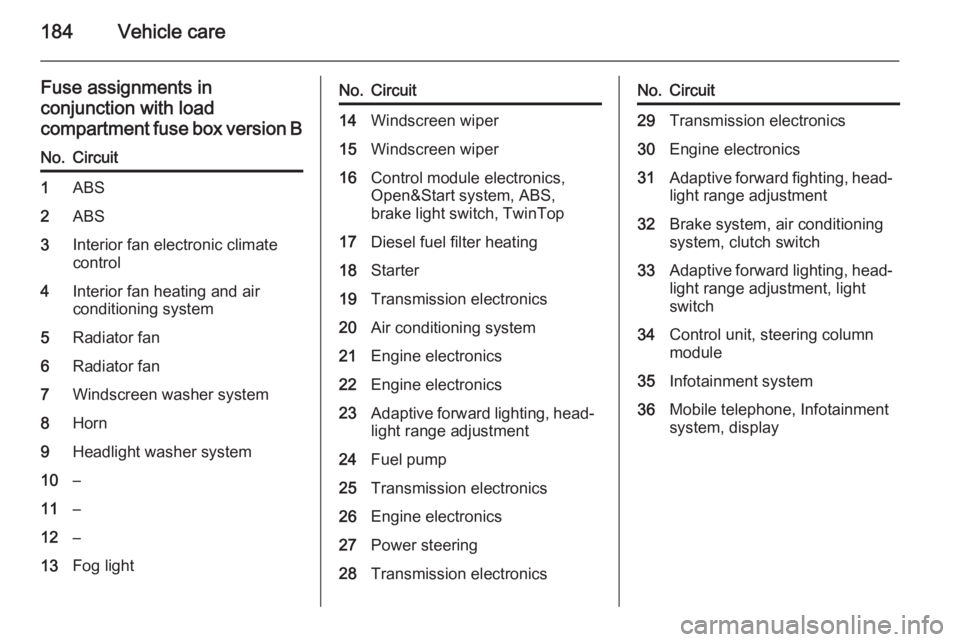
Fuse assignments inconjunction with load
compartment fuse box version BNo.Circuit1ABS2ABS3Interior fan electronic climate control4Interior fan heating and air
conditioning system5Radiator fan6Radiator fan7Windscreen washer system8Horn9Headlight washer system10–11–12–13Fog lightNo.Circuit14Windscreen wiper15Windscreen wiper16Control module electronics,
Open&Start system, ABS,
brake light switch, TwinTop17Diesel fuel filter heating18Starter19Transmission electronics20Air conditioning system21Engine electronics22Engine electronics23Adaptive forward lighting, head‐
light range adjustment24Fuel pump25Transmission electronics26Engine electronics27Power steering28Transmission electronicsNo.Circuit29Transmission electronics30Engine electronics31Adaptive forward fighting, head‐ light range adjustment32Brake system, air conditioning
system, clutch switch33Adaptive forward lighting, head‐
light range adjustment, light
switch34Control unit, steering column
module35Infotainment system36Mobile telephone, Infotainment
system, display
Page 192 of 245
190Vehicle careTyre designationsE.g. 195/65 R 15 91 H195=Tyre width, mm65=Cross-section ratio (tyre
height to tyre width), %R=Belt type: RadialRF=Type: RunFlat15=Wheel diameter, inches91=Load index e.g. 91 is
equivalent to 618 kgH=Speed code letter
Speed code letter:
Q=up to 160 km/hS=up to 180 km/hT=up to 190 km/hH=up to 210 km/hV=up to 240 km/hW=up to 270 km/h
Tyre pressure
Check the pressure of cold tyres at
least every 14 days and before any
long journey. Do not forget the spare
wheel. This also applies to vehicles
with tyre pressure monitoring.
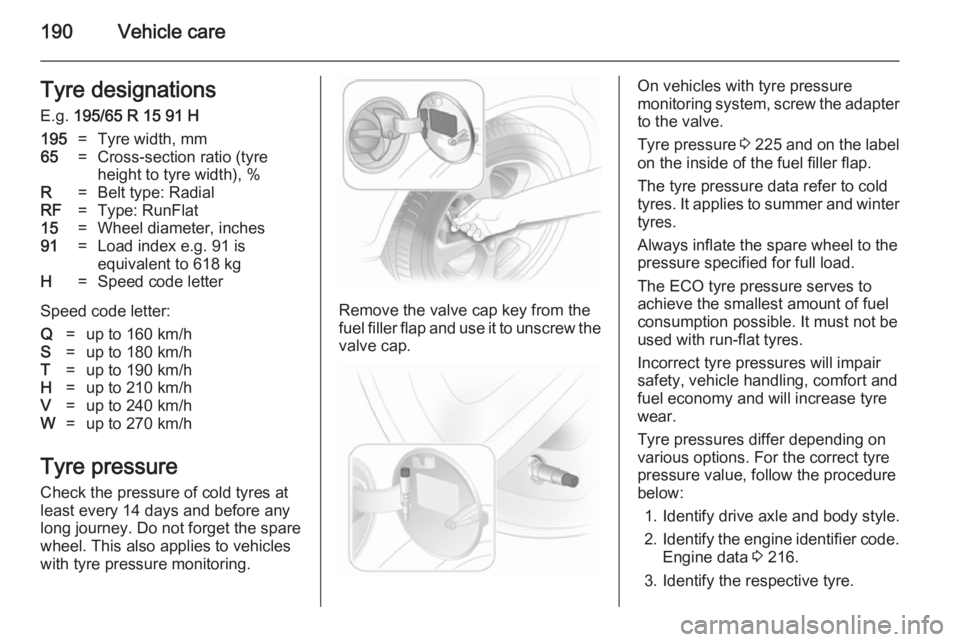
Remove the valve cap key from the
fuel filler flap and use it to unscrew the
valve cap.
On vehicles with tyre pressure
monitoring system, screw the adapter
to the valve.
Tyre pressure 3 225 and on the label
on the inside of the fuel filler flap.
The tyre pressure data refer to cold
tyres. It applies to summer and winter tyres.
Always inflate the spare wheel to the
pressure specified for full load.
The ECO tyre pressure serves to
achieve the smallest amount of fuel
consumption possible. It must not be used with run-flat tyres.
Incorrect tyre pressures will impair
safety, vehicle handling, comfort and
fuel economy and will increase tyre
wear.
Tyre pressures differ depending on
various options. For the correct tyre
pressure value, follow the procedure
below:
1. Identify drive axle and body style.
2. Identify the engine identifier code.
Engine data 3 216.
3. Identify the respective tyre.
Page 197 of 245
Vehicle care195
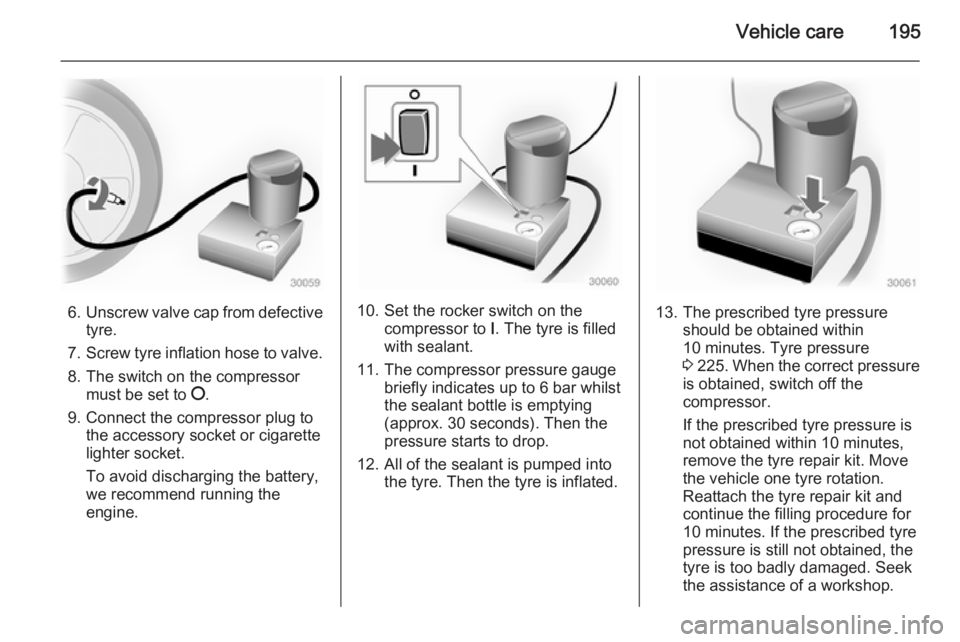
6.Unscrew valve cap from defective
tyre.
7. Screw tyre inflation hose to valve.
8. The switch on the compressor must be set to §.
9. Connect the compressor plug to the accessory socket or cigarette
lighter socket.
To avoid discharging the battery,
we recommend running the
engine.10. Set the rocker switch on the compressor to I. The tyre is filled
with sealant.
11. The compressor pressure gauge briefly indicates up to 6 bar whilstthe sealant bottle is emptying
(approx. 30 seconds). Then the
pressure starts to drop.
12. All of the sealant is pumped into the tyre. Then the tyre is inflated.13. The prescribed tyre pressureshould be obtained within
10 minutes. Tyre pressure
3 225 . When the correct pressure
is obtained, switch off the
compressor.
If the prescribed tyre pressure is
not obtained within 10 minutes,
remove the tyre repair kit. Move
the vehicle one tyre rotation.
Reattach the tyre repair kit and
continue the filling procedure for 10 minutes. If the prescribed tyre
pressure is still not obtained, the
tyre is too badly damaged. Seek
the assistance of a workshop.
Page 202 of 245
200Vehicle careJump startingDo not start with quick charger.
A vehicle with a discharged battery
can be started using jump leads and the battery of another vehicle.9 Warning
Be extremely careful when starting
with jump leads. Any deviation
from the following instructions can
lead to injuries or damage caused
by battery explosion or damage to the electrical systems of both
vehicles.
9 Warning
Avoid contact with eyes, skin,
fabrics, and painted surfaces. The fluid contains sulphuric acid which can cause injuries and damage in
the event of direct contact.
■ Never expose the battery to naked flames or sparks.
■ A discharged battery can already freeze at temperatures of 0 °C.Defrost the frozen battery before
connecting jump leads.
■ Wear eye protection and protective
clothing when handling a battery.
■ Use a booster battery with the same voltage (12 Volts). Its
capacity (Ah) must not be much
less than that of the discharged
battery.
■ Use jump leads with insulated terminals and a cross section of at
least 16 mm 2
(25 mm 2
for diesel
engines).
■ Do not disconnect the discharged battery from the vehicle.
■ Switch off all unnecessary electrical
consumers.
■ Do not lean over the battery during jump starting.
■ Do not allow the terminals of one lead to touch those of the other
lead.■ The vehicles must not come into contact with each other during the
jump starting process.
■ Apply the parking brake, transmission in neutral, automatic
transmission in P.
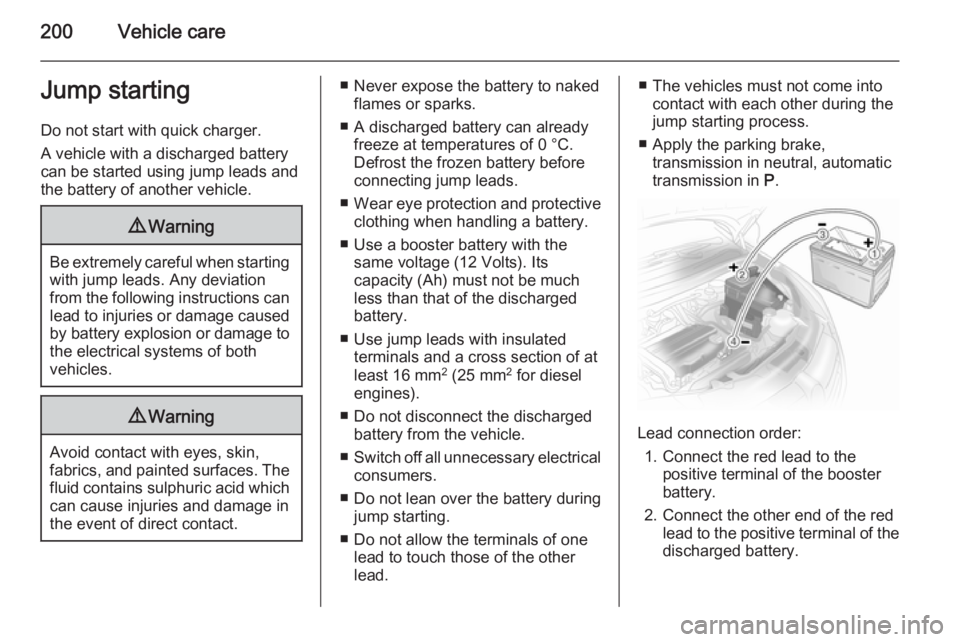
Lead connection order:
1. Connect the red lead to the positive terminal of the booster
battery.
2. Connect the other end of the red lead to the positive terminal of the
discharged battery.
Page 203 of 245

Vehicle care201
3. Connect the black lead to thenegative terminal of the booster
battery.
4. Connect the other end of the black
lead to a vehicle grounding point,
such as the engine block or an
engine mounting bolt. Connect as far away from the discharged
battery as possible, however at
least 60 cm.
Route the leads so that they cannot
catch on rotating parts in the engine
compartment.
To start the engine: 1. Start the engine of the vehicle providing the jump.
2. After 5 minutes, start the other engine. Start attempts should be
made for no longer than
15 seconds at an interval of
1 minute.
3. Allow both engines to idle for approx. 3 minutes with the leads
connected.4. Switch on electrical consumers (e.g. headlights, heated rear
window) of the vehicle receiving
the jump start.
5. Reverse above sequence exactly when removing leads.Towing
Towing the vehicle
Disengage the cover at the bottom
and remove downwards.
The towing eye is stowed with the
vehicle tools 3 187.
Page 204 of 245
202Vehicle care
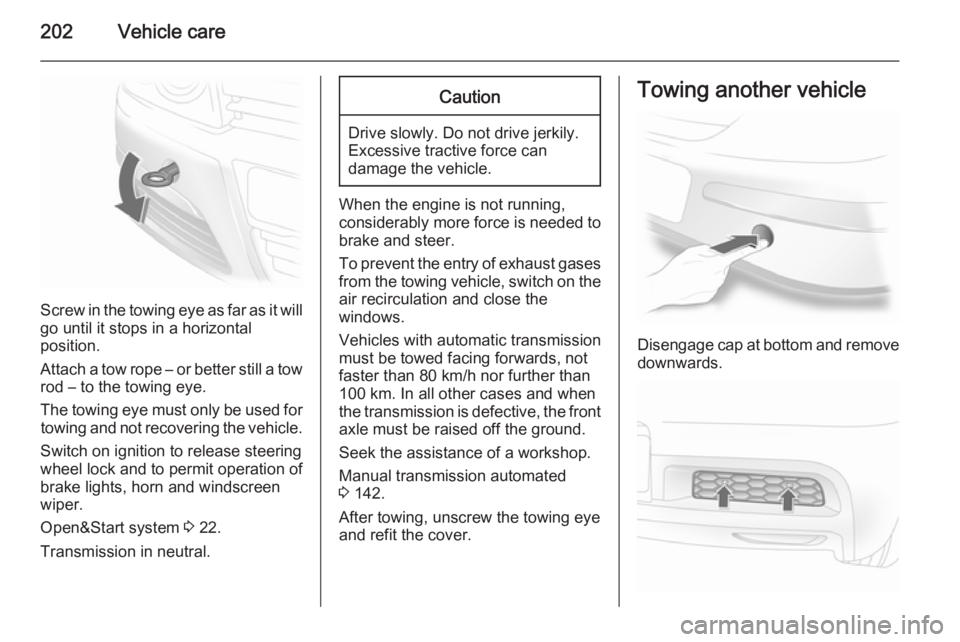
Screw in the towing eye as far as it will
go until it stops in a horizontal
position.
Attach a tow rope – or better still a tow
rod – to the towing eye.
The towing eye must only be used for towing and not recovering the vehicle.
Switch on ignition to release steering
wheel lock and to permit operation of
brake lights, horn and windscreen
wiper.
Open&Start system 3 22.
Transmission in neutral.
Caution
Drive slowly. Do not drive jerkily.
Excessive tractive force can
damage the vehicle.
When the engine is not running,
considerably more force is needed to
brake and steer.
To prevent the entry of exhaust gases from the towing vehicle, switch on the
air recirculation and close the
windows.
Vehicles with automatic transmission
must be towed facing forwards, not faster than 80 km/h nor further than
100 km. In all other cases and when
the transmission is defective, the front axle must be raised off the ground.
Seek the assistance of a workshop.
Manual transmission automated
3 142.
After towing, unscrew the towing eye
and refit the cover.
Towing another vehicle
Disengage cap at bottom and remove
downwards.
Page 206 of 245
204Vehicle care
If using a car wash, comply with the
car wash manufacturer's instructions. The windscreen wipers and rear
window wiper must be switched off.
Remove antenna and external
accessories such as roof racks etc.
If you wash your vehicle by hand,
make sure that the insides of the
wheel housings are also thoroughly
rinsed out.
Clean edges and folds on opened
doors and the bonnet as well as the
areas they cover.Caution
Always use a cleaning agent with
a pH value of 4 to 9.
Do not use cleaning agents on hot surfaces.
Do not clean the engine compartmentwith a steam-jet or high-pressure jet
cleaner.
Thoroughly rinse and leather-off the vehicle. Rinse leather frequently. Use
separate leathers for painted and
glass surfaces: remnants of wax on
the windows will impair vision.
Do not use hard objects to remove
spots of tar. Use tar removal spray on
painted surfaces.
Exterior lights
Headlight and other light covers are
made of plastic. Do not use any
abrasive or caustic agents, do not use an ice scraper, and do not clean them
dry.
Polishing and waxing Wax the vehicle regularly (at the
latest when water no longer beads).
Otherwise, the paintwork will dry out.
Polishing is necessary only if the paint
has become dull or if solid deposits
have become attached to it.
Paintwork polish with silicone forms a
protective film, making waxing
unnecessary.
Plastic body parts must not be treated with wax or polishing agents.Windows and windscreen wiper
blades
Use a soft lint-free cloth or chamois
leather together with window cleaner and insect remover.
When cleaning the rear window from
inside, always wipe in parallel to the
heating element to prevent damage.
For mechanical removal of ice, use a
sharp-edged ice scraper. Press the
scraper firmly against the glass so
that no dirt can get under it and
scratch the glass.
Clean smearing wiper blades with a
soft cloth and window cleaner.
Sun roof Never clean with solvents or abrasive
agents, fuels, aggressive media
(e.g. paint cleaner, acetone-
containing solutions etc.), acidic or
highly alkaline media or abrasive
pads. Do not apply wax or polishing
agents to the middle part of the sun
roof.