seats OPEL CASCADA 2018 Manual user
[x] Cancel search | Manufacturer: OPEL, Model Year: 2018, Model line: CASCADA, Model: OPEL CASCADA 2018Pages: 267, PDF Size: 8 MB
Page 64 of 267
62Seats, restraintsLV: NEKĀDĀ GADĪJUMĀ
neizmantojiet uz aizmuguri vērstu
bērnu sēdeklīti sēdvietā, kas tiek
aizsargāta ar tās priekšā uzstādītu
AKTĪVU DROŠĪBAS SPILVENU, jo
pretējā gadījumā BĒRNS var gūt
SMAGAS TRAUMAS vai IET BOJĀ.
ET: ÄRGE kasutage tahapoole
suunatud lapseturvaistet istmel, mille
ees on AKTIIVSE TURVAPADJAGA
kaitstud iste, sest see võib
põhjustada LAPSE SURMA või
TÕSISE VIGASTUSE.
MT: QATT tuża trażżin għat-tfal li
jħares lejn in-naħa ta’ wara fuq sit
protett b’AIRBAG ATTIV quddiemu;
dan jista’ jikkawża l-MEWT jew
ĠRIEĦI SERJI lit-TFAL.
GA: Ná húsáid srian sábháilteachta
linbh cúil RIAMH ar shuíochán a
bhfuil mála aeir ag feidhmiú os a
chomhair. Tá baol BÁIS nó GORTÚ
DONA don PHÁISTE ag baint leis.
Beyond the warning required by
ECE R94.02, for safety reasons
never use a forward-facing child
restraint system on the passenger
seat with an active front airbag.9 Danger
Do not use a child restraint system
on the passenger seat with active
front airbag.
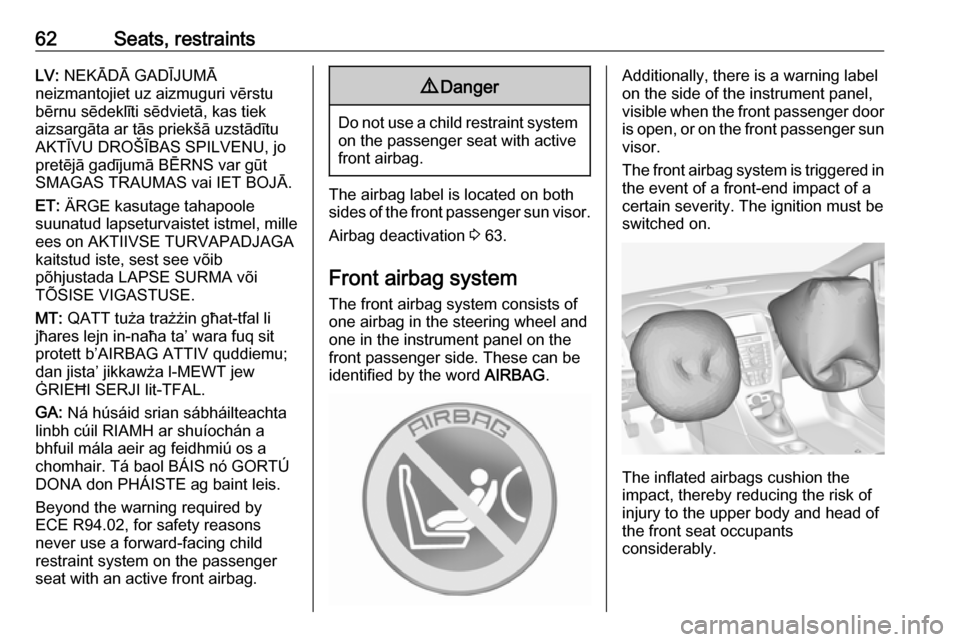
The airbag label is located on both
sides of the front passenger sun visor.
Airbag deactivation 3 63.
Front airbag system The front airbag system consists of
one airbag in the steering wheel and
one in the instrument panel on the
front passenger side. These can be
identified by the word AIRBAG.
Additionally, there is a warning label
on the side of the instrument panel,
visible when the front passenger door
is open, or on the front passenger sun
visor.
The front airbag system is triggered in the event of a front-end impact of a
certain severity. The ignition must be
switched on.
The inflated airbags cushion the
impact, thereby reducing the risk of
injury to the upper body and head of
the front seat occupants
considerably.
Page 65 of 267
Seats, restraints639Warning
Optimum protection is only
provided when the seat is in the
proper position.
Seat position 3 49.
Keep the area in which the airbag
inflates clear of obstructions.
Fit the seat belt correctly and
engage securely. Only then is the
airbag able to protect.
Side airbag system
The side airbag system consists of an
airbag in each front seat backrest.
This can be identified by the word
AIRBAG .
The side airbag system is triggered in the event of a side impact of a certain
severity. The ignition must be
switched on.
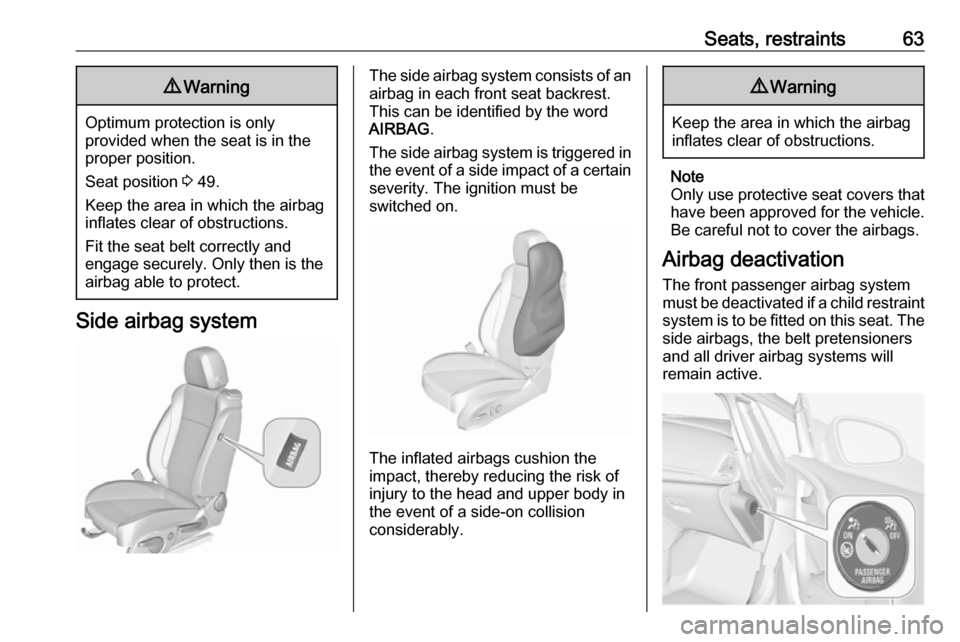
The inflated airbags cushion the
impact, thereby reducing the risk of
injury to the head and upper body in
the event of a side-on collision
considerably.
9 Warning
Keep the area in which the airbag
inflates clear of obstructions.
Note
Only use protective seat covers that have been approved for the vehicle.Be careful not to cover the airbags.
Airbag deactivation
The front passenger airbag system
must be deactivated if a child restraint
system is to be fitted on this seat. The side airbags, the belt pretensioners
and all driver airbag systems will
remain active.
Page 66 of 267
64Seats, restraintsThe front passenger airbag system
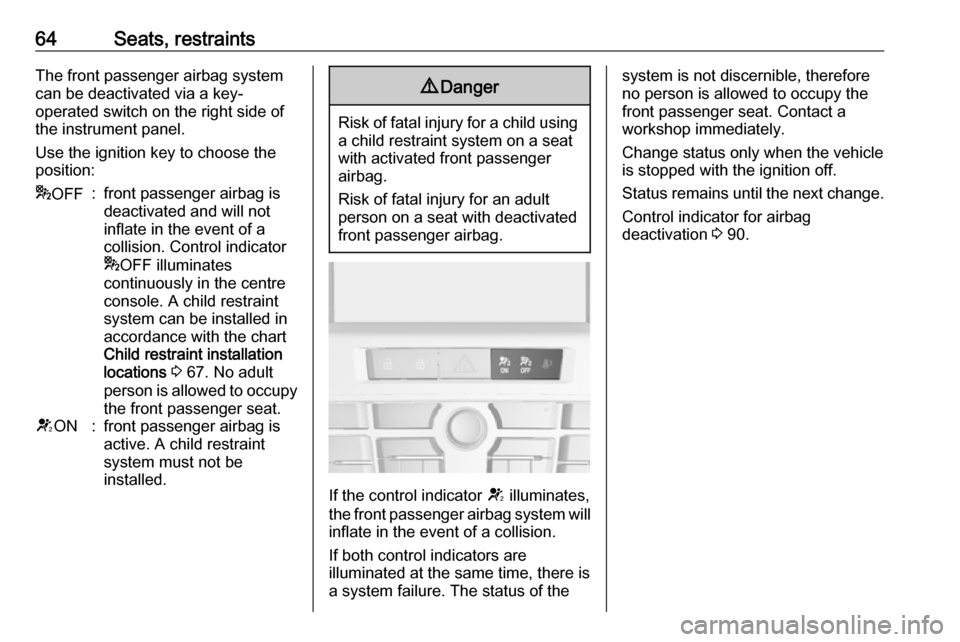
can be deactivated via a key-
operated switch on the right side of
the instrument panel.
Use the ignition key to choose the
position:* OFF:front passenger airbag is
deactivated and will not
inflate in the event of a
collision. Control indicator
* OFF illuminates
continuously in the centre
console. A child restraint
system can be installed in
accordance with the chart
Child restraint installation
locations 3 67. No adult
person is allowed to occupy the front passenger seat.V ON:front passenger airbag is
active. A child restraint
system must not be
installed.9 Danger
Risk of fatal injury for a child using
a child restraint system on a seat
with activated front passenger
airbag.
Risk of fatal injury for an adult
person on a seat with deactivated
front passenger airbag.
If the control indicator V
illuminates,
the front passenger airbag system will inflate in the event of a collision.
If both control indicators are
illuminated at the same time, there is
a system failure. The status of the
system is not discernible, therefore
no person is allowed to occupy the
front passenger seat. Contact a
workshop immediately.
Change status only when the vehicle
is stopped with the ignition off.
Status remains until the next change.
Control indicator for airbag
deactivation 3 90.
Page 67 of 267
Seats, restraints65Child restraints
Child restraint systems
We recommend the following child
restraint systems which are tailored
specifically to the vehicle:
● Group 0, Group 0+
OPEL Baby cradle, with or
without ISOFIX base, for children
up to 13 kg
● Group I
OPEL Duo, Britax Römer King,
for children from 9 kg to 18 kg
● Group II, Group III
OPEL Kid, OPEL Kidfix, for
children from 15 kg up to 36 kg
When a child restraint system is being
used, pay attention to the following
usage and installation instructions
and also those supplied with the child
restraint system.
Always comply with local or national
regulations. In some countries, the
use of child restraint systems is
forbidden on certain seats.9 Warning
When using a child restraint
system on the front passenger
seat, the airbag systems for the
front passenger seat must be
deactivated; if not, the triggering of the airbags poses a risk of fatal
injury to the child.
This is especially the case if rear-
facing child restraint systems are
used on the front passenger seat.
Airbag deactivation 3 63.
Airbag label 3 59.
9 Warning
When using child restraint
systems on the rear seats, ensure that the backrests are engaged
securely in upright position.
Selecting the right system
The rear seats are the most
convenient location to fasten a child
restraint system.
Children should travel facing
rearwards in the vehicle as long as
possible. This makes sure that the child's backbone, which is still very
weak, is under less strain in the event of an accident.
Suitable are restraint systems that
comply with valid UN ECE
regulations. Check local laws and
regulations for mandatory use of child restraint systems.
Ensure that the child restraint system
to be installed is compatible with the
vehicle type.
Ensure that the mounting location of
the child restraint system within the
vehicle is correct, see following
tables.
Allow children to enter and exit the
vehicle only on the side facing away
from the traffic.
When the child restraint system is not in use, secure the seat with a seat beltor remove it from the vehicle.
Page 68 of 267
66Seats, restraintsNote
Do not affix anything on the child
restraint systems and do not cover
them with any other materials.
A child restraint system which has
been subjected to stress in an
accident must be replaced.
ISOFIX child restraint systems
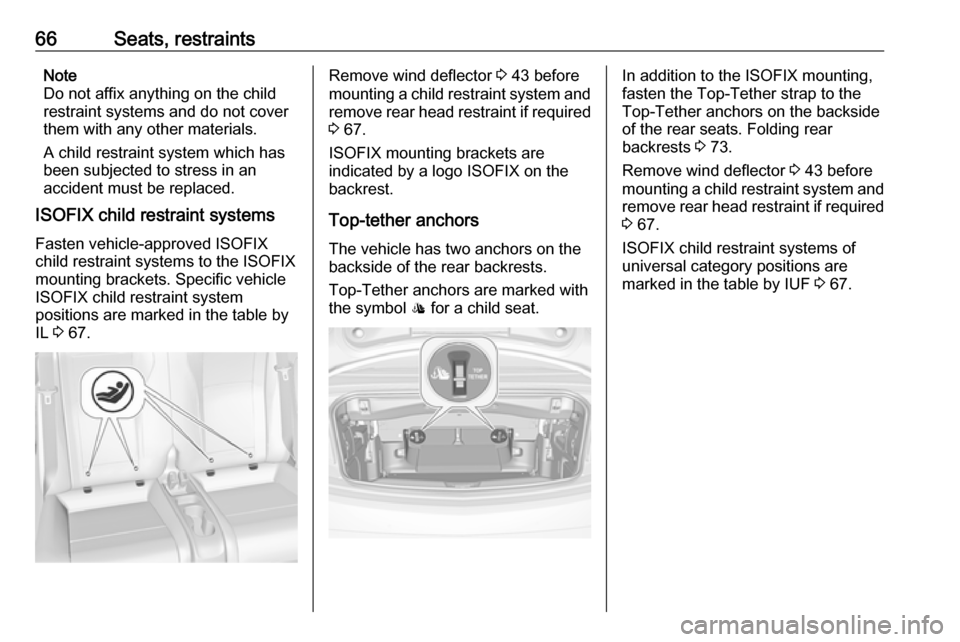
Fasten vehicle-approved ISOFIX
child restraint systems to the ISOFIX
mounting brackets. Specific vehicle
ISOFIX child restraint system
positions are marked in the table by
IL 3 67.Remove wind deflector 3 43 before
mounting a child restraint system and remove rear head restraint if required
3 67.
ISOFIX mounting brackets are
indicated by a logo ISOFIX on the
backrest.
Top-tether anchors
The vehicle has two anchors on the
backside of the rear backrests.
Top-Tether anchors are marked with
the symbol : for a child seat.In addition to the ISOFIX mounting,
fasten the Top-Tether strap to the
Top-Tether anchors on the backside
of the rear seats. Folding rear
backrests 3 73.
Remove wind deflector 3 43 before
mounting a child restraint system and remove rear head restraint if required
3 67.
ISOFIX child restraint systems of
universal category positions are
marked in the table by IUF 3 67.
Page 69 of 267

Seats, restraints67Child restraint installation locations
Permissible options for fitting a child restraint system
Weight class
On front passenger seat
On rear seats
activated airbagdeactivated airbagGroup 0: up to 10 kgXU 1UGroup 0+: up to 13 kgXU 1UGroup I: 9 to 18 kgXU1U2Group II: 15 to 25 kgXXUGroup III: 22 to 36 kgXXU1:If the child restraint system is being secured using a three-point seat belt, move seat into the rear adjustment area
and set seat height to uppermost position. Adjust seat backrest as far as necessary to a vertical position to ensure
that the belt is tight on the buckle side.2:Remove rear head restraint when using child restraint systems in this weight group 3 47.U:Universal suitability in conjunction with three-point seat belt.X:No child restraint system permitted in this weight class.
Page 70 of 267

68Seats, restraintsPermissible options for fitting an ISOFIX child restraint systemWeight classSize classFixtureOn front passenger seatOn rear seatsGroup 0: up to 10 kgEISO/R1XIL *Group 0+: up to 13 kgEISO/R1XIL *DISO/R2XIL *CISO/R3XIL *Group I: 9 to 18 kgDISO/R2XIL *CISO/R3XIL *BISO/F2XIL, IUF**B1ISO/F2XXIL, IUF**AISO/F3XIL, IUF**Group II: 15 to 25 kgXILGroup III: 22 to 36 kgXILIL:Suitable for particular ISOFIX restraint systems of the 'specific-vehicle', 'restricted' or 'semi-universal' categories.The ISOFIX restraint system must be approved for the specific vehicle type.IUF:Suitable for ISOFIX forward-facing child restraint systems of universal category approved for use in this weight class.X:No ISOFIX child restraint system approved in this weight class.*:Move the respective front seat ahead of the child restraint system forwards as far as necessary.**:Remove respective rear head restraint when using child restraint systems in this size class 3 47.
Page 71 of 267

Seats, restraints69ISOFIX size class and seat deviceA – ISO/F3:Forward-facing child restraint system for children of maximum size in the weight class 9 to 18 kg.B – ISO/F2:Forward-facing child restraint system for smaller children in the weight class 9 to 18 kg.B1 – ISO/F2X:Forward-facing child restraint system for smaller children in the weight class 9 to 18 kg.C – ISO/R3:Rear-facing child restraint system for children of maximum size in the weight class up to 18 kg.D – ISO/R2:Rear-facing child restraint system for smaller children in the weight class up to 18 kg.E – ISO/R1:Rear-facing child restraint system for young children in the weight class up to 13 kg.
Page 73 of 267

Storage71Cupholders
Cupholders are located in the centre
console.
Depending on the version,
cupholders are located under a cover
in the centre console.
Slide cover backwards. Bottles can
be stowed after folding up the
intermediate shelf 3 72.
Additional cupholders are located
between the rear seats.
Front storage
A storage compartment is located
next to the steering wheel.
Page 75 of 267
Storage73Load compartment
Load compartment extension
Folding load compartment partition
To enlarge the load compartment when the soft top is closed, the load
compartment partition can be folded
in.
● Close soft top 3 36.
● Open the boot lid 3 26.
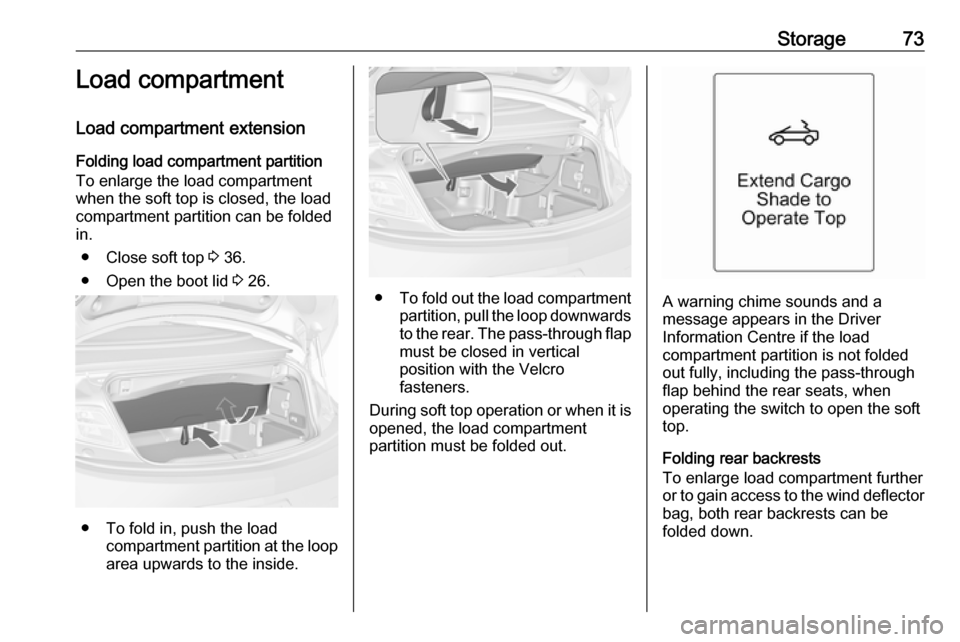
● To fold in, push the load
compartment partition at the looparea upwards to the inside.
● To fold out the load compartment
partition, pull the loop downwards to the rear. The pass-through flap
must be closed in vertical
position with the Velcro
fasteners.
During soft top operation or when it is opened, the load compartment
partition must be folded out.A warning chime sounds and a
message appears in the Driver
Information Centre if the load
compartment partition is not folded
out fully, including the pass-through
flap behind the rear seats, when operating the switch to open the softtop.
Folding rear backrests
To enlarge load compartment further
or to gain access to the wind deflector
bag, both rear backrests can be
folded down.