tyre pressure OPEL CASCADA 2018 Manual user
[x] Cancel search | Manufacturer: OPEL, Model Year: 2018, Model line: CASCADA, Model: OPEL CASCADA 2018Pages: 267, PDF Size: 8 MB
Page 222 of 267

220Vehicle care14. Detach the tyre repair kit. Pushcatch on bracket to remove
sealant bottle from bracket. Screw the tyre inflation hose to the free
connection of the sealant bottle.
This prevents sealant from
escaping. Stow tyre repair kit in
load compartment.
15. Remove any excess sealant using a cloth.
16. Take the label indicating maximum permitted speed from
the sealant bottle and affix in the
driver's field of view.
17. Continue driving immediately so that sealant is evenly distributed
in the tyre. After driving approx.
10 km (but no more than
10 minutes), stop and check tyre
pressure. Screw compressor air
hose directly onto tyre valve and
compressor when doing this.
If tyre pressure is more than
1.3 bar , set it to the correct value.
Repeat the procedure until there
is no more loss of pressure.
If the tyre pressure has fallen
below 1.3 bar, the vehicle must
not be used. Seek the assistance
of a workshop.
18. Stow away the tyre repair kit in the
load compartment.
Note
The driving characteristics of the repaired tyre are severely affected,
therefore have this tyre replaced.
If unusual noise is heard or the
compressor becomes hot, turn
compressor off for at least
30 minutes.
The built-in safety valve opens at a
pressure of 7 bar.
Note the expiry date of the kit. After
this date its sealing capability is no
longer guaranteed. Pay attention to
storage information on sealant
bottle.
Replace the used sealant bottle. Dispose of the bottle as prescribed
by applicable laws.
The compressor and sealant can be used from approx. -30 °C.
The adapters supplied can be used
to pump up other items e.g.
footballs, air mattresses, inflatable
dinghies etc. They are located on the underside of the compressor. To
remove, screw on compressor air
hose and withdraw adapter.
Wheel changing
Some vehicles are equipped with a
tyre repair kit instead of a spare wheel
3 217.
Page 224 of 267

222Vehicle care2. Install the wheel wrench ensuringthat it locates securely and loosen
each wheel nut by half a turn.
The wheels may be protected by
locking wheel nuts. To loosen
these specific nuts, first attach the adapter onto the head of the nut
before installing the wheel
wrench. The adapter is located in
the glovebox.
3. Ensure the jack is correctly positioned under the relevant
vehicle jacking point.
4. Set the jack to the necessary height. Position it directly below
the jacking point in a manner that
prevents it from slipping.
Attach wheel wrench and with the
jack correctly aligned rotate
wrench until wheel is clear of the
ground.
5. Unscrew the wheel nuts. 6. Change the wheel. Spare wheel 3 223.
7. Screw on the wheel nuts.
8. Lower vehicle.
9. Install the wheel wrench ensuring that it is located securely and
tighten each nut in a crosswise
sequence. Tightening torque is
140 Nm.
10. Align the valve hole in the wheel cover with the tyre valve before
installing.
Install wheel nut caps.
Install centre cap on alloy wheels.
11. Stow the replaced wheel 3 223,
the vehicle tools 3 210 and the
adapter for the locking wheel nuts
3 70.
12. Check the tyre pressure of the installed tyre and the wheel nut
torque as soon as possible.
Page 233 of 267

Vehicle care231Caution
Always use a cleaning agent with
a pH value of four to nine.
Do not use cleaning agents on hot surfaces.
Caution
After washing or cleaning, the softtop must be completely dried
before opening. If a wet soft top
remains opened for a longer time,
it would be damaged by water
spotting and mould growth.
When cleaning with a high-pressure
jet cleaner ensure a minimum
distance of 30 cm to the rear brand
emblem to prevent unintended
unlocking.
Thoroughly rinse and leather-off the
vehicle. Rinse leather frequently. Use
separate leathers for painted and
glass surfaces: remnants of wax on the windows will impair vision.
Have the door hinges of all doors
greased by a workshop.
Do not use hard objects to remove
spots of tar. Use tar removal spray on
painted surfaces.
Exterior lights
Headlight and other light covers are
made of plastic. Do not use any
abrasive or caustic agents, do not use
an ice scraper, and do not clean them dry.
Polishing and waxing Wax painted parts of the vehicle
regularly (at the latest when water no
longer beads). Otherwise, the
paintwork will dry out.
Polishing is necessary only if the paint
has become dull or if solid deposits
have become attached to it.
Paintwork polish with silicone forms a
protective film, making waxing
unnecessary.
Soft top as well as plastic body parts
must not be treated with wax or
polishing agents.Windows and windscreen wiper
blades
Use a soft lint-free cloth or chamois leather together with window cleaner and insect remover.
When cleaning the rear window from
inside, always wipe in parallel to the
heating element to prevent damage.
For mechanical removal of ice, use a
sharp-edged ice scraper. Press the
scraper firmly against the glass so
that no dirt can get under it and
scratch the glass.
Remove dirt residues from smearing wiper blades by using a soft cloth and window cleaner. Also make sure to
remove any residues such as wax,
insect residues and similar from the
window.
Ice residues, pollution and continuous wiping on dry windows will damage or
even destroy the wiper blades.
Wheels and tyres Do not use high-pressure jet
cleaners.
Page 239 of 267
Technical data237Technical dataVehicle identification..................237
Vehicle Identification Number ..237
Identification plate ...................237
Engine identification ................238
Vehicle data ............................... 239
Recommended fluids and lubricants ................................ 239
Engine data ............................. 242
Performance ............................ 243
Vehicle weight ......................... 245
Vehicle dimensions .................246
Capacities ................................ 247
Tyre pressures ........................ 248Vehicle identification
Vehicle IdentificationNumber
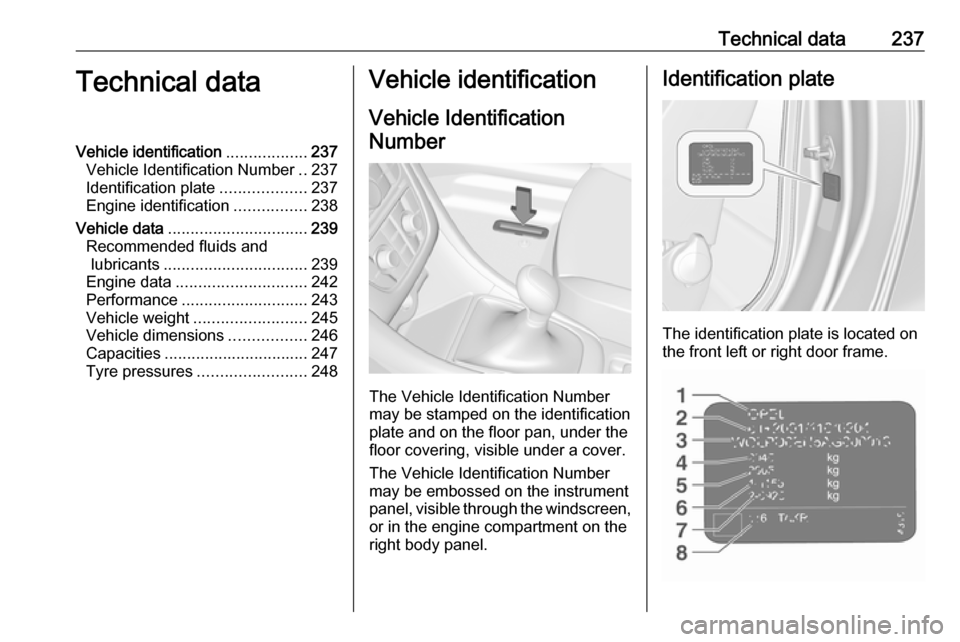
The Vehicle Identification Number
may be stamped on the identification plate and on the floor pan, under thefloor covering, visible under a cover.
The Vehicle Identification Number
may be embossed on the instrument
panel, visible through the windscreen,
or in the engine compartment on the
right body panel.
Identification plate
The identification plate is located on
the front left or right door frame.
Page 250 of 267
![OPEL CASCADA 2018 Manual user 248Technical dataTyre pressuresComfort with up to 3 peopleECO with up to 3 peopleWith full loadEngineTyresfrontrearfrontrearfrontrear[kPa/bar]
([psi])[kPa/bar]
([psi])[kPa/bar]
([psi])[kPa/bar]
([psi]](/img/37/18799/w960_18799-249.png "OPEL CASCADA 2018 Manual user 248Technical dataTyre pressuresComfort with up to 3 peopleECO with up to 3 peopleWith full loadEngineTyresfrontrearfrontrearfrontrear[kPa/bar]
([psi])[kPa/bar]
([psi])[kPa/bar]
([psi])[kPa/bar]
([psi]")
248Technical dataTyre pressuresComfort with up to 3 peopleECO with up to 3 peopleWith full loadEngineTyresfrontrearfrontrearfrontrear[kPa/bar]
([psi])[kPa/bar]
([psi])[kPa/bar]
([psi])[kPa/bar]
([psi])[kPa/bar]
([psi])[kPa/bar]
([psi])B14NEL,
B14NET,
A16XHT,
B16SHT,
B16SHL235/55 R17,230/2.3 (34)230/2.3 (34)280/2.8 (41)280/2.8 (41)240/2.4
(35)280/2.8
(41)235/50 R18,245/45 R18,235/45 R19,245/40 R20,225/55 R17
Page 253 of 267

Customer information251Antenna Kathrain
Kathrein Automotive GmbH
Roemerring 1, 31137 Hildesheim, Germany
Operation frequency: N/A
Maximum output: N/A
OnStar module
LGE
LG Electronics European Shared
Service Center B.V., Krijgsman 1,
1186 DM Amstelveen, The
NetherlandsOperation
frequency (MHz)Maximum output
(dBm)2402 - 248042412 - 246218880 - 915331710 - 1785241850 - 1910241920 - 1980242500 - 257023Immobiliser
Continental Automotive GmbH
Siemensstrasse 12, 93055
Regensburg, Germany
Operation frequency: 125 kHz
Maximum output:
5.1 dBuA/m @ 10m
Radio remote control receiver
Continental Automotive GmbH
Siemensstrasse 12, 93055
Regensburg, Germany
Operation frequency: 433.92 MHz
Maximum output: N/A
Radio remote control transmitter
Continental Automotive GmbH
Siemensstrasse 12, 93055
Regensburg, Germany
Operation frequency: 433.92 MHz
Maximum output: -5,7 dBm
Tyre pressure sensors
Schrader Electronics Ltd.
11 Technology Park, Belfast Road,
Antrim BT41 1QS, Northern Ireland,
United KingdomOperation frequency: 433.92 MHz
Maximum output: 10 dBm
Radar systems
Country-specific Declarations of
Conformity for radar systems are
shown on the following page:
Page 260 of 267

258Customer informationRadio Frequency
Identification (RFID)
RFID technology is used in some
vehicles for functions such as tyre
pressure monitoring and ignition
system security. It is also used in
connection with conveniences such
as radio remote controls for door
locking/unlocking and starting, and in-
vehicle transmitters for garage door
openers. RFID technology in Opel
vehicles does not use or record
personal information or link with any
other Opel system containing
personal information.
Page 265 of 267

263QQuickheat ................................... 132
R
Radio Frequency Identification (RFID) ..................................... 258
Radio remote control ...................22
REACH ....................................... 254
Reading lights ............................ 122
Rear floor storage cover ..............75
Rear fog light ............................... 94
Rear fog lights ........................... 120
Rear storage ................................. 75
Rear view camera ...................... 172
Recommended fluids and lubricants ........................ 234, 239
Refuelling ................................... 180
Registered trademarks ...............256
Retained power off .....................137
Reversing lights .........................121
Ride control systems ..................153
Rollover protection system ...........45
S Seat adjustment ............................. 7
Seat belt ........................................ 8
Seat belt reminder .......................89
Seat belts ..................................... 56
Seat folding .................................. 52
Seat heating ................................. 55
Seat position ................................ 49Seat ventilation............................. 55
Selective catalytic reduction .......143
Selector lever ............................. 147
Service ............................... 134, 233
Service display ............................ 87
Service information ....................233
Side airbag system ......................63
Side blind spot alert ....................170
Sidelights .................................... 112
Side turn signal lights ................202
Soft top ........................................ 36
Software acknowledgement .......254
Spare wheel ............................... 223
Speed limiter............................... 159
Speedometer ............................... 85
Starting and operating ................137
Starting off ................................... 18
Starting the engine ....................137
Steering ...................................... 136
Steering wheel adjustment ......9, 79
Steering wheel controls ...............79
Stop-start system........................ 138
Storage ......................................... 70
Storage compartments .................70
Sunvisor lights ........................... 122
Sun visors .................................... 35
Symbols ......................................... 4T
Tachometer ................................. 86
Tail lights ................................... 201
Three-point seat belt .................... 57
Tools .......................................... 210
Tow bar....................................... 183
Towing ................................ 183, 228
Towing another vehicle .............229
Towing equipment .....................184
Towing the vehicle .....................228
Traction Control system ............. 153
Traction Control system off........... 92
Traffic sign assistant ...................174
Trailer coupling ........................... 183
Trailer towing ............................. 183
Transmission ............................... 17
Transmission display .................146
Tread depth ............................... 216
Trip odometer .............................. 85
Turn and lane-change signals ...120
Turn signal ................................... 89
Tyre chains ................................ 217
Tyre designations ......................211
Tyre pressure ............................ 215
Tyre pressure monitoring system ............................... 93, 211
Tyre pressures ........................... 248
Tyre repair kit ............................. 217