belt OPEL CASCADA 2019 Manual user
[x] Cancel search | Manufacturer: OPEL, Model Year: 2019, Model line: CASCADA, Model: OPEL CASCADA 2019Pages: 261, PDF Size: 7.94 MB
Page 65 of 261
Seats, restraints639Warning
Optimum protection is only
provided when the seat is in the
proper position.
Seat position 3 49.
Keep the area in which the airbag
inflates clear of obstructions.
Fit the seat belt correctly and
engage securely. Only then is the
airbag able to protect.
Side airbag system
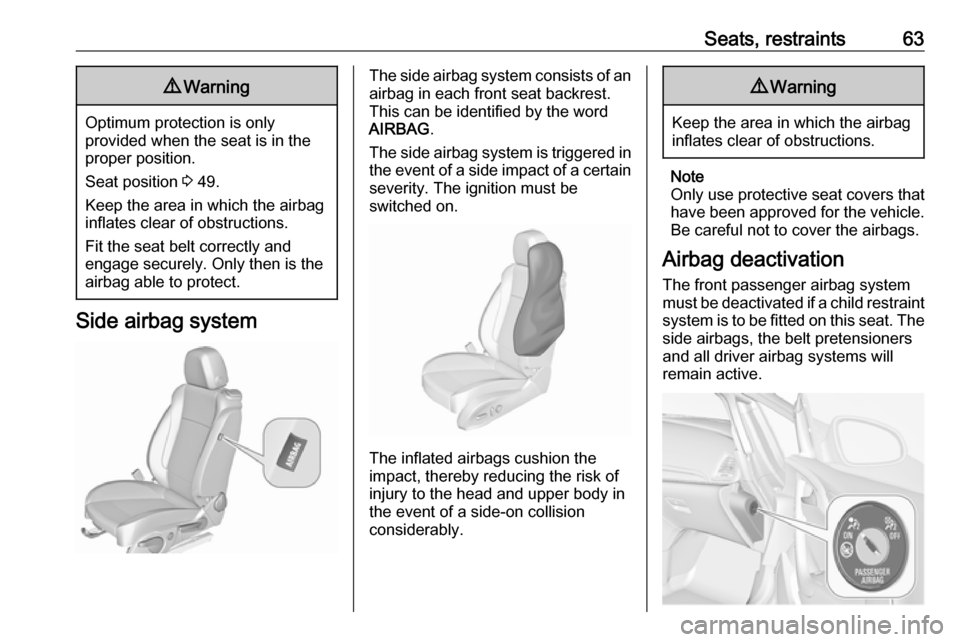
The side airbag system consists of an
airbag in each front seat backrest.
This can be identified by the word
AIRBAG .
The side airbag system is triggered in the event of a side impact of a certain
severity. The ignition must be
switched on.
The inflated airbags cushion the
impact, thereby reducing the risk of
injury to the head and upper body in
the event of a side-on collision
considerably.
9 Warning
Keep the area in which the airbag
inflates clear of obstructions.
Note
Only use protective seat covers that have been approved for the vehicle.Be careful not to cover the airbags.
Airbag deactivation
The front passenger airbag system
must be deactivated if a child restraint
system is to be fitted on this seat. The side airbags, the belt pretensioners
and all driver airbag systems will
remain active.
Page 67 of 261
Seats, restraints65Child restraints
Child restraint systems
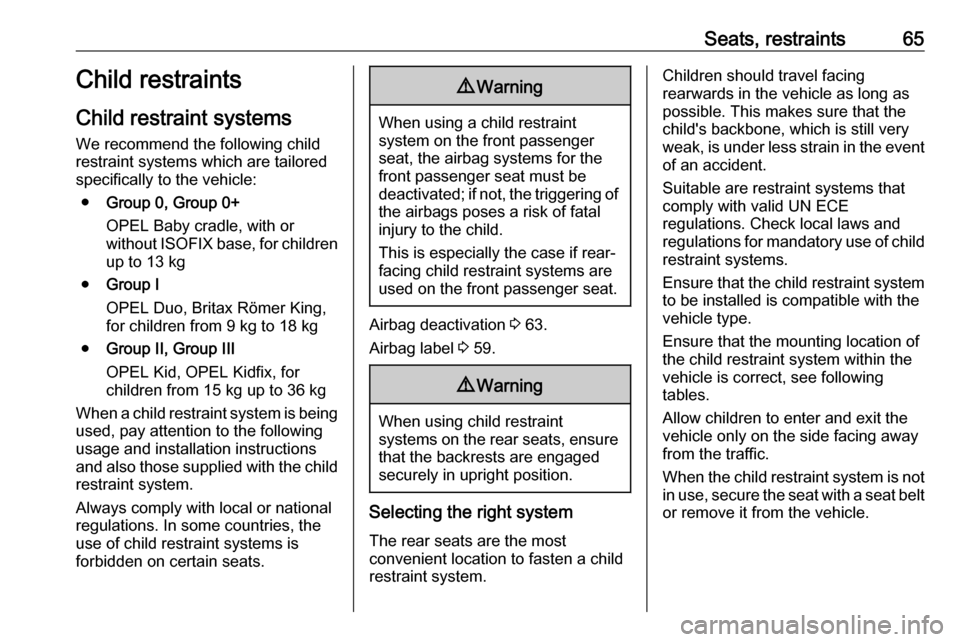
We recommend the following child
restraint systems which are tailored
specifically to the vehicle:
● Group 0, Group 0+
OPEL Baby cradle, with or
without ISOFIX base, for children
up to 13 kg
● Group I
OPEL Duo, Britax Römer King,
for children from 9 kg to 18 kg
● Group II, Group III
OPEL Kid, OPEL Kidfix, for
children from 15 kg up to 36 kg
When a child restraint system is being
used, pay attention to the following
usage and installation instructions
and also those supplied with the child
restraint system.
Always comply with local or national
regulations. In some countries, the
use of child restraint systems is
forbidden on certain seats.9 Warning
When using a child restraint
system on the front passenger
seat, the airbag systems for the
front passenger seat must be
deactivated; if not, the triggering of the airbags poses a risk of fatal
injury to the child.
This is especially the case if rear-
facing child restraint systems are
used on the front passenger seat.
Airbag deactivation 3 63.
Airbag label 3 59.
9 Warning
When using child restraint
systems on the rear seats, ensure that the backrests are engaged
securely in upright position.
Selecting the right system
The rear seats are the most
convenient location to fasten a child
restraint system.
Children should travel facing
rearwards in the vehicle as long as
possible. This makes sure that the child's backbone, which is still very
weak, is under less strain in the event of an accident.
Suitable are restraint systems that
comply with valid UN ECE
regulations. Check local laws and
regulations for mandatory use of child restraint systems.
Ensure that the child restraint system
to be installed is compatible with the
vehicle type.
Ensure that the mounting location of
the child restraint system within the
vehicle is correct, see following
tables.
Allow children to enter and exit the
vehicle only on the side facing away
from the traffic.
When the child restraint system is not in use, secure the seat with a seat beltor remove it from the vehicle.
Page 68 of 261
66Seats, restraintsNote
Do not affix anything on the child
restraint systems and do not cover
them with any other materials.
A child restraint system which has
been subjected to stress in an
accident must be replaced.
Child restraint systems can be
fastened with:
● Three-point seat belt
● ISOFIX brackets
● Top-tether anchor
Three-point seat belt
Child restraint systems can be
fastened by using a three-point seat
belt. Depending on the size of the
used child restraint systems, up to
three child restraint systems can be
attached to the rear seats. After
fastening the child restraint system
the seat belt has to be tightened
3 67.
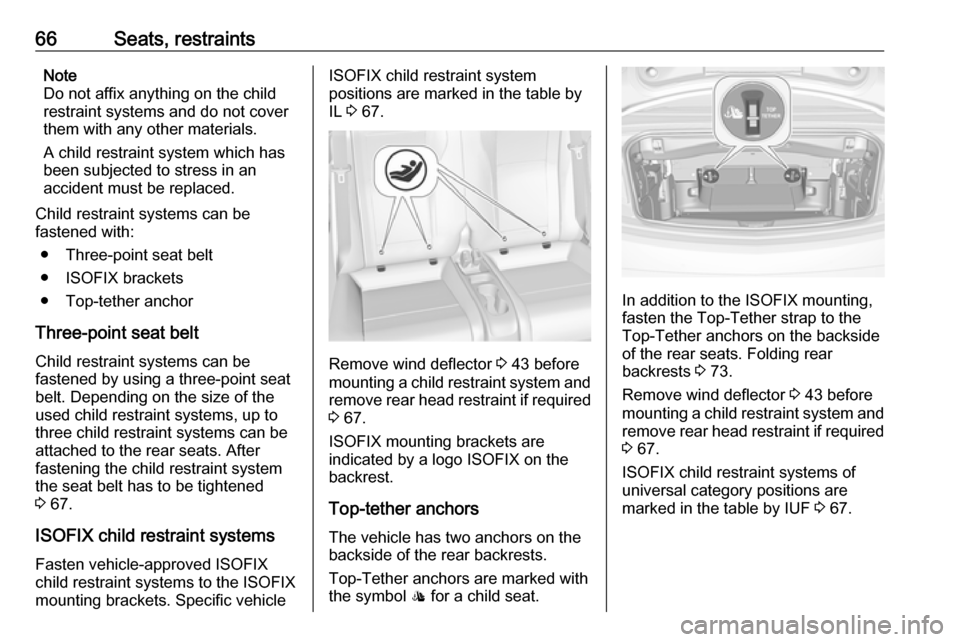
ISOFIX child restraint systems Fasten vehicle-approved ISOFIX
child restraint systems to the ISOFIX
mounting brackets. Specific vehicleISOFIX child restraint system
positions are marked in the table by
IL 3 67.
Remove wind deflector 3 43 before
mounting a child restraint system and remove rear head restraint if required
3 67.
ISOFIX mounting brackets are
indicated by a logo ISOFIX on the
backrest.
Top-tether anchors
The vehicle has two anchors on the
backside of the rear backrests.
Top-Tether anchors are marked with
the symbol : for a child seat.
In addition to the ISOFIX mounting,
fasten the Top-Tether strap to the
Top-Tether anchors on the backside
of the rear seats. Folding rear
backrests 3 73.
Remove wind deflector 3 43 before
mounting a child restraint system and remove rear head restraint if required3 67.
ISOFIX child restraint systems of
universal category positions are
marked in the table by IUF 3 67.
Page 69 of 261

Seats, restraints67Child restraint installation locations
Permissible options for fitting a child restraint system
Weight class
On front passenger seat
On rear seats
activated airbagdeactivated airbagGroup 0: up to 10 kgXU 1UGroup 0+: up to 13 kgXU 1UGroup I: 9 to 18 kgXU1U2Group II: 15 to 25 kgXXUGroup III: 22 to 36 kgXXU1:If the child restraint system is being secured using a three-point seat belt, move seat into the rear adjustment area
and set seat height to uppermost position. Adjust seat backrest as far as necessary to a vertical position to ensure
that the belt is tight on the buckle side.2:Remove rear head restraint when using child restraint systems in this weight group 3 47.U:Universal suitability in conjunction with three-point seat belt.X:No child restraint system permitted in this weight class.
Page 80 of 261

78Instruments and controlsInstruments and
controlsControls ....................................... 79
Steering wheel adjustment ........79
Steering wheel controls .............79
Heated steering wheel ...............79
Horn ........................................... 80
Windscreen wiper and washer ..80
Outside temperature ..................81
Clock ......................................... 82
Power outlets ............................. 83
Cigarette lighter ......................... 84
Ashtrays .................................... 84
Warning lights, gauges and indi‐ cators ........................................... 85
Instrument cluster ......................85
Speedometer ............................. 85
Odometer .................................. 85
Trip odometer ............................ 85
Tachometer ............................... 86
Fuel gauge ................................ 86
Engine coolant temperature gauge ....................................... 86
Service display .......................... 87
Control indicators ......................88
Turn lights .................................. 90Seat belt reminder.....................91
Airbag, belt tensioners and roll bars .......................................... 91
Airbag deactivation ....................91
Charging system .......................91
Malfunction indicator light ..........92
Brake and clutch system ...........92
Operate pedal ............................ 92
Electric parking brake ................92
Electric parking brake fault ........93
Antilock brake system (ABS) .....93
Upshift ....................................... 93
Power steering .......................... 93
Lane departure warning ............93
Electronic Stability Control off ...94
Electronic Stability Control and Traction Control system ...........94
Traction Control system off .......94
Exhaust filter .............................. 94
Tyre pressure monitoring system ...................................... 94
Engine oil pressure ....................95
Low fuel ..................................... 95
Immobiliser ................................ 95
Exterior light .............................. 95
High beam ................................. 95
High beam assist .......................95
Adaptive forward lighting ...........95
Front fog lights ........................... 96
Rear fog light ............................. 96Cruise control............................ 96
Vehicle detected ahead .............96
Door open .................................. 96
Displays ....................................... 96
Driver Information Centre ..........96
Info Display .............................. 101
Vehicle messages ......................103
Warning chimes .......................103
Battery voltage ........................ 104
Vehicle personalisation ..............104
Telematics service .....................109
OnStar ..................................... 109
Page 92 of 261

90Instruments and controlsControl indicators in the centre
console
Overview
OTurn signal 3 90XSeat belt reminder 3 91vAirbag and belt tensioners and
roll bars 3 91VAirbag deactivation 3 91pCharging system 3 91ZMalfunction indicator light
3 92RBrake and clutch system 3 92-Operate pedal 3 92mElectric parking brake 3 92jElectric parking brake fault
3 93uAntilock brake system (ABS)
3 93RUpshift 3 93cPower steering 3 93)Lane departure warning 3 93aElectronic Stability Control off
3 94bElectronic Stability Control and
Traction Control system 3 94kTraction Control system off
3 94%Exhaust filter 3 94wTyre pressure monitoring
system 3 94IEngine oil pressure 3 95iLow fuel 3 95dImmobiliser 3 958Exterior light 3 95CHigh beam 3 95lHigh beam assist 3 95fAdaptive forward lighting 3 95>Fog light 3 96rRear fog light 3 96mCruise control 3 96AVehicle detected ahead 3 96hDoor open 3 96
Turn lights
O illuminates or flashes green.
Illuminates briefly The parking lights are switched on.
Flashes
A turn signal or the hazard warning
flashers are activated.
Rapid flashing: failure of a turn signal
light or associated fuse, failure of turn signal light on trailer.
Page 93 of 261
Instruments and controls91Bulb replacement 3 192, Fuses
3 200.
Turn signals 3 122.
Seat belt reminder
Seat belt reminder on front seats
X for driver's seat illuminates or
flashes red.
k for front passenger seat illuminates
or flashes red, when seat is occupied.
Illuminates
After the ignition has been switched
on until the seat belt has been
fastened.
Flashes
After having started the engine for a
maximum of 100 seconds until the
seat belt has been fastened.
Airbag, belt tensioners and roll bars
v illuminates red.When the ignition is switched on, the
control indicator illuminates for
approx. 4 seconds. If it does not
illuminate, does not extinguish after
4 seconds or illuminates whilst
driving, there is a fault in the airbag
system, in the belt tensioner or the deployable roll bars. The airbags, belt
pretensioners and roll bars may fail to trigger in the event of an accident.
Deployment of the belt tensioners,
airbags or deployable roll bars is
indicated by continuous illumination
of v.9 Warning
Have the cause of the fault
remedied immediately by a
workshop.
Airbag system, belt tensioners 3 59,
3 56.
Rollover protection system 3 45.
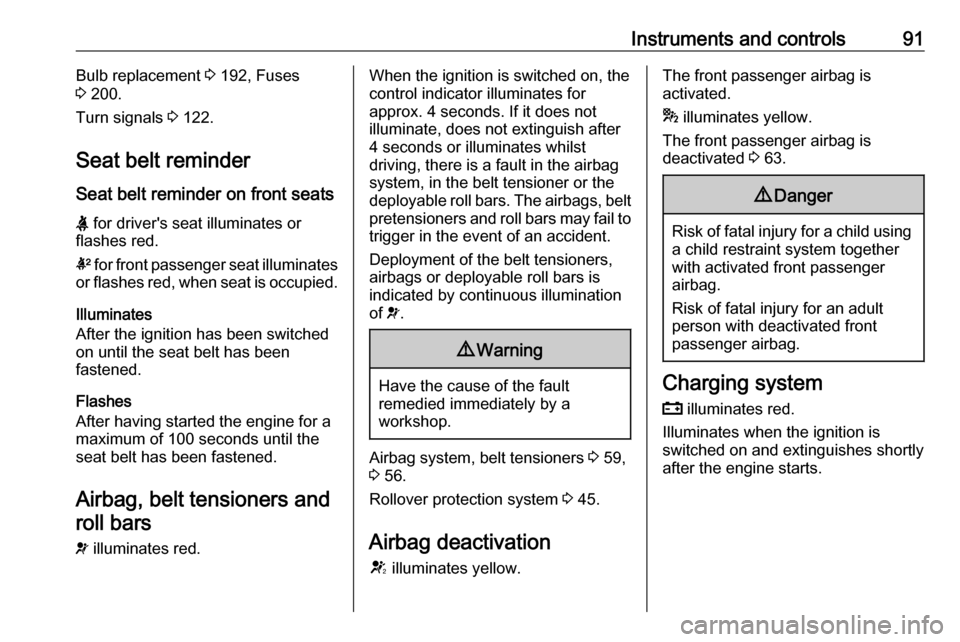
Airbag deactivation V illuminates yellow.
The front passenger airbag is
activated.
* illuminates yellow.
The front passenger airbag is
deactivated 3 63.9 Danger
Risk of fatal injury for a child using
a child restraint system together
with activated front passenger
airbag.
Risk of fatal injury for an adult
person with deactivated front
passenger airbag.
Charging system
p illuminates red.
Illuminates when the ignition is
switched on and extinguishes shortly
after the engine starts.
Page 105 of 261
Instruments and controls103Vehicle messages
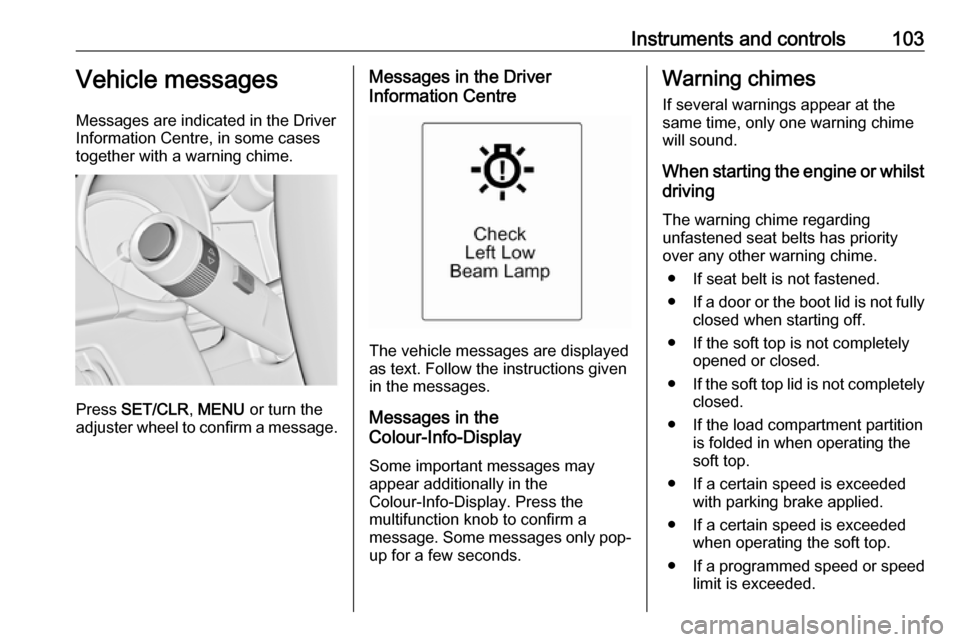
Messages are indicated in the Driver
Information Centre, in some cases
together with a warning chime.
Press SET/CLR , MENU or turn the
adjuster wheel to confirm a message.
Messages in the Driver
Information Centre
The vehicle messages are displayed
as text. Follow the instructions given
in the messages.
Messages in the
Colour-Info-Display
Some important messages may
appear additionally in the
Colour-Info-Display. Press the
multifunction knob to confirm a
message. Some messages only pop- up for a few seconds.
Warning chimes
If several warnings appear at the
same time, only one warning chime
will sound.
When starting the engine or whilst
driving
The warning chime regarding
unfastened seat belts has priority
over any other warning chime.
● If seat belt is not fastened.
● If a door or the boot lid is not fully
closed when starting off.
● If the soft top is not completely opened or closed.
● If the soft top lid is not completely
closed.
● If the load compartment partition is folded in when operating the
soft top.
● If a certain speed is exceeded with parking brake applied.
● If a certain speed is exceeded when operating the soft top.
● If a programmed speed or speed
limit is exceeded.
Page 112 of 261
110Instruments and controlsOnStar buttons
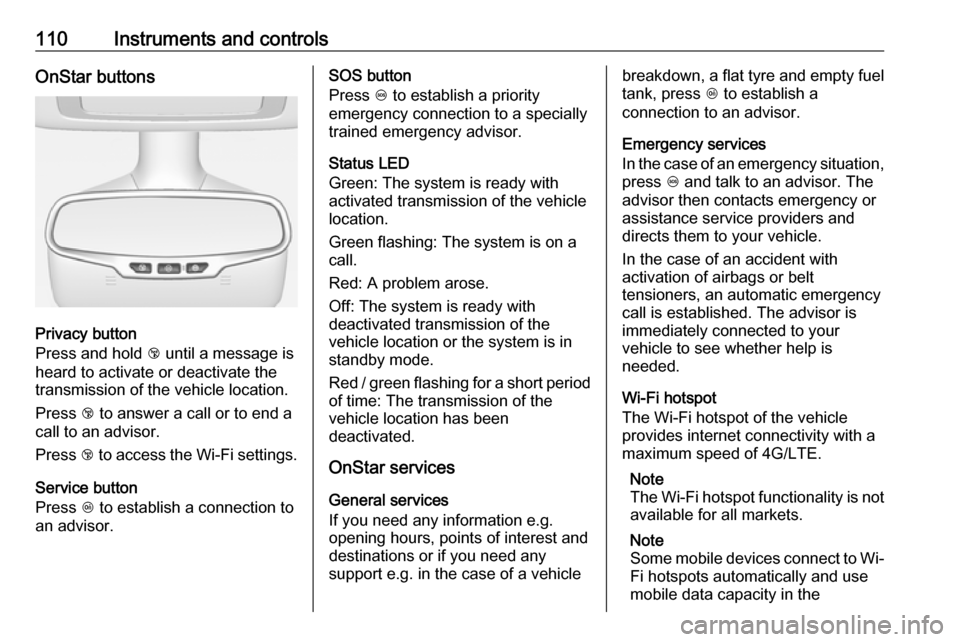
Privacy button
Press and hold j until a message is
heard to activate or deactivate the
transmission of the vehicle location.
Press j to answer a call or to end a
call to an advisor.
Press j to access the Wi-Fi settings.
Service button
Press Z to establish a connection to
an advisor.
SOS button
Press [ to establish a priority
emergency connection to a specially
trained emergency advisor.
Status LED
Green: The system is ready with
activated transmission of the vehicle
location.
Green flashing: The system is on a
call.
Red: A problem arose.
Off: The system is ready with
deactivated transmission of the
vehicle location or the system is in
standby mode.
Red / green flashing for a short period of time: The transmission of the
vehicle location has been
deactivated.
OnStar services
General services
If you need any information e.g.
opening hours, points of interest and
destinations or if you need any
support e.g. in the case of a vehiclebreakdown, a flat tyre and empty fuel
tank, press Z to establish a
connection to an advisor.
Emergency services
In the case of an emergency situation,
press [ and talk to an advisor. The
advisor then contacts emergency or
assistance service providers and
directs them to your vehicle.
In the case of an accident with
activation of airbags or belt
tensioners, an automatic emergency
call is established. The advisor is
immediately connected to your
vehicle to see whether help is
needed.
Wi-Fi hotspot
The Wi-Fi hotspot of the vehicle
provides internet connectivity with a
maximum speed of 4G/LTE.
Note
The Wi-Fi hotspot functionality is not
available for all markets.
Note
Some mobile devices connect to Wi- Fi hotspots automatically and use
mobile data capacity in the
Page 138 of 261

136Climate controlAir conditioning regularoperation
In order to ensure continuously
efficient performance, cooling must
be operated for a few minutes once a
month, irrespective of the weather
and time of year. Operation with
cooling is not possible when the
outside temperature is too low.
Service For optimal cooling performance, it is recommended to annually check the
climate control system, starting
three years after initial vehicle
registration, including:
● functionality and pressure test
● heating functionality
● leakage check
● check of drive belts
● cleaning of condenser and evaporator drainage
● performance check
Note
Refrigerant R-134a contains
fluorinated greenhouse gases.