door lock OPEL COMBO 2017 Manual user
[x] Cancel search | Manufacturer: OPEL, Model Year: 2017, Model line: COMBO, Model: OPEL COMBO 2017Pages: 195, PDF Size: 4.71 MB
Page 31 of 195
Keys, doors and windows29Vehicle security
Anti-theft locking system9 Warning
Do not use the system if there are
people in the vehicle! The doorscannot be unlocked from the
inside.
The system deadlocks all the doors. All doors must be closed otherwise
the system cannot be activated.
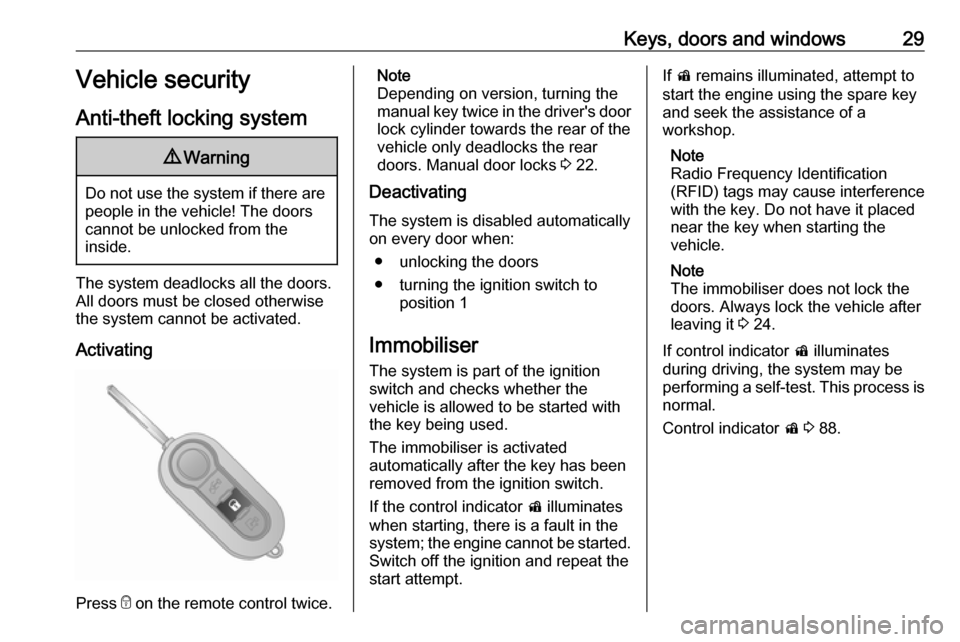
Activating
Press e on the remote control twice.
Note
Depending on version, turning the manual key twice in the driver's door lock cylinder towards the rear of the
vehicle only deadlocks the rear
doors. Manual door locks 3 22.
Deactivating
The system is disabled automatically
on every door when:
● unlocking the doors
● turning the ignition switch to position 1
Immobiliser
The system is part of the ignition
switch and checks whether the
vehicle is allowed to be started with
the key being used.
The immobiliser is activated
automatically after the key has been removed from the ignition switch.
If the control indicator d illuminates
when starting, there is a fault in the
system; the engine cannot be started. Switch off the ignition and repeat the
start attempt.If d remains illuminated, attempt to
start the engine using the spare key
and seek the assistance of a
workshop.
Note
Radio Frequency Identification
(RFID) tags may cause interference
with the key. Do not have it placed
near the key when starting the
vehicle.
Note
The immobiliser does not lock the
doors. Always lock the vehicle after
leaving it 3 24.
If control indicator d illuminates
during driving, the system may be
performing a self-test. This process is
normal.
Control indicator d 3 88.
Page 35 of 195
Keys, doors and windows33Child safety system for rear
windows
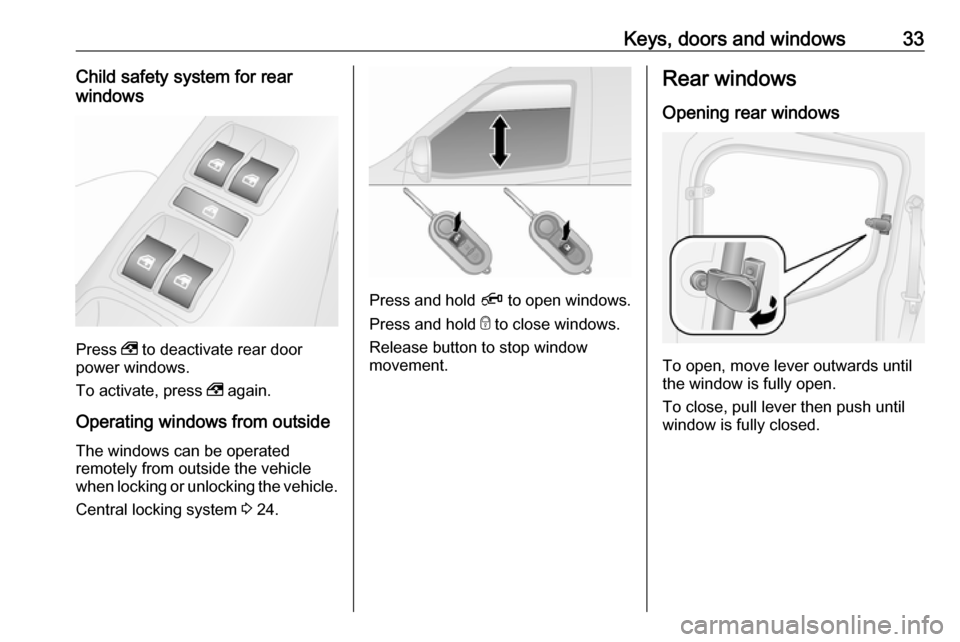
Press , to deactivate rear door
power windows.
To activate, press , again.
Operating windows from outside
The windows can be operated
remotely from outside the vehicle
when locking or unlocking the vehicle.
Central locking system 3 24.
Press and hold Ä to open windows.
Press and hold e to close windows.
Release button to stop window
movement.
Rear windows
Opening rear windows
To open, move lever outwards until
the window is fully open.
To close, pull lever then push until
window is fully closed.
Page 62 of 195

60StorageGlovebox
Pull lever to open the glovebox cover.Depending on version, the glovebox
may be lockable using the ignition
key.
The glovebox should be closed whilst
driving.
Cupholders
Cupholders are located in the console between the front seats.
The cupholders can also be used to
hold the portable ashtray unit 3 74.
Front storage
Storage compartments are located in the front door pockets.
Coat hooks are located on the cabin
bulkhead (where fitted).
Overhead console
Store only lightweight items such as
paperwork or maps in the overhead
console.
Page 67 of 195
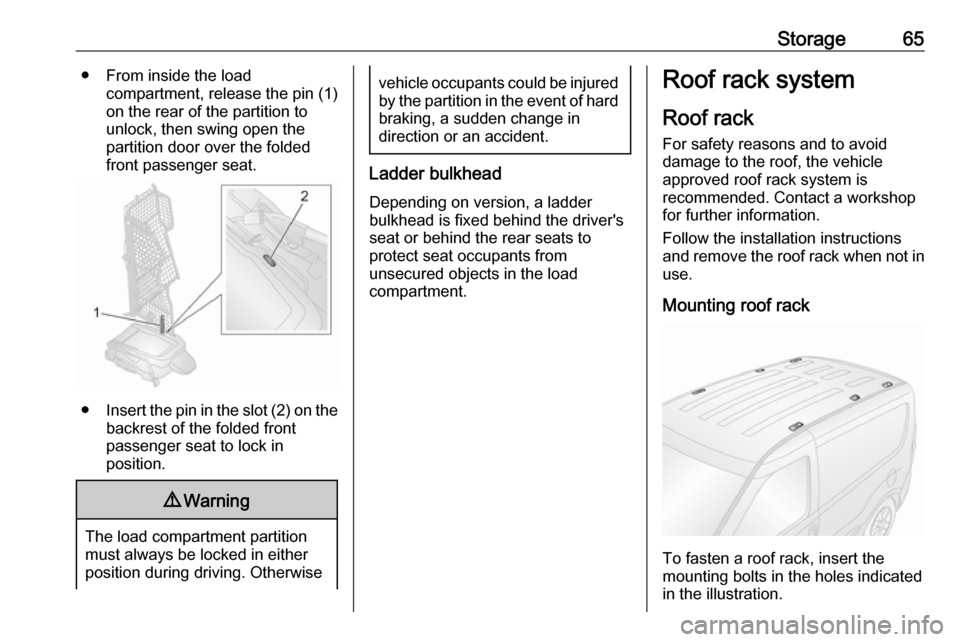
Storage65● From inside the loadcompartment, release the pin (1)
on the rear of the partition to
unlock, then swing open the
partition door over the folded
front passenger seat.
● Insert the pin in the slot (2) on the
backrest of the folded front
passenger seat to lock in
position.
9 Warning
The load compartment partition
must always be locked in either
position during driving. Otherwise
vehicle occupants could be injured by the partition in the event of hardbraking, a sudden change in
direction or an accident.
Ladder bulkhead
Depending on version, a ladder
bulkhead is fixed behind the driver's
seat or behind the rear seats to
protect seat occupants from
unsecured objects in the load
compartment.
Roof rack system
Roof rack
For safety reasons and to avoid
damage to the roof, the vehicle
approved roof rack system is
recommended. Contact a workshop
for further information.
Follow the installation instructions
and remove the roof rack when not in use.
Mounting roof rack
To fasten a roof rack, insert the
mounting bolts in the holes indicated
in the illustration.
Page 70 of 195

68Instruments and controlsInstruments and
controlsControls ....................................... 69
Steering wheel adjustment ........69
Steering wheel controls .............69
Horn ........................................... 69
Windscreen wiper/washer .........70
Rear window wiper/washer .......70
Headlamp washer .....................71
Outside temperature ..................71
Clock ......................................... 71
Power outlets ............................. 73
Cigarette lighter ......................... 74
Ashtrays .................................... 74
Warning lights, gauges and indi‐ cators ........................................... 75
Instrument cluster ......................75
Speedometer ............................. 75
Odometer .................................. 75
Trip odometer ............................ 75
Tachometer ............................... 75
Fuel gauge ................................ 76
Fuel selector .............................. 76
Engine coolant temperature gauge ....................................... 77
Service display .......................... 77Transmission display .................78
Control indicators ......................78
Generic warning ........................80
Turn signal ................................. 81
Seat belt reminder .....................81
Airbag and belt tensioners .........81
Airbag deactivation ....................82
Charging system .......................82
Malfunction indicator light ..........82
Brake system ............................. 83
Brake pad wear ......................... 83
Antilock brake system (ABS) .....83
Transmission ............................. 83
Gear shifting .............................. 84
Hill start assist ........................... 84
Ultrasonic parking assist ...........84
Electronic Stability Control ........84
Engine coolant temperature ......85
Preheating ................................. 85
Diesel particle filter ....................85
Tyre pressure monitoring system ...................................... 86
Engine oil pressure ....................86
Change engine oil .....................87
Low engine oil level ...................87
Low fuel ..................................... 87
Drain fuel filter ........................... 88
Immobiliser ................................ 88
Stop-start system ......................88
Exterior light .............................. 88High beam................................. 88
Fog light ..................................... 89
Rear fog light ............................. 89
Cruise control ............................ 89
Door open .................................. 89
Information displays .....................89
Driver Information Centre ..........89
Vehicle messages ........................94
Warning chimes .........................94
Fuel system messages ..............95
Trip computer ............................... 95
Page 82 of 195

80Instruments and controlsControl indicator in the roof
console
Airbag deactivation 3 52, 3 82.
Overview
9Generic warning 3 80OTurn signal 3 81XSeat belt reminder 3 81vAirbag and belt tensioners
3 81*Airbag deactivation 3 82pCharging system 3 82ZMalfunction indicator light
3 82RBrake system 3 83FBrake pad wear 3 83uAntilock brake system (ABS)
3 83sTransmission 3 83[ ÒGear shifting 3 84ZHill start assist 3 84rUltrasonic parking assist
3 84RElectronic Stability Control
3 84$Engine coolant temperature
3 85!Preheating 3 85%Diesel particle filter 3 85wTyre pressure monitoring
system 3 86IEngine oil pressure 3 86,
Change engine oil 3 87SLow engine oil level 3 87$Low fuel 3 87UDrain fuel filter 3 88dImmobiliser 3 88ÆStop-start system 3 888Exterior light 3 88µExterior light failure 3 88CHigh beam 3 88>Fog light 3 89øRear fog light 3 89mCruise control 3 89(Door open 3 89
Generic warning
9 illuminates yellow.
Depending on model variant, control
indicator 9 may illuminate
independently or in conjunction with
Æ 3 88, t 3 88, Z 3 84 or r
3 84.
Page 95 of 195

Instruments and controls93See radio or Radio info (Display audio
and radio information)
Available depending on version,
activate radio info (set to On) to
display audio and radio information
(e.g. station frequency, RDS
messages, track number). Deactivate when not required (set to Off).
Autoclose (Automatic central locking
when driving)
Activate the autoclose feature (set to
On ) to automatically lock the doors
when vehicle speed exceeds
20 km/h. Deactivate when not
required (set to Off).
Units or Unit of Measurement (for Distance, Fuel consumption and
Temperature)
After accessing this menu option, it is
possible to set the unit of
measurement for distance, fuel
consumption and temperature.
Select Distance and confirm. Set the
unit of measurement to km or mi
(miles) and confirm.
Select Consumption and confirm.
When the Distance unit is set to km, it
is possible to set the unit ofmeasurement for fuel consumption to either l/100km or km/l . When the
Distance unit is set to mi (miles), fuel
consumption is shown in mpg.
Select Temperature and confirm. Set
the unit of measurement to °C or °F
and confirm.
Language
Languages selectable include:
English, German, French, Italian,
Portuguese, Spanish, Dutch, Polish and Turkish. Select desired language
and confirm.
Buzzer volume or Warning volume
(Warning chime volume)
Adjust the volume of warning chimes
and confirm. eight volume levels are
available.
Warning chimes 3 94.
Button vol. or Button volume
A chime is sounded every time
SET q, R or S is pressed.
Adjust the volume of these chimes
and confirm. eight volume levels are
available.
Warning chimes 3 94.Belt buzzer or Seat belt buzzer
(Reactivate warning chime for driver
and/or front passenger seat belt
reminder)
This menu option is available only if
the seat belt reminder is not active.
When reactivated, the driver and/or
front passenger are alerted with a
warning chime when the
corresponding seat belt is not
fastened.
Seat belt reminder 3 81.
Service (Distance to next service) Access this menu option to view the
remaining distance to the next service (available depending on version).
The distance to next service is also
displayed automatically when the
distance reaches 2,000 km and is
repeated after every additional
200 km.
Service display 3 77.
Page 134 of 195

132Driving and operatingFuel selector
Pressing Y in the centre console
switches between petrol and natural
gas operation. The LED 1 status
shows the current operating mode.
1 off:natural gas
operation1 illuminates:petrol operation
As soon as the natural gas tanks are
empty, petrol operation is
automatically engaged. Control
indicator Y illuminates in the Driver
Information Centre 3 89 until the
ignition is switched off.
When switching automatically
between petrol or gas operation, a
brief delay of engine tractive power
may be noticeable.
Every six months run the petrol tank
down until control indicator §
illuminates and then refuel. This is
necessary to maintain fuel quality as
well as system function necessary for
petrol operation.
Fill the tank completely at regular
intervals to prevent corrosion in the
tank.
Refuelling
Fuel filler flap is located at left rear
side of vehicle.9 Danger
Before refuelling, switch off engine
and any external heaters with
combustion chambers. Switch off
any mobile phones.
Follow the operating and safety
instructions of the filling station
when refuelling.
9 Danger
Fuel is flammable and explosive.
No smoking. No naked flames or
sparks.
If you can smell fuel in your
vehicle, have the cause of this
remedied immediately by a
workshop.
Caution
In case of misfuelling, do not
switch on ignition.
Release the fuel filler flap by pulling
the flap by hand.
Insert ignition key into fuel filler cap
and turn anticlockwise to unlock.
To remove fuel filler cap, rotate
anticlockwise.
Caution
To avoid damage, do not attempt
to operate the sliding side door
when the fuel filler flap is open.
Page 135 of 195

Driving and operating133Note
Depending on model, the sliding
side door may be fitted with a safety
system that prevents the door from
being opened fully when the fuel
filler flap is open.
Sliding side door 3 26.
The fuel filler cap can be retained in
the bracket on the fuel filler flap.
To refuel, fully insert the pump nozzle
and switch it on.
After automatic cut-off, the tank can be topped up by operating the pump
nozzle a maximum of two more times.
Caution
Wipe off any overflowing fuel
immediately.
To close, replace fuel filler cap and
turn clockwise.
Insert ignition key into fuel filler cap
and turn clockwise to lock, then
remove key.
Close the fuel filler flap.
Natural gas refuelling
Open the fuel filler flap.
9 Warning
Refuel only with a maximum
output pressure of 250 bar. Use
only temperature compensated
filling stations.
The refuelling procedure must be
completed, i.e. the filler neck must be vented.
The capacity of the natural gas tank
depends on outside temperature,
filling pressure and type of refuelling
system.
Close the fuel filler flap after
refuelling.
Terms for " natural gas vehicles "
abroad:
GermanErdgasfahrzeugeEnglishNGVs = Natural Gas Vehi‐
clesFrenchVéhicules au gaz naturel –
or – Véhicules GNVItalianMetano auto
Page 140 of 195

138Vehicle careCaution
When transporting the vehicle on
a train or on a recovery vehicle, the
mud flaps might be damaged.
Vehicle storage
Storage for a long period of time
If the vehicle is to be stored for several months:
● Wash and wax the vehicle.
● Have the wax in the engine compartment and underbody
checked.
● Clean and preserve the rubber seals.
● Fill up fuel tank completely.
● Change the engine oil.
● Drain the washer fluid reservoir.
● Check the coolant antifreeze and
corrosion protection.
● Adjust tyre pressure to the value specified for full load.
● Park the vehicle in a dry, wellventilated place. Engage first or
reverse gear to prevent the
vehicle from rolling.
● Do not apply the parking brake.
● Open the bonnet, close all doors and lock the vehicle.
● Disconnect the clamp from the negative terminal of the vehicle
battery. Beware that all systems
are not functional, e.g. anti-theft
locking system.
Putting back into operation
When the vehicle is to be put back into operation:
● Connect the clamp to the negative terminal of the vehicle
battery. Activate the electronics
of the power windows.
● Check tyre pressure.
● Fill up the washer fluid reservoir.
● Check the engine oil level.
● Check the coolant level.
● Fit the number plates if necessary.End-of-life vehicle recovery
Information on end-of-life vehicle
recovery centres and the recycling of
end-of-life vehicles is available on our website. Only entrust this work to an
authorised recycling centre.
Natural gas vehicles must be recycled by a service centre authorised for
natural gas vehicles.