parking brake OPEL COMBO 2017 Manual user
[x] Cancel search | Manufacturer: OPEL, Model Year: 2017, Model line: COMBO, Model: OPEL COMBO 2017Pages: 195, PDF Size: 4.71 MB
Page 126 of 195
124Driving and operating9Warning
If there is a fault in the ABS, the
wheels may be liable to lock due
to braking that is heavier than
normal. The advantages of ABS are no longer available. During
hard braking, the vehicle can no longer be steered and may
swerve.
Have the cause of the fault remedied
by a workshop.
Control indicator u 3 83.
Parking brake
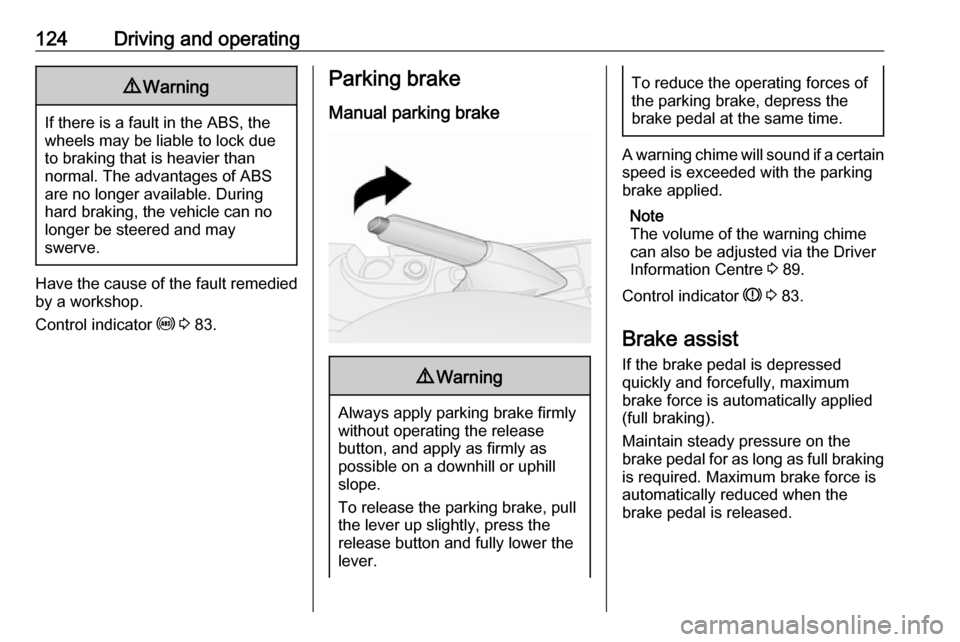
Manual parking brake9 Warning
Always apply parking brake firmly
without operating the release
button, and apply as firmly as
possible on a downhill or uphill
slope.
To release the parking brake, pull
the lever up slightly, press the
release button and fully lower the
lever.
To reduce the operating forces of
the parking brake, depress the
brake pedal at the same time.
A warning chime will sound if a certain
speed is exceeded with the parking
brake applied.
Note
The volume of the warning chime
can also be adjusted via the Driver
Information Centre 3 89.
Control indicator R 3 83.
Brake assist If the brake pedal is depressed
quickly and forcefully, maximum
brake force is automatically applied
(full braking).
Maintain steady pressure on the brake pedal for as long as full braking
is required. Maximum brake force is
automatically reduced when the
brake pedal is released.
Page 140 of 195

138Vehicle careCaution
When transporting the vehicle on
a train or on a recovery vehicle, the
mud flaps might be damaged.
Vehicle storage
Storage for a long period of time
If the vehicle is to be stored for several months:
● Wash and wax the vehicle.
● Have the wax in the engine compartment and underbody
checked.
● Clean and preserve the rubber seals.
● Fill up fuel tank completely.
● Change the engine oil.
● Drain the washer fluid reservoir.
● Check the coolant antifreeze and
corrosion protection.
● Adjust tyre pressure to the value specified for full load.
● Park the vehicle in a dry, wellventilated place. Engage first or
reverse gear to prevent the
vehicle from rolling.
● Do not apply the parking brake.
● Open the bonnet, close all doors and lock the vehicle.
● Disconnect the clamp from the negative terminal of the vehicle
battery. Beware that all systems
are not functional, e.g. anti-theft
locking system.
Putting back into operation
When the vehicle is to be put back into operation:
● Connect the clamp to the negative terminal of the vehicle
battery. Activate the electronics
of the power windows.
● Check tyre pressure.
● Fill up the washer fluid reservoir.
● Check the engine oil level.
● Check the coolant level.
● Fit the number plates if necessary.End-of-life vehicle recovery
Information on end-of-life vehicle
recovery centres and the recycling of
end-of-life vehicles is available on our website. Only entrust this work to an
authorised recycling centre.
Natural gas vehicles must be recycled by a service centre authorised for
natural gas vehicles.
Page 162 of 195

160Vehicle careApply the parking brake and engagefirst or reverse gear.
The tyre repair kit may be located
under the front seat, in the glovebox,
or on the right side of the load
compartment behind a cover.
1. Take the tyre repair kit from the vehicle.
2. Remove the compressor.
3. Set the compressor upright near the tyre.
4. Unscrew valve cap from defective
tyre.
5. Screw the flexible filler hose onto the tyre valve.
6. The switch on the compressor must be set to J.
7. Connect the compressor plug to the power outlet or cigarette
lighter socket.
To avoid discharging the vehicle
battery, we recommend running
the engine.8. Set the rocker switch on the compressor to I. The tyre is filled
with sealant.
9. All of the sealant is pumped into the tyre. Then the tyre is inflated.
Tyre pressure 3 185. When the
correct pressure is obtained,
switch off the compressor.
10. If a pressure of 1.5 bar is not obtained within five minutes,
remove the tyre repair kit. Move
the vehicle one tyre rotation.
Reattach the tyre repair kit and
continue the filling procedure for five minutes. If a pressure of
1.8 bar is still not obtained within
five minutes, the tyre is too badly
Page 164 of 195

162Vehicle care2. Turn the canister anticlockwise tolift it out.
3. Insert the new canister and turn it clockwise.
4. Connect the compressor air hose to the canister and fit the flexible
filler tube into its allocated space.
Wheel changing
Some vehicles are equipped with a
tyre repair kit instead of a spare wheel 3 159.
Make the following preparations and
observe the following information:
● Park the vehicle on a level, firm and non-skid surface. The front
wheels must be in the straight-
ahead position.
● Apply the parking brake and engage first or reverse gear.
● Remove the spare wheel 3 163.
● Never change more than one wheel at once.
● Use the jack only to change wheels in case of puncture, not
for seasonal winter or summer
tyre change.● The jack is maintenance-free.
● If the ground on which the vehicle
is standing is soft, a solid board
(max. 1 cm thick) should be
placed under the jack.
● No people or animals may be in the vehicle when it is jacked-up.
● Never crawl under a jacked-up vehicle.
● Do not start the vehicle when it is
raised on the jack.
● Clean wheel nuts and thread with
a clean cloth before mounting the
wheel.9 Warning
Do not grease wheel bolt, wheel
nut and wheel nut cone.
1. Disengage wheel nut caps with a screwdriver and remove. Pull off
the wheel cover using a suitable
tool.
2. Attach wheel wrench securely and loosen each wheel nut by halfa turn.
Page 168 of 195

166Vehicle careJump startingDo not start with quick charger.
A vehicle with a discharged battery
can be started using jump leads and the battery of another vehicle.9 Warning
Be extremely careful when starting
with jump leads. Any deviation
from the following instructions can
lead to injuries or damage caused
by battery explosion or damage to the electrical systems of both
vehicles.
9 Warning
Avoid contact of the vehicle
battery with eyes, skin, fabrics and painted surfaces. The fluid
contains sulphuric acid which can
cause injuries and damage in the
event of direct contact.
● Never expose the vehicle battery
to naked flames or sparks.
● A discharged vehicle battery can already freeze at a temperature
of 0 °C. Defrost the frozen battery
before connecting jump leads.
● Wear eye protection and protective clothing when
handling a vehicle battery.
● Use a booster battery with the same voltage (12 Volts). Its
capacity (Ah) must not be much less than that of the discharged
vehicle battery.
● Use jump leads with insulated terminals and a cross section of
at least 16 mm 2
(25 mm 2
for
diesel engines).
● Do not disconnect the discharged
battery from the vehicle.
● Switch off all unnecessary electrical consumers.
● Do not lean over the vehicle battery during jump starting.
● Do not allow the terminals of one
lead to touch those of the other
lead.● The vehicles must not come into contact with each other during
the jump starting process.
● Apply the parking brake, transmission in neutral.
Lead connection order:
1. Connect the red lead to the positive terminal of the booster
battery.
2. Connect the other end of the red lead to the positive terminal of the
discharged vehicle battery.
Page 193 of 195

191OObject detection systems ...........129
Odometer ..................................... 75
Oil, engine .......................... 173, 177
Operating windows from outside ..31
Outside temperature ....................71
Overhead console .......................60
Overrun cut-off ........................... 114
P Parking ................................ 19, 116
Parking assist ............................ 129
Parking brake ............................ 124
Particulate filter ........................... 117
Payload......................................... 66
Pedals......................................... 111
Performance .............................. 181
Performing work ........................139
Pollen filter ................................. 110
Power outlets ............................... 73
Power steering fluid ....................141
Power windows ............................ 31
Preheating ................................... 85
Puncture ..................................... 162
R Radio Frequency Identification (RFID) ..................................... 187
Radio info ..................................... 89
Radio remote control ...................21
Rear doors ................................... 26Rear fog light ............................... 89
Rear fog lights ........................... 100
Rear parcel shelf .......................... 62
Rear seats .................................... 40
Rear storage ................................. 61
Rear windows .............................. 33
Rear window wiper/washer .......... 70
Recommended fluids and lubricants ........................ 173, 177
Refuelling ................................... 132 Remote control ............................. 21
Removing seats ............................ 42
Reversing lights .........................100
Ride control systems ..........125, 126
Roof bars ...................................... 61
Roof load ...................................... 66
Roof rack ..................................... 65
Roof racks .................................... 66
S Safety belts ................................... 44
Seat adjustment ....................... 7, 37
Seat belt ........................................ 8
Seat belt reminder .......................81
Seat belt reminder warning chime 89
Seat belts ..................................... 44
Seat folding .................................. 38
Seat heating ................................. 40
Seat position ................................ 36
Second row seats ........................40Selector lever ............................. 120
Service ............................... 110, 172
Service display ......................77, 89
Service information ....................172
Settings menu............................... 89
Side airbag system ......................52
Sidelights ...................................... 98
Side turn signal lights ................148
Sliding door .................................. 26
Sliding side door ........................... 26
Spare wheel ............................... 163
Speed limit warning chime............ 89
Speedometer ............................... 75
Standard display ........................... 89
Starting and operating ................112
Starting off ................................... 17
Starting the engine ............112, 119
Steering ...................................... 111
Steering wheel adjustment ......9, 69
Steering wheel controls ...............69
Stop engine .................................. 80
Stop-start system.................. 88, 114
Storage ......................................... 59
Storage compartments .................59
Sun visors .................................... 34
Symbols ......................................... 4
T
Tachometer ................................. 75
Tailgate ......................................... 27