parking brake OPEL COMBO D 2017.5 Manual user
[x] Cancel search | Manufacturer: OPEL, Model Year: 2017.5, Model line: COMBO D, Model: OPEL COMBO D 2017.5Pages: 201, PDF Size: 4.76 MB
Page 127 of 201

Driving and operating125Eco mode selects the most suitable
gear depending on the speed of the
vehicle, the engine speed and the
intensity with which the accelerator is
pressed.
Activation
Press E on the selector lever housing.
Control indicator E is shown in the
transmission display to indicate
activation.
Deactivation
Eco mode is switched off by:
● pressing E again
● switching to manual mode
In order to protect the transmission at
extremely high clutch temperatures,
an intermittent audible warning chime may sound. In such cases, depress
the brake pedal, select N and apply
the parking brake to allow the clutch
to cool down.
Kickdown If the accelerator pedal is pressed
past the pressure point, the
transmission shifts to a lower geardepending on engine speed. Full
engine power is available for
acceleration.
If engine speed is too high the
transmission switches to a higher
gear, even in manual mode. Without
kickdown this automatic shift is not
effected in manual mode.
Fault
In the event of a fault, control indicator s is shown in the transmission
display.
Continued driving is possible,
provided the vehicle is driven with
care and anticipation. A warning
message may appear in the Driver
Information Centre in conjunction with
a warning chime 3 95.
Note
The volume of the warning chime
can also be adjusted via the Driver
Information Centre 3 90.
Have the cause of the fault remedied by a workshop.
Page 129 of 201

Driving and operating127Parking brake
Manual parking brake9 Warning
Always apply parking brake firmly
without operating the release
button, and apply as firmly as
possible on a downhill or uphill
slope.
To release the parking brake, pull
the lever up slightly, press the
release button and fully lower the
lever.
To reduce the operating forces of
the parking brake, depress the
brake pedal at the same time.
A warning chime will sound if a certain
speed is exceeded with the parking
brake applied.
Note
The volume of the warning chime
can also be adjusted via the Driver
Information Centre 3 90.
Control indicator R 3 84.
Brake assist If the brake pedal is depressed
quickly and forcefully, maximum
brake force is automatically applied
(full braking).
Maintain steady pressure on the brake pedal for as long as full braking
is required. Maximum brake force is
automatically reduced when the
brake pedal is released.
Hill start assist
The system helps prevent unintended movement when driving away on
inclines.
When releasing the brake pedal after
stopping on an incline, the brakes
remain on for a further two seconds.
The brakes release automatically as
soon as the vehicle begins to
accelerate or the two seconds holding
time is over.
If control indicator Z 3 85 illuminates
while driving, there is a fault in the Hill
start assist. Depending on version, a
corresponding warning message,
e.g. Hill holder unavailable , may also
Page 133 of 201

Driving and operating131Turn end of lever to the ON position;
control indicator m 3 90 illuminates in
the instrument cluster. Depending on
version, a corresponding message,
e.g. Cruise Control on , may also be
displayed in the Driver Information
Centre 3 90.
Activation Accelerate to the desired speed and
push lever upwards ( +); the current
speed is stored and maintained.
Accelerator pedal can be released.
Vehicle speed can be increased by
depressing the accelerator pedal.
When the accelerator pedal is
released, the previously stored speed
is resumed.
Cruise control remains activated
while gearshifting.
Increase speed
With cruise control active, push lever
upwards ( +) or briefly push lever
upwards ( +) repeatedly: speed
increases continuously or in small
increments.Alternatively accelerate to the desired speed and store by pushing lever
upwards ( +).
Reduce speed
With cruise control active, push lever
downwards ( -) or briefly push lever
downwards ( -) repeatedly; speed
decreases continuously or in small
increments.
Deactivation Automatic deactivation: ● vehicle speed below approx. 30 km/h
● the brake pedal is depressed
● the clutch pedal is depressed
● the traction control system/Anti- Slip Regulator (ASR) or
Electronic Stability Control (ESC)
is operating
● the antilock brake system (ABS) is operating
Resume stored speed
Press = at a speed above 30 km/h.
The stored speed will be obtained.Switching off
Turn end of lever to the OFF position;
control indicator m extinguishes. The
stored speed is deleted. Switching off the ignition also deletes the stored
speed.
Parking assist9 Warning
It is the driver who bears full
responsibility for the parking
manoeuvre.
Always check the surrounding
area while reversing and using the parking assist system.
The parking assist makes parking
easier by measuring the distance between the vehicle and obstacles,
and giving acoustic signals.
Page 143 of 201

Vehicle care141Caution
When transporting the vehicle on
a train or on a recovery vehicle, the
mud flaps might be damaged.
Vehicle storage
Storage for a long period of time
If the vehicle is to be stored for several months:
● Wash and wax the vehicle.
● Have the wax in the engine compartment and underbody
checked.
● Clean and preserve the rubber seals.
● Fill up fuel tank completely.
● Change the engine oil.
● Drain the washer fluid reservoir.
● Check the coolant antifreeze and
corrosion protection.
● Adjust tyre pressure to the value specified for full load.
● Park the vehicle in a dry, wellventilated place. Engage first or
reverse gear to prevent the
vehicle from rolling.
● Do not apply the parking brake.
● Open the bonnet, close all doors and lock the vehicle.
● Disconnect the clamp from the negative terminal of the vehicle
battery. Beware that all systems
are not functional, e.g. anti-theft
locking system.
Putting back into operation
When the vehicle is to be put back into operation:
● Connect the clamp to the negative terminal of the vehicle
battery. Activate the electronics
of the power windows.
● Check tyre pressure.
● Fill up the washer fluid reservoir.
● Check the engine oil level.
● Check the coolant level.
● Fit the number plates if necessary.End-of-life vehicle recovery
Information on end-of-life vehicle
recovery centres and the recycling of
end-of-life vehicles is available on our website. Only entrust this work to an
authorised recycling centre.
Natural gas vehicles must be recycled by a service centre authorised for
natural gas vehicles.
Page 165 of 201
Vehicle care163Wheel covers must not impair brake
cooling.9 Warning
Use of unsuitable tyres or wheel
covers could lead to sudden
pressure loss and thereby
accidents.
Tyre chains
Tyre chains are only permitted on the
front wheels.
Always use fine mesh chains that add no more than 10 mm to the tyre tread
and the inboard sides (including chain lock).
Do not exceed 50 km/h when tyre
chains are fitted.9 Warning
Damage may lead to tyre blowout.
Tyre repair kit
Minor damage to the tyre tread can be
repaired with the tyre repair kit.
Do not remove foreign bodies from
the tyres.
Tyre damage exceeding 4 mm or that is at tyre's sidewall cannot be repairedwith the tyre repair kit.
9 Warning
Do not drive faster than 80 km/h.
Do not use for a lengthy period.
Steering and handling may be
affected.
If you have a flat tyre:
Apply the parking brake and engage
first or reverse gear.
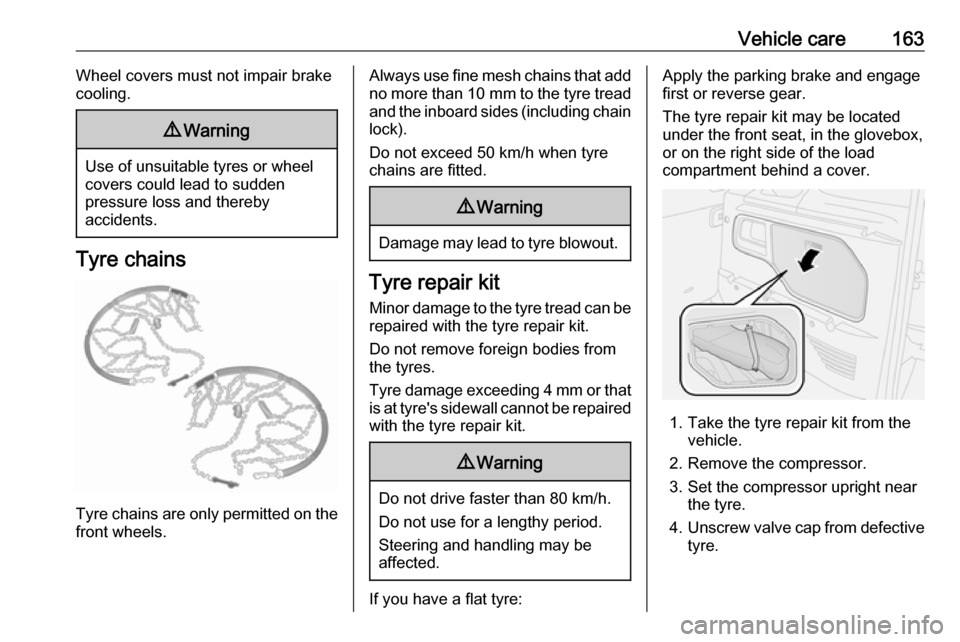
The tyre repair kit may be located
under the front seat, in the glovebox,
or on the right side of the load
compartment behind a cover.
1. Take the tyre repair kit from the vehicle.
2. Remove the compressor.
3. Set the compressor upright near the tyre.
4. Unscrew valve cap from defective
tyre.
Page 167 of 201

Vehicle care165
If tyre pressure is more than
1.8 bar , set it to the correct value.
Repeat the procedure until there
is no more loss of pressure.
If the tyre pressure has fallen
below 1.8 bar, the vehicle must
not be used. Seek the assistance
of a workshop.
15. Stow away tyre repair kit in load compartment.
Note
The driving characteristics of the
repaired tyre are severely affected,
therefore have this tyre replaced.
If unusual noise is heard or the
compressor becomes hot, turn
compressor off and allow to cool.
Note the expiry date of the kit. After
this date its sealing capability is no
longer guaranteed. Pay attention to
storage information on sealant
bottle.
Replace the used sealant bottle.
Dispose of the bottle as prescribed
by applicable laws.
The compressor and sealant can be used from approx. -20 °C.
Replacing the sealant canister
To replace the sealant canister: 1. Disconnect the compressor air hose.2. Turn the canister anticlockwise to lift it out.
3. Insert the new canister and turn it clockwise.
4. Connect the compressor air hose to the canister and fit the flexible
filler tube into its allocated space.
Wheel changing
Some vehicles are equipped with a
tyre repair kit instead of a spare wheel 3 163.
Make the following preparations and
observe the following information:
● Park the vehicle on a level, firm and non-skid surface. The front
wheels must be in the straight- ahead position.
● Apply the parking brake and engage first or reverse gear.
● Remove the spare wheel 3 167.
● Never change more than one wheel at once.
● Use the jack only to change wheels in case of puncture, not
for seasonal winter or summer
tyre change.
Page 172 of 201

170Vehicle care● A discharged vehicle battery canalready freeze at a temperature
of 0 °C. Defrost the frozen battery before connecting jump leads.
● Wear eye protection and protective clothing when
handling a vehicle battery.
● Use a booster battery with the same voltage (12 Volts). Its
capacity (Ah) must not be much
less than that of the discharged
vehicle battery.
● Use jump leads with insulated terminals and a cross section of
at least 16 mm 2
(25 mm 2
for
diesel engines).
● Do not disconnect the discharged
battery from the vehicle.
● Switch off all unnecessary electrical consumers.
● Do not lean over the vehicle battery during jump starting.
● Do not allow the terminals of one
lead to touch those of the other
lead.● The vehicles must not come into contact with each other during
the jump starting process.
● Apply the parking brake, transmission in neutral.
Lead connection order:
1. Connect the red lead to the positive terminal of the booster
battery.
2. Connect the other end of the red lead to the positive terminal of the
discharged vehicle battery.
3. Connect the black lead to the negative terminal of the booster
battery.
4. Connect the other end of the black
lead to a vehicle grounding point,
such as the engine block or an
engine mounting bolt. Connect as far away from the discharged
vehicle battery as possible,
however at least 60 cm.
Route the leads so that they cannot
catch on rotating parts in the engine
compartment.
To start the engine: 1. Start the engine of the vehicle providing the jump.
2. After five minutes, start the other engine. Start attempts should be
made for no longer than
15 seconds at an interval of
one minute.
3. Allow both engines to idle for approx. three minutes with the
leads connected.
Page 199 of 201

197OObject detection systems ...........131
Odometer ..................................... 76
Oil, engine .......................... 177, 181
Operating windows from outside ..32
Outside temperature ....................72
Overhead console .......................61
Overrun cut-off ........................... 116
P Parking ................................ 19, 119
Parking assist ............................ 131
Parking brake ............................ 127
Particulate filter ........................... 120
Payload......................................... 67
Pedals......................................... 113
Performance .............................. 185
Performing work ........................142
Pollen filter ................................. 111
Power outlets ............................... 74
Power steering fluid ....................144
Power windows ............................ 32
Preheating ................................... 86
Puncture ..................................... 165
R Radio Frequency Identification (RFID) ..................................... 193
Radio info ..................................... 90
Radio remote control ...................21
Rear doors ................................... 26Rear fog light ............................... 90
Rear fog lights ........................... 101
Rear parcel shelf .......................... 63
Rear seats .................................... 41
Rear storage ................................. 62
Rear windows .............................. 34
Rear window wiper/washer .......... 71
Recommended fluids and lubricants ........................ 177, 181
Refuelling ................................... 135 Registered trademarks ...............191
Remote control ............................. 21
Removing seats ............................ 42
Reversing lights .........................101
Ride control systems ..........128, 129
Roof bars ...................................... 62
Roof load ...................................... 67
Roof rack ............................. 67, 187
Roof racks .................................... 67
S Safety belts ................................... 45
Seat adjustment ....................... 7, 37
Seat belt ........................................ 8
Seat belt reminder .......................82
Seat belt reminder warning chime 90
Seat belts ..................................... 45
Seat folding .................................. 38
Seat heating ................................. 40
Seat position ................................ 36Second row seats ........................41
Selector lever ............................. 122
Service ............................... 111, 176
Service display ......................78, 90
Service information ....................176
Settings menu............................... 90
Side airbag system ......................53
Sidelights ...................................... 99
Side turn signal lights ................151
Sliding door .................................. 26
Sliding side door ........................... 26
Spare wheel ............................... 167
Speed limit warning chime............ 90
Speedometer ............................... 76
Standard display ........................... 90
Starting and operating ................114
Starting off ................................... 17
Starting the engine ............115, 122
Steering ...................................... 114
Steering wheel adjustment ......9, 70
Steering wheel controls ...............70
Stop engine .................................. 81
Stop-start system.................. 89, 116
Storage ......................................... 60
Storage compartments .................60
Sun visors .................................... 34
Symbols ......................................... 4