brake OPEL COMBO D 2017.5 Manual user
[x] Cancel search | Manufacturer: OPEL, Model Year: 2017.5, Model line: COMBO D, Model: OPEL COMBO D 2017.5Pages: 201, PDF Size: 4.76 MB
Page 147 of 201
Vehicle care145If the fluid level in the reservoir falls
below the MIN mark consult a
workshop.
If an unusual noise sounds during
steering or the power steering reacts
conspicuously, seek the assistance of
a workshop.
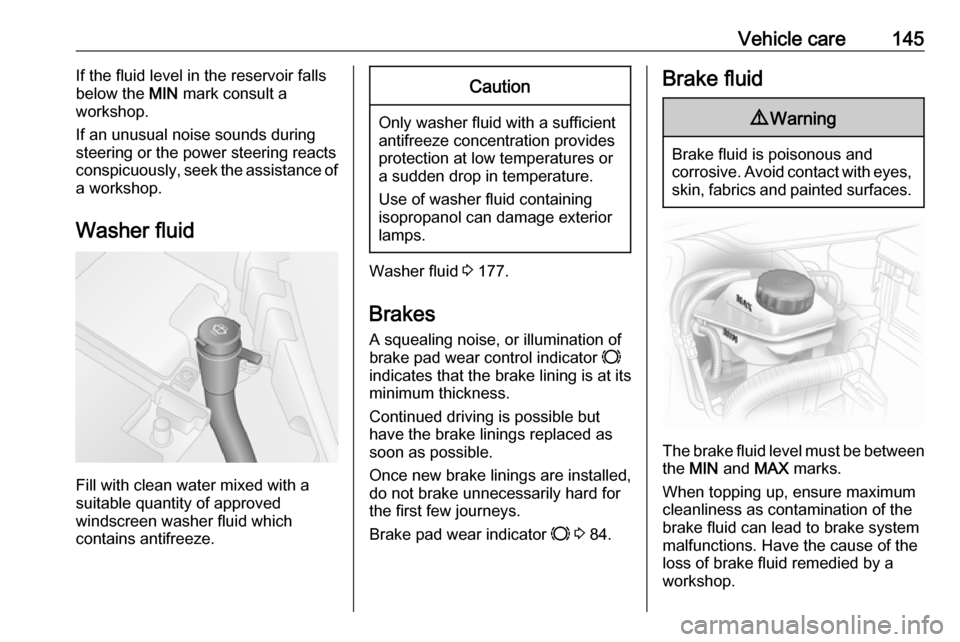
Washer fluid
Fill with clean water mixed with a
suitable quantity of approved
windscreen washer fluid which
contains antifreeze.
Caution
Only washer fluid with a sufficient
antifreeze concentration provides
protection at low temperatures or
a sudden drop in temperature.
Use of washer fluid containing
isopropanol can damage exterior
lamps.
Washer fluid 3 177.
Brakes A squealing noise, or illumination of
brake pad wear control indicator F
indicates that the brake lining is at its
minimum thickness.
Continued driving is possible but
have the brake linings replaced as
soon as possible.
Once new brake linings are installed,
do not brake unnecessarily hard for
the first few journeys.
Brake pad wear indicator F 3 84.
Brake fluid9 Warning
Brake fluid is poisonous and
corrosive. Avoid contact with eyes, skin, fabrics and painted surfaces.
The brake fluid level must be between
the MIN and MAX marks.
When topping up, ensure maximum cleanliness as contamination of the
brake fluid can lead to brake system
malfunctions. Have the cause of the
loss of brake fluid remedied by a
workshop.
Page 148 of 201
146Vehicle careOnly use high-performance brake
fluid approved for the vehicle.
Brake and clutch fluid 3 177.
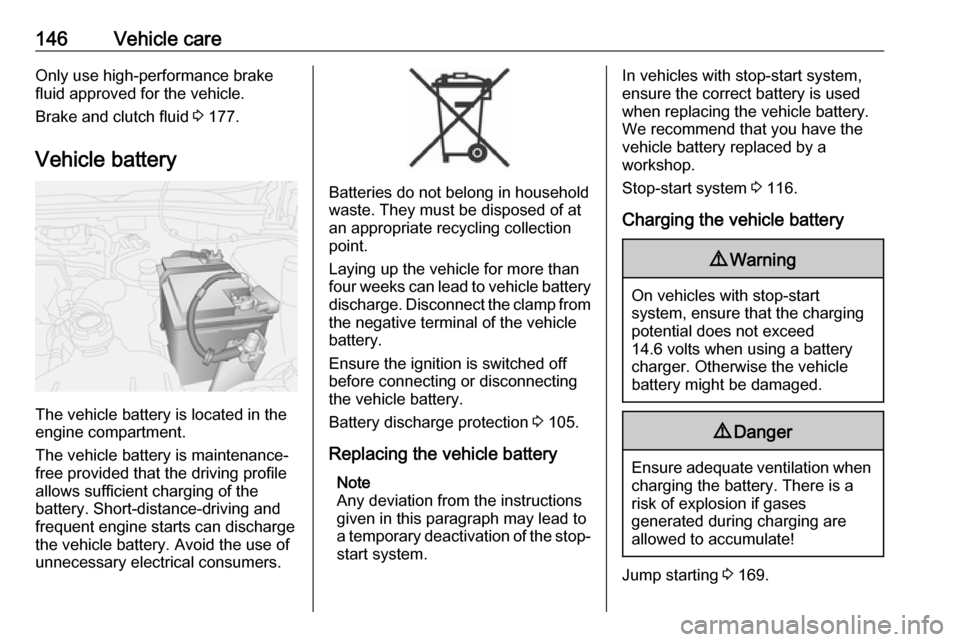
Vehicle battery
The vehicle battery is located in the
engine compartment.
The vehicle battery is maintenance-
free provided that the driving profile
allows sufficient charging of the
battery. Short-distance-driving and
frequent engine starts can discharge
the vehicle battery. Avoid the use of
unnecessary electrical consumers.
Batteries do not belong in household
waste. They must be disposed of at
an appropriate recycling collection
point.
Laying up the vehicle for more than
four weeks can lead to vehicle battery
discharge. Disconnect the clamp from
the negative terminal of the vehicle
battery.
Ensure the ignition is switched off
before connecting or disconnecting
the vehicle battery.
Battery discharge protection 3 105.
Replacing the vehicle battery Note
Any deviation from the instructions
given in this paragraph may lead to
a temporary deactivation of the stop-
start system.
In vehicles with stop-start system,
ensure the correct battery is used
when replacing the vehicle battery.
We recommend that you have the
vehicle battery replaced by a
workshop.
Stop-start system 3 116.
Charging the vehicle battery9 Warning
On vehicles with stop-start
system, ensure that the charging potential does not exceed
14.6 volts when using a battery
charger. Otherwise the vehicle
battery might be damaged.
9 Danger
Ensure adequate ventilation when
charging the battery. There is a
risk of explosion if gases
generated during charging are
allowed to accumulate!
Jump starting 3 169.
Page 153 of 201

Vehicle care151
4.Unscrew the four retaining screws
using a screwdriver. Turn bulb
holder for reverse light
anticlockwise and replace bulb.
5. Remove bulb holder and seal from lamp assembly.
6. Push bulb into socket slightly, rotate anticlockwise, remove and
renew bulb.Brake light ( 1)
Turn signal light ( 2)
Tail light ( 3)
Tail light/fog light ( 4)
7. Install seal on bulb holder ensuring it is fitted correctly.
Install bulb holder in lamp
assembly ensuring that it
engages correctly. Tighten the
four retaining screws using a
screwdriver.
8. Install reverse light bulb holder and turn clockwise to tighten.
9. Engage connector plug.
10. Insert lamp assembly in body, ensuring correct positioning.
Tighten the three retaining
screws.
11. Switch on ignition, operate and check all lights.
Side turn signal lights
Have bulbs replaced by a workshop.
Centre high-mounted brakelight
Have bulbs replaced by a workshop.
Page 165 of 201
Vehicle care163Wheel covers must not impair brake
cooling.9 Warning
Use of unsuitable tyres or wheel
covers could lead to sudden
pressure loss and thereby
accidents.
Tyre chains
Tyre chains are only permitted on the
front wheels.
Always use fine mesh chains that add no more than 10 mm to the tyre tread
and the inboard sides (including chain lock).
Do not exceed 50 km/h when tyre
chains are fitted.9 Warning
Damage may lead to tyre blowout.
Tyre repair kit
Minor damage to the tyre tread can be
repaired with the tyre repair kit.
Do not remove foreign bodies from
the tyres.
Tyre damage exceeding 4 mm or that is at tyre's sidewall cannot be repairedwith the tyre repair kit.
9 Warning
Do not drive faster than 80 km/h.
Do not use for a lengthy period.
Steering and handling may be
affected.
If you have a flat tyre:
Apply the parking brake and engage
first or reverse gear.
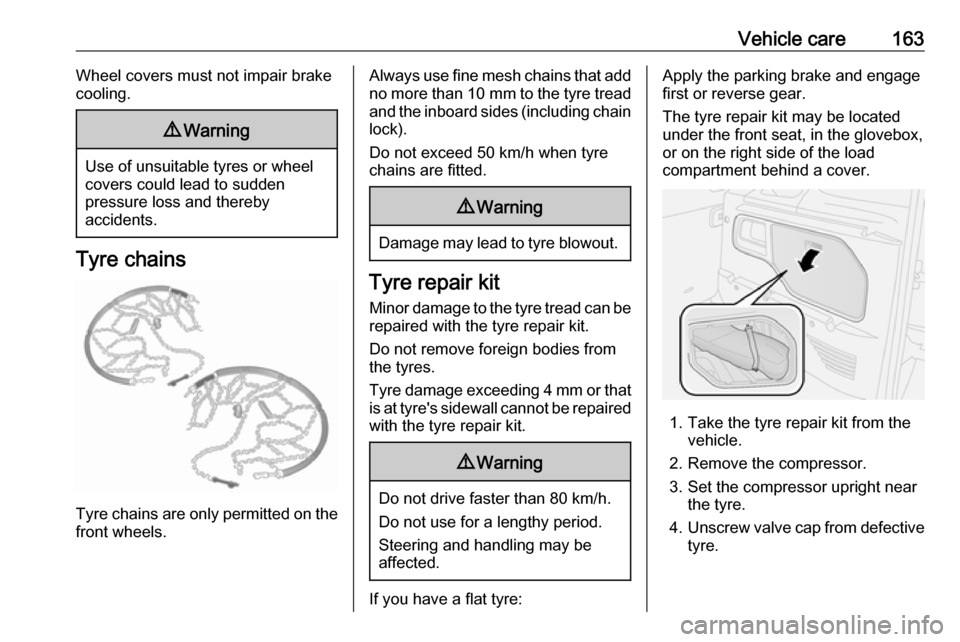
The tyre repair kit may be located
under the front seat, in the glovebox,
or on the right side of the load
compartment behind a cover.
1. Take the tyre repair kit from the vehicle.
2. Remove the compressor.
3. Set the compressor upright near the tyre.
4. Unscrew valve cap from defective
tyre.
Page 167 of 201

Vehicle care165
If tyre pressure is more than
1.8 bar , set it to the correct value.
Repeat the procedure until there
is no more loss of pressure.
If the tyre pressure has fallen
below 1.8 bar, the vehicle must
not be used. Seek the assistance
of a workshop.
15. Stow away tyre repair kit in load compartment.
Note
The driving characteristics of the
repaired tyre are severely affected,
therefore have this tyre replaced.
If unusual noise is heard or the
compressor becomes hot, turn
compressor off and allow to cool.
Note the expiry date of the kit. After
this date its sealing capability is no
longer guaranteed. Pay attention to
storage information on sealant
bottle.
Replace the used sealant bottle.
Dispose of the bottle as prescribed
by applicable laws.
The compressor and sealant can be used from approx. -20 °C.
Replacing the sealant canister
To replace the sealant canister: 1. Disconnect the compressor air hose.2. Turn the canister anticlockwise to lift it out.
3. Insert the new canister and turn it clockwise.
4. Connect the compressor air hose to the canister and fit the flexible
filler tube into its allocated space.
Wheel changing
Some vehicles are equipped with a
tyre repair kit instead of a spare wheel 3 163.
Make the following preparations and
observe the following information:
● Park the vehicle on a level, firm and non-skid surface. The front
wheels must be in the straight- ahead position.
● Apply the parking brake and engage first or reverse gear.
● Remove the spare wheel 3 167.
● Never change more than one wheel at once.
● Use the jack only to change wheels in case of puncture, not
for seasonal winter or summer
tyre change.
Page 172 of 201

170Vehicle care● A discharged vehicle battery canalready freeze at a temperature
of 0 °C. Defrost the frozen battery before connecting jump leads.
● Wear eye protection and protective clothing when
handling a vehicle battery.
● Use a booster battery with the same voltage (12 Volts). Its
capacity (Ah) must not be much
less than that of the discharged
vehicle battery.
● Use jump leads with insulated terminals and a cross section of
at least 16 mm 2
(25 mm 2
for
diesel engines).
● Do not disconnect the discharged
battery from the vehicle.
● Switch off all unnecessary electrical consumers.
● Do not lean over the vehicle battery during jump starting.
● Do not allow the terminals of one
lead to touch those of the other
lead.● The vehicles must not come into contact with each other during
the jump starting process.
● Apply the parking brake, transmission in neutral.
Lead connection order:
1. Connect the red lead to the positive terminal of the booster
battery.
2. Connect the other end of the red lead to the positive terminal of the
discharged vehicle battery.
3. Connect the black lead to the negative terminal of the booster
battery.
4. Connect the other end of the black
lead to a vehicle grounding point,
such as the engine block or an
engine mounting bolt. Connect as far away from the discharged
vehicle battery as possible,
however at least 60 cm.
Route the leads so that they cannot
catch on rotating parts in the engine
compartment.
To start the engine: 1. Start the engine of the vehicle providing the jump.
2. After five minutes, start the other engine. Start attempts should be
made for no longer than
15 seconds at an interval of
one minute.
3. Allow both engines to idle for approx. three minutes with the
leads connected.
Page 173 of 201

Vehicle care1714. Switch on electrical consumers(e.g. headlights, heated rear
window) of the vehicle receiving
the jump start.
5. Reverse above sequence exactly when removing leads.Towing
Towing the vehicle
Release the cap by carefully lifting
with a screwdriver. To prevent
damage, it is recommended to place
a cloth between the screwdriver and
the frame.
The towing eye is stowed with the vehicle tools 3 158.
Screw in the towing eye as far as it will
go until it stops in a horizontal
position.
Attach a tow rope – or better still a tow
rod – to the towing eye.
Caution
The towing eye must only be used for towing and not for recovering
the vehicle.
Switch on ignition to release steering
wheel lock and to permit operation of
brake lights, horn and windscreen
wiper.
Transmission in neutral.
Note
If neutral cannot be selected on
vehicles with manual transmission
automated (MTA), the vehicle must
only be towed with the drive wheels
raised off the ground.
Caution
Drive slowly. Do not drive jerkily.
Excessive tractive force can
damage the vehicle.
When the engine is not running,
considerably more force is needed to
brake and steer.
Page 180 of 201

178Service and maintenanceDexos is the newest engine oil quality
that provides optimum protection for
petrol and diesel engines. If it is
unavailable, engine oils of other listed qualities must be used.
Recommendations for petrol engines
are also valid for Compressed Natural
Gas (CNG) fuelled engines.
Select the appropriate engine oil
based on its quality and on the
minimum ambient temperature
3 181.
Topping up engine oil
Engine oils of different manufacturers and brands can be mixed as long as
they comply with the required engine
oil quality and viscosity.
Use of engine oil with only
ACEA A1/B1 or only A5/B5 quality is
prohibited, since it can cause long-
term engine damage under certain
operating conditions.
Select the appropriate engine oil
based on its quality and on the
minimum ambient temperature
3 181.Additional engine oil additives
The use of additional engine oil
additives could cause damage and
invalidate the warranty.
Engine oil viscosity
The SAE viscosity grade gives
information on the thickness of the oil.
Multigrade oil is indicated by two
figures, e.g. SAE 5W-30. The first
figure, followed by a W, indicates the
low temperature viscosity and the
second figure the high temperature
viscosity.
Select the appropriate viscosity grade depending on the minimum ambient
temperature 3 181.
All of the recommended viscosity
grades are suitable for high ambient
temperatures.
Coolant and antifreeze
Use only antifreeze approved for the
vehicle. Consult a workshop.
The system is factory filled with
coolant designed for excellent
corrosion protection and frost
protection down to approx. -28 °C. In
regions with very low temperatures,the factory filled coolant provides frost
protection down to approx. -37 °C.
This concentration should be
maintained all year round.
The use of additional coolant
additives that intend to give additional
corrosion protection or seal against
minor leaks can cause function
problems. Liability for consequences
resulting from the use of additional coolant additives will be rejected.
Washer fluid
Use only washer fluid approved for
the vehicle to prevent damage of
wiper blades, paintwork, plastic and
rubber parts. Consult a workshop.
Brake and clutch fluidOver time, brake fluid absorbs
moisture which will reduce braking
effectiveness. The brake fluid should therefore be replaced at the specified interval.
Page 196 of 201

194IndexAAccessories and vehicle modifications .......................... 140
Adjustable air vents ...................110
Airbag activation ........................... 90
Airbag and belt tensioners ...........82
Airbag deactivation ..........53, 83, 90
Airbag label............................. 48, 53
Airbag system .............................. 48
Air conditioning regular operation ................................ 111
Air conditioning system .............. 107
Air intake .................................... 111
Air vents...................................... 110
Alert .............................................. 95
Antilock brake system ................ 126
Antilock brake system (ABS) .......84
Anti-Slip Regulator (ASR) ...........128
Anti-theft locking system .............. 29
Appearance care ........................172
Armrest ......................................... 40
Ashtrays ....................................... 75
ASR (Anti-Slip Regulator) ...........128
Audible warning chimes................ 95
Autoclose ...................................... 90
Automatic fuel cut-off ............96, 115
Automatic locking .........................90
Autostop ..................................... 116
AUX socket ................................... 74B
Battery ........................................ 146
Battery discharge protection ......105
Belts.............................................. 45
Bonnet ....................................... 142
Brake and clutch fluid .................177
Brake assist ............................... 127
Brake fluid .................................. 145
Brake pad wear ............................ 84
Brakes ............................... 126, 145
Brake system ............................... 84
Breakdown.................................. 171
Bulb replacement ....................... 148
C Capacities .................................. 189
Car Pass ...................................... 21
Catalytic converter .....................120
Central locking system ................24
Centre high-mounted brake light 151
Change engine oil .......................88
Changing tyre and wheel size ...162
Charging system .......................... 83
Child locks ................................... 25
Child restraint installation locations ................................... 57
Child restraints.............................. 55
Child restraint systems ................55
Child safety system for rear windows .................................... 32
Page 198 of 201

196GGauges ......................................... 76
Gear shifting ................................. 85
General information ...................138
Generic warning .............81, 96, 115
Glovebox ..................................... 61
Gross Vehicle Weight ...................67
H
Halogen headlights ....................148
Hand brake ................................. 127
Hazard warning flashers ............100
Headlamp washer......................... 72
Headlight flash ............................. 99
Headlight range adjustment ......100
Headlights..................................... 99
Headlights when driving abroad 100
Head restraint adjustment .............8
Head restraints ............................ 35
Heated mirrors ............................. 31
Heated rear window ..................... 34
Heating ........................................ 40
Heating and ventilation system . 106
High beam ............................. 89, 99
Hill start assist ...................... 85, 127
Horn ....................................... 14, 70
I Identification plate .....................180
Ignition switch positions .............114
Immobiliser ............................ 29, 89Indicators...................................... 76
Information displays...................... 90
Initial drive information.................... 6
Installing seats .............................. 42
Instrument cluster ........................76
Instrument panel fuse box .........156
Instrument panel illumination .....154
Instrument panel illumination control .................................... 102
Instrument panel overview ........... 10
Instrument panel storage ..............60
Interior care ............................... 175
Interior lighting ......................90, 102
Interior lights ...................... 103, 153
Interior mirrors .............................. 31
Introduction .................................... 3
ISOFIX .......................................... 55
J Jump starting ............................. 169
K Kerb weight................................... 67Key number .................................. 20
Keys ............................................. 20
Keys, locks ................................... 20
L
Language ..................................... 90
Lashing eyes ......................... 65, 67
Laying up the vehicle ..................146Light switch .................................. 99
Load compartment ................28, 62
Load compartment cover .............63
Load compartment grille ...............66
Load compartment lighting .........104
Loading ............................. 38, 41, 42
Loading information .............67, 187
Loadspace dimensions ...............187
Lock cylinders ............................... 20
Low engine oil level .....................88
Low fuel ....................................... 88
Luggage floor net .........................65
Lumbar support ............................ 37
M Malfunction indicator light ............83
Manual adjustment ......................30
Manual anti-dazzle ......................31
Manual door locks ........................22
Manual mode ............................. 124
Manual transmission .................. 121
Manual transmission automated 122
Manual windows ..........................32
Mirror adjustment ........................... 8
Misted light covers .....................102
Multifunction display .....................90
N
Natural gas ................................. 189
New vehicle running-in ..............114
Number plate light .....................152